
Electrical Troubleshooting in Bethesda, MD
A Clean Electrical Report, Before You List or Renovate
Whether you’re troubleshooting an active problem or want a clean bill of health before a sale or renovation, Ahmad Shaban — a Virginia-licensed Master Electrician — finds the actual cause and puts it in writing.
Key Takeaways
- Licensed: Master Electrician, Commonwealth of Virginia #2710086216
- Insured: Fully insured, with coverage proof available on request before any repair begins
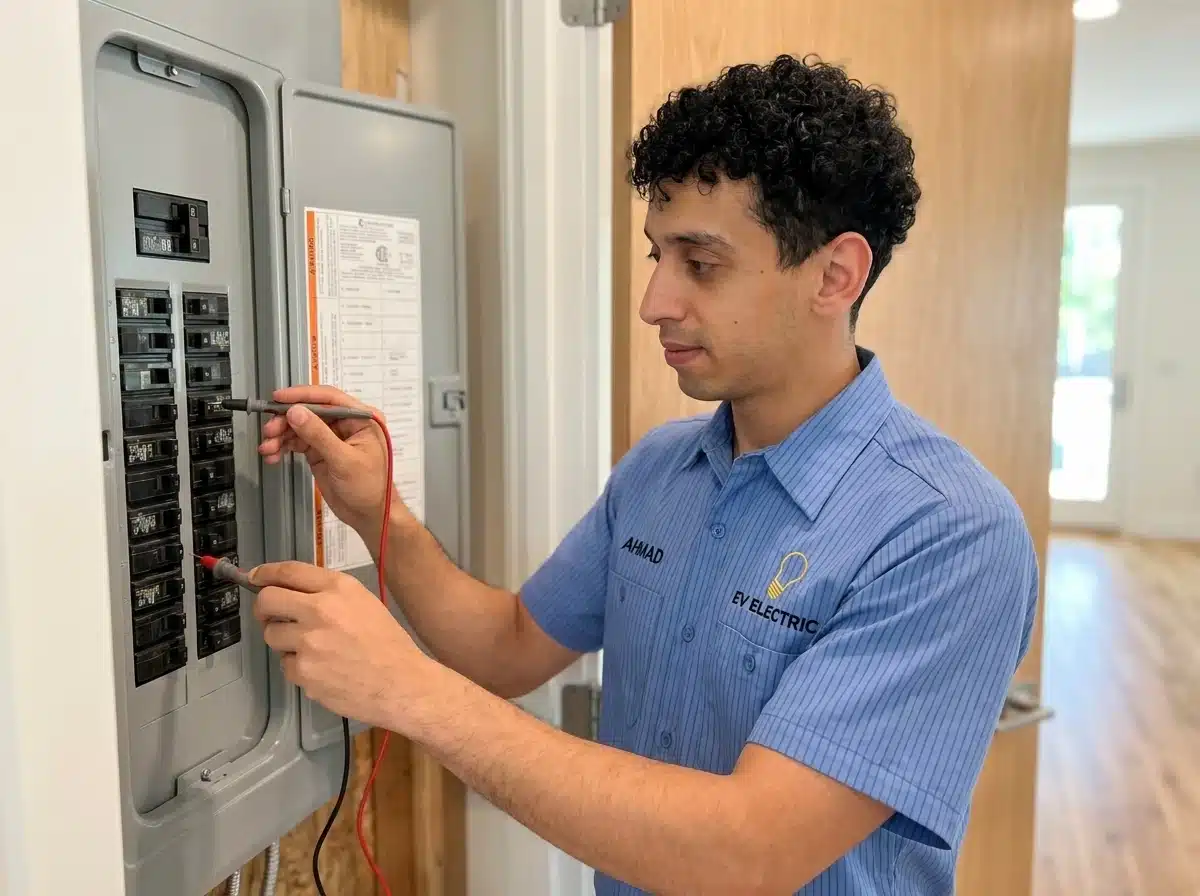
- A real diagnostic on every visit: multimeter, circuit tracer, AFCI and GFCI testing (AFCI = arc-fault circuit interrupter, a breaker that shuts off power at the first sign of a dangerous electrical arc; GFCI = ground-fault circuit interrupter, an outlet or breaker that shuts off power when it senses current leaking somewhere it shouldn’t), and an infrared thermal camera when heat is a factor
- No trip fee, free estimates — no surprise charges once the work is done
- Same-day or next-day appointments in most cases — about 30-35 minutes from our Fairfax Blvd office
- Service area: Bethesda and the rest of Montgomery County, plus Northern Virginia and Washington, DC
Bethesda Homes Can Carry Three Different Wiring Generations at Once
Because Bethesda’s housing spans everything from 1910s Edgemoor and Battery Park originals to the mid-1960s Bradley Hills build-out to present-day rebuilds on the same streets, it’s common for one house to carry two or three distinct wiring generations behind its walls — a pre-war knob-and-tube remnant in an unfinished attic, a 1960s aluminum branch circuit added when the home was expanded, and a fully modern circuit from a 2015 kitchen remodel, all on the same panel. A blown breaker or a warm outlet can trace back to any one of them, and guessing which generation is at fault, rather than checking, is how a repair ends up not holding.
That’s what troubleshooting actually is: the diagnostic step before the fix, where we find the root cause instead of reacting to the symptom. Ahmad Shaban is a Virginia-licensed Master Electrician, and he’s the one who shows up — no dispatcher, no rotating crew. He reads the panel, tests the circuits, traces the fault to its source, and explains what’s happening in plain English before any repair starts.
Bethesda’s housing, era by era — corrected against the actual build history
Bethesda is an unincorporated CDP (Census Designated Place) in Montgomery County — Montgomery County’s Department of Permitting Services issues electrical permits here, and Pepco is the electric utility. Bethesda sits directly northwest of Washington, DC, bordered by the Capital Beltway (I-495) to the north and the Potomac River to the west, about 30-35 minutes from our Fairfax Blvd office.
Pre-1941 original subdivisions
Battery Park (built out 1923-1941), Edgemoor (platted 1912), Kenwood (subdivided 1928), Huntington Terrace (platted 1910)Bethesda’s earliest named subdivisions, predating the postwar boom by decades. These homes were originally wired for far lower loads than modern usage assumes — fused panels in the 30-60 amp range were standard, and knob-and-tube wiring is plausible in unrenovated original sections, since it was standard national practice into the 1930s-40s.
Symptoms: Knob-and-tube remnants in unrenovated attics or wall cavities. Original fused panels long past due for replacement. Two-prong ungrounded outlets in rooms untouched by a later renovation.
Mid-1960s-and-later build-out — the aluminum-wiring window
Bradley Hills (main build-out after the Capital Beltway opened), continued growth in Woodhaven and SomersetBradley Hills’ housing stock is predominantly from the mid-1960s onward — later than some earlier accounts suggested — once the newly opened Capital Beltway drew developers to the area. This construction window overlaps the period when aluminum branch-circuit wiring was more commonly installed nationally, due to a copper-price spike. Aluminum expands and contracts differently than copper at connections, and over 50-plus years those connections can loosen.
Symptoms: Warm outlets or switch plates with no other obvious cause. A breaker or connection that’s been “fixed” once and came back. We check for aluminum branch wiring directly with a panel inspection rather than assuming either way.
1975-present renovations and rebuilds
Wyngate, Woodacres, and a documented pattern of larger new construction replacing older homes in Burning Tree, Glen Echo Heights, and parts of EdgemoorBethesda’s high land values have supported an active renovation and rebuild market for years — well documented in neighborhoods like Glen Echo Heights, where original 1930s-40s homes now sit beside recent large new construction on the same streets. Homes built or fully rewired in this window meet modern GFCI and, from 2008 onward, AFCI code requirements, but a utility service drop sized for the smaller original home is a common oversight when a larger replacement goes up on the same lot.
Symptoms: A modern 200-amp panel fed by a utility service drop still sized for the smaller home that used to occupy the lot. Nuisance AFCI trips on vacuum cleaners and other motor-driven loads — often correct behavior, not a fault. Smart-home wiring installed by a builder’s low-voltage contractor with incorrect neutral bonding.
If your home falls into any of these patterns, the diagnostic step tells you whether you’re looking at a quick fix, a bigger repair, or a panel upgrade — and gives you a written record either way.
Specific problems we diagnose every week in Bethesda
Here’s what Ahmad gets called about most often in Bethesda. If your situation matches one of these, you’re in the right place.
Breaker trips and won’t reset
One trip is the breaker protecting the circuit — that’s normal. When the same breaker trips again as soon as you push it back, the fault is still live: a short somewhere in the run, a circuit carrying more load than its wire gauge can handle, or the breaker itself worn past its rating. In Bethesda’s older sections we also check whether an aging overhead Pepco connection is contributing before replacing anything.
One room goes dark, the rest of the house doesn’t
Most often a tripped GFCI hiding on the circuit, or a backstabbed connection that finally let go. Bethesda’s renovation-heavy blocks add a second possibility: a junction box buried behind new drywall from a past remodel that nobody labeled. We map the circuit before opening anything.
Flickering lights that get worse over months, not overnight
A slow-building voltage drop, most often from a loose neutral at the meter base. Persistent voltage drops shorten the life of every motor in the house — worth catching early rather than waiting for it to fail outright.
Warm switch plates or a burning smell
This gets treated as urgent every time. A warm plate or a burning smell almost always traces to a connection that has loosened over time and is now generating heat under load — the kind of fault that starts a wall fire if it isn’t found. Ahmad locates the hot spot with an IR thermal camera before opening anything.
Suspected aluminum wiring in a Bradley Hills or similar-era home
Homes built from the mid-1960s onward, once the Beltway drew developers to Bethesda’s western neighborhoods, sit inside the national aluminum-branch-wiring window. We check for it directly.
EV charger tripping breakers or overheating a circuit
A Level 2 charger pulls continuous high-amp current for hours at a stretch, and older circuits in Kenwood, Burning Tree, and other larger-lot neighborhoods weren’t built for that kind of sustained load. Our EV charger installation in Bethesda page covers the permanent fix.
A clean electrical report ahead of a sale or renovation
Bethesda’s active renovation and resale market means this is a common, non-emergency request. We diagnose the panel and wiring and put the findings in writing.
A garage or basement sub-panel from a past remodel keeps acting up
In Bethesda’s teardown-and-renovate market, a sub-panel added during someone else’s remodel five or ten years ago is one of the most common finds, often undersized for what’s been added to it since. We verify the feeder size and confirm the whole setup still meets current code before calling it fixed.
What renovation crews find behind Bethesda walls — and why they call an electrician
Bethesda’s land values have made it one of the most actively renovated communities in the DC metro area for decades. That renovation pace creates a specific pattern we see regularly: a contractor opens a wall for a kitchen expansion or a bathroom remodel and finds wiring they weren’t expecting — knob-and-tube in a Kenwood colonial’s original plaster walls, cloth-insulated copper behind a Bradley Hills bathroom that hasn’t been touched since 1967, or an unlabeled junction box buried above a drop ceiling in a basement that was finished in the 1990s.
The general contractor can’t proceed until someone qualified determines whether the existing wiring is safe to build around, needs to be rerouted, or needs to be replaced entirely. That determination is the diagnostic — not a full rewire estimate, not an opinion over the phone, but an on-site assessment with the wall already open and the wiring visible. Ahmad does these regularly for renovation crews working in Bethesda, and the written report he leaves becomes part of the project file the GC carries through the Montgomery County permit inspection.
The most common discovery is a mix: modern Romex on the circuits that were updated during a prior renovation, and older wiring on the circuits that weren’t. A kitchen remodel in an Edgemoor home, for example, might open walls and find that the kitchen circuits were upgraded in the 1990s but the adjacent dining room still runs on original cloth-insulated wiring from the 1940s. The question isn’t whether the old wiring “still works” — it probably does — but whether it meets current code for the new load the renovation is about to put on it, and whether the insulation is intact enough to safely close behind new drywall for another 30 years.
How a Bethesda troubleshooting visit works, start to finish
Call 571-500-6637 or use the quote form. This is the process for every visit.
You describe what’s happening — Ahmad figures out what to bring
Ahmad answers the phone himself. He’ll ask what the symptom is, which part of the house it’s in, and roughly how old the home is — because a flickering light in a 1930s Edgemoor colonial points toward different causes than the same symptom in a 2018 Glen Echo Heights rebuild. If you’re describing heat at a switch or a burning smell, he’ll walk you through which breaker to turn off before he arrives.
Scheduling — 30-35 minutes up the Beltway from our Fairfax Blvd office
Most Bethesda troubleshooting calls during business hours land the same day or the following morning. Ahmad gives you a one-hour arrival window, not a four-hour block. The drive from 9488 Fairfax Blvd to most of Bethesda is 30-35 minutes via I-495 — longer during rush hour on the inner loop, shorter on weekends.
The diagnostic starts at the panel, not at the symptom
Ahmad opens the panel first, because in a Bethesda home that’s been through multiple renovations the panel layout itself often reveals the issue faster than chasing the symptom room by room. He reads voltage at the bus bars, tests individual breakers under load with a multimeter, maps circuits with a tracer, and uses an IR thermal camera if the complaint involves heat. You’re standing there for all of it.
You hear what caused it and what the fix costs — before he picks up a tool
Ahmad explains the root cause, the repair, and the price in plain terms. If the diagnostic reveals something bigger than expected — a panel that needs replacing rather than a breaker that needs swapping — he writes that up as a separate estimate so you can weigh the cost against the timeline. Nothing starts without your sign-off.
Most repairs wrap up the same visit — bigger jobs get documented and scheduled
A breaker replacement, a GFCI swap, a connection re-torqued at the bus bar — the common fixes happen on the spot with parts Ahmad carries. Panel upgrades, full circuit re-runs, and aluminum-wiring remediation jobs get their own written estimate and a return visit. Montgomery County DPS handles the electrical permit for Bethesda; Ahmad files it when the scope requires one.
How estimates work
Bethesda homes range from 1,200-square-foot Battery Park originals to 7,000-square-foot Glen Echo Heights rebuilds — and the electrical work behind the walls varies just as widely. We don’t estimate troubleshooting over the phone because the answer depends on what’s actually in the panel, not what the listing said when you bought the house. Ahmad sees the wiring in person, writes the number, and you approve it before any work starts. No trip fee, free estimates.
- Troubleshooting visit with same-call repair. Ahmad runs the diagnostic — typically 1-2 hours — and handles the fix on the spot if it’s something straightforward: a breaker that needs replacing, an outlet that needs re-wiring, a connection that’s worked loose at the panel. The written estimate covers parts and labor and is in your hands before he starts.
- Diagnostic-only visit. Bethesda homeowners preparing for a renovation or a sale often want the written report without committing to a repair the same day. Ahmad diagnoses, documents the findings, and you take the report to your contractor, your inspector, or your own decision-making timeline.
- Panel upgrades and larger jobs. Replacing an original fused panel in a Kenwood colonial or adding a sub-panel for a basement build-out in Wyngate — these get their own written estimate, separate from the diagnostic visit, so you can compare options before committing.
- After-hours availability. Burning smell, sparking outlet, a breaker that won’t hold at all — if yours can’t wait until morning, mention it when you call.
Bethesda neighborhoods we serve
We cover all of Bethesda, MD, including:
- Kenwood — large 1928-era colonials on cherry-blossom-lined streets near the Chevy Chase border
- Battery Park — built out 1923-1941, predominantly Dutch Colonial homes, adjacent to Edgemoor
- Edgemoor — platted 1912, walkable to downtown Bethesda with a mix of original colonials and newer construction
- Huntington Terrace — platted 1910, one of Bethesda’s earliest named subdivisions
- Bradley Hills — mostly built after the mid-1960s, near a top-rated elementary school off Bradley Boulevard
- Somerset — an incorporated town of tree-lined streets between Wisconsin Avenue and Little Falls Parkway
- Burning Tree — heavily wooded estate lots averaging half an acre in western Bethesda
- Glen Echo Heights — an exclusive enclave near the Potomac with a well-documented pattern of new construction alongside original homes
- Wyngate & Woodacres — closer-in neighborhoods with Colonial, Cape Cod, and Ranch housing stock
- Westbard & Woodhaven — a revitalizing corridor and an English-village-character neighborhood near the Beltway
Outside Bethesda, we serve Chevy Chase, Potomac, Rockville, and upper Northwest DC, plus Vienna, Fairfax, McLean, Kensington, and the rest of Montgomery County. We also cover Northern Virginia (Fairfax County, Arlington).
About Ahmad Shaban, Master Electrician
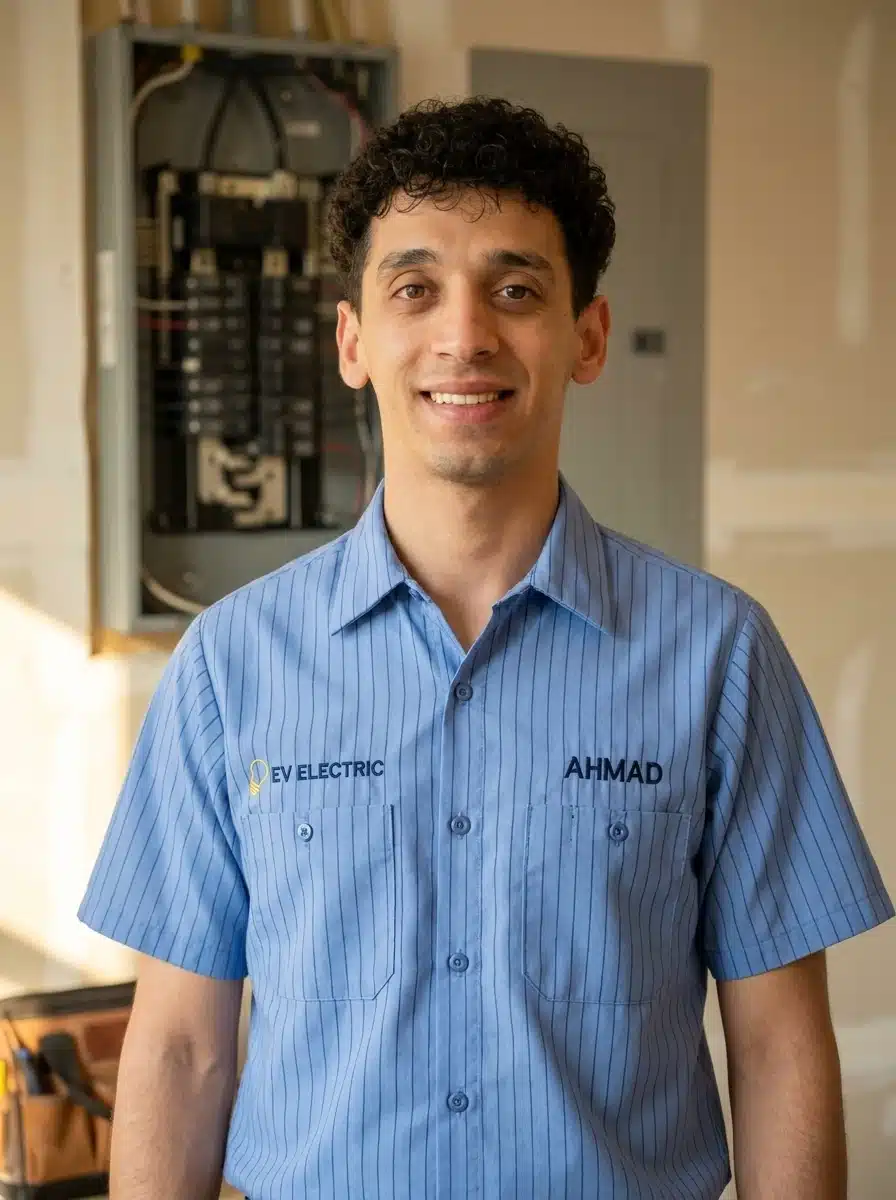
Bethesda’s mix of pre-war originals, mid-century expansions, and ground-up rebuilds means a troubleshooting call here can involve three different wiring standards in the same house. That range is where Ahmad Shaban’s background matters — he earned the credential Master Electrician, Commonwealth of Virginia #2710086216 after roughly four years of journeyman work and the state licensing exam, and he opened EV Electric Services specifically to do this kind of diagnostic-first residential work. The business is fully insured for jobs across Montgomery County, Northern Virginia, and DC.
There is no crew and no office staff. Ahmad is the person who answers the phone, shows up at your door, opens the panel, and explains what he found. For Bethesda in particular — where a homeowner selling in Edgemoor, a renovation crew in Burning Tree, and a new-construction owner in Glen Echo Heights might all call in the same week — that continuity matters, because the same person who diagnosed the last job in your neighborhood already knows what the local housing stock tends to produce.
EV Electric Services carries a 5.0-star average across 113 Google reviews — all from residential customers in Northern Virginia and Montgomery County, none solicited through review-generation services.
Related electrical services in Bethesda
Troubleshooting is the front door. If your diagnosis leads to a larger repair, these are the next steps we handle:
Frequently asked questions
How does pricing work for electrical troubleshooting in Bethesda, MD?
Ahmad comes to the house, looks at the actual work, and gives a written estimate before any repair starts. No trip fee, free estimates. Diagnostic visits include most minor on-the-spot repairs; major repairs get a separate written estimate.
How quickly can you come out for a troubleshooting call in Bethesda?
Same-day or next-day in most cases during weekday business hours. Bethesda is about 30-35 minutes from our Fairfax Blvd office via the Capital Beltway. Urgent situations — burning smell, sparking, warm walls — get triaged to the earliest available slot.
What’s included in a troubleshooting visit?
A real diagnostic: multimeter, circuit tracer, AFCI/GFCI tester, and an IR thermal camera if heat is suspected. Ahmad opens panels, tests circuits under load, traces the fault to its source, then explains what he found before any repair starts.
Can you provide a written electrical report before I sell or renovate?
Yes — this is a common, non-emergency request in Bethesda. Ahmad diagnoses the panel and wiring and documents the findings in writing, which you can share with a buyer, an inspector, or a contractor.
What’s the most common electrical problem in Bethesda homes?
It depends on the era. Pre-1941 homes in Battery Park, Edgemoor, and Kenwood most often call about original fused panels and legacy wiring; Bradley Hills and similar mid-1960s-and-later construction most often calls about suspected aluminum branch wiring; newer construction and rebuilds most often call about AFCI nuisance tripping or an undersized utility service drop.
Do you check for aluminum wiring?
Yes — directly, with a panel inspection, for homes built from the mid-1960s through the early 1970s, which is the era aluminum branch wiring was more commonly installed nationally. Bradley Hills’ main build-out falls in this window.
Are you licensed and insured?
Yes. Ahmad’s license is Master Electrician, Commonwealth of Virginia #2710086216 — the state’s highest electrician credential. EV Electric Services is fully insured. Proof is available on request before any work begins.
Ready to get your problem diagnosed?
Electrical troubleshooting across Bethesda — Kenwood to Bradley Hills, Edgemoor to Burning Tree.
Most weekday calls get a visit the same day or the next morning.