
Smoke Alarm Installation · Virginia Code Compliance
Virginia’s Smoke Alarm Rules Are Not What Most Websites Tell You
Half of what you read online about smoke alarm requirements is written for states that are not Virginia. The fire code chapter that other states use to require alarms in existing homes does not exist here — it was deleted in its entirety. The renovation trigger that forces a hardwired upgrade was also deleted. And the placement rules follow bedrooms and sleeping areas, not the “one on every level” guidance you see on national websites.
Ahmad installs and replaces smoke alarms across Northern Virginia, DC and Maryland — hardwired, battery and interconnected. Every installation starts with the Virginia code, not a template copied from another state. You get a placement plan that matches what the law actually requires, installed to the 2021 standard, and documented for your records.
No trip fee, free estimates. Ahmad is a Master Electrician, Commonwealth of Virginia #2710086216.
What the law requires in an existing Virginia home
Virginia adopted the 2021 I-codes, effective January 18, 2024. What follows comes from those codes — not from the fire code (Virginia deleted that chapter) and not from the building code that governs new construction. Existing homes are governed by the Virginia Existing Building Code, and its requirements are narrower than most websites suggest.
Placement. Under IRC R314.3 as adopted by Virginia, smoke alarms are required in each sleeping room, outside each separate sleeping area in the immediate vicinity of the bedrooms, and on each additional story including basements and habitable attics. They must be located not less than three feet from a bathroom door containing a bathtub or shower. The 2021 IRC also requires an alarm in the hallway and in the room open to it where the ceiling height of a room serving bedrooms exceeds the hallway ceiling by 24 inches or more — a clause Virginia adopts unchanged.
No retrofit mandate. Virginia does not require existing homeowners to retrofit to the new-construction standard. The VCC amendment deleting IRC R314.2.2 means a renovation permit does not trigger a forced upgrade. The only route to a forced upgrade is VEBC § 1101.6, which applies only when a building official determines that battery-powered smoke alarms have not been maintained.
Replacement standard. When you replace an alarm, the replacement must meet the 2021 standard: UL 217-listed, no more than ten years from the date of manufacture, and if battery-only, powered by a ten-year sealed battery. That last requirement is the one people confuse with a landlord rule. It is not — it binds any homeowner replacing any device.
Change of occupancy. A change of occupancy is a real trigger. If the use classification of the building changes, VEBC § 704.3 requires compliance with the current code for the new occupancy. This is the situation most likely to force an alarm upgrade in a home that would otherwise be left alone.
Locality limits. Virginia law limits what a county or city can require beyond the statewide code. A locality may not require upgrading any smoke alarms provided by the building code in effect at the time of the last renovation for which a building permit was required. The protection attaches to permitted renovations specifically — unpermitted work does not carry it.
If the alarm system you need also means a circuit update, our whole-house rewire page covers when that becomes the right answer.
Five things people get wrong about Virginia’s smoke alarm rules
What is the Fairfax County code for installing smoke detectors? The answer requires separating what Virginia law requires from what national websites assume it does. Five claims below appear across competitor pages, fire-safety guides, and even some fire department educational materials. Each one is true somewhere — and false in Virginia.
“The fire code requires alarms in existing homes.” Not in Virginia. SFPC Chapter 11, the existing-buildings chapter other states use, was deleted in its entirety by 13VAC5-52-230. The requirement lives in the building code, and the triggers are narrower — replacement, change of occupancy, or a building official’s finding that battery alarms have not been maintained. The safe practice: install alarms in every location the placement rules name, regardless of whether the code compels you to.
“Pulling a renovation permit forces hardwired, interconnected alarms.” Not here. Virginia deleted IRC R314.2.2 through VCC amendment 24. Most IRC-adopting states keep that section, which is why the advice appears so often. The safe practice: if you are opening walls, install the best system you can — the code does not require it, and you should do it anyway.
“Virginia requires landlords to install ten-year sealed-battery alarms.” The requirement is real but mislabeled. VEBC § 302.3 applies to any replacement alarm in any dwelling, owner-occupied or rented — triggered by replacing a device, not by renting. Calling it a landlord rule understates who it binds. The safe practice: replace with a sealed-battery unit every time, regardless of who owns the home.
“Virginia law mandates an annual landlord inspection.” The state statute sets a ceiling, not a floor. Va. Code § 55.1-1220(A)(8) says no more than once every twelve months. Your county or city may set its own standard — confirm the current text of your local ordinance before relying on the state baseline alone. The safe practice: inspect annually whether or not your specific jurisdiction requires it — smoke alarms fail silently.
“Virginia requires a point-of-sale smoke alarm inspection.” We found no such requirement in the Code of Virginia, the Uniform Statewide Building Code, the Statewide Fire Prevention Code, or the Fairfax County Code. Virginia home sales are disclosure-only. The safe practice: get a pre-purchase safety walkthrough before closing — that is something we do, and it is free when no work is booked.
Not required does not mean not recommended. The NFPA, the U.S. Fire Administration, and the Fairfax County FRD all recommend replacing alarms every ten years, installing on every level, and interconnecting the system. Those are evidence-backed recommendations from the people who study fire deaths. They are not Virginia law for existing homes — and an honest page says both things.
Hardwired vs battery — and when you need an electrician
Before you touch a hardwired alarm
Kill the breaker for the alarm circuit at the panel before removing, replacing, or disconnecting any hardwired smoke alarm. Hardwired alarms sit on a 120-volt branch circuit — the same voltage as your outlets and lights. Do not work on any alarm while the circuit is energized. If you cannot identify which breaker controls the alarm circuit, turn off the main. Call a licensed electrician if you are not equipped to test safely.
Call (571) 500-6637Do you need an electrician to install a smoke alarm? It depends on the type. A battery alarm mounts to a ceiling with screws and a twist-lock base — no wiring, no circuit. A hardwired alarm connects to a 120-volt branch circuit through a junction box in the ceiling, with wire run through the wall or ceiling cavity to the panel.
What makes hardwired work electrical work. Installing a hardwired alarm means working inside an energized circuit space, landing conductors at the junction box, and confirming the circuit can carry the additional load. Replacing one means de-energizing the circuit, matching the wiring adapter to the new unit, and confirming that the interconnection wire is intact if the system is interconnected. The FAQ below covers the self-install question and the adapter mechanics in detail.
A battery alarm is a product purchase. A hardwired installation or replacement is electrical work — priced per alarm installed. More on panel capacity and circuit work.
The one that chirps at 2 a.m.
A smoke alarm chirps when it needs attention. In the middle of the night, the question is what kind — and whether you need an electrician or a battery.
Before you touch a hardwired alarm that is chirping
Kill the breaker for the alarm circuit at the panel first. A hardwired alarm is connected to a live 120-volt circuit even when it is only chirping. Do not twist it off the mounting plate, disconnect it, or touch the wiring until the circuit is confirmed dead. If you cannot identify which breaker controls the alarm, turn off the main. Call a licensed electrician if you are unsure.
Call (571) 500-6637Low-battery chirp. A single chirp every 30 to 60 seconds, usually from one alarm. On a battery-only unit, replace the battery. On a hardwired unit, the backup battery is the most common cause — but the alarm may be past its useful life. Kill the breaker first, then twist the unit off its mounting plate and check the manufacture date on the back. If it is more than ten years old, the battery is not the problem. Replace the alarm.
End-of-life chirp. Many newer alarms chirp in a distinct pattern when the unit has reached the end of its engineered lifespan. This is not a battery issue. The alarm is telling you to replace it.
Should hardwired smoke detectors be replaced? Yes — on a schedule. NFPA 72, the U.S. Fire Administration, and the Fairfax County FRD all recommend replacement at ten years from manufacture. Virginia enforces this at the point of replacement: under VEBC § 302.3, you may not install a device more than ten years from its manufacture date. No Virginia provision commands removing a working alarm on its tenth birthday — but if you wait until it fails, you are unprotected until the replacement arrives. The legal trigger is at replacement, not at the calendar date. More on diagnosing electrical faults.
Interconnection — what it means and when it is required
Interconnected smoke alarms trigger as a group. When one detects smoke, every alarm in the system sounds. In a two-storey house where the fire starts in the basement and the bedrooms are upstairs, interconnection is what wakes the sleepers before smoke reaches their floor.
Virginia requires interconnection only in new construction. Where more than one alarm is required under the placement rules, IRC R314.4 requires them to be interconnected — and IRC R314.6 requires AC primary power. Both apply to new construction. Virginia deleted the provision that would extend these requirements to renovations.
Wireless interconnection satisfies the requirement. You do not need to run a dedicated interconnect wire between every alarm location. A wireless system uses radio-frequency communication between units to trigger the group, and Virginia’s adopted code accepts it. For retrofits in existing homes, wireless interconnection is usually the practical path — it avoids pulling wire through finished ceilings and walls.
No retrofit interconnection mandate exists in Virginia. If your home has standalone alarms, no Virginia law compels you to connect them. The NFPA and the Fairfax County FRD recommend interconnection regardless — and the safety case is strong. The distinction between what the code compels and what fire safety recommends runs through every section of this page.
If interconnecting your system requires new circuits or a panel evaluation, our circuit breaker replacement page covers the electrical side.
Carbon monoxide alarms
Ahmad installs carbon monoxide alarms alongside smoke alarms. The Virginia code treats them separately, and the requirements are narrower than most websites report.
Where CO alarms are required. IRC R315.2.1 as adopted by Virginia requires CO alarms in new R-5 construction only — and only where the dwelling contains a fuel-fired appliance or has an attached garage communicating with the dwelling. If neither condition exists, no CO alarm is required even in new construction.
Placement. Under IRC R315.3 as adopted by Virginia, CO alarms must be installed outside each separate sleeping area in the immediate vicinity of the bedrooms. Where a fuel-burning appliance is located within a bedroom or its attached bathroom, a CO alarm must also be installed inside that bedroom. A gas fireplace in the bedroom triggers it — and so does a gas water heater or wall furnace in the ensuite. A homeowner with exactly that arrangement who reads only “outside each sleeping area” is being told the wrong thing about a lethal gas.
Not “one on every level.” That guidance comes from other states and from fire-department educational materials. CO is roughly the same density as air and does not rise like smoke. Placement follows sleeping areas, not floor count.
No retrofit mandate. Existing Virginia homes have no CO alarm requirement. The one route is a tenant’s written request under Va. Code § 55.1-1229(E) — the landlord must install within 90 days and may recover the reasonable cost.
The safe practice: if you have any fuel-burning appliance or an attached garage, install CO alarms whether the code requires them or not. Carbon monoxide kills without warning. We install combination smoke/CO units and standalone CO detectors — Ahmad checks whether your home has a triggering condition during the visit.
If you rent out a property
Smoke alarm compliance for landlords comes from two levels of law, and they do not say the same thing. The state sets a baseline; your county or city may set a firmer one.
The state statute. Va. Code § 55.1-1220(A)(8) requires a landlord to provide a certificate stating all smoke alarms are present, inspected, and in working order — no more than once every twelve months. That is a ceiling on how often you can be required to certify, not a mandate to do so annually.
Your local ordinance may go further. Fairfax County and other Northern Virginia jurisdictions have their own smoke alarm ordinances that may impose additional requirements. The specifics vary by jurisdiction — confirm the current text of your local ordinance before relying on the state baseline alone.
Tenant responsibilities. Interim testing, repair, and maintenance in rented dwellings is the tenant’s responsibility under Va. Code § 15.2-922(B) — except for alarms in public or common areas of multifamily buildings, which remain the owner’s. No tenant may tamper with or disable a smoke alarm under § 55.1-1227.
CO alarms for tenants. A tenant may request a carbon monoxide alarm in writing. Under Va. Code § 55.1-1229(E), the landlord must install it within 90 days and may recover the reasonable cost.
What this means for your compliance visit. A landlord certification visit covers every alarm location, confirms each unit is functional and within its manufacture-date window, and produces the certificate the statute requires. If any alarm needs replacing, we do it during the same visit. No trip fee, free estimates.
Fairfax County’s free alarm program — and where it stops
Will the fire department come and install smoke detectors? In Fairfax County, yes — with limits that matter.
The Fairfax County Fire and Rescue Department free smoke alarm program provides battery-powered alarms to county residents. The FRD visits your home, checks existing alarms, and installs new battery units where needed. No income test, age requirement, or owner/renter distinction is stated — it is open to Fairfax County residents.
Where the program stops. The county’s own published language says it clearly:
“Please note that fire department personnel are not able to repair or replace hard-wired smoke alarms. A certified electrician will be needed for hard-wired smoke alarms.”
That sentence is the reason this section exists. The county program covers battery alarms — not hardwired systems, not interconnected setups, and not combination smoke/CO units. It does not produce a landlord compliance certificate.
A note on geography. This is a Fairfax County FRD program. The City of Fairfax is an independent city with its own fire department, and we could not verify whether it offers an equivalent. If you live in the City of Fairfax rather than Fairfax County, do not use the county’s request form — call your city fire department directly.
We work alongside the county program, not in competition with it. If the FRD visit finds that your home needs hardwired alarms, that is where we come in. No trip fee, free estimates.
What an installation visit looks like
The national pages answer “how much” without ever describing the work. A smoke alarm installation is not a parts swap — it is an inspection, a placement decision, and then the wiring. Here is what that looks like in practice.
We check what you have now
Ahmad starts at the panel and works through the house — type, age, location, and whether each alarm is hardwired or battery. If any unit is past its manufacture date or in the wrong location, you hear about it before anything else.
He maps the placement plan
The placement plan follows the Virginia code: each sleeping room, outside each sleeping area, each additional storey. If a unit belongs somewhere it is not, or does not belong where it is, you see the plan before any work starts.
The installation
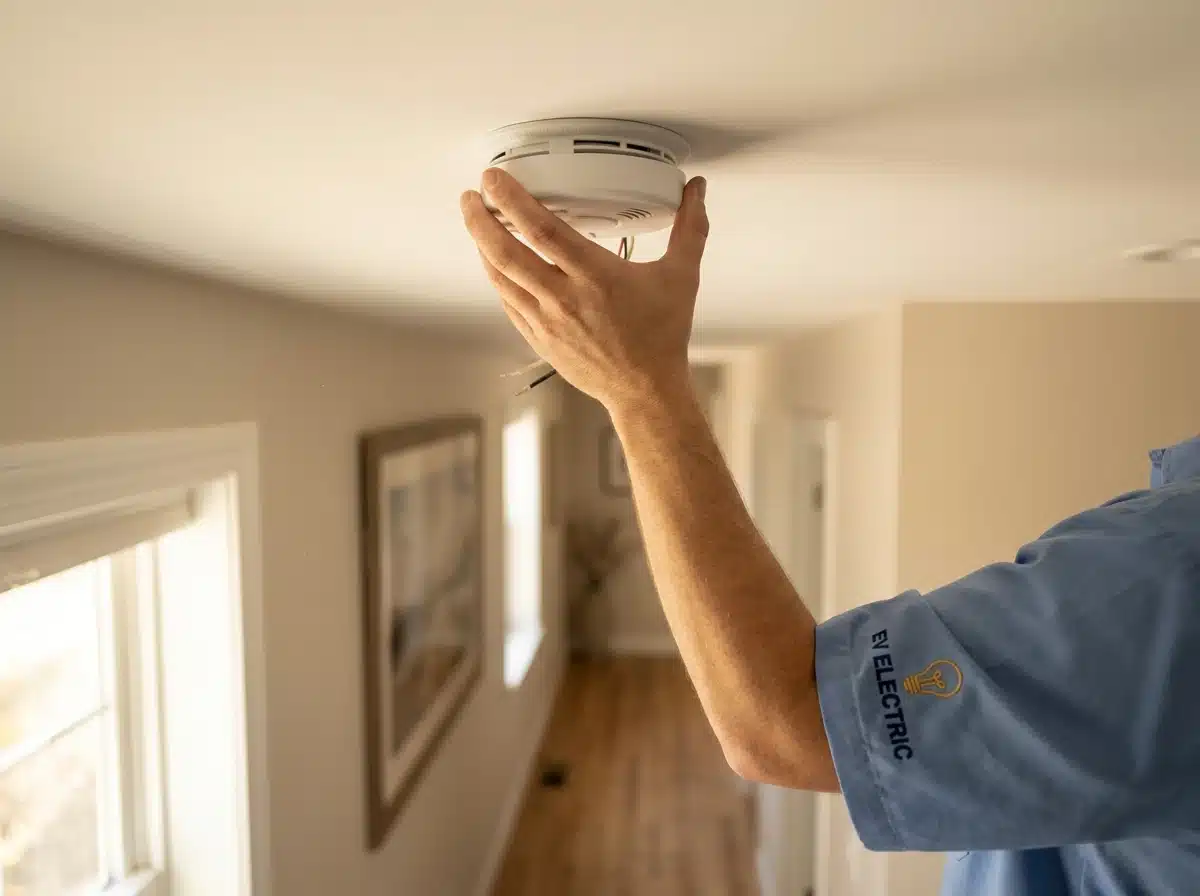
Hardwired alarms are wired at the junction box with the circuit de-energized and confirmed dead. Battery alarms mount at the ceiling. Both are tested after installation — individually and, if the system is interconnected, as a group.
You get the documentation
What was installed, where, and why. If the visit is for a landlord certification, the certificate is produced on site. Most full-house installs run one to two hours. No trip fee, free estimates.
What smoke alarm installation costs
$100–$135 per alarm
Hardwired installation (2026)
Most homes need one per bedroom, one outside each sleeping area, and one per storey — typically five to eight alarms for a three-bedroom, two-storey house. The per-alarm price is the price. The alarm count drives the total.
How much would an electrician charge to install a smoke alarm? The cost depends on the number of alarms your home needs, the type — hardwired or battery — and whether new wiring has to be run. The range above covers a standard hardwired installation at each location. Unusual access, attic runs, or homes without existing alarm wiring may adjust the scope, and that is covered in the estimate before any work begins.
Estimates are free. If the problem needs diagnosing first, we tell you what that costs before we begin. No trip fee, free estimates.
The electrician who installs your alarms
Most alarm installations are sold as commodity work — a technician with a drill and a bag of units. Ahmad treats it as a code-compliance visit. The placement plan comes first, built from the Virginia residential code and checked against the house, before anything is mounted. That plan is what separates an installation that satisfies an inspector from one that merely beeps.
Ahmad holds a Master Electrician, Commonwealth of Virginia #2710086216 — the highest individual electrician credential the state issues. On a smoke alarm job, placement and interconnection decisions sit at the intersection of the building code and the electrical code. The person making those decisions holds the licence personally, not through an employer.
The alarms Ahmad replaces most often are original equipment in homes built between the 1960s and the 1990s across Fairfax County, Vienna, McLean, and Falls Church. Many are past the ten-year manufacture-date window and no longer meet the replacement standard — but they have never chirped, so no one has checked.
113 Google reviews, 5.0-star average. EV-Electric Services is fully insured — 9488 Fairfax Blvd, Fairfax, VA 22031.Where we install smoke alarms
We cover Fairfax County, Falls Church, Arlington, Alexandria, DC, and Montgomery County from our shop at 9488 Fairfax Blvd, Fairfax, VA 22031. Most of the alarm work concentrates in the same belt of 1960s–1990s housing where the original smoke alarms are now past the ten-year replacement window — and where the code questions on this page apply most directly.
Smoke Alarm Installation, Fairfax VA
Virginia code compliance for Fairfax County homes — placement, hardwired, landlord certification.
Smoke Alarm Installation, Vienna VA
Ten minutes from our shop. Whole-house alarm installation and replacement for 1970s–1990s housing stock.
Smoke alarm installation in McLean, Oakton, Burke, Annandale, Bethesda, Potomac, and the rest of our service area runs through this page until city-specific pages are built. No trip fee, free estimates across our full service area. View all services and cities →
Smoke alarm installation questions
How much should it cost to install a smoke detector?
$100–$135 per alarm installed (2026) for a standard hardwired installation. A three-bedroom home typically needs five to eight alarms, so the total reflects the alarm count. Battery alarms are a product purchase — the range is for hardwired work with a licensed electrician.
How much does it cost to replace a hardwired smoke alarm?
$100–$135 per alarm (2026) for a hardwired replacement. Replacement includes matching the wiring adapter to the new unit and confirming the circuit and interconnection are intact. If the adapter has been discontinued, the job may involve a new connector — still within the per-alarm range.
Can you install a smoke detector by yourself?
A battery alarm mounts with screws and a twist-lock base — most homeowners can do it. The harder part is placement: Virginia requires alarms in each sleeping room, outside each sleeping area, and on each additional story. A detector in the wrong room does not satisfy code even though it works. A hardwired alarm connects to a 120-volt circuit through a junction box — that is electrical work. The circuit must be confirmed dead before you touch it. Call a licensed electrician for any hardwired work.
Do I need an electrician to replace hardwired smoke detectors?
Yes. The wiring adapter is manufacturer-specific — a First Alert harness does not fit a Kidde base, and older homes may have wiring that predates the current connector standard. If the adapter does not match, you are working with bare conductors in a ceiling cavity. If the system is interconnected, the replacement must communicate with every other alarm on the run. The circuit must be confirmed dead before any of it starts. Call a licensed electrician.
Do you need an electrician to install new smoke alarms?
For battery alarms, no — though getting the placement right matters more than most homeowners expect. For hardwired alarms, yes. The installation means running wire to a junction box, landing conductors, and tying into a panel circuit. Virginia requires hardwired alarms in new construction only, but if you choose to upgrade, the wiring work requires a licensed electrician.
Need your smoke alarms checked or replaced?
Smoke alarm installation and replacement across Northern Virginia, DC and Maryland — Virginia code compliance, hardwired and battery, landlord certification. Master Electrician on site, no trip fee, free estimates. Same-day and emergency visits available. Call, describe what you need, and we will get Ahmad to you.
(571) 500-6637