
Electrical Troubleshooting · Northern Virginia & Maryland
Tell Us What It’s Doing — We’ll Find Out Why
A breaker that keeps tripping, lights that flicker, an outlet that went dead, a burning smell behind a wall plate. Every one of those is your wiring telling you something, and the answer is in the reading, not the guessing.
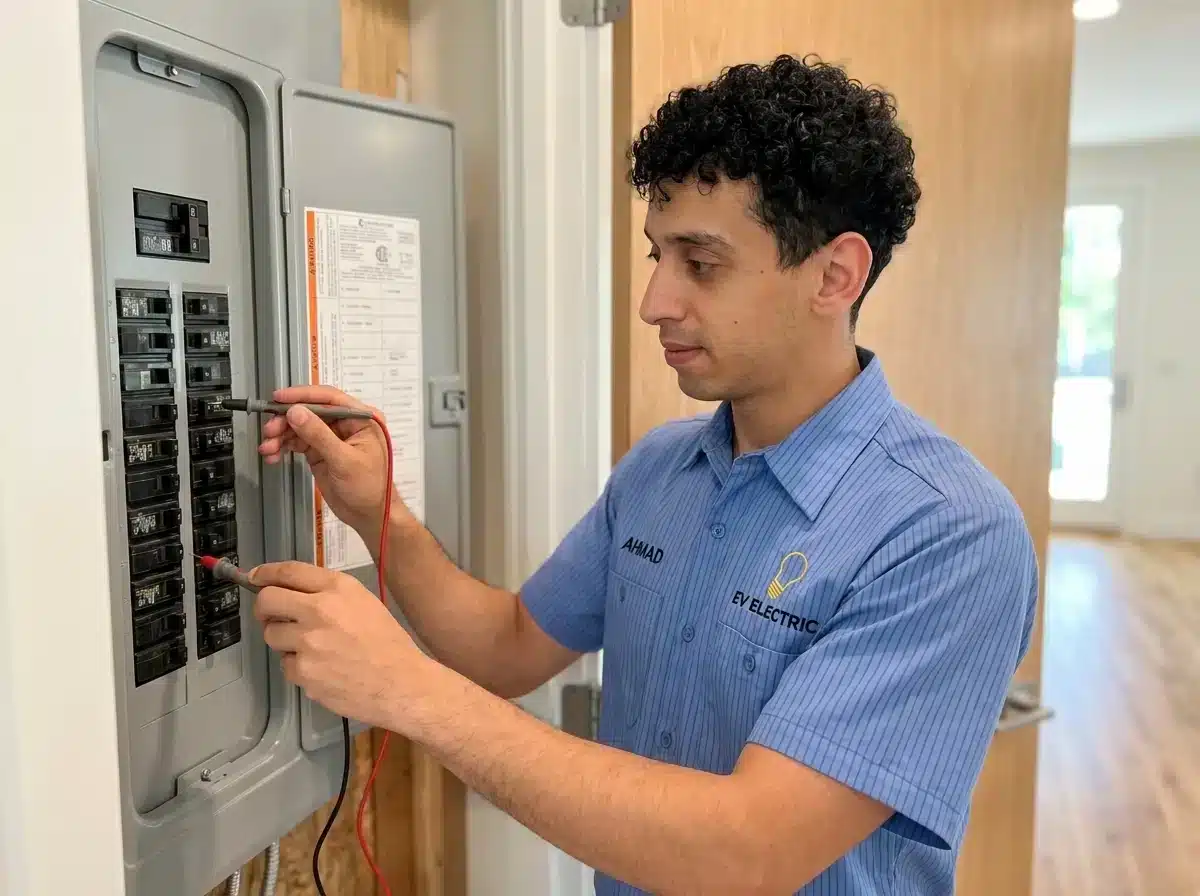
Ahmad traces the fault with meters and a thermal camera before anything comes apart. You get the diagnosis, what it means, and a written estimate — before any work starts. If what you are seeing is urgent, he will tell you that on the phone and walk you through making it safe until he arrives. If it can wait, you get a scheduled visit at a time that works for you.
Most of the houses we troubleshoot were built in the 1960s through the 1990s across Northern Virginia and the DC-side Maryland suburbs. The wiring in those houses was installed for the loads of that era, and the symptoms homeowners search for — tripping breakers, flickering lights, dead outlets — are the wiring saying the load has changed.
No trip fee, free estimates. Ahmad is a Master Electrician, Commonwealth of Virginia #2710086216.
Start here: find what your system is doing
Most people who land on this page are not searching for “electrical troubleshooting.” They are searching for what their house is doing right now. The table below matches your symptom to the section that covers it, tells you how urgent it is, and whether to call today or schedule a visit.
| What you’re seeing | Urgency | What to do | Section |
|---|---|---|---|
| Breaker keeps tripping | Schedule this week | Leave the breaker off and call | §3 below |
| One light or one room flickering | Schedule this week | Note whether it follows the bulb or the fixture | §4 below |
| Whole house flickering or dimming | Same day | Possible loose neutral — can damage electronics. Call today | §4 below |
| Outlet or room dead | Schedule soon | Check the breaker and any upstream GFCI first | §5 below |
| Burning smell from outlet or panel | Stop and call now | If the smell is at an outlet, kill the breaker for that circuit. If it is at the panel itself, do not open or operate it — leave the area and call | §6 below |
| Sparking outlet | Stop and call now | Kill the breaker for that circuit, then unplug | §6 below |
| Buzzing switch or dimmer | Schedule soon | Leave the switch off until it is checked | §6 below |
| Hot outlet or cover plate | Stop and call now | Kill the breaker for that circuit, then unplug. If the breaker is unknown, kill the main | §6 below |
If what you are seeing is not on the list, call (571) 500-6637 and describe it — no trip fee, free estimates. Troubleshooting in McLean and the other city pages below cover area-specific patterns.
When a breaker keeps tripping
Should I be worried if my breaker keeps tripping? Yes, if it happens more than once on the same circuit. A breaker is a safety device. When it trips it is doing its job — it detected more current than the circuit is rated for and it opened the circuit to prevent the wire from overheating. The question is why, and there are four common answers.
Before you investigate
Turn the breaker off at the panel and leave it off. Do not work on any circuit while it is energized, and do not keep resetting a breaker that trips repeatedly — each re-close sends current into the fault. If the panel itself is warm, smells burnt, or shows scorch marks, do not open or operate it — leave the area and call a licensed electrician immediately.
Call (571) 500-6637Overload. The circuit is carrying more than it was designed for. In Northern Virginia housing stock from the 1970s through the 1990s, this is the most common cause — kitchens and home offices wired for the loads of 1985 now running equipment that did not exist then. The fix is redistributing the load or adding a dedicated circuit.
Short circuit. A hot conductor is touching a neutral or a ground somewhere on the run. The current spike is much larger than an overload, so the breaker trips hard and fast. On a troubleshooting visit, we isolate the circuit, disconnect the loads, and test segment by segment to determine whether the fault is in a device or in the wiring itself.
Ground fault. Current is leaking to ground through a path it should not be on — moisture, insulation damage, a connection touching a metal box. GFCI outlets and breakers catch this at much lower thresholds, which is why kitchens, bathrooms and outdoor circuits are required to have them. A standard breaker tripping on a ground fault means the leakage is large enough to look like an overload — a bigger problem than a nuisance trip.
A failing breaker. What will cause a breaker to trip again after it is reset? Sometimes the breaker itself. Breakers wear out, especially if they have tripped many times over many years. The internal mechanism weakens and trips at lower and lower thresholds. If a breaker trips under a load it once handled without trouble, and the load has not changed, the breaker is the suspect.
A single trip after plugging in an appliance that draws a startup surge is usually an overload on a circuit near its limit. A breaker that trips repeatedly without an obvious cause needs to be measured — we trace it and tell you what we find before quoting any work. More on breaker replacement and when it is the right call.
When lights flicker or dim
What does a flickering light mean? It depends on whether it is one fixture, one circuit, or the whole house, because those three patterns point to completely different causes.
One fixture flickering. Usually a bulb problem or a loose connection at the fixture itself. Incandescent and halogen bulbs flicker when they are failing. LEDs flicker when the driver is incompatible with the dimmer switch or when the dimmer is rated for a higher minimum load than the LEDs draw. Swap the bulb first. If the flicker follows the fixture rather than the bulb, the connection at the fixture box needs to be checked.
One circuit or one room flickering. This is usually a loose connection at a junction box, a backstabbed outlet or switch somewhere upstream on the run, or a failing breaker. Do flickering lights indicate an electrical problem? On a single circuit, yes — a loose connection generates heat under load, and heat is what starts fires in walls. The connection that flickers under a 10-amp draw today will arc under a 15-amp draw next winter. In houses with push-in (backstab) wiring, this is often the first visible sign that a connection is failing, and the outlet or switch responsible may be two or three devices away from the fixture that flickers.
Whole-house flickering. When every light in the house dims or brightens together, especially when a large appliance kicks on, the problem is at the service entrance or in the utility feed. The two legs of a 240-volt residential service share a neutral, and a loose neutral at the meter base, the weatherhead, or the panel causes voltage to shift between the two legs. One leg sees too much, the other sees too little, and fixtures on both sides show it. This is the one that needs same-day attention, because the overvoltage leg can damage electronics and appliances. If the panel itself is the problem, our panel upgrade page covers when replacement is the right answer.
The loose-neutral case. A loose neutral at the service entrance is the most common cause of whole-house voltage swings in the 1960s–1980s housing stock across Fairfax County and the surrounding jurisdictions. The connection corrodes over decades, the resistance increases, and the voltage split drifts. We measure both legs at the panel and at the meter. If the readings are unbalanced under load, the neutral is the first thing to check. Troubleshooting in Fairfax.
When an outlet or a whole room is dead
Why is my outlet suddenly not working? Three causes account for nearly every dead-outlet call we run in Northern Virginia.
A tripped GFCI upstream. GFCI outlets protect everything downstream on the same circuit. A tripped GFCI in the garage can kill an outlet in a bedroom two rooms away — and in houses built before 2000, that wiring pattern is common. Before calling anyone, check every GFCI in the house and press the reset button on each one.
A backstab failure. Outlets installed with push-in (backstab) connections rather than screw terminals lose contact over time. The spring weakens, the wire slips, and the outlet goes dead — sometimes intermittently at first, then permanently. This is the most common reason for a single outlet failing in a house where the breaker is still on and no GFCI has tripped. Can you fix a dead outlet? Yes — but the fix depends on whether it is the device or the connection, and confirming which one requires a meter.
An open neutral. A broken or disconnected neutral leaves the hot conductor energized with nowhere for the current to go. The outlet looks dead, but the wire behind it is live. This is a wiring fault, not a device fault, and it usually means a connection has failed somewhere upstream on the run — inside a junction box, at a wire nut, or at another device on the same circuit.
Do not open the outlet
A dead outlet may still have voltage present at the terminals even though nothing works when you plug something in. Before removing any cover plate or touching any wiring, switch the breaker for that circuit off at the panel. If you cannot identify which breaker controls the outlet, turn off the main breaker. Never probe or work on a circuit you have not confirmed is de-energized. Call a licensed electrician if you are not equipped to test safely.
Call (571) 500-6637When an entire room goes dead, the breaker is the first thing to check. If it has not tripped, the problem is usually a connection failure at the first device on the circuit. We trace from the panel outward until we find the break. More on outlet service and replacement.
Stop and call: burning smell, sparking, buzzing, a hot outlet
If you are seeing any of these, stop using the circuit and call. A brief spark on plug-in and a faint dimmer buzz have benign explanations, and the cards below describe the difference — but the dangerous versions of both look the same at first, and the safe response is the same: kill the breaker, then call.
Burning smell from an outlet, switch or panel
A burning smell behind a wall plate means a connection is arcing or a conductor is overheating — kill the breaker for that circuit. If the smell or heat is at the panel itself, do not open or operate it. Leave the area and call immediately. Emergency service.
Sparking outlet
A brief blue spark when you plug something in is normal — the contacts close under load. An orange spark, a spark that lasts more than an instant, or a spark accompanied by a pop or a smell is an arc fault. Kill the breaker for that circuit first, then unplug. If you cannot identify the breaker, kill the main. Emergency service.
Buzzing switch or dimmer
A faint buzz from a dimmer running incandescent or halogen bulbs is a known characteristic, not a fault. A buzz from a standard toggle switch, or a loud buzz from any switch, means a loose connection or a failing device. Turn the switch off and schedule a visit. Troubleshooting in Vienna.
Hot outlet or cover plate
An outlet or cover plate that is warm to the touch under normal load is overloaded or has a failing internal connection. Kill the breaker for that circuit first, then unplug. If the breaker is unknown, kill the main. A hot outlet with nothing plugged into it means the wiring behind it is the problem, not the device. Outlet service.
Any of these symptoms on a circuit that also serves a bedroom should be treated as same-day — sleeping occupants will not smell smoke or notice a failing connection. Our emergency electrician page covers how to reach Ahmad outside normal hours.
How we find the fault without opening every box
A loose connection heats up long before it fails. That heat is invisible through a wall plate, but not through a thermal camera.
Ahmad carries one on troubleshooting calls. Before anything comes apart, he scans the panel, the circuit and the fixtures, and the hot joint shows up as a bright spot on the screen. It means the diagnosis starts from evidence instead of from guesswork, and it means less of your wall and ceiling has to come open to find a fault that could be anywhere on the run.
It also catches the problems that have not happened yet — an overloaded breaker running hot, a backstabbed outlet on its way to failing, an aluminium-to-copper joint that needs attention before it becomes a burn mark.
What you get: the reading, what it means, and the options — before any work is authorised.
What actually happens on a troubleshooting visit
Every national explainer tells you what might be wrong. None of them tell you what the visit looks like. Here is how ours runs.
You describe the symptom on the phone
What is it doing, when did it start, and does it happen all the time or only under certain loads? That conversation takes two minutes and it tells Ahmad what meters and equipment to bring. No trip fee, free estimates.
Ahmad reads the panel first
The panel tells the story of the house. Its age, its make, how many circuits are in use, whether anything has been added without a permit, and whether any connections are running hot under load.
He traces the circuit to the fault
With the thermal reading and a clamp meter, the diagnosis follows the evidence from the panel outward. Loose connections, backstab failures, overloaded conductors, ground faults — each one leaves a measurable signature. You see the reading and hear what it means while he is still at the device.
You get the finding and a written estimate
Here is what is wrong, here is what fixes it, here is what it costs. Written, itemized, no obligation. If the fix is straightforward and you want it done now, it usually happens the same visit. If it is a larger job, you have the estimate in hand to schedule at your convenience.
When the fault is the wiring itself
Sometimes the troubleshooting visit finds that the problem is not a device, not a breaker, and not a loose connection — it is the conductor in the wall.
Aluminum branch wiring. Installed in houses built between roughly 1965 and 1973, aluminum expands and contracts at a different rate from the copper and steel it connects to. Over decades, connections loosen, oxidize, and generate heat at outlets and switches. The repair is installing approved connectors at every termination point — it does not require pulling new wire.
Backstab connections. Push-in connections were standard practice for decades, but the spring contact is the weak point. One failing backstab is a single dead outlet. A house full of them is a pattern. When we find the same failure at several devices on one circuit, we re-land every connection at the screw terminals.
Knob-and-tube wiring. Homes built before the 1940s in parts of Fairfax County, Falls Church, and the older sections of Arlington and Alexandria may still have original knob-and-tube. It is not inherently dangerous when intact, unmodified and in open air, but it was never designed for insulation contact, modern loads, or the modifications that decades of owners have made to it. When troubleshooting uncovers it as the root cause, the conversation shifts to a partial or whole-house rewire. More on rewiring.
These are not DIY repairs
Aluminum re-termination, backstab replacement across a circuit, and knob-and-tube assessment all require the power off at the panel, confirmed de-energized with a tester. Do not attempt these yourself — both aluminum and knob-and-tube have failure modes invisible until they cause a fire. Call a licensed electrician.
Call (571) 500-6637Estimates and what diagnosis costs
Estimates are free. If the problem needs diagnosing first, we tell you what that costs before we begin.
A free estimate means Ahmad looks at a defined job — a panel that needs replacing, a charger that needs installing, a circuit that needs adding — and tells you what it costs. No obligation.
Troubleshooting is different. When you call because something is wrong and nobody knows what, the visit itself is the work — finding the unknown job, not quoting a known one. The cost of that diagnostic work is agreed with you before any of it starts, and it is applied to the repair if you go ahead with the fix.
A pre-purchase safety walkthrough for a buyer, with no work booked, is free. The post-job safety inspection on completed work is also free. This page is about existing faults — and diagnosing an existing fault is not free.
No trip fee, free estimates. Diagnosis is quoted before it begins.
The electrician who does the diagnosis
Troubleshooting is the work Ahmad chose the trade for. Most electricians prefer installation — defined scope, known materials, predictable hours. Fault-finding is the opposite: every call starts with a question nobody has answered yet, and the job is not done until the reading explains the symptom. That is why he handles these calls personally rather than dispatching them.
Ahmad holds a Master Electrician, Commonwealth of Virginia #2710086216 — the highest electrician credential the state issues to an individual. It required documented journeyman hours and a state exam. On a troubleshooting visit, it means the person reading your panel and interpreting the measurements holds that credential personally, not through an employer.
The housing stock he works in most often — 1960s through 1990s homes across Fairfax County, Vienna, McLean, and the Maryland suburbs — shares recurring failure modes: backstabbed outlets loosening under load, aluminum wiring oxidizing at terminations, panels that were full before anyone plugged in a car charger. Knowing what to look for before the cover plate comes off is how a one-hour visit stays a one-hour visit.
EV-Electric Services is fully insured and based at 9488 Fairfax Blvd, Fairfax, VA 22031. 113 Google reviews, 5.0-star average — real, recent, and from Northern Virginia and Maryland homeowners.
Where we troubleshoot
EV-Electric Services is based at 9488 Fairfax Blvd in the City of Fairfax. We cover Fairfax County, Falls Church, DC, and Montgomery County. Each city below has its own troubleshooting page.
Fairfax, VA
1950s–1980s stock with Federal Pacific and Zinsco panels still in service.
Vienna, VA
10 minutes from our shop. Heavy 1970s–1980s stock with original panels.
McLean, VA
Renovation-era rewire and panel work alongside troubleshooting.
Oakton, VA
1970s–1990s housing stock with capacity-driven tripping.
Tysons, VA
Condo and townhouse troubleshooting alongside single-family.
Falls Church, VA
Older housing in the City of Falls Church with pre-1960 wiring.
Annandale, VA
Split-level and colonial stock with shared-circuit tripping.
Burke, VA
1980s–1990s subdivisions with original backstab wiring.
Washington, DC
Rowhouse and pre-war stock with knob-and-tube and ungrounded circuits.
Bethesda, MD
1960s–1970s ranch and split-level stock with aluminum branch wiring.
Chevy Chase, MD
Pre-war homes with knob-and-tube and original panels.
Potomac, MD
Large homes with high-capacity panels and EV charger loads.
Rockville, MD
Mixed housing stock across Rockville and North Bethesda.
No trip fee, free estimates across our full service area. View all services and cities →
Electrical troubleshooting questions
How many times can a breaker trip before it goes bad?
There is no fixed count stamped on the handle. What degrades is the bimetal strip inside — it heats, bends, and opens the contacts. Each trip fatigues the metal until the strip opens at currents it once ignored. Fault-condition trips cause more damage per event than overload trips because the current spike is larger. A breaker rated for several thousand operations under test conditions will reach that limit sooner in a house where it trips monthly.
How to tell if a breaker is bad?
We load the circuit to a known draw and measure the current leaving the breaker while it is energized. If it opens well below its rating, the mechanism is worn. We then de-energize the panel and check the torque on the bus-bar lug, because a loose connection mimics a bad breaker and replacing the wrong part solves nothing. Call a licensed electrician — both steps require the panel open.
How do I get my lights to stop flickering?
Describe when it happens — constant, only under heavy load, or only at a certain time of day. That pattern is the single most useful piece of information you can give a licensed electrician before the visit, because it narrows the search from every connection on the circuit to the conditions that reproduce the fault. A video of the flicker on your phone is worth more than a description.
How do I know if an outlet is blown?
“Blown” usually means one of two things. The outlet itself may have failed — cracked contacts or a push-in terminal that released the wire. Or the circuit feeding it has an open neutral, which means voltage is present but current cannot complete the return path. A plug-in tester reads “dead” in both cases. Call a licensed electrician — a meter test at the terminals is the only way to tell which one you have.
How to fix an electrical outlet that does not work?
We kill the breaker, confirm the circuit is dead with a meter, and pull the outlet. What we find behind the plate determines the fix — sometimes it is a single failed connection, sometimes it is the outlet body itself, and occasionally the fault is not at this outlet at all but at a device further upstream on the run. You get the finding and the options before we do anything. Call a licensed electrician.
Something wrong with your wiring? Tell us what it’s doing.
Electrical troubleshooting across Northern Virginia, DC and Maryland — Master Electrician on site, no trip fee, free estimates. Same-day and emergency visits available. Call, describe the symptom, and we will get Ahmad to you.
(571) 500-6637