
Light Fixture Installation · Recessed, Chandelier & Room-by-Room
The Fixture Is the Easy Part — the Wiring Behind It Is the Job
Every room in your house asks something different of its lighting — a kitchen needs task lighting spaced for countertops, a dining room needs a box rated for a chandelier’s weight, a bathroom needs moisture-rated fixtures and GFCI-protected receptacles. The fixture itself is a purchase. The wiring, the box, the circuit capacity and the switch are the installation.
Ahmad installs recessed lighting, chandeliers, vanity fixtures, under-cabinet lighting, ceiling fixtures and outdoor fixtures across Northern Virginia, DC and Maryland. Every installation starts at the panel and works forward — confirming the circuit can carry the load, verifying the box is rated for the weight, and making sure the switch and dimmer are compatible with the fixture before anything goes on the ceiling.
No trip fee, free estimates. Ahmad is a Master Electrician, Commonwealth of Virginia #2710086216.
Start with the room, not the fixture
Most light fixture installation pages list fixture types — recessed, pendant, flush mount — and describe each one. That is a product page, not an installation guide. The room tells you what the wiring needs to do. A kitchen has different circuit demands than a hallway. A bathroom has code requirements a bedroom does not. A dining room ceiling box rated for a flush mount will fail under a chandelier.
Do you need an electrician to install a light fixture? If the fixture plugs in, no. If it connects to a junction box in the ceiling or wall — and nearly every permanent fixture does — the answer depends on what is behind the drywall. A straight swap on an existing box with matching wiring is the simplest version. Adding a fixture where none exists, running a new switch leg, upgrading a box for a heavier fixture, or adding a circuit for a room that does not have one — those are electrical jobs, and they start at the panel.
The sections below walk through your home room by room. Each one names the fixture types that room typically needs, the wiring consequence behind each one, and what makes that room’s installation different from the others.
Living and family rooms — recessed lighting
Before any recessed lighting work
Kill the breaker for the lighting circuit at the panel before cutting into a ceiling, removing an existing fixture, or working inside any junction box. Recessed cans sit inside the ceiling cavity where insulation, framing and other wiring share the space. Do not cut a hole or pull a wire while the circuit is live. Call a licensed electrician if you are not equipped to confirm the circuit is dead.
Call (571) 500-6637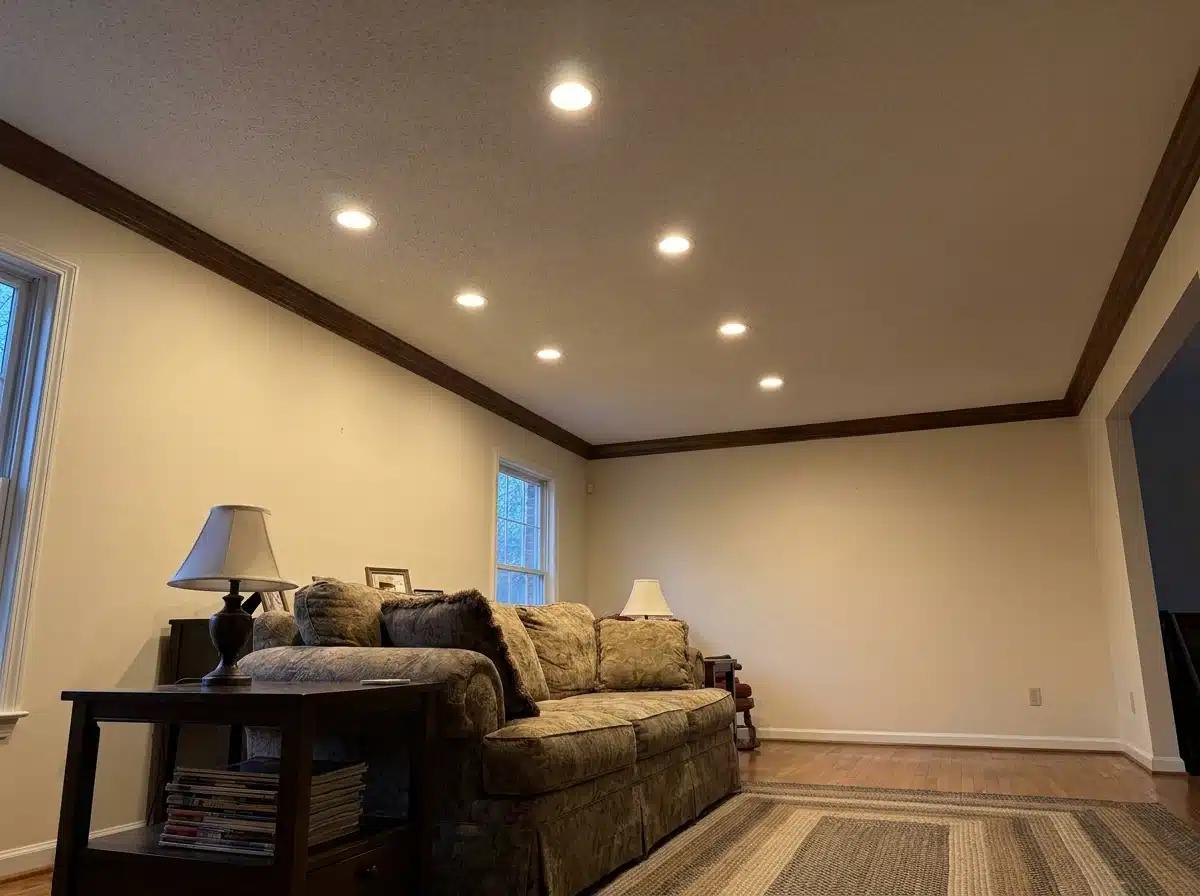
Recessed lighting is the most requested installation we handle. A living room layout typically runs six to eight cans on a single circuit, each cut into the ceiling, wired to a junction box, and connected to a dimmer-compatible switch.
How many recessed lights do I need for a 12×12 room? The spacing rule is one can for every 20 to 25 square feet of floor area. A 12×12 room is 144 square feet — six cans, spaced roughly two feet from each wall and four to five feet apart. The count changes if the ceiling is vaulted or if the cans are accent rather than general illumination.
IC-rated housings. Do you need an electrician to install recessed lighting? Yes — and insulation contact is one reason. A recessed can sits inside the ceiling cavity, and in most Northern Virginia homes the attic insulation sits directly against it. An IC-rated (insulation contact) housing is designed for that. A non-IC can covered by insulation can overheat. Determining which housing your ceiling requires is part of the installation, not a product choice you make at the store.
The wiring behind a six-can layout. Six cans on one circuit means six junction boxes, a home run to the panel, and a switch leg to the dimmer. In most living rooms the total LED draw is well under 15 amps, so circuit capacity is rarely the constraint. The constraint is access — whether you can reach the cavity from above, or whether the installation has to work from below.
$100–$250 per fixture
Recessed lighting installation (2026)
A six-can room is six fixtures. The per-fixture price covers the installation at each location — the fixture count drives the total. Under-cabinet, chandelier and standard ceiling fixtures fall in the same range.
Recessed lighting installation in Fairfax. Panel capacity and circuit work.
Kitchens — task lighting, under-cabinet, spacing
Before working on kitchen lighting
Kill the breaker for the kitchen lighting circuit at the panel. Kitchens often have multiple circuits sharing the same space — lighting, countertop outlets, and appliance circuits. Confirm you have de-energized the correct one before touching any fixture or junction box. Call a licensed electrician if you are not sure which breaker controls the lighting.
Call (571) 500-6637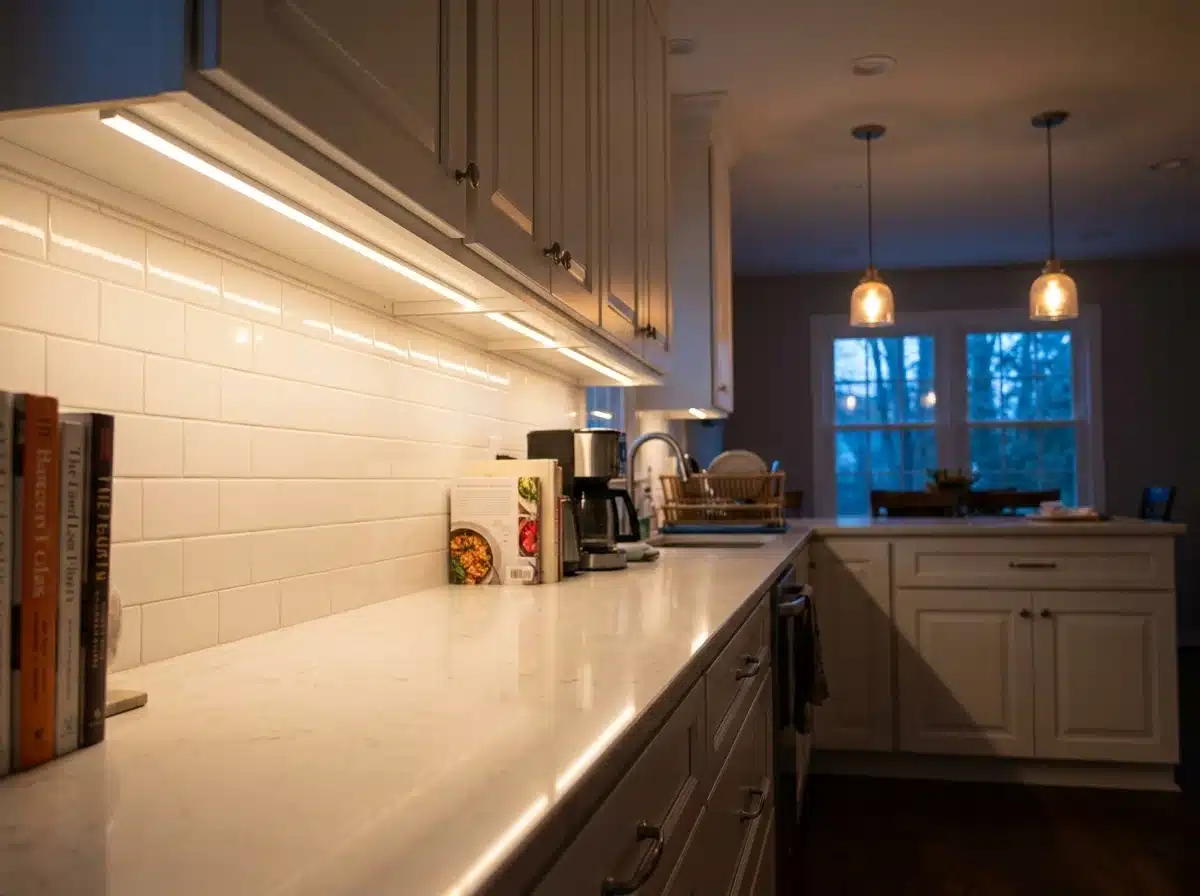
A kitchen asks more of its lighting than any other room: general illumination from above, task lighting over countertops, and under-cabinet lighting on its own switch. Each layer runs on a different fixture type, and in older Northern Virginia kitchens they often share a single circuit that was never designed for all three.
Recessed lighting over the work triangle. The recessed layout in a kitchen follows the countertops, not the room geometry. Cans go over the sink, over the stove, and over the primary prep surface — spaced to eliminate shadows where you are cutting, not evenly across the ceiling. IC-rated housings apply here exactly as in a living room, and the spacing is tighter because the task demands are higher.
Under cabinet lighting installation. Under-cabinet fixtures mount to the underside of wall cabinets and illuminate the countertop below. Hardwired under cabinet lighting connects to a junction box inside the cabinet, usually fed from a dedicated switch. The installation involves fishing wire through the cabinet backs and connecting at a junction box — not plugging into a countertop outlet. Code requires a minimum number of countertop receptacles spaced for access, and an outlet occupied by a permanent appliance does not count toward that requirement. More on outlet and circuit work.
Pendant lighting over islands. A pendant over a kitchen island hangs from a ceiling box rated for its weight. If no box exists above the island, the installation includes running a new circuit or extending an existing one, cutting in a box, and installing a switch. The box location matters — a pendant centred over the island means the box is centred, not offset from wherever the previous fixture was.
Dining rooms and entryways — chandeliers and heavy fixtures
Before removing or installing a chandelier
Kill the breaker for the fixture circuit at the panel before touching the canopy, disconnecting any wiring, or supporting the fixture weight. A chandelier hanging from a live circuit is a shock hazard and a fall hazard at the same time. Do not attempt to hold a heavy fixture while working on energized wiring. Call a licensed electrician.
Call (571) 500-6637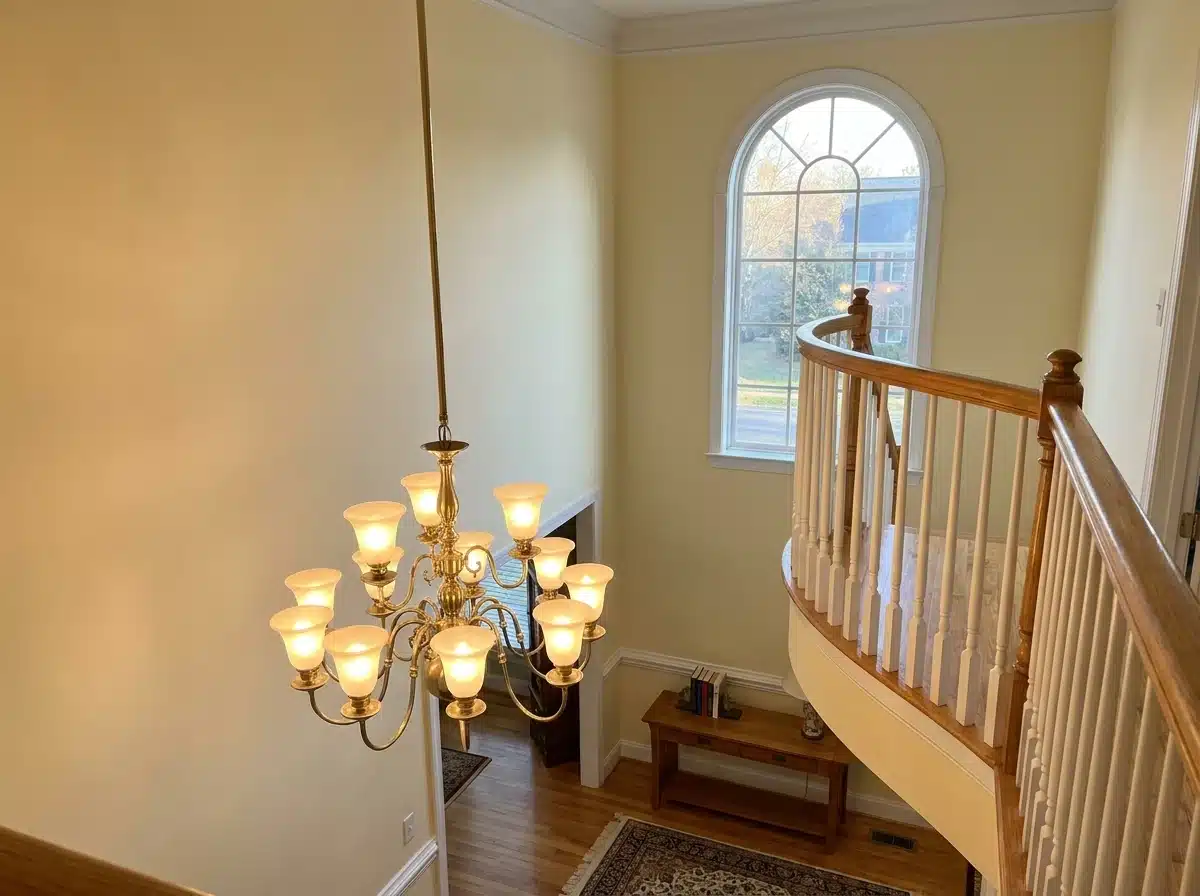
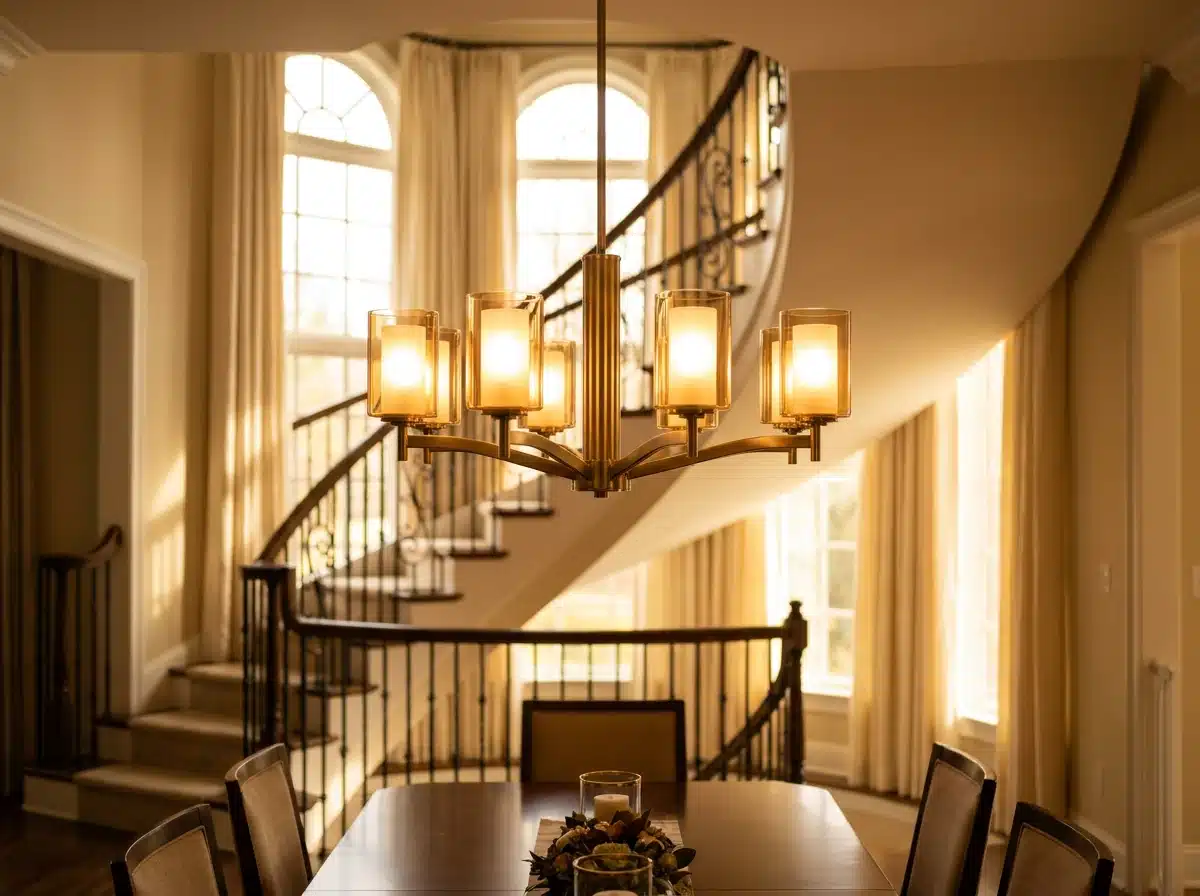
Do you need an electrician to install a chandelier? In almost every case, yes — and the reason is weight, not wiring. A standard ceiling box is rated for a fixture up to 50 pounds. Many chandeliers exceed that, and a box that held a flush-mount light for 30 years will not hold a chandelier that weighs three times as much. The box must be rated for the fixture weight, independently supported by the framing, and accessible for inspection. If the existing box is a lightweight plastic retrofit, it gets replaced.
The box rating is the installation. A ceiling box rated for a light is not rated for a fan, and often not rated for a heavy chandelier. The rating is stamped on the box. If it says “50 lb” and your chandelier weighs 55, the box must be replaced with a fan-rated or heavy-fixture box that mounts independently to the ceiling joist. That replacement is the job — the wiring connection is the easy part. Chandelier installation cost depends primarily on the box work, not on the fixture itself. Ceiling fan installation covers the same box-rating work from the fan side.
Entryway and foyer fixtures. A two-storey entryway chandelier adds height to the equation. The fixture hangs on a longer stem, the total weight including chain and canopy is higher, and reaching the box for installation or maintenance requires scaffolding or a lift. Ahmad installs these and sets the hanging height before the fixture goes up — adjusting afterwards means re-accessing a box that may be 18 feet above the floor.
Bedrooms and hallways — ceiling light installation
Before replacing a ceiling fixture
Kill the breaker for the fixture circuit at the panel. Confirm it is dead with a tester before disconnecting any wiring. A fixture that appears off because the switch is down is still energized at the junction box. Call a licensed electrician if you cannot confirm the circuit is de-energized.
Call (571) 500-6637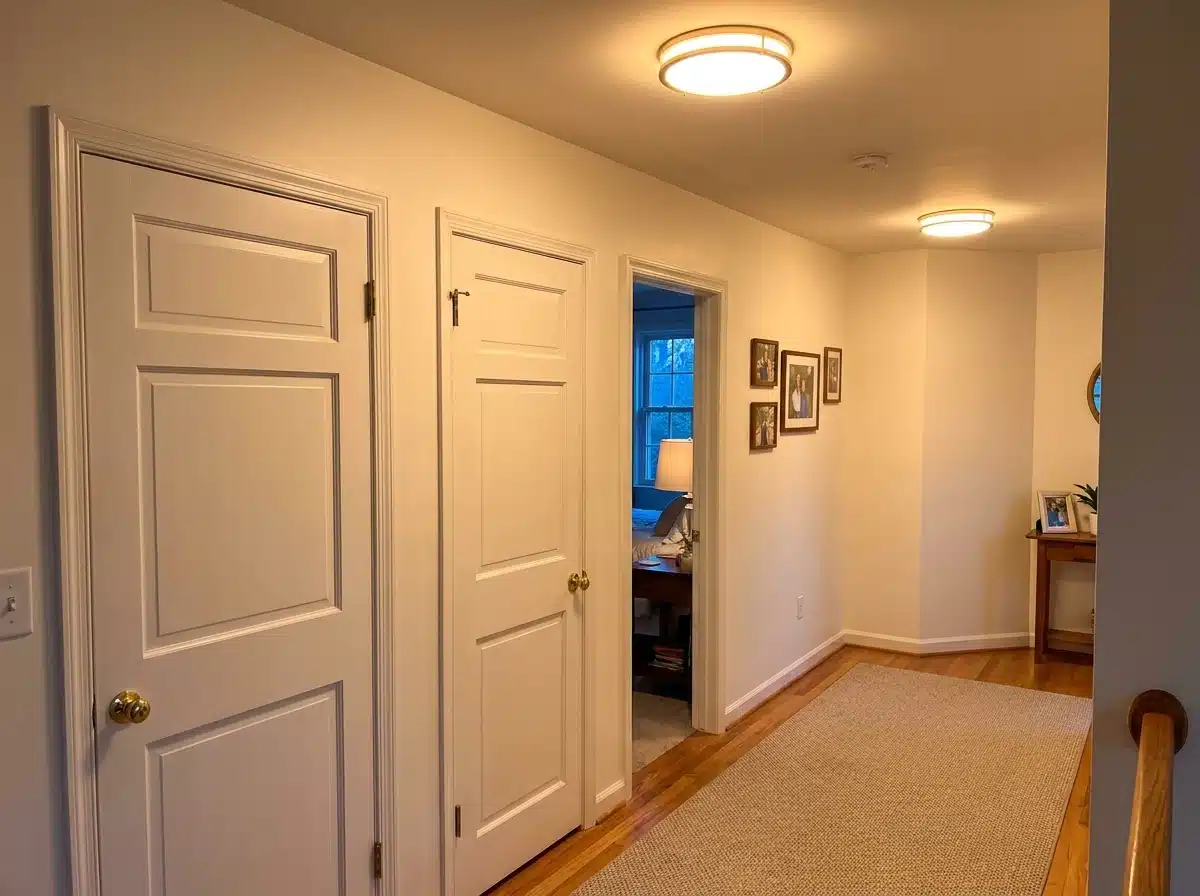
Bedrooms and hallways are the simplest ceiling light installation in most homes — a flush-mount or semi-flush fixture on an existing box, controlled by a wall switch. A straight swap where the box, the wiring, and the switch are already in place is the fastest job on this page.
When the swap is not straightforward. In homes built before the 1980s across Fairfax County and Falls Church, the existing junction box may be undersized, mounted to old plaster lath instead of framing, or wired with conductors that do not include a ground. A fixture that sits flat on drywall will not sit flat on a plaster ceiling with an uneven medallion. Older homes also carry two-wire circuits without a neutral at the switch box, which limits dimmer compatibility.
Adding a fixture where none exists. A hallway that has never had a ceiling light needs a new junction box cut into the ceiling, a switch leg run to a wall switch location, and a circuit connection at the panel or at an existing junction box on the run. That is a different scope from replacing what is already there, and it is the version that may involve a permit — see the wiring section below.
Bathrooms — vanity lighting
Before working on bathroom lighting
Kill the breaker for the bathroom circuit at the panel. Bathrooms combine water and electricity in close proximity — every fixture installation in a bathroom must be performed with the circuit confirmed dead. Call a licensed electrician for any bathroom electrical work.
Call (571) 500-6637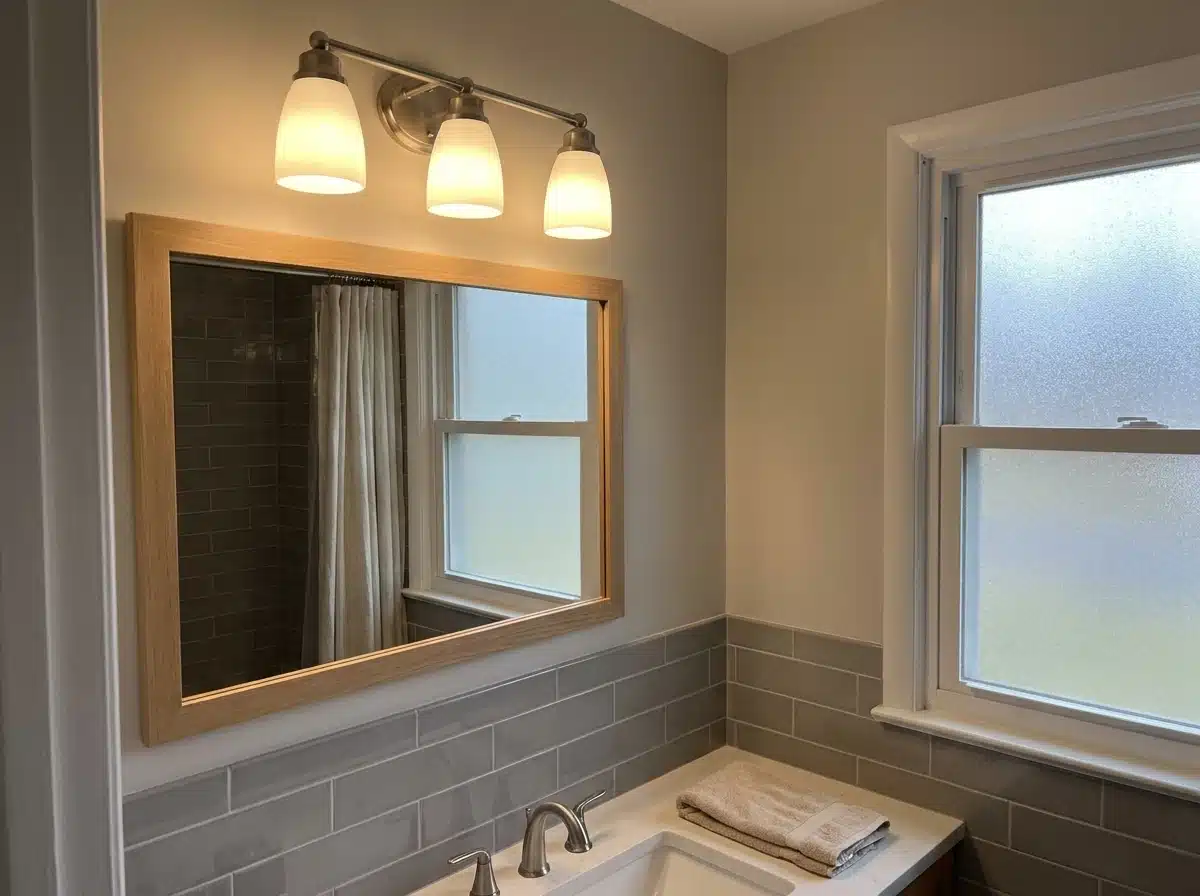
A vanity light mounts above or beside the bathroom mirror and connects to a junction box in the wall. The installation is similar to a ceiling fixture — box, wiring, switch — with one critical difference: location. Fixtures in a bathroom must be rated for damp or wet locations depending on their proximity to the shower or tub. A fixture rated for a dry location installed above a shower is a code issue and a safety hazard.
The GFCI requirement. All bathroom receptacles are required to be GFCI-protected. If the vanity light shares a circuit with the bathroom outlets, those outlets should already have GFCI protection at the first receptacle or at the breaker. If they do not, the installation includes adding it.
Ventilation is a separate job. Bathroom ventilation — exhaust fans, duct runs, moisture control — is covered on our bathroom exhaust fan installation page. This section covers lighting only.
Outdoor, porch and landscape lighting
Before working on outdoor lighting
Kill the breaker for the outdoor circuit at the panel. Outdoor fixtures are exposed to rain, snow and ground moisture — working on an energized outdoor circuit carries a higher shock risk than indoor work. Call a licensed electrician for any outdoor electrical installation.
Call (571) 500-6637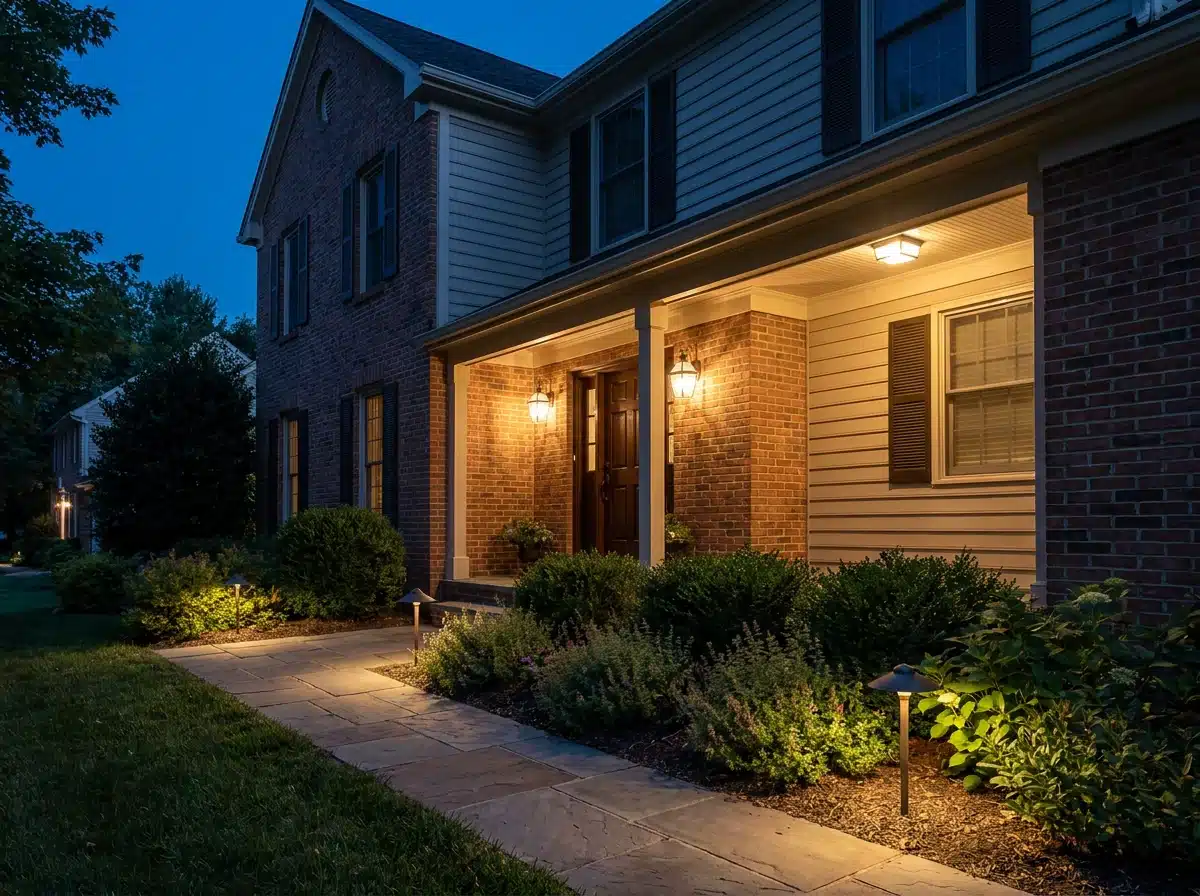
Outdoor lighting installations divide into two categories: line-voltage fixtures that wire directly to a branch circuit, and low-voltage landscape systems that run through a transformer. Both start at the panel, but the wiring path and the code requirements are different.
Porch and wall-mounted fixtures. A porch light or exterior wall sconce mounts to a weatherproof junction box on the exterior wall. The fixture and the box must be rated for wet locations. If an outdoor light is being added where none exists, the circuit must be extended through the wall and the box must be cut in with proper flashing. Any outdoor receptacles on that circuit require GFCI protection. In homes where the only outdoor lighting is a single porch light on the front door, adding fixtures at the garage, the back door, or along a walkway means extending the outdoor circuit or running a new one.
Low-voltage landscape lighting. Landscape path lights, uplights, and accent fixtures typically run at 12 volts through a transformer plugged into or hardwired to an outdoor GFCI outlet. The transformer is the electrical installation. The fixtures themselves connect to low-voltage cable and do not require a licensed electrician — but sizing the transformer, protecting the feed circuit, and installing the GFCI outlet it plugs into do.
What the wiring behind it actually involves
All wiring work starts with the power off
Kill the breaker for the circuit at the panel before opening any junction box, disconnecting any fixture, or pulling any wire. Confirm the circuit is dead with a non-contact voltage tester before touching any conductor. Do not work on energized wiring. If you cannot identify the correct breaker, turn off the main. Call a licensed electrician.
Call (571) 500-6637Can I install a light fixture myself? A straight light fixture replacement — same box, same wiring, same switch — is the version a homeowner with basic tools and a voltage tester can handle safely, provided the breaker is off and confirmed dead. Beyond that, the work enters licensed-electrician territory.
A new fixture where none exists. Adding a light where no junction box and no switch exist means cutting in a box, running cable to a switch location and back to the panel, and confirming the circuit has capacity.
Switch legs and neutrals. In homes wired before the 2011 NEC update, the switch box may lack a neutral conductor. Many modern dimmers and smart switches require one, so upgrading the switch may mean pulling new cable to the switch location.
Permits. Fairfax County does not publish a blanket like-for-like exemption for fixture replacements. Whether a permit is required depends on the scope — a swap on an existing box and circuit is treated differently from running a new circuit. We confirm the permit requirement for your specific address before the work starts.
Box ratings, summarised. A standard box is rated for 50 pounds. A fan-rated box is braced to the joists and rated for dynamic loads — a chandelier over 50 pounds needs one. A recessed can is its own housing, IC-rated for insulation contact or non-IC for open ceilings only. Troubleshooting in Falls Church.
Recessed lighting with no attic access
Before cutting into any ceiling
Kill the breaker for every circuit that could run through the ceiling cavity you are about to cut into. In a finished ceiling with no attic access, you cannot see what is above the drywall — wiring, plumbing, and HVAC runs may all share the space. Do not cut without confirming the area is safe. Call a licensed electrician.
Call (571) 500-6637What if there is no attic above the ceiling? In a two-storey home, a condo, or a finished basement, the cavity between floors is not accessible from above. Standard recessed cans install from the attic side. Without access, none of that works.
Remodel cans and canless retrofits. A remodel can installs entirely from below — it slides through the ceiling hole and clips to the drywall from inside the cavity. A canless retrofit is simpler still: a slim LED disc that mounts to a junction box with no housing. Both eliminate attic access as a requirement, but neither eliminates the wiring — the circuit still runs through the cavity, and the switch leg still needs to reach the wall.
Plaster ceilings. In older housing across Fairfax County, Arlington, and Falls Church, many ceilings are plaster over wood lath. Cutting a clean hole without cracking the surrounding surface requires different tools, and a remodel can does not clip to plaster the way it clips to drywall. The installation often involves reinforcing the opening or a different mounting method.
The no-attic installation takes longer per can because every step happens through a four-inch hole. Ahmad scopes the access situation during the estimate visit and tells you which approach your ceiling requires before quoting.
Dimmers, LEDs, flicker and buzz
A dimmer switch designed for incandescent bulbs does not always work with LED fixtures. The mismatch causes three visible symptoms: flicker at low dim levels, an audible buzz from the switch or the fixture, and a limited dimming range where the light jumps from full brightness to off with no usable middle.
Why it happens. An incandescent dimmer reduces voltage to reduce brightness — the filament glows less. An LED driver converts AC to DC internally, and a voltage reduction that dims a filament smoothly can confuse a driver that expects a stable input. The result is the driver cycling on and off rapidly, which you see as flicker and hear as buzz.
The fix is the dimmer, not the bulb. An LED-rated dimmer (sometimes called an ELV or trailing-edge dimmer) reduces brightness by controlling the waveform rather than the voltage. It costs more than a standard dimmer and requires a neutral at the switch box — which older homes may not have. Replacing the dimmer is part of a fixture installation when the new fixtures are LED and the existing dimmer is incandescent-rated.
If your lights are already flickering or buzzing, our electrical troubleshooting page covers the full diagnosis — dimmer incompatibility is one cause, but loose connections and failing fixtures produce similar symptoms.
What light fixture installation costs
$100–$250 per fixture
Light fixture installation (2026)
Recessed, chandelier, vanity, under-cabinet, ceiling and outdoor fixtures all fall in the same per-fixture range. The fixture count drives the total — a six-can recessed layout is six fixtures.
The range covers a standard installation at each fixture location. Where the fixture sits in the range depends on the type of fixture, whether an existing box and circuit are in place, and the ceiling access. A straight swap on an existing box is at the low end. A new fixture location with no prior wiring is at the upper end.
Estimates are free. If the problem needs diagnosing first, we tell you what that costs before we begin. No trip fee, free estimates.
Who does the work
A handyman hangs the fixture. An electrician checks the box, the circuit, and the switch before the fixture goes up. Ahmad starts every lighting job at the panel — confirming the circuit has capacity, verifying the junction box is rated for the weight, and testing dimmer compatibility with the new LEDs. The fixture goes on the ceiling last, after everything behind it is confirmed safe.
He holds a Master Electrician, Commonwealth of Virginia #2710086216 — the credential that separates someone who can evaluate a box rating and sign off on a circuit modification from someone who cannot. Ahmad earned it through documented journeyman hours and a state exam, and he holds it as an individual, not through a company.
Recessed layouts in living rooms, chandelier swaps in dining rooms, vanity replacements in bathrooms built before GFCI was standard — every room on this page describes work Ahmad does regularly in Fairfax County and the surrounding cities. 113 Google reviews, 5.0-star average. EV-Electric Services is fully insured — 9488 Fairfax Blvd, Fairfax, VA 22031.
Service area for light fixture installation
Our shop is at 9488 Fairfax Blvd, Fairfax, VA 22031. Fixture installations run from Fairfax County through Arlington, Falls Church, Alexandria, into DC, and across to Montgomery County on the Maryland side. The two city pages below cover the areas where we do the most lighting work.
Light Fixture Installation, Fairfax VA
Recessed layouts, chandelier mounting, and kitchen lighting across Fairfax County.
Light Fixture Installation, Vienna VA
Ten minutes from our shop. Recessed and vanity fixtures in 1970s–1990s housing stock.
McLean, Oakton, Burke, Annandale, Bethesda, and Potomac are served through this page until their own city pages go live. No trip fee, free estimates across our full service area. View all services and cities →
Light fixture installation questions
How much does it cost to put in recessed lights?
$100–$250 per fixture installed (2026). A six-can room is six fixtures, so the total reflects the count. Unusual access — no attic, plaster ceilings, or a long wire run — pushes individual fixtures toward the upper end.
How much does it cost to have someone install a chandelier?
$100–$250 per fixture (2026). That covers the electrical connection, box verification or replacement, and mounting. If the ceiling box is not rated for the chandelier’s weight, it gets replaced with a fan-rated box — included in the installation, not a separate charge.
Can I install recessed lighting myself?
The hardware is a product purchase. The installation is electrical work — cutting into a ceiling cavity, running cable, landing conductors at junction boxes, and tying into a panel circuit. The cans must be IC-rated if insulation will contact them, and the circuit must be confirmed dead before any of it starts. Call a licensed electrician for recessed lighting installation.
Can I install a chandelier myself?
A chandelier adds weight to a standard fixture connection. A box rated for a flush mount may not hold it — the rating is stamped on the box, and checking it means removing the existing fixture with the circuit confirmed dead. If the box needs replacing, the work involves opening the ceiling to access the framing. Call a licensed electrician for any chandelier installation.
How to properly install a light fixture?
Kill the breaker at the panel and confirm the circuit is dead. Remove the old fixture and inspect the junction box — check that it is securely mounted, rated for the new fixture’s weight, and grounded. Connect black to black, white to white, green or bare to the ground screw. Secure the fixture to the box and restore power. If the box is loose, undersized, or ungrounded, call a licensed electrician before proceeding.
Ready to upgrade your lighting?
Light fixture installation across Northern Virginia, DC and Maryland — recessed, chandelier, vanity, under-cabinet, ceiling and outdoor. Master Electrician on site, no trip fee, free estimates. We respond within one business day. Call, describe what you need, and we will get Ahmad to you.
(571) 500-6637