
Electrical Panel Upgrades in Rockville, MD
Modern Panel. Full Capacity. Done Right.
Breakers tripping every time you run the dryer? Insurance company flagging your Federal Pacific panel? Need capacity for an EV charger but the panel’s already maxed out? Ahmad Shaban — Virginia-licensed Master Electrician — upgrades residential panels across Rockville and Montgomery County. Permit, utility coordination, and inspection handled start to finish.
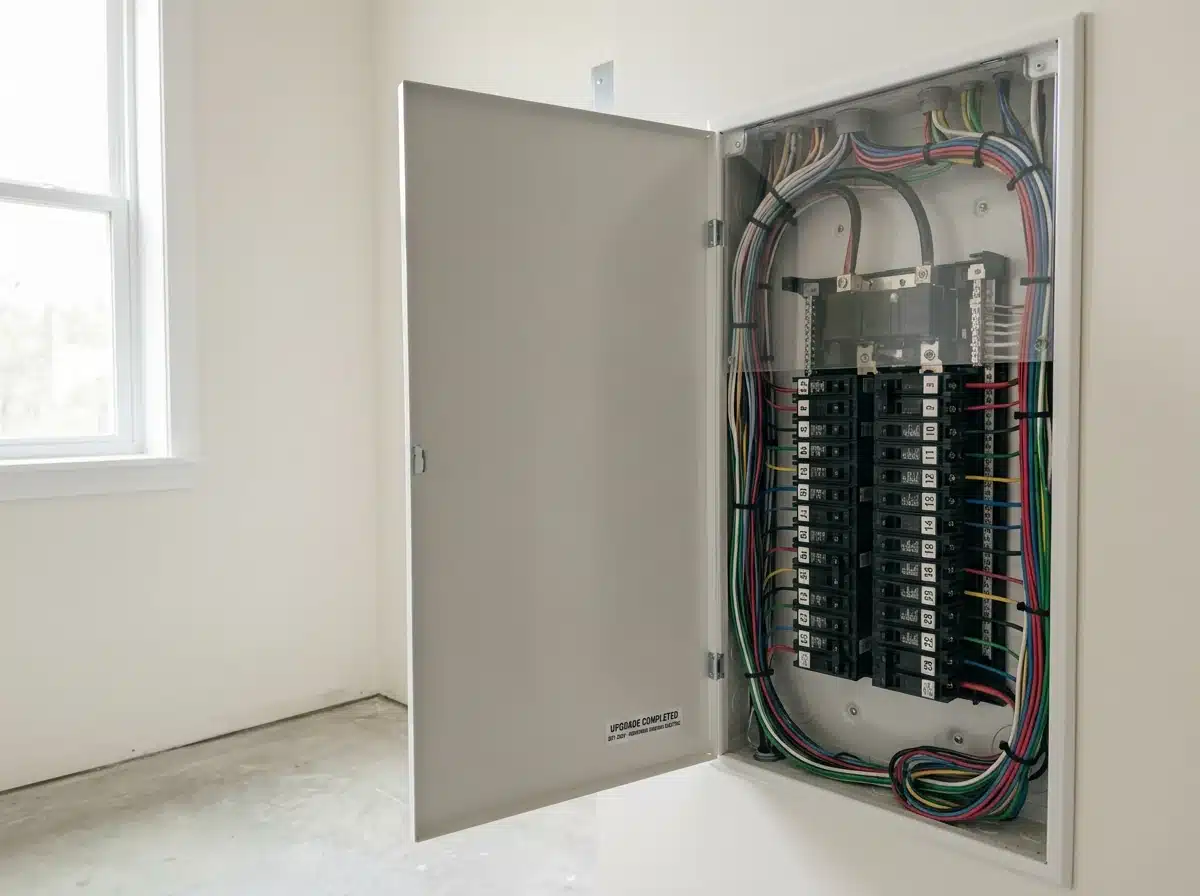
What “panel upgrade” actually means
A panel upgrade means replacing the electrical panel — the metal box where your circuits terminate — with a modern, higher-capacity unit. The old panel comes out, a new panel goes in, every circuit gets re-landed on properly rated breakers, and the whole thing passes county inspection. Most Rockville homes built before 2000 have 100-amp or smaller panels. A 200-amp upgrade gives you the capacity modern life actually demands — HVAC, kitchen loads, EV charging, home office — without tripping breakers or overloading circuits.
The most common trigger is a panel that’s either too small or too dangerous to keep. Federal Pacific Stab-Lok and Zinsco panels are documented fire risks — breakers that fail to trip on overcurrent. Fuse boxes from the 1950s and 1960s can’t support today’s loads. And even a 100-amp breaker panel from the 1980s runs out of space the moment you add an EV charger or finish a basement. We replace all of these with current-code Square D or Eaton panels sized to your actual load calculation, not a guess.
Ahmad Shaban is a Virginia-licensed Master Electrician with a crew behind him. He runs panel upgrades across Rockville and the rest of Montgomery County — Twinbrook Cape Cods, King Farm townhomes, College Gardens colonials. The work isn’t “swap a box and leave.” It’s open the panel, inspect the service entrance, run a proper load calculation, pull the permit, coordinate the utility shut-off, install the new panel, test every circuit, and walk you through what changed. You know what’s in the wall before we close it up.
Why Rockville homeowners call us for panel upgrade
Rockville is the county seat of Montgomery County, Maryland, sitting about 12 miles northwest of Washington, DC along the I-270 corridor. Rockville Pike (MD-355) is the city’s commercial spine, running north-south through the center of town and connecting Bethesda to Gaithersburg. I-270 parallels it on the west side, providing the primary commuter route between DC and Frederick. The city has three Metro stations — Rockville, Twinbrook, and Shady Grove — making it one of the most transit-connected suburbs in the DC region. Rockville is roughly 8 miles north of Bethesda, 6 miles south of Gaithersburg, and 22 miles from our Fairfax office via the Beltway and I-270.
1940s–1960s post-war Cape Cods, ramblers & small colonials
Twinbrook, East Rockville, Hungerford, Lincoln Park, Rose Hill FallsRockville’s post-war housing boom began in the late 1940s when developers modeled Twinbrook after Levittown — affordable Cape Cods for returning GIs, initially priced under $12,000. These homes were built with 60-amp or early 100-amp panels and cloth-insulated copper wiring sized for a radio, a refrigerator, and a few ceiling lights. Plumbing is original galvanized steel. Many Twinbrook homes were designed with unfinished upper floors to be expanded later — and that expansion often happened without permits or proper wiring upgrades. By 2026, these homes carry central AC, kitchen appliances, home offices, and sometimes EV chargers on electrical systems designed for a fraction of that load.
Symptoms: Breakers tripping on 60-amp or early 100-amp panels never designed for modern loads. Cloth-insulated wiring with brittle insulation cracking at junction boxes and outlet connections. Backstabbed outlets that worked loose after 70+ years of thermal cycling. Federal Pacific Electric (FPE) or Zinsco panels that fail to trip on overcurrent — a documented fire hazard common in 1950s Rockville housing stock. Unpermitted wiring in finished upper floors of Cape Cods originally built with unfinished attic space.
1960s–1980s split-levels, colonials & planned communities
Woodley Gardens, College Gardens, Luxmanor, Rockshire, Woodmont areaAs Rockville’s population surged from 6,900 in 1950 to nearly 45,000 by 1980, developers built larger planned communities with split-levels, colonials, and bi-levels on bigger lots. These homes typically have 150-amp or 200-amp panels with copper wiring, but GFCI protection is absent or minimal in kitchens and bathrooms (the NEC didn’t require kitchen counter GFCIs until 1996). Many homes from this era have additions — family rooms, finished basements, deck sub-panels — added over decades with varying quality of workmanship. Aluminum branch wiring appears in some mid-1970s Rockville homes, particularly in the larger split-levels and colonials built between 1972 and 1978.
Symptoms: GFCI gaps in kitchens and bathrooms — pre-1996 homes often have one GFCI outlet or none where current code requires protection at every counter receptacle. Aluminum branch wiring with oxidized connections at outlets and switches, creating heat buildup at terminations. Intermittent faults from multiple wiring vintages where additions splice into original branch circuits. Undersized sub-panels in finished basements and additions added without permits or proper load calculations.
1990s–2020s townhomes, condos & mixed-use (King Farm, Fallsgrove, Town Square)
King Farm, Fallsgrove, Rockville Town Square, Twinbrook Quarter, West End infillRockville’s modern era began with King Farm in 1997 — a 450-acre New Urbanist community with 3,300+ units — followed by Fallsgrove in the early 2000s and the Town Square redevelopment near the Metro. These homes are built to modern code with 200-amp panels, AFCI protection on bedroom and living-area circuits (NEC 2008+), and tamper-resistant receptacles. Townhomes and condos dominate, with shared walls creating unique wiring access challenges. The high density of these communities means PEPCO’s distribution infrastructure serves far more load per transformer than older neighborhoods, and voltage sag during peak summer demand is not uncommon.
Symptoms: Nuisance AFCI breaker trips on motor-driven loads like vacuums, treadmills, and garage door openers — the breaker is working correctly but the homeowner thinks the circuit is faulty. Shared-wall townhome wiring access limitations making troubleshooting and additions more complex than single-family homes. Voltage sag during peak summer demand in high-density developments where PEPCO transformers serve more units than originally planned. Smart-home wiring with incorrect neutral bonds causing phantom loads and intermittent switch or dimmer failures.
If your home falls into any of these eras, you’re not unusual — you’re just living in a house whose electrical system was designed for a different decade. That’s the most common reason Rockville homeowners call us.
Specific situations we handle every week in Rockville
Here are the calls Ahmad gets most often from Rockville homeowners. If your situation matches one of these, you’re in the right place.
Frequent breaker trips
A breaker that trips once is doing its job. A breaker that trips daily, or that pops the moment you reset it, points to a panel that can’t handle the load you’re putting on it. We trace the circuit, measure the load, and tell you whether you need a new circuit, a new panel, or a fix upstream.
Fuse box instead of breakers
If your panel still has screw-in fuses instead of breakers, you’re on a system that hasn’t been the standard since the 1960s. Modern appliances draw loads fuse boxes weren’t designed for. We replace the fuse panel with a current-code 200-amp breaker panel that supports today’s electrical demand.
Federal Pacific or Zinsco panel
Both brands are documented fire risks — Federal Pacific Stab-Lok breakers fail to trip in measurable percentages of cases, and Zinsco panels overheat at the bus bar. If you have one, replacement is the safety call, not a maintenance call. We can identify the brand on-site in 5 minutes.
Lights dim when the AC or fridge kicks on
A voltage drop when a large appliance starts means your service can’t deliver consistent power. The cause is often an undersized panel, a loose neutral, or a feeder that wasn’t sized for what’s now drawing on it. Diagnostic first; upgrade if the cause traces to panel capacity.
Burning smell or warm panel cover
Stop using the affected circuits and call us today. Heat at the panel is almost always a loose connection on a breaker or bus bar, and loose connections in panels are the leading cause of electrical fires inside homes. We treat this as urgent.
Planning an EV charger or hot tub
Most older panels can’t safely take a continuous 40–50 amp load on top of the existing house demand. If you’re planning to add an EV charger, hot tub, or kitchen renovation, a panel upgrade often comes first. We size the upgrade to support both today’s load and what you’re adding.
Outdated 60- or 100-amp service
Homes built before 1965 often have 60-amp service; homes built 1965–2000 typically have 100-amp. Modern homes need 200-amp service to support HVAC, kitchen appliances, EV charging, and the rest of how you actually live. Upgrading is standard work, not exotic.
Adding a major addition or finished basement
A major remodel triggers a code-required load calculation. If the new load pushes past your panel’s safe capacity, the upgrade happens as part of the project. We coordinate the upgrade with the general contractor’s schedule so the inspector signs off the first time.
Our panel upgrade process — what happens when you call
When you call 571-500-6637 or request a quote online, here’s what happens.
A real conversation, not a script
We pick up the phone. You tell us what’s driving the upgrade — outdated panel, EV charger plans, home addition, frequent trips. We ask about your home’s age, your panel’s brand if you know it, and what’s on your wish list. If there’s any safety concern (burning smell, warm panel, sparking), we treat it as urgent and slot you in same-week.
Diagnostic visit and written estimate
We come to your house, open the panel, check the service entrance and meter, and run a load calculation against what you’re using today plus what you’re adding. You get a written estimate with the panel brand, amperage, breaker count, permit fee, and labor laid out clearly. No surprise pricing on the work day.
Permit and utility coordination
Most jurisdictions require a permit pulled by a licensed electrician for any panel upgrade. We file the permit, schedule the inspection, and coordinate with your utility for the temporary power-down. You don’t talk to the permit office or the utility — that’s our job.
The upgrade itself — typically one day
Morning: utility cuts power at the meter. We remove the old panel, install the new panel, re-land every circuit on the new breakers, and label them clearly. Afternoon: utility re-energizes the service, we power up, test every circuit, and walk you through the new panel. Most residential upgrades finish in one day.
Inspection and sign-off
The county inspector visits within a few days. We meet them at your house, walk them through the work, and they sign off. You get a copy of the permit and inspection record. The work is on the books with the county — protects your home insurance and your resale value.
How estimates work
We don’t quote panel upgrades over the phone — every house is different and you deserve an honest number, not a guess. A diagnostic visit comes first, then you get a written estimate before any work begins. No surprise charges on the work day.
- A diagnostic visit comes first. We look at the panel, the service entrance, and what’s drawing power. You get a written estimate before any work starts.
- The estimate covers the panel hardware, the labor, the permit fee, and the utility coordination. No add-ons on the work day.
- Major related work — service-entrance changes, meter-base replacements, sub-panels, EV-charger circuits — gets its own line item, not bundled in. You see what each piece costs.
- After-hours and weekend work is available; we mention the premium up-front before booking.
We don’t post fixed prices because every house is different — service entrance condition, meter location, breaker count, code upgrades triggered by the work. The estimate after a real diagnostic visit is the only honest number.
About Ahmad Shaban, Master Electrician
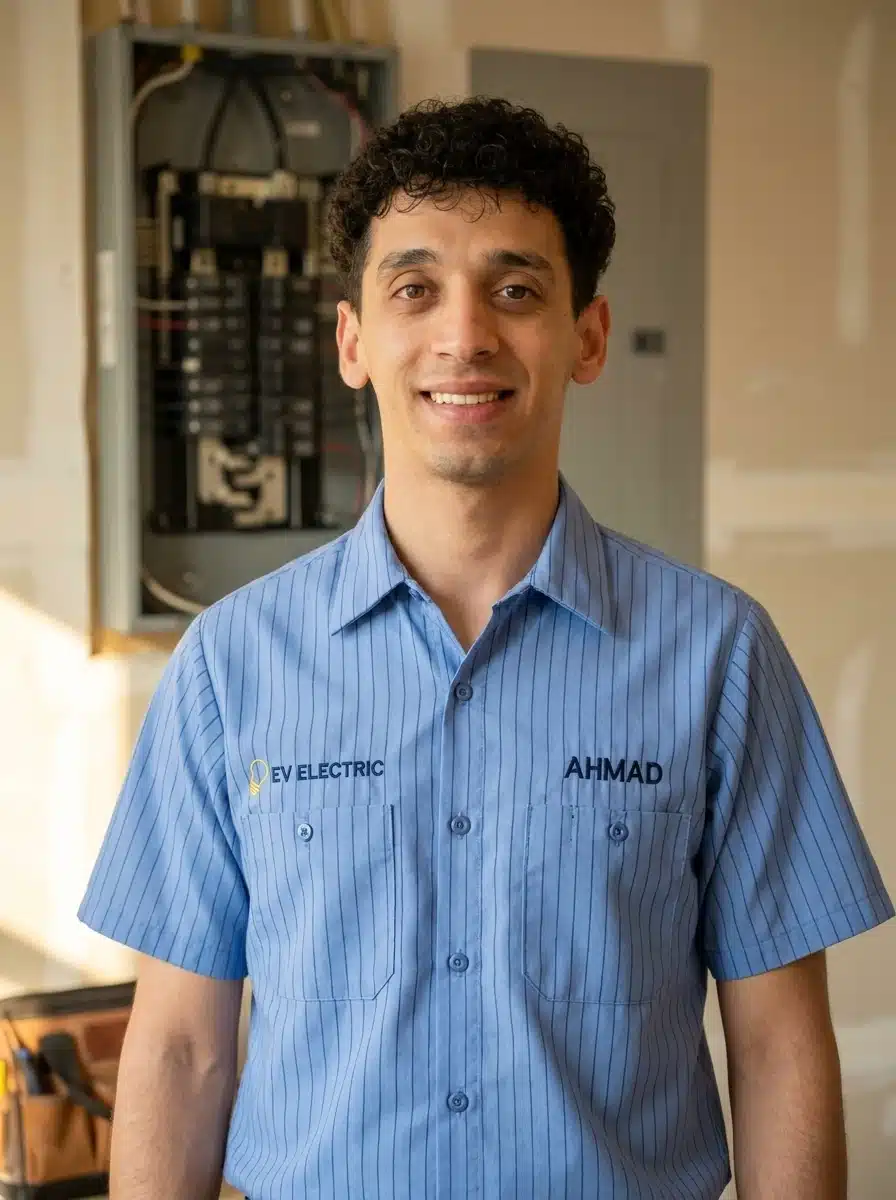
Ahmad Shaban holds a Virginia Master Electrician license — the highest individual credential the Commonwealth issues for electrical work. It takes a minimum of four years of journeyman experience plus a state exam to earn. EV Electric Services is fully insured (general liability and workers’ comp), and Ahmad runs a maintenance crew that handles residential work across Montgomery County, Fairfax County, and the broader DC metro region.
This isn’t a franchise where you get a different tech every visit. Ahmad is the owner and the lead electrician — he’s on the job site for panel upgrades, running the load calc, landing the circuits, and signing off on the work. When you call, you’re talking to the person who’s going to be inside your panel, not a dispatcher routing you to whoever’s available.
EV Electric Services holds a 5.0-star average across 113 customer reviews. Our review base is real, recent, and from Northern Virginia and Montgomery County homeowners. We don’t ghost-write reviews or recycle them across business directories.
Rockville neighborhoods we serve
We cover all of Rockville, MD, including:
- Twinbrook — post-war Cape Cods and ramblers near the Twinbrook Metro station, one of Rockville’s oldest subdivisions
- King Farm — award-winning 1990s–2000s New Urbanist community with townhomes, condos, and single-family homes near Shady Grove
- Fallsgrove — early-2000s planned community with townhomes, courtyard homes, and condos near Shady Grove Road
- Woodley Gardens — Montgomery County’s first pre-planned community — 1960s colonials, split-levels, and ramblers on wooded lots
- College Gardens — 1960s planned residential unit with larger colonials and split-levels west of Rockville Pike
- East Rockville — historic streetcar-suburb neighborhood east of the tracks with early 20th-century and post-war homes
- West End / Town Center — Rockville’s walkable downtown core — mix of historic Victorians, mid-century homes, and newer infill
- Hungerford / Rose Hill Falls — established neighborhoods south of town center with 1950s–1970s housing stock
- Rockville Town Square area — mixed-use redevelopment near the Rockville Metro with condos, apartments, and townhomes
- Luxmanor / Woodmont Country Club area — upscale 1950s–1960s neighborhood with larger lots adjacent to the country club
Outside Rockville, we serve Bethesda, Potomac, Gaithersburg, Kensington, North Bethesda, Silver Spring, and the rest of Montgomery County. Across the river in Virginia, we cover Vienna, Fairfax, McLean, Arlington, Alexandria, and all of Northern Virginia.
Related electrical services in Rockville
A panel upgrade often connects to other electrical work — EV charger installs that need the new capacity, rewiring that pairs with the panel swap, or generators that require a transfer switch on the upgraded panel. Here’s what else we do in Rockville.
Frequently asked questions
How much does an electrical panel upgrade cost in Rockville, MD?
It depends on your service entrance condition, the panel size, breaker count, and whether code-triggered upgrades (like grounding electrode work or meter-base replacement) come along with it. A straightforward 200-amp panel swap in a house with a clean service entrance is a different number than a 60-amp-to-200-amp upgrade that requires a new meter base and feeder run. We give you a written estimate after a diagnostic visit — not a range over the phone. The estimate is the price; there are no add-ons on the work day.
How long does a panel upgrade take?
Most residential panel upgrades finish in one day. The utility cuts power at the meter in the morning. We remove the old panel, install the new one, re-land every circuit, and label them clearly. By afternoon, the utility re-energizes the service, we test every circuit, and walk you through the new panel. Power is typically off for 6–8 hours. If your upgrade includes a service-entrance change or meter-base replacement, it may stretch into a second morning, but we’ll tell you that at the estimate stage — no surprises on the work day.
Do I need a permit for a panel upgrade in Rockville, MD?
Yes. Montgomery County requires a permit for any panel upgrade — no exceptions. The permit must be pulled by a licensed electrician, not the homeowner. After the work is complete, a county inspector visits to verify the installation meets the current National Electrical Code. We handle the permit application, schedule the inspection, and meet the inspector at your house. You don’t talk to the county permit office. The permit protects your homeowner’s insurance and your resale value — unpermitted panel work can void both.
What are the signs I need to upgrade my electrical panel?
The big ones: breakers tripping regularly under normal loads, a fuse box instead of breakers, a Federal Pacific or Zinsco panel (documented fire risks), lights dimming when the AC or fridge kicks on, a burning smell or warm panel cover, or simply running out of space to add circuits. If your home has 60-amp or 100-amp service and you’re adding major loads — EV charger, hot tub, finished basement, kitchen remodel — the panel upgrade usually needs to happen before the new load goes in.
What size panel do I need for my home?
For most single-family homes, 200 amps is the modern standard — it’s been the default for new construction since around 2015 and supports HVAC, a full kitchen, EV charging, and a home office without running short on capacity. Older homes often have 100-amp service, which was adequate in the 1980s but falls short today. Homes with multiple high-draw systems — two HVAC zones, an EV charger, a hot tub, and a workshop — may need 320-amp or 400-amp service. We run a load calculation during the diagnostic visit and tell you exactly what size makes sense for how you actually use the house.
Is my Federal Pacific or Zinsco panel dangerous?
Yes. Federal Pacific Stab-Lok breakers have been shown in independent testing to fail to trip on overcurrent in a significant percentage of cases — meaning the breaker doesn’t do the one job it exists to do. Zinsco panels overheat at the bus-bar connection, melting breaker housings onto the bus. Both brands are considered fire hazards by home inspectors, insurance underwriters, and electrical engineers. If you have one, replacement is the safety call. We can identify the brand on-site in five minutes and give you a written estimate the same visit.
Can my panel handle an EV charger / hot tub / addition?
Maybe — but often not if your panel is 100 amps or less. A Level 2 EV charger draws 40–50 amps continuously, a hot tub draws 40–60 amps, and a major addition adds multiple new branch circuits. On a 100-amp panel that’s already serving your HVAC and kitchen, there’s often no safe headroom for these loads. We run a load calculation to find out — sometimes there’s room, sometimes the panel upgrade needs to happen first. Either way, you know the answer before any equipment gets ordered or installed.
Does upgrading my panel increase my home’s value?
Yes — though the value isn’t always a dollar figure on an appraisal. A modern 200-amp panel with a clean permit and inspection record removes a red flag that home inspectors routinely call out. It makes your home insurable at standard rates (some carriers surcharge or decline homes with FPE/Zinsco panels). And it signals to buyers that the electrical system won’t need immediate work after closing. The upgrade pays for itself most directly when it prevents a deal from falling through over an inspection finding or an insurance requirement.
Ready to upgrade your panel?
Licensed panel upgrades with permit, utility coordination, and inspection — done right the first time in Rockville, MD.
We respond within one business day.