
Electrical Troubleshooting in Annandale, VA
Find the Cause First — Then Fix It
A tripped breaker, a dead outlet, a flickering light — Ahmad Shaban, a Virginia-licensed Master Electrician, diagnoses the actual cause before touching a wire. Residential service across Annandale and central Fairfax County.
Key Takeaways
- Licensed: Master Electrician, Commonwealth of Virginia #2710086216
- Insured: EV Electric Services carries full liability coverage — proof available on request
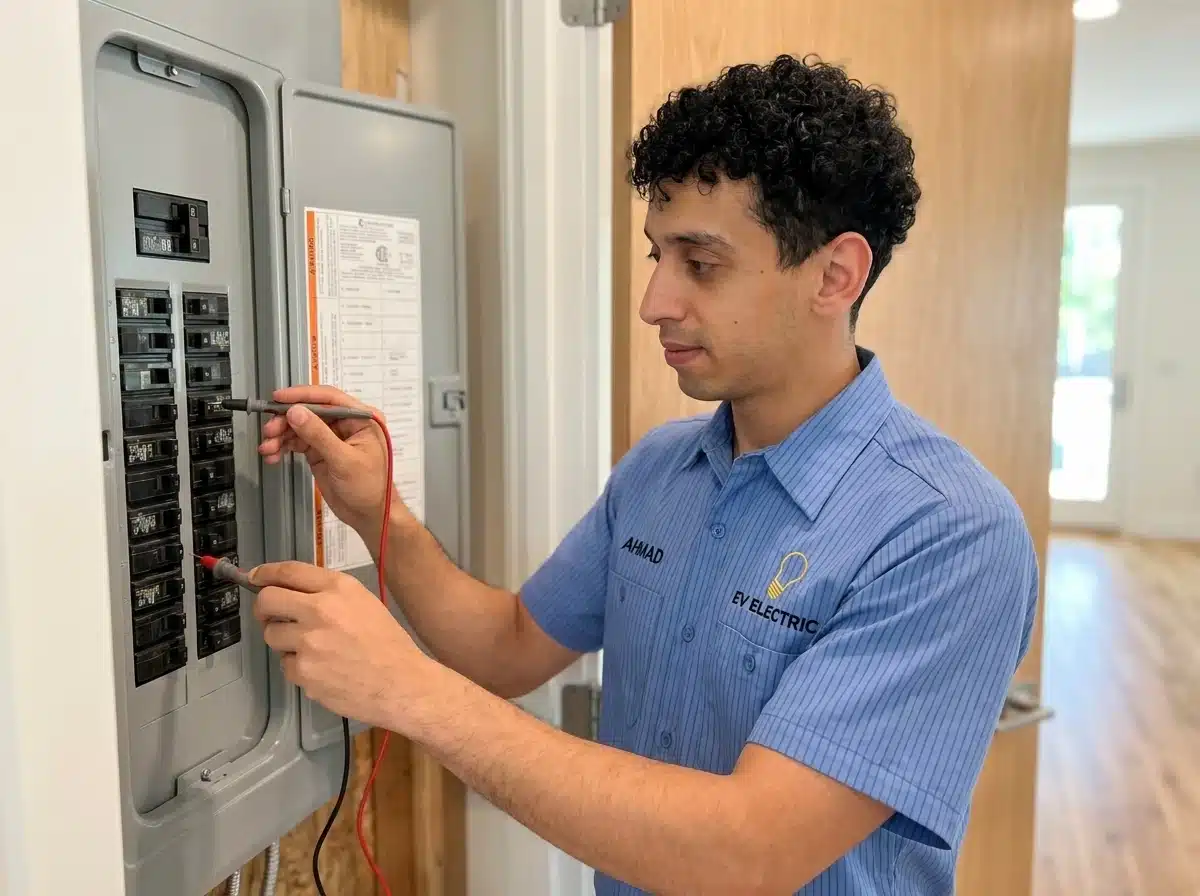
- A real diagnostic, not a guess: multimeter, circuit tracer, and AFCI/GFCI testers — AFCI (arc-fault circuit interrupter) breakers shut off power at the first sign of a dangerous arc, GFCI (ground-fault circuit interrupter) outlets and breakers shut off power when current leaks somewhere it shouldn’t — plus an IR thermal camera when heat is a factor
- No trip fee, free estimates — Ahmad looks at the actual problem before naming a number
- Same-day or next-day appointments in most cases — about 15-20 minutes from our Fairfax Blvd office
- Service area: Annandale and the rest of central Fairfax County
What homeowners in Annandale actually call about
Before we get to what electrical troubleshooting means in the abstract, here’s what Ahmad is actually diagnosing on most Annandale service calls this month. If your issue is on this list, you already know you’re in the right place.
A breaker that won’t stay reset
One trip is the breaker doing its job. A breaker that pops the moment you reset it, or trips two or three times a week, means a short, an overloaded circuit, or a breaker that has simply worn out. We isolate which of the three it is before replacing anything.
Warm outlets or a burning smell
Stop using the circuit and call. This is the one symptom we treat as urgent rather than routine — almost always heat building at a loose connection, and a loose connection behind drywall is how house fires start. We find the exact point of heat with an IR thermal camera.
Outlets that went dead for no reason
Usually a tripped GFCI (ground-fault circuit interrupter — the outlet that shuts off power when it senses current leaking somewhere it shouldn’t) hiding in a garage or bathroom, or a backstabbed connection that finally worked loose behind the wall. We trace the circuit, not guess at it.
Lights that flicker or dim on their own
Voltage drop is the usual cause — a loose neutral connection at the meter base, or a feeder wire that’s degraded. In Annandale’s older ramblers this is frequently tied to a service entrance that has never been touched since the home was built.
A room, or half the house, that lost power
An open neutral at the service entrance can leave one leg of your panel dead while the other still works — and it’s a real hazard to electronics in the house. We test both legs and pin down exactly where the break is.
An aluminum-wired outlet or switch that runs hot
If your Annandale home was built or expanded between the mid-1960s and early 1970s — Canterbury Woods and Truro both sit squarely in this window — there’s a real chance of aluminum branch wiring behind the walls. Aluminum expands and contracts differently than copper, and connections loosen over the years. We check for it directly rather than assuming.
A basement sub-panel from someone else’s finished-basement project
Common in Annandale’s original ramblers, where a finished-basement project decades ago added a sub-panel sized for that era’s load, not today’s. We verify the feeder size and check it against the aluminum-wiring window before calling the panel itself the problem.
The Decade That Explains Most Annandale Service Calls
More than the abstract definition of troubleshooting, the thing worth knowing about Annandale specifically is this: if your home was built or expanded between the mid-1960s and early 1970s — Canterbury Woods and Truro both sit squarely in that window — there’s a real chance of aluminum branch wiring behind the walls, installed nationally during a copper-price spike in that exact stretch. Aluminum expands and contracts differently than copper at outlets, switches, and panel connections, and over 50-plus years those connections work loose. A tripped breaker or a warm switch plate in one of these homes often traces back to that specific construction window, not to whatever the newest work in the house happens to be.
That’s what troubleshooting actually is: the step before the repair, where we find the actual cause instead of guessing at the symptom, whether that cause is a loose neutral, an overloaded circuit, or the aluminum-wiring pattern above. Ahmad Shaban is a Virginia-licensed Master Electrician and the person who shows up at the door — no dispatcher, no rotating crew. He reads the panel, tests the circuits, and explains what he found in plain language before any repair starts.
Annandale’s housing stock — and why it drives so many of these calls
Annandale is an unincorporated community in Fairfax County, Virginia — there’s no separate town government, so Fairfax County is the authority that issues electrical permits here. Dominion Energy is the electric utility and Washington Gas serves the area, same as most of Fairfax County. Annandale sits along Little River Turnpike and Braddock Road, roughly 20-25 minutes from our Fairfax Blvd office.
1950s ramblers and early split-levels
Sleepy Hollow Woods (established 1959), early sections of Wakefield and RavensworthAnnandale’s earliest postwar wave — brick ramblers and the first split-levels, built as Fairfax County’s population exploded after World War II. These homes shipped with 60-amp fuse boxes, sometimes upgraded to 100-amp panels by a later owner, and cloth-insulated copper wiring sized for a refrigerator and a radio, not central air and a home office. Two-prong ungrounded outlets are still standard in unrenovated rooms.
Symptoms: Original 60-amp fuse panels with no spare capacity for a modern kitchen or an EV charger. Cloth-insulated wiring that cracks and crumbles when disturbed behind a wall. Two-prong outlets with no equipment ground, which fails any home inspection.
Mid-1960s to early-1970s split-levels and colonials — the aluminum-wiring window
Canterbury Woods (mid-1960s), Truro (late 1960s-early 1970s), later sections of RavensworthThis is the window worth flagging directly: nationally, copper prices spiked between roughly 1965 and 1973, and a meaningful share of branch-circuit wiring installed in that window nationwide was aluminum rather than copper. Canterbury Woods and Truro were both built exactly in this stretch. Aluminum expands and contracts more than copper at outlets, switches, and panel connections, and over 50-plus years those connections work loose — which shows up as warm cover plates, flickering, or a breaker that won’t stay reset.
Symptoms: Warm switch plates or outlets with no other obvious cause. Flickering that gets worse over the years rather than staying constant. A breaker or outlet that has been “repaired” once already and came back. We check for aluminum branch wiring directly with a panel inspection rather than assuming either way.
1970s expansions, additions, and later infill
Woodburn and Woodburn Village, Camelot, Broyhill Crest, and additions throughout Ravensworth Farm and Ravensworth ParkAnnandale kept growing through the 1970s with additional subdivisions, finished basements, and home additions layered onto the earlier housing stock. Panels in this era are typically 100-150 amp with PVC-insulated copper wiring — a real improvement over the earliest homes, but still undersized for a household running central AC, an electric range, and a couple of EV chargers at once. GFCI protection is inconsistent: present in some kitchens and bathrooms if the room was ever remodeled, absent everywhere else.
Symptoms: Panels maxed out with no open slots for a new circuit. No GFCI protection in older bathrooms or exterior outlets. Patchwork wiring where a 1965 original circuit was extended by a 1985 addition and again by a 2005 basement finish, each with a different wire gauge.
If your home falls into any of these three patterns, a diagnostic visit tells you whether you’re looking at a quick fix, a bigger repair, or a panel upgrade — before you spend money guessing.
The patchwork-wiring problem in homes that have been renovated more than once
A pattern that comes up repeatedly in Annandale — and less often in newer communities — is what happens when a home has been through multiple rounds of renovation over the decades, each one done by a different contractor, each one extending or tapping into the original wiring without a master plan.
A typical example: a 1960s Canterbury Woods split-level with original cloth-insulated copper wiring on the main floor, aluminum branch wiring in a den addition from 1972, PVC-insulated copper from a kitchen remodel in 1995, and a modern Romex run for a basement finish in 2015. Four wire types, four eras of code, four different contractors’ work, all meeting inside one panel — and often no documentation of which circuit feeds what.
This is where intermittent problems live. A breaker that trips only when two specific rooms draw power at the same time. A GFCI that nuisance-trips in the bathroom because it’s sharing a circuit with a garage outlet added 30 years later. Flickering that appears only in winter because thermal contraction tightens a marginal splice that works fine in summer. These aren’t problems you solve by replacing the part that seems broken — they’re problems you solve by mapping the actual circuit layout and finding where the eras collide.
Ahmad carries a circuit tracer specifically for this kind of work. It lets him follow a circuit from the panel through the walls and identify which outlets, switches, and junction boxes are actually on which breaker — without opening drywall. In a home with undocumented patchwork wiring, that map is often the most valuable thing the diagnostic produces, because it tells you not just what’s wrong now but where the next failure is likely to show up.
What happens when you call
Call 571-500-6637 or use the quote form. Five steps, no surprises.
Ahmad picks up — no phone tree, no intake form
You describe the symptom. Ahmad asks follow-up questions most dispatchers wouldn’t think of — whether the problem tracks with your HVAC cycling, whether it showed up after a recent storm, whether the house has ever had aluminum wiring remediated. If what you’re describing sounds like heat at a connection, he’ll walk you through shutting off the right breaker before he arrives.
On-site within a day for most Annandale calls
Our office is on Fairfax Blvd — a straight shot down Little River Turnpike, about 15–20 minutes depending on traffic near the Gallows Road interchange. During business hours, most troubleshooting visits land same-day or the following morning. You get a one-hour arrival window, not an all-afternoon block.
The panel tells the story — Ahmad reads it with you there
In a home that’s been through two or three rounds of work — an original 1960s panel, a circuit added for a kitchen remodel, a sub-panel in the finished basement — the panel layout itself reveals where the weak points are. Ahmad opens it, tests circuits under load with a multimeter and circuit tracer, and uses an IR thermal camera if heat is part of the complaint. You see what he sees.
He explains the cause and the cost before picking up a tool
Ahmad walks you through what the diagnostic found — where the fault is, what caused it, and whether it’s a repair-now situation or something you can schedule on your own timeline. The written estimate is firm. If the job turns out bigger than expected once a wall is open, he stops and re-quotes rather than billing past the number.
Most repairs finish the same visit
Swapping a breaker, replacing a failed GFCI, re-terminating a loose connection — the common fixes happen on the spot with parts Ahmad carries. Panel upgrades, full circuit re-runs, and aluminum-wiring remediation get their own written estimate and a scheduled return. Either way, you leave with a written record of the diagnosis and the work performed.
How estimates work
Annandale’s housing stock spans three construction eras, and the wiring behind the wall could be cloth-insulated copper, aluminum, or modern Romex depending on when that part of the home was built or renovated. That’s why we don’t quote troubleshooting over the phone — a guess isn’t an estimate. Ahmad comes to the house, runs the diagnostic, and hands you a written number based on what he actually found. No trip fee, free estimates.
- Troubleshooting visit (diagnostic + minor repair). Most visits run 1–2 hours: Ahmad traces the fault, identifies the cause, and handles common fixes on the spot — a replacement breaker, a new GFCI, a connection that needs re-terminating. The estimate covers parts and labor and is written before any repair starts.
- Diagnostic only, repair later. If you’d rather get the answer first and schedule the fix separately, that works too. Ahmad diagnoses, writes the estimate, and you pick the date.
- Panel upgrades, circuit re-runs, and aluminum-wiring remediation. Bigger jobs — including the full-panel upgrades that many Annandale ramblers eventually need — are quoted separately, in writing, before any work begins.
- After-hours visits on request. Most calls don’t need one. If yours is genuinely urgent, mention it when you call and we’ll work it out.
About Ahmad Shaban, Master Electrician
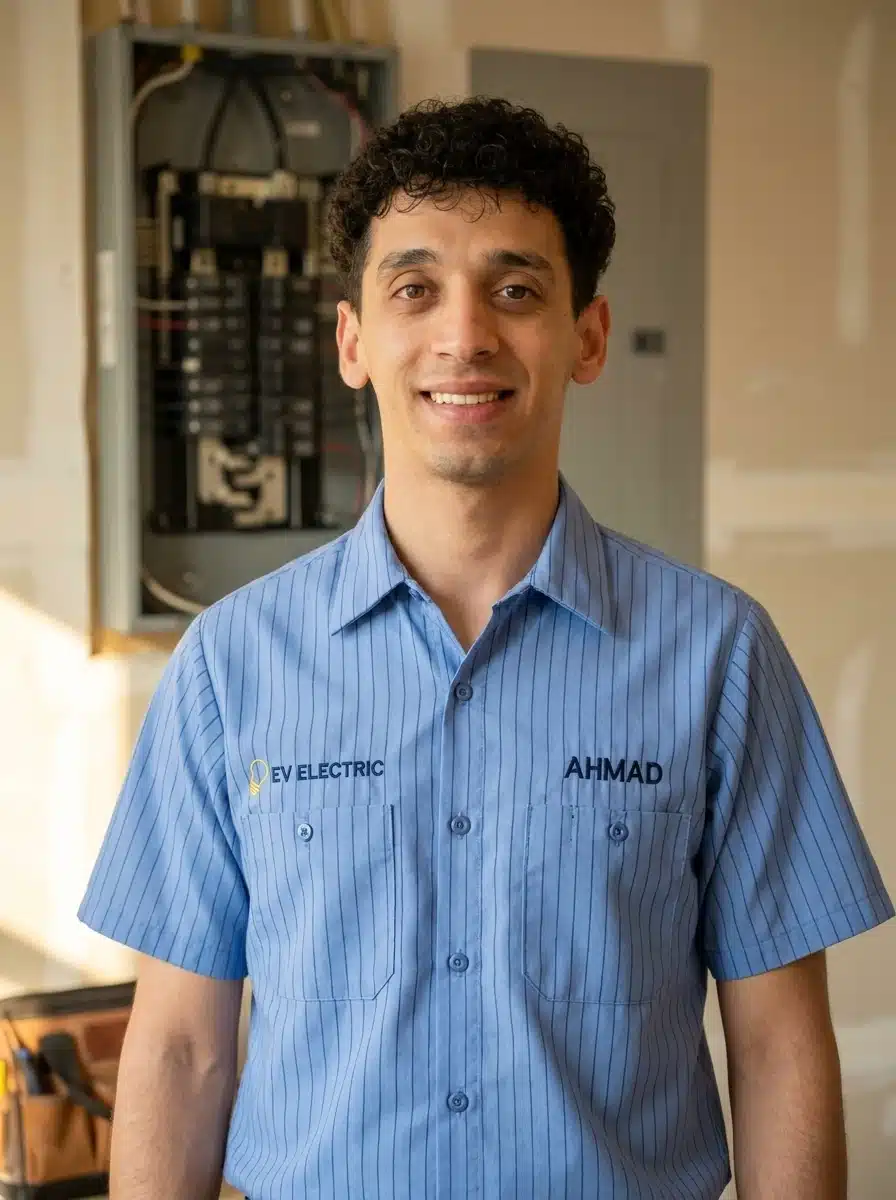
Troubleshooting in Annandale means reading panels that have been touched by two or three different contractors over 60 years — an original fuse box swapped for a 100-amp panel in the 1980s, a sub-panel added for a basement finish in the 2000s, none of it documented. That kind of layered history is where Ahmad Shaban’s experience matters most. He holds the credential Master Electrician, Commonwealth of Virginia #2710086216 — the state’s highest electrician license, earned after years of journeyman work and a state exam. He spent roughly four years working toward the license before opening EV Electric Services, and the business is fully insured.
When you book a troubleshooting call in Annandale, Ahmad is the person who arrives — not a crew, not a subcontractor he’s sending in his place. He’s the one opening the panel, running the circuit tracer, and telling you in plain language what he found and what it will cost to fix. One person, start to finish, for every visit.
EV Electric Services holds a 5.0-star average across 113 Google reviews. The review base is real and recent, from Northern Virginia and Montgomery County homeowners — nothing recycled or ghost-written.
Annandale-area neighborhoods we serve
We cover all of Annandale, VA, including:
- Canterbury Woods — 1960s split-levels, colonials, and ramblers near Wakefield Park — inside the aluminum-branch-wiring construction window
- Sleepy Hollow Woods — established 1959; mid-century ramblers and split-levels with clean, original rooflines
- Truro — larger executive-style homes from the late 1960s and early 1970s
- Wakefield — commuter-favored area near I-495 and Little River Turnpike
- Ravensworth, Ravensworth Farm & Ravensworth Park — multigenerational neighborhoods with deep roots and community-pool amenities
- Broyhill Crest — close to Columbia Pike, popular with Pentagon and Arlington commuters
- Camelot — larger homes near Inova Fairfax Hospital and Gallows Road
- Woodburn & Woodburn Village — a mix of condos, townhomes, and single-family homes near local employment hubs
- Wakefield Chapel — an established residential pocket off Wakefield Chapel Road
- Winterset, Ravensworth Grove, Wynfield & Strathmeade — additional established subdivisions throughout the Annandale area
Outside Annandale, we serve nearby Burke, Oakton, and Falls Church, plus Vienna, Fairfax, and the rest of central and northern Fairfax County, Arlington, Montgomery County MD, and Washington, DC.
Related electrical services in Annandale
Troubleshooting is the front door. If your diagnosis points to a larger repair, here’s what comes next:
Frequently asked questions
How does pricing work for electrical troubleshooting in Annandale, VA?
Ahmad comes to the house, looks at the actual problem, and gives a written estimate before any repair starts. No trip fee, free estimates. Diagnostic visits include most minor on-the-spot repairs; larger repairs get a separate written estimate.
How quickly can you come out to Annandale?
Same-day or next-day in most cases during weekday business hours. Annandale is about 15-20 minutes from our Fairfax Blvd office. If your situation is urgent — burning smell, sparking, warm walls — you’ll be triaged to the earliest available slot.
What’s included in a troubleshooting visit?
A real diagnostic: multimeter, circuit tracer, AFCI/GFCI tester, and an IR thermal camera if heat is suspected. Ahmad opens the panel, tests circuits under load, traces the fault to its source, and explains what he found before touching a wire to repair it.
Do you check for aluminum wiring?
Yes — it’s a direct question for homes in Canterbury Woods, Truro, and other neighborhoods built between the mid-1960s and early 1970s, which is the era aluminum branch wiring was more commonly installed nationally. We inspect for it rather than assume it’s present or absent.
When should I call an electrician instead of trying to fix it myself?
Call if you smell burning, see sparking, feel warm walls or switch plates, have a breaker that trips daily, or lose power to part of the house with no clear cause. Resetting a breaker once is fine. Resetting it three times in a row is a fire risk, not a DIY project.
Are you licensed and insured?
Yes. Ahmad’s license is Master Electrician, Commonwealth of Virginia #2710086216 — the state’s highest electrician credential — and EV Electric Services is fully insured. Proof is available on request before work begins.
Do you offer 24/7 emergency service?
We offer after-hours service on request, but we don’t market ourselves as a 24/7 emergency operation. Most troubleshooting is fastest handled by booking the earliest available weekday or weekend slot. If you have a genuine emergency — sparks, burning smell, fire risk — call 571-500-6637 and you’ll be triaged immediately.
Ready to get your problem diagnosed?
Electrical troubleshooting across Annandale — Canterbury Woods to Ravensworth, Broyhill Crest to Woodburn.
Most appointments land within one business day.