
Panel Upgrades in Tysons, VA
Panel Upgrades in Tysons, VA — Condos, Townhomes, and Single-Family Homes
Ahmad Shaban — Virginia Master Electrician — handles condo utility-closet upgrades with HOA coordination and single-family service upgrades with outdoor disconnects. Fairfax County permits included.
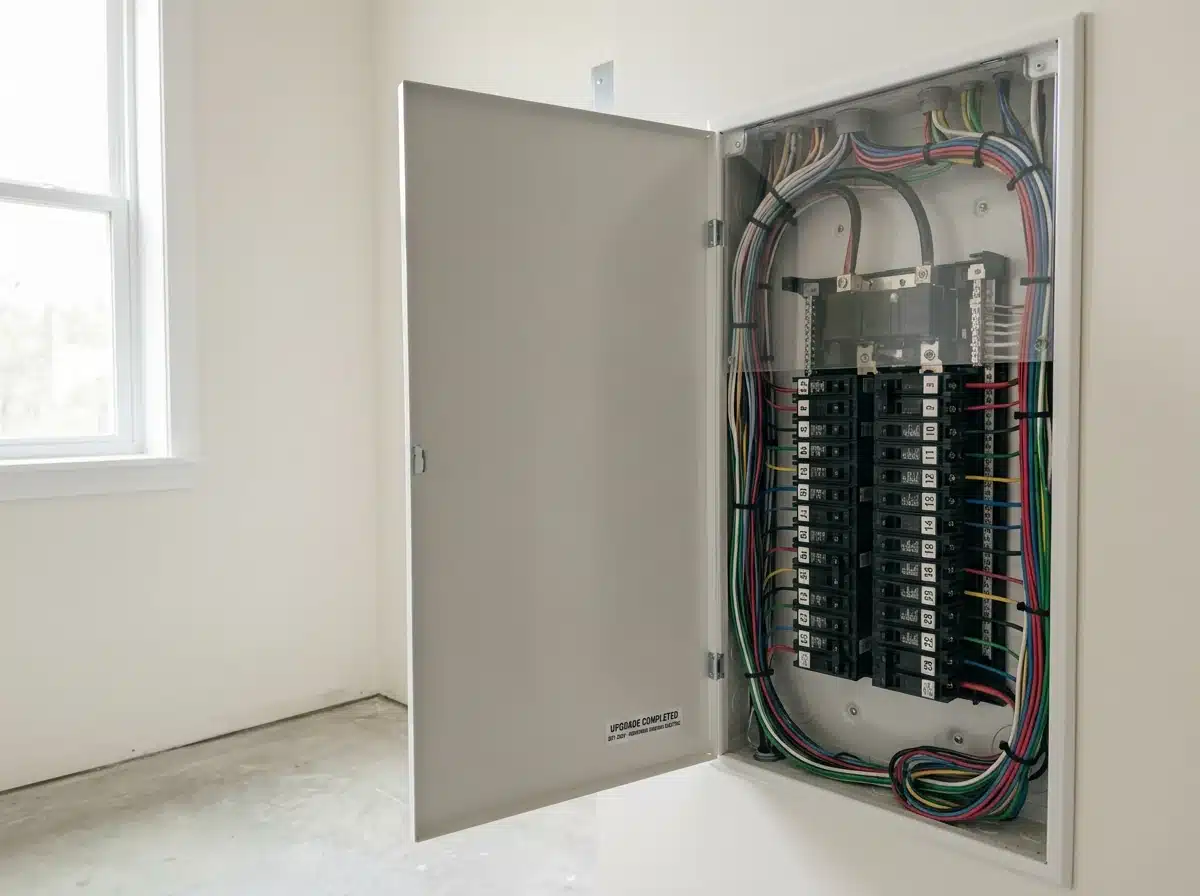
Are you in a condo or a house?
The scope of a panel upgrade in Tysons depends on your building type. The permit authority is the same — Fairfax County — but the physical work, coordination, and code requirements differ.
Condo Panel Upgrade
Upgrading a panel in a Tysons condo? The panel is in a utility closet inside your unit. You need HOA approval before work starts, building management schedules the power-down window, and the permit goes through Fairfax County LDS. EV handles the coordination.
- Utility-closet panel replacement
- HOA written approval required first
- Building management power-down coordination
- Whole-home surge protection (NEC 230.67)
- Fairfax County ELER permit via PLUS portal
House or Townhome Panel Upgrade
Upgrading a panel in a Tysons house or townhome? The scope includes an outdoor emergency disconnect (NEC 230.85), whole-home surge protection (NEC 230.67), and Dominion meter-base coordination. Same Fairfax County ELER permit, different physical scope.
- Outdoor emergency disconnect (NEC 230.85)
- Whole-home surge protection (NEC 230.67)
- Dominion Energy meter-base coordination
- Service entrance conductor upgrade if needed
- Fairfax County ELER permit via PLUS portal
What a code-complete panel upgrade includes in Tysons — and what drives the cost
A code-complete panel upgrade in Tysons today includes more than the panel itself. For single-family homes: outdoor emergency disconnect (NEC 230.85), whole-home surge protection (NEC 230.67), Fairfax County ELER permit, and Dominion meter-base coordination. For condos: surge protection, ELER permit, and HOA coordination.
If a quote you received does not include these code-required items, it is either not code-complete or those items will appear as add-ons later. We include them in the written estimate upfront — no surprise line items.
Call 571-500-6637 for a free written estimate — we assess the panel on-site before quoting.
FPE Stab-Lok panels in Pimmit Hills and Idylwood — your insurer may be requiring this
Federal Pacific Stab-Lok panels are documented fire risks — independent testing shows their breakers can fail to trip on overload. Most insurers now refuse to write or will cancel policies on homes with these panels. In Tysons’ 1960s–1970s single-family stock — particularly in Pimmit Hills and Idylwood — FPE panels are common.
If your insurer has flagged your panel, or a home-sale inspection identified an FPE unit, here is what the process looks like and why a code-complete replacement matters.
Call 571-500-6637 for a Same-Day AssessmentTysons panel upgrades by building type
Tysons is the only Northern Virginia community with a true urban condo/SFH housing mix. Four distinct building types create four different panel upgrade scenarios.
Mid-rise and high-rise condos
Tysons Corner Center area, The Boro, Spring Hill2000s–2020s construction with utility-closet panels. Many units have 100A service that was adequate at build-out but has no headroom for a Level 2 EV charger or modern appliance loads. HOA coordination is required before any work begins.
Scenario: A 2005 mid-rise condo near Tysons Corner Center — owner adding Level 2 EV charger; 100A unit panel with no headroom; upgraded to 150A, coordinated with building management for the power-down window and Fairfax County for the ELER permit.
1960s–1970s single-family homes
Rotonda, Pimmit Hills, IdylwoodOriginal 100A panels sized for mid-century loads. FPE Stab-Lok panels are common in this era — documented fire risks that trigger insurance denial or cancellation. Full service upgrade to 200A with outdoor disconnect and surge protection.
Scenario: A 1968 ranch in Pimmit Hills — insurer flagged FPE Stab-Lok; upgraded to 200A, added outdoor emergency disconnect (NEC 230.85) and whole-home surge protection (NEC 230.67). Dominion meter-base coordinated.
1990s–2010s townhomes
Spring Hill, Tysons Galleria area200A service was standard, but GFCI gaps from pre-2008 code and EV-charger load demands are the common triggers. Many townhome garages lack the circuit capacity for a Level 2 charger without a sub-panel addition.
Scenario: A 2003 townhome near Spring Hill — no headroom for Level 2 EV charger on existing panel; added 60A sub-panel in garage, dedicated 50A circuit for charger, Fairfax County ELER permit pulled.
2010s+ luxury condos
The Boro, newer Spring Hill developmentsModern 200A service with AFCI breakers and smart-home wiring. Failure modes skew toward nuisance AFCI trips from smart-home device harmonics, bonded-neutral errors from prior-owner DIY installs, and EV-charger circuits added without a load calculation.
Scenario: A 2018 luxury unit in The Boro — AFCI breaker nuisance-tripping on smart-home circuit; diagnosed as harmonic interference, not a genuine arc fault. Breaker replacement, not a full panel swap.
How a condo panel upgrade works in Tysons — 7 steps
No competitor in Tysons publishes a condo-specific panel upgrade process. Here is exactly how it works when your panel is in a utility closet and you need HOA coordination.
- Contact HOA or property management — get written approval for the panel replacement. EV can provide the scope-of-work letter your HOA needs to issue approval.
- Schedule utility-closet assessment with EV — Ahmad inspects the panel, measures the load, and provides a written estimate. The assessment confirms whether the panel is in a utility closet, electrical room, or in-unit location.
- EV pulls the Fairfax County ELER permit — filed through the PLUS portal. Tysons is unincorporated Fairfax County — single permit authority, no town layer.
- Building management lockout and coordination — the building schedules the power-down window. EV coordinates the timing so the outage is contained to the approved window.
- Panel replacement in the utility closet — new panel installed, whole-home surge protection added (NEC 230.67), circuits reorganized and labeled.
- Dominion service restoration — power restored through Dominion Energy coordination. Service verified before EV leaves.
- County inspection + HOA sign-off — Fairfax County inspector verifies the work. EV provides completion documentation for your HOA file.
For single-family homes and townhomes: Steps 1 and 4 (HOA approval and building management lockout) are replaced by outdoor emergency disconnect installation (NEC 230.85) and direct Dominion meter-base coordination. The permit, inspection, and surge protection steps are the same.
Eight panel scenarios we see in Tysons
Each scenario describes a real scope of work. The neighborhoods and building types named are where we see each one most often.
Condo 100A to 150/200A
Tysons Corner Center area, Rotonda condos — utility-closet panel with no headroom for EV charger or modern appliance load. HOA coordination, surge protection, Fairfax County ELER permit.
SFH 100A to 200A
Pimmit Hills, Idylwood — original 100-amp panels on 1960s–70s homes. Full service upgrade with outdoor disconnect (NEC 230.85), surge (NEC 230.67), and Dominion coordination.
FPE Stab-Lok replacement
Pimmit Hills — insurer flagged the Federal Pacific panel. Full removal, modern 200A panel, all code-required adders. Documentation provided for your insurance carrier.
Zinsco replacement
Same 1960s–70s era stock. Zinsco breakers can fuse to the bus and fail to trip — same insurance pressure, same replacement scope as FPE. Full panel replacement required.
Condo EV sub-panel
The Boro, Spring Hill condos — unit panel has no headroom for a 40A or 50A EV charger circuit. Sub-panel addition in parking-level utility area, coordinated with HOA and building management.
Townhome load expansion
Tysons Galleria area townhomes — 200A panel with no spare capacity for EV charger plus heat pump. Load calculation, garage sub-panel, dedicated circuit. EV charger details.
Pre-sale inspection flag
All Tysons building types — home inspector flags panel brand, age, or capacity. Code-complete replacement before listing removes the buyer objection and keeps the sale timeline on track.
Smart-home / AFCI correction
The Boro, newer Spring Hill — AFCI breaker nuisance trips from smart-home device harmonics or bonded-neutral errors. Diagnostic first; panel swap only if the breaker panel itself is the root cause.
Permitting in Tysons — same County office, different scope by building type
Despite its urban character, Tysons is not an incorporated city. Every parcel here falls under Fairfax County, so the permit path is identical for a condo tower on Route 7 and a ranch in Pimmit Hills — the scope just differs.
The permit authority
Fairfax County LDS processes every residential electrical permit in Tysons — condos, townhomes, and detached houses alike. We submit the ELER application through the County’s PLUS system (plus.fairfaxcounty.gov) so the homeowner never touches the portal.
- County phone: 703-222-0801
- Government Center: 12055 Government Center Pkwy, Fairfax 22035
- Permit class: ELER — residential electrical trade (no architectural plans needed for standard panel work)
How the code differs for condos vs houses
The 2020 NEC (statewide via the 2021 VA USBC) added two items that change the scope depending on building type:
- Outdoor disconnect (NEC 230.85): mandatory for houses and townhomes. In condo towers, the building’s service entrance has its own disconnect provisions — the County inspector assesses unit-level applicability case-by-case
- Surge protector (NEC 230.67): mandatory on every panel replacement regardless of building type — condos included
- Dominion Energy serves Tysons (not Pepco). Meter-pull coordination goes through Dominion for both condos and houses
For condos: the permit is the same ELER filing, but we also handle the HOA coordination letter and the building management lockout scheduling before work begins. For houses: we add the outdoor disconnect and schedule the Dominion meter pull. Either way, you approve the estimate and we manage every step from filing through final inspection.
Two estimate structures — because condos and houses are different jobs
A condo utility-closet swap and a single-family service conversion look nothing alike on paper. We write separate estimate templates for each so every line item matches your actual scope — not a generic “panel upgrade” number.
- House or townhome scope: breaker panel, meter base, service conductors, outdoor disconnect (code-required since 2020 NEC), surge protector (also code-required), County ELER filing, Dominion meter-pull scheduling, and the post-install inspection. Everything on one estimate — nothing appears as an invoice surprise.
- Condo scope: utility-closet panel replacement, surge protector, the HOA approval letter we draft for you, the building management lockout window we coordinate, County ELER filing, and inspection. No outdoor disconnect in most configurations — the building’s service entrance handles that differently.
- Sub-panel (either building type): a dedicated 60A–100A panel for EV charger headroom or workshop feeds. Separate load calc, separate ELER permit. In condos, the HOA coordination is folded in.
Can you DIY a panel upgrade?
Safe to handle yourself
- Resetting a tripped breaker
- Labeling your panel directory
- Testing GFCI outlets with the built-in test button
Call a licensed electrician
- Any panel replacement or service upgrade — requires a Fairfax County ELER permit and licensed contractor
- Any work inside the panel enclosure — live bus bars, lethal voltage
- Condo panel work — also requires HOA approval and building management coordination
- Dominion meter-base coordination — only a licensed contractor can schedule the meter pull
On-site assessments from Fairfax Circle — typically same morning
Our shop is at 9488 Fairfax Blvd, near Fairfax Circle. Tysons is approximately 15 minutes north via Route 123 or I-495. The Silver Line Metro runs through Tysons with stops at Tysons Corner and Spring Hill stations — we mention this because it orients you to where we serve, not because we take the Metro to your panel.
Drive times from our shop
- Tysons Corner Center area ~15 min
- Spring Hill ~14 min
- The Boro ~15 min
- Rotonda ~13 min
- Pimmit Hills ~16 min
- Idylwood ~14 min
- Tysons Galleria area ~15 min
- Wolf Trap area ~12 min
A local master electrician, not a franchise from Williamsburg or a regional call center. Buttner Electric, currently ranking for Tysons panel searches, is based in Williamsburg — over 100 miles away. Ahmad’s shop is on the Route 123 corridor, 15 minutes from Tysons. When you call for a panel assessment, we can usually be on-site that same morning.
On-site load assessment + written estimate — we drive to Tysons, inspect the panel, measure the load, and hand you a written estimate before any work begins. The assessment trip is free.
When Tysons panels fail — seasonal patterns
Summer: Central AC plus condo HVAC systems on 100A panels push undersized service to the limit. Condo buildings with shared electrical infrastructure see the highest demand in July and August — if your unit panel is undersized, that is when it trips.
Winter: Electric heaters, EV chargers on evening schedules, and heat pumps on townhomes combine for peak evening loads. A 200A panel with poor load distribution trips when the EV charger, heat pump, and dryer run simultaneously.
Both seasons expose the same root cause: a panel sized for a load profile that no longer exists. The best time to upgrade is before the season that stresses your system — not during the outage.
Your electrician: Ahmad Shaban
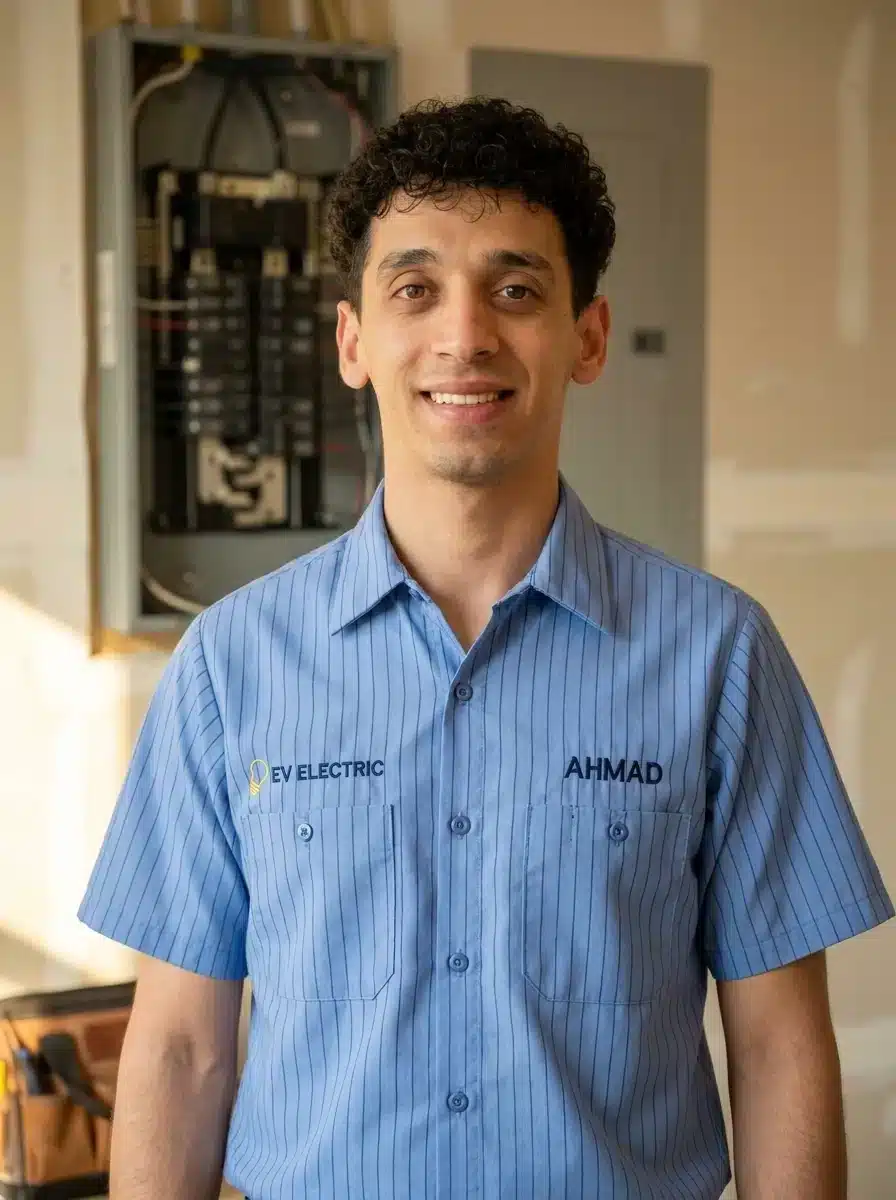
Ahmad Shaban — Virginia Master Electrician. He is equally comfortable assessing a utility-closet panel on the 12th floor of a Spring Hill condo tower and a weathered FPE panel in a Pimmit Hills ranch basement. That range of building types is what sets Tysons apart from the rest of our service area, and it is why Ahmad handles most Tysons assessments personally. Crew and insurance back every job.
5.0-star average across 113 Google reviews from Northern Virginia homeowners. We work on houses and condos — no commercial or industrial contracts sharing the schedule.
Tysons neighborhoods and areas we serve for panel upgrades
Tysons is unincorporated Fairfax County — all neighborhoods and buildings permit through Fairfax County LDS. We serve every Tysons area, including:
- Tysons Corner Center area — mid-rise and high-rise condos; 2000s–2020s construction; utility-closet panel upgrades with HOA coordination
- Spring Hill — mixed condos and townhomes near the Silver Line Metro station; EV charger sub-panels and load expansion
- The Boro — newer luxury condos; modern 200A panels; AFCI diagnostics and smart-home circuit corrections
- Rotonda — 1960s–70s condos and SFH; 100A panels; FPE and Zinsco replacement territory
- Tysons Galleria area — 1990s–2010s townhomes; GFCI gaps and EV charger load expansion
- Pimmit Hills — 1960s SFH stock; FPE Stab-Lok panels; insurance-driven replacements
- Idylwood — similar era to Pimmit Hills; 100A panels on 1960s–70s homes
- Wolf Trap area — estate-era SFH; 100A to 200A service upgrades
Related electrical services in Tysons
A panel upgrade is often the starting point. These are the services Tysons homeowners and condo owners commonly pair with or discover during the assessment:
Frequently asked questions — panel upgrades in Tysons
How much does a panel upgrade cost in Tysons?
A code-complete panel upgrade in Tysons includes the panel, surge protection (NEC 230.67), Fairfax County ELER permit, and inspection. For SFH, add outdoor emergency disconnect (NEC 230.85) and Dominion coordination. For condos, add HOA coordination. Call 571-500-6637 for a free written estimate.
How much does a condo panel upgrade cost?
A condo panel upgrade in Tysons includes the utility-closet panel replacement, surge protection, HOA coordination letter, building management lockout scheduling, Fairfax County ELER permit, and inspection. The scope is different from a single-family upgrade — no outdoor disconnect needed in most condo units. We assess on-site before quoting.
Can I upgrade my electrical panel without rewiring my house?
In most cases, yes. A panel upgrade replaces the panel and service entrance — it does not require rewiring branch circuits. The existing wiring connects to the new panel. If branch wiring has a separate issue (aluminum connections, damaged insulation), that is a different scope identified during the assessment.
How much does it cost to upgrade from 100 amp to 200 amp?
A 100-to-200-amp service upgrade is the most common scope in Tysons’ 1960s–70s SFH neighborhoods (Pimmit Hills, Idylwood). The cost includes the panel, service entrance conductors, outdoor disconnect, surge protector, permit, and Dominion coordination. We provide a written estimate after an on-site assessment.
Is upgrading your electrical panel worth it?
If your insurer is requiring it (FPE or Zinsco), it is not optional — the alternative is losing coverage. If your panel is undersized for your current loads (EV charger, AC, heat pump), an upgrade prevents chronic tripping. If you are selling, it removes a common buyer objection. In condos, it enables EV charger installation.
Do I need HOA approval for a condo panel upgrade?
Yes. Even though the panel is inside your unit, the work requires a building-wide power-down window coordinated by building management. Most Tysons HOAs require written approval before any electrical work that affects shared infrastructure. EV provides the scope-of-work letter your HOA needs.
Do I need a permit in Fairfax County?
Yes. Tysons is unincorporated Fairfax County. All electrical panel work requires an ELER trade permit through Fairfax County Land Development Services. EV Electric pulls the permit through the PLUS portal and coordinates the inspection. You do not navigate the permit system yourself.
What is an FPE Stab-Lok panel and why does my insurer care?
Federal Pacific Electric (FPE) Stab-Lok breakers have been shown in independent testing to fail to trip on overload — meaning they may not protect the circuit during a fault. Most insurers consider FPE a documented fire risk and refuse to write or renew policies. Replacing the panel clears the underwriting requirement.
Get a written estimate — same-day assessments in Tysons
On-site assessment, code-complete scope, written estimate before any work starts. Serving condos, townhomes, and single-family homes across Tysons — Tysons Corner Center, Spring Hill, The Boro, Rotonda, Pimmit Hills, Idylwood, and Wolf Trap.
571-500-6637