
Electrical Troubleshooting in Falls Church, VA
“Falls Church” Is Really Three Jurisdictions — We Know Which Applies
The independent City of Falls Church, the surrounding Fairfax County area, and a slice of Arlington County all carry a “Falls Church” address. Ahmad Shaban, a Virginia-licensed Master Electrician, diagnoses the problem and handles whichever permitting authority your address falls under.
Key Takeaways
- Licensed: Master Electrician, Commonwealth of Virginia #2710086216
- Insured: Fully insured for residential electrical work across all three local jurisdictions
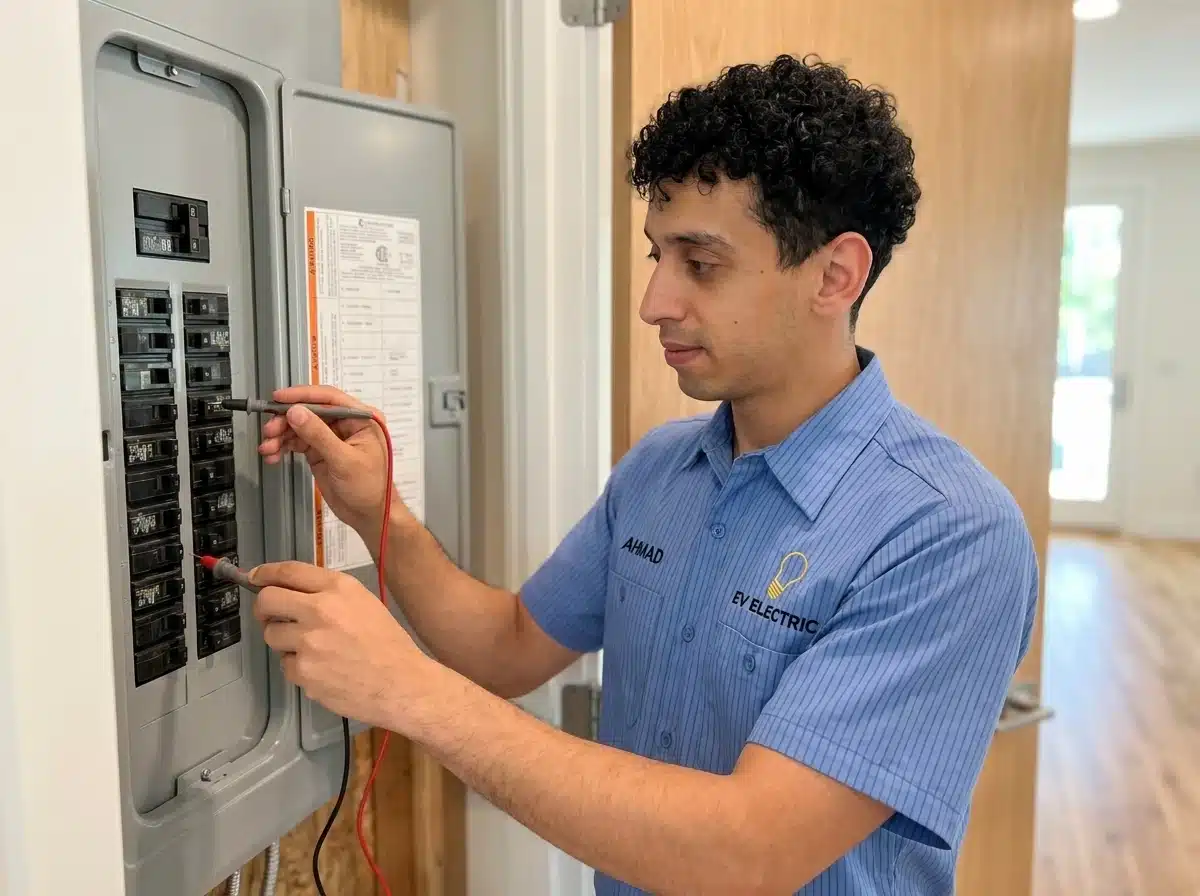
- Every visit gets a real diagnostic: multimeter, circuit tracer, an IR thermal camera when heat is involved, and testing for AFCI (the breaker that shuts off power at the first sign of a dangerous arc) and GFCI (the outlet or breaker that shuts off power when it senses a current leak)
- No trip fee, free estimates — including whichever jurisdiction’s permit fee applies
- Same-day or next-day appointments in most cases — about 10-20 minutes from our Fairfax Blvd office
- Service area: the City of Falls Church, Pimmit Hills, and the surrounding Fairfax/Arlington area
Why “Falls Church” isn’t just one place
This is worth explaining upfront, because it genuinely affects who handles your permit: a “Falls Church, VA” mailing address can mean one of three different jurisdictions. The independent City of Falls Church is its own small city (about 2 square miles, incorporated 1948) with its own Department of Code Administration (703-248-5080, permits@fallschurchva.gov) — completely separate from Fairfax County. A much larger surrounding area — including Pimmit Hills and the West Falls Church CDP — carries a Falls Church mailing address but is actually unincorporated Fairfax County, permitted through Fairfax County Land Development Services. And a third slice — East Falls Church and Madison Manor — carries a Falls Church-adjacent identity but sits in Arlington County, with its own inspections office. We work across all three; we just make sure we’re filing with the right one.
Troubleshooting itself works the same everywhere: it’s the diagnostic step where we find the actual cause of a symptom before repairing anything. Ahmad Shaban is a Virginia-licensed Master Electrician and the one who shows up — no dispatcher, no rotating crew. He reads the panel, tests the circuits, and explains what he found before any repair starts.
Specific problems we diagnose every week in the Falls Church area
Here’s what Ahmad gets called about most often across this area. If your situation matches one of these, you’re in the right place.
Breaker trips and won’t reset
A single trip is the breaker doing what it’s designed to do. When the same breaker trips every time you run the microwave and the AC together — or won’t latch at all — that’s either a short somewhere downstream, a circuit carrying more load than its wire gauge supports, or a breaker whose internal mechanism has worn out after decades of service. Ahmad tests all three before swapping anything.
A Federal Pacific or Zinsco panel in a 1930s-1950s home
Pimmit Hills’ original 1950s ramblers and Broadmont’s 1930s-1950s Cape Cods and split-levels are the neighborhoods where we most often find these documented fire-hazard panel brands. If yours carries either logo, it’s worth a direct inspection.
One room’s outlets go dead, the rest of the house is fine
Almost always a tripped GFCI you don’t know is on the circuit, or a backstabbed connection that let go behind the wall. In Broadmont and Greenway Downs, where a lot of the wiring dates to a 1970s-80s update rather than the original 1920s-40s build, we check that update work first before assuming it’s the older wiring underneath.
Flickering lights when the AC or fridge cycles
Points to voltage drop — commonly a loose neutral at the meter base, and in Falls Church’s older sections, sometimes an aging Dominion service connection that hasn’t been touched since the home was built.
Warm switch plates or a burning smell
Don’t wait on this one. A switch plate that’s warm to the touch means current is generating heat where it shouldn’t — typically a wire that’s worked loose from its terminal inside the box. Ahmad brings an IR thermal camera to pinpoint the hot spot without opening every plate on the circuit.
EV charger circuit issues
In this area’s established postwar neighborhoods, EV charging puts continuous high-amp draw on circuits that weren’t sized for it. See our EV charger installation page for permanent solutions.
A panel that’s undersized for a newer teardown-rebuild
The area’s proximity to DC and Metro access has driven real teardown-rebuild activity. A modern panel fed by a utility service drop still sized for the smaller original home is a common finding.
The housing stock behind the three jurisdictions
Dominion Energy is the electric utility and Washington Gas serves the whole area, regardless of which of the three jurisdictions your address falls in. We’re about 10-20 minutes from our Fairfax Blvd office depending on which part of the area you’re in.
Late-1920s to 1940s first-wave homes
Greenway Downs (platted late 1920s, built out through the 1940s)The area’s earliest residential growth, inside the City of Falls Church. These homes commonly started on knob-and-tube wiring and fused service well under 100 amps, sized for a radio and a few ceiling lights. Many have gone through a panel upgrade since, but remnants of the original wiring can still turn up during a renovation.
Symptoms: Knob-and-tube remnants in unrenovated sections. Two-prong ungrounded outlets with no equipment ground. Original service entrance cables undersized for today’s loads.
1930s-1950s Cape Cods, split-levels & ramblers
Broadmont, Cherry Hill, Jefferson Village, Hillwood (City of Falls Church, built 1930s-1950s)A mix of Cape Cods, split-levels, ramblers, and some Victorians inside the City of Falls Church. Jefferson Village and Hillwood share the same construction era as Broadmont and Cherry Hill — homes built for families who chose Falls Church for its schools and small-city character, and whose owners have generally invested in upkeep and renovation over the decades. This is the era where we most often find original Federal Pacific or Zinsco panels — both manufactured through this period and both documented today as carrying elevated fire-hazard risk.
Symptoms: Federal Pacific or Zinsco panels still in service decades past when the brands were discontinued over safety concerns. 60-100 amp panels with no room for a modern kitchen or an EV charger. Cloth-insulated wiring cracking with age in unrenovated sections.
1950-1958 postwar veteran housing — Pimmit Hills
Pimmit Hills (unincorporated Fairfax County, built 1950-1958 for WWII and Korean War veterans)Roughly 1,675 small ramblers — originally about 833 square feet, 3 bedrooms, 1 bath — built starting in 1950 across 663 acres. Original electrical service was minimal even by the standards of the era. Decades of additions, second stories, and finished basements have since been layered onto these small original panels, often without a matching service upgrade.
Symptoms: Original small-service panels overwhelmed by decades of additions — a second story, a finished basement, and now an EV charger, all sharing a service sized for a 1950s starter rambler. Sub-panels added during renovations with grounding or bonding that was never verified. Aluminum branch wiring in any later-1960s additions to these original homes.
1960s-1970s mid-century stock
Winter Hill, Virginia Village, South Falls Church (City and Fairfax County overlap)The next wave of construction brought standard 100-amp panels — an improvement over the earlier era’s 60-amp service, but still undersized for today’s loads. This is also the window where FPE Stab-Lok (a Federal Pacific breaker design with a documented history of failing to trip under fault conditions) panels were commonly installed. Homes in Winter Hill and Virginia Village that haven’t been renovated since construction often still carry these original panels, and some mid-1970s additions used aluminum branch wiring — a material that requires specific connection techniques to remain safe.
Symptoms: 100-amp panels at capacity after kitchen or bathroom renovations. FPE Stab-Lok breakers that don’t trip when they should. Aluminum-to-copper connections at outlets and switches showing signs of oxidation or overheating.
If your home falls into any of these patterns, the diagnostic step tells you whether you’re looking at a quick fix, a bigger repair, or a panel upgrade — and which permitting office it needs to go through.
When the last contractor didn’t pull a permit — or pulled it from the wrong office
This is a pattern we see more often in the Falls Church area than anywhere else we serve, and it comes directly from the three-jurisdiction split. A homeowner in Pimmit Hills hires an electrician to add a sub-panel for a basement finish. The electrician assumes Falls Church is Falls Church, pulls a permit from the City — but the address is actually unincorporated Fairfax County. The work might be fine, but the permit doesn’t exist in the right system. Or worse: the contractor skipped the permit entirely because they weren’t sure which office to call, and a later buyer inherits wiring that was never inspected.
We run into this most often during troubleshooting calls that start as one thing and turn into another. A homeowner calls about a breaker that keeps tripping in a finished basement. Ahmad opens the sub-panel and finds it was installed without a proper grounding connection to the main panel — work that would have been caught during a permit inspection if one had happened. The immediate fix (the tripping breaker) is straightforward. The underlying issue (an unbonded sub-panel) is a separate conversation, and it’s one Ahmad walks through with you before writing anything up.
The same pattern shows up in the area’s teardown-rebuilds. Falls Church’s proximity to DC and the West Falls Church Metro has driven real teardown activity — smaller postwar homes demolished and replaced with larger construction on the same lot. The new home’s electrical load is three or four times what the original was designed for, but the Dominion Energy service drop feeding the lot sometimes doesn’t get upsized to match. When the new owner starts running the HVAC, the EV charger, and the kitchen appliances simultaneously, the lights dim and the main breaker trips — not because anything inside the house is wrong, but because the service itself is undersized for the new structure sitting on it.
What happens when you call
Call 571-500-6637 or use the quote form. Here’s the process from first call to finished repair.
One phone call, no transfer — Ahmad asks the right questions
You describe the symptom. Ahmad will ask where in the Falls Church area you are — because that tells him the likely construction era, the panel vintage, and which permitting office handles your address. If what you’re describing sounds like heat at a connection or a breaker that won’t hold, he’ll tell you which breaker to shut off before he gets there.
Scheduling is short — Fairfax Blvd to Falls Church is a 15-minute drive
Our office is on Fairfax Blvd, east of the city center. Most of the Falls Church area — Pimmit Hills, the City proper, West Falls Church — is 10–20 minutes away depending on Route 7 traffic. During business hours, weekday troubleshooting visits usually land the same day or the next morning.
Ahmad opens the panel with you standing there
The diagnostic is hands-on: multimeter readings under load, a circuit tracer to map which breakers feed which rooms, and an IR thermal camera when the complaint involves heat or a burning smell. In a Pimmit Hills rambler that’s been added onto twice, the panel layout itself often tells the story — original circuits on one side, a 1980s sub-feed on the other, and a later addition tapped in wherever there was room.
You hear what’s wrong and what it costs before anything gets touched
Ahmad explains the fault, the cause, and the repair in plain terms — not electrical shorthand. If the fix is straightforward, you get a written estimate on the spot. If it turns into something larger (a panel that needs replacing rather than a breaker that needs swapping), he writes that up separately so you can weigh the options.
Common repairs finish that same visit — bigger jobs get filed under the right jurisdiction
A breaker swap, a connection re-terminated, a GFCI replaced — those happen on the spot with parts on the truck. A panel upgrade or a full circuit re-run gets its own estimate and, if a permit is required, Ahmad files it with whichever office actually governs your address: the City of Falls Church Department of Code Administration, Fairfax County Land Development Services, or Arlington County inspections.
About Ahmad Shaban, Master Electrician
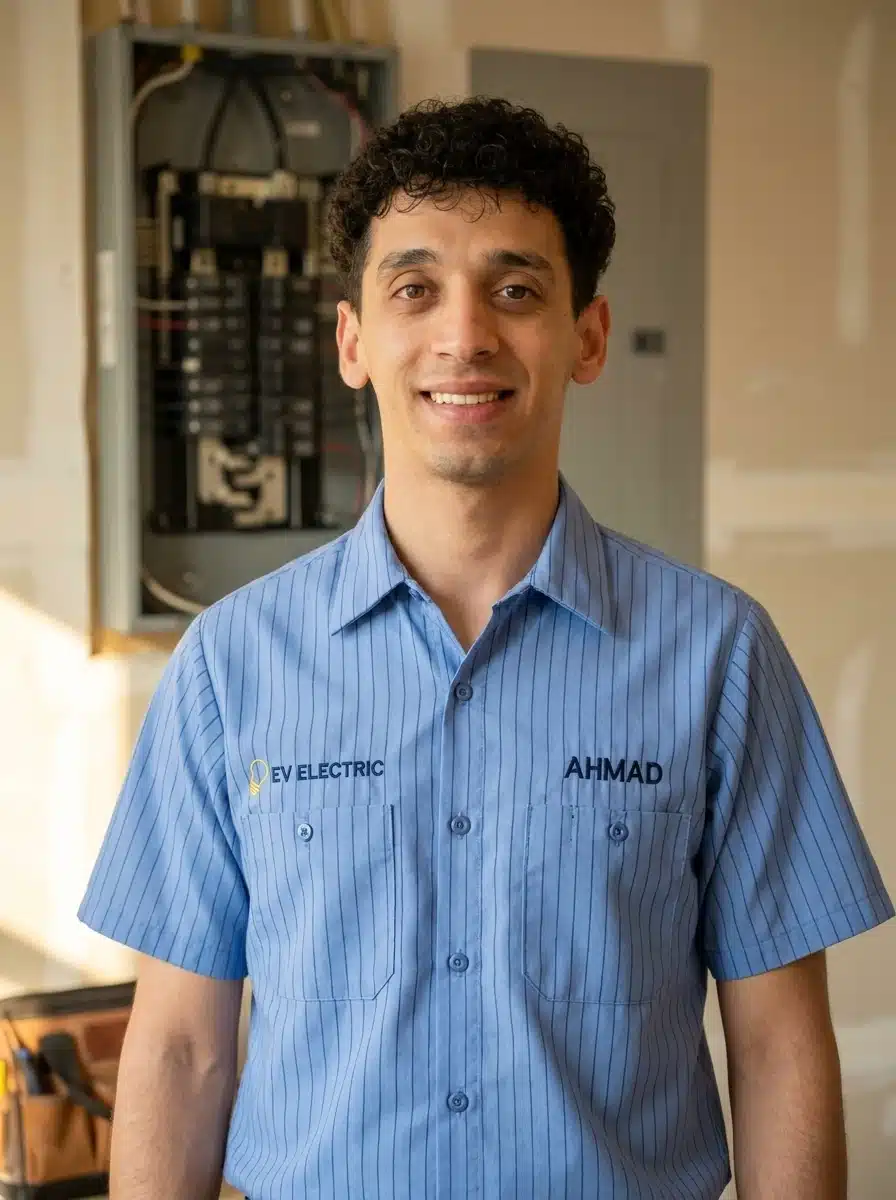
A “Falls Church” troubleshooting call can mean pulling up to a 1950 Pimmit Hills rambler on a 60-amp panel that’s been carrying additions for seven decades, or a Broadmont Cape Cod with a Federal Pacific breaker box that’s never been replaced, or a teardown-rebuild near the Metro where the new construction outgrew the original utility drop. Ahmad Shaban has worked in all three settings across this area, and he’s the only person who shows up — there is no office staff routing calls and no crew arriving in his place.
Ahmad’s credential is Master Electrician, Commonwealth of Virginia #2710086216, the state’s highest residential electrician license. Falls Church homeowners tend to invest seriously in their homes — they want the work diagnosed correctly and done to code, not just done cheaply — and that’s the kind of call Ahmad is built for. EV Electric Services is fully insured for work across the City of Falls Church, the surrounding Fairfax County communities, and the Arlington County neighborhoods that share a Falls Church mailing address.
EV Electric Services holds a 5.0-star average across 113 Google reviews — real ratings from Northern Virginia homeowners, not recycled directory listings.
How estimates work
We don’t quote troubleshooting over the phone — not because we’re being cagey, but because this area’s wiring varies too much by era and neighborhood for a phone guess to be honest. A Greenway Downs home built in the 1930s and a Pimmit Hills rambler from 1952 present completely different panels and completely different fault patterns. Ahmad sees the actual wiring before he writes a number. No trip fee, free estimates — and the written estimate includes any applicable permit fee, regardless of which of the three local jurisdictions your address falls under.
- Troubleshooting visit with same-call repair. Ahmad runs the diagnostic — typically 1–2 hours — and handles the fix on the spot if it’s within scope: a failed breaker, a loose connection, a GFCI that won’t hold. You get a written estimate before any wrench turns.
- Diagnosis first, repair on your schedule. Some homeowners want the answer before committing to the fix, especially when they’re weighing whether a panel upgrade makes more sense than a spot repair. Ahmad writes up what he found and what it would cost, and you decide when.
- Bigger jobs quoted separately. A Federal Pacific panel replacement in a Broadmont home, a sub-panel for a finished basement in Pimmit Hills, a full circuit re-run in a teardown-rebuild — each gets its own written estimate, including the permit from whichever jurisdiction applies.
- After-hours availability. Not every call needs it, but if you’re smelling something burning or a breaker won’t hold at all, mention it when you call.
Falls Church-area neighborhoods we serve
We cover the full Falls Church area, including:
- Greenway Downs — City of Falls Church, platted late 1920s, built out through the 1940s
- Broadmont — City of Falls Church, 1930s-1950s Cape Cods, split-levels, and ramblers
- Cherry Hill area — City of Falls Church, anchored by a ca.-1845 farmstead now a city park
- Pimmit Hills — unincorporated Fairfax County, 1950s veteran-era ramblers
- West Falls Church CDP — Fairfax County, including Jefferson Village, Westlawn, Hillwood, Sleepy Hollow, and Broyhill Park
- Winter Hill — City of Falls Church, 1960s mid-rise and garden apartment area near Seven Corners
- Virginia Village — City of Falls Church, 1950s-1960s single-family homes
- Seven Corners — Fairfax County, Falls Church-adjacent commercial and residential area
- East Falls Church — Arlington County — a separate jurisdiction from the City and from Fairfax County
- Madison Manor — Arlington County — paired with East Falls Church in local real-estate listings
Outside this area, we serve nearby Annandale, Burke, and Oakton in Fairfax County, and our upper Northwest DC service area just over the District line, plus Vienna, McLean, Tysons, and the rest of Fairfax County and Montgomery County MD.
Related electrical services in the Falls Church area
Troubleshooting is the front door. If your diagnosis points to a larger repair, here’s what we handle next:
Frequently asked questions
Is my Falls Church address in the City or Fairfax County?
It depends on the exact address — a Falls Church mailing address can mean the independent City of Falls Church (permitted through its own Department of Code Administration, 703-248-5080), unincorporated Fairfax County (including Pimmit Hills and the West Falls Church CDP, permitted through Fairfax County LDS), or, for East Falls Church and Madison Manor, Arlington County. We confirm which applies before pulling any permit.
How does pricing work for electrical troubleshooting here?
Ahmad comes to the house, looks at the actual work, and gives a written estimate before any repair starts. No trip fee, free estimates.
How quickly can you come out?
Same-day or next-day in most cases during weekday business hours, roughly 10-20 minutes from our Fairfax Blvd office.
Do you check for Federal Pacific or Zinsco panels?
Yes — these were commonly installed in this area’s 1930s-1950s homes, especially in Pimmit Hills and Broadmont, and are documented today as elevated fire-hazard brands. We inspect directly rather than assume.
What’s the most common electrical problem in this area’s homes?
It depends on the neighborhood. Pimmit Hills’ 1950s ramblers most often call about original small-service panels overwhelmed by decades of additions; Broadmont and Greenway Downs’ older stock most often calls about legacy panels and wiring.
When should I call an electrician instead of fixing it myself?
Call immediately for burning smell, sparking, or warm switch plates. A breaker that won’t stay reset, or a room that’s lost power with no clear cause, is worth a same-week call regardless of which jurisdiction side of town you’re on.
Are you licensed and insured?
Yes. Ahmad’s license is Master Electrician, Commonwealth of Virginia #2710086216, and EV Electric Services is fully insured.
Ready to get your problem diagnosed?
Weekday troubleshooting across the Falls Church area — City, Fairfax County, and Arlington County sides alike.
Most calls get a visit the same day or the next morning.