
Electrical Troubleshooting in Washington, DC
Same-Day Diagnosis from a Master Electrician
Lights flickering? Breaker tripping? Outlets gone dead? Ahmad Shaban — Virginia-licensed Master Electrician — finds the cause and fixes it. Residential service across Washington and surrounding areas.
What “electrical troubleshooting” actually means
Most homeowners call an electrician when something stops working — a row of outlets goes dead, a breaker keeps tripping, lights flicker every time the AC kicks on. “Troubleshooting” is what we do before we fix it. It’s the diagnostic step where we find the root cause, not just the symptom.
A blown breaker is the symptom. The cause could be a loose neutral wire behind a 1960s outlet box, an overloaded circuit because a new microwave shares a line with the toaster, or a damaged conductor inside a wall the previous owner finished without a permit. Each cause has a different fix. Pinpointing the right one is the work that saves you from paying twice — once for a wrong guess, and again for the real repair.
Ahmad Shaban is a Virginia-licensed Master Electrician with a maintenance team behind him. He runs diagnostics on residential electrical systems across Washington and the rest of Northern District of Columbia. The work isn’t “swap and pray.” It’s read the panel, test the circuits, trace the fault, then explain what’s happening in plain English before any repair starts.
Why Washington homeowners call us for diagnostics
Washington, DC’s Northwest quadrant contains the District’s most concentrated residential electrician demand — affluent single-family neighborhoods stretching from Georgetown along the Potomac to Tenleytown, Chevy Chase DC, and the Palisades. Key corridors include Wisconsin Avenue, Massachusetts Avenue, MacArthur Boulevard, and Foxhall Road. These neighborhoods sit between Rock Creek Park to the east and the Potomac River to the west. NW DC is about 15–20 miles from our Fairfax Blvd office, with access via I-66, the Key Bridge, or Chain Bridge depending on the specific neighborhood.
1800s–1920s historic row houses, Victorians & Federal-style homes
Georgetown, Cleveland Park (Victorians), Glover Park (early row houses), Palisades (early homes)DC’s oldest residential neighborhoods contain housing stock predating modern electrical systems entirely. Georgetown’s Federal-style row houses date to the late 1700s and early 1800s — electricity was retrofitted decades after construction. Cleveland Park’s Queen Anne Victorians and Craftsman homes were built in the 1890s–1910s with early knob-and-tube wiring. These homes present unique challenges: thick plaster-and-lath walls, no accessible wall cavities for new wiring, historic preservation requirements (some in Historic Districts), and layers of electrical work from every decade since the 1920s. DC’s own permitting authority — the Department of Buildings (DOB) — and historic preservation review add complexity beyond suburban jurisdictions.
Symptoms: Knob-and-tube wiring still active in wall cavities and attics — especially in Georgetown and Cleveland Park homes that have never been fully rewired. Original 60-amp fuse boxes or early panel upgrades mounted in awkward locations (closets, under stairs) where the retrofit electrician could access masonry walls. Two-prong ungrounded outlets throughout — running a ground wire through plaster-and-lath walls without damage requires specialized technique. Overloaded circuits from 100+ years of adding loads to wiring designed for a few light bulbs.
1920s–1950s colonials, Tudors & Cape Cods
Chevy Chase DC, Tenleytown, Spring Valley, American University Park, Palisades (later homes), Cathedral HeightsDC’s NW residential expansion in the 1920s–1950s produced the colonials, Tudors, and Cape Cods that define neighborhoods like Chevy Chase DC, Spring Valley, and Tenleytown. These homes were built with 60-amp or 100-amp panels and cloth-insulated copper wiring — a significant improvement over earlier construction but still undersized for today’s loads. Spring Valley’s estate homes (3,000–5,000 square feet) have more circuits than typical homes of the era but are still overwhelmed by modern demands. Foxhall’s secluded properties often have long service runs from the street. GFCI protection is absent in all pre-1975 construction.
Symptoms: 100-amp panels with no spare breaker slots — common in Tenleytown and American University Park homes where central AC, updated kitchens, and home offices were added over decades. Cloth-insulated wiring with cracking insulation in attics and wall cavities. No GFCI protection in kitchens, bathrooms, or exterior outlets. Long service-entrance runs in Spring Valley and Foxhall causing voltage drop during peak loads. Backstabbed outlet connections from 1970s–1980s renovation work failing after decades.
2000s–2020s gut renovations & major additions
Georgetown (gut renovations), Spring Valley (additions), Chevy Chase DC (modernized), Palisades (updated), Foxhall (estate renovations)DC’s NW neighborhoods have seen extensive renovation activity — gut renovations in Georgetown that preserve the facade while completely replacing interior systems, large additions in Spring Valley and Foxhall, and systematic modernization in Chevy Chase DC and Tenleytown. These projects install 200-amp panels with AFCI protection and modern wiring, but must interface with PEPCO’s existing infrastructure and navigate DC Department of Buildings (DOB) permitting (which differs significantly from Virginia and Maryland county permits). Historic District requirements in Georgetown may limit exterior modifications to service entrances. The combination of modern interior systems with aged utility feeds creates recurring issues.
Symptoms: Undersized PEPCO service drops — the utility feed was sized for the original home’s modest loads, not the renovated structure’s modern demands. AFCI nuisance trips in renovated portions where new wiring runs near old (abandoned but not removed) wiring in shared wall cavities. DC Department of Buildings (DOB) inspection requirements that differ from Virginia/Maryland — specific grounding electrode requirements, panel labeling standards, and historic district constraints. Voltage drop to rear additions and carriage houses fed by undersized conductors.
If your home falls in any of these patterns, the diagnostic step is what tells you whether you need a quick fix, a bigger repair, or a panel upgrade. Guessing costs more than knowing. That’s why people call.
Specific problems we diagnose every week in Washington
Here are the calls Ahmad gets most often from Washington homeowners. If your situation matches one of these, you’re in the right place.
Breaker trips and won’t reset
A breaker that trips once is doing its job. A breaker that trips daily, or that pops the moment you reset it, points to a short, an overloaded circuit, or a failed breaker itself. We trace the circuit, isolate the load, and find which of the three it is.
Outlets dead in one room, fine in another
Usually a tripped GFCI you don’t know about, a backstabbed connection that worked loose, or a wire nut that came apart in a junction box behind drywall. Diagnostic time matters — we trace the circuit map and find the break in 15-30 minutes instead of opening every box in the house.
Flickering lights when the AC or fridge cycles
This points to a voltage drop, often from a loose neutral at the meter base or a damaged feeder. Persistent voltage drops shorten the life of every motor in your house and are a real fire-risk signal. We pull the meter cover, test the service entrance, and identify the source.
Burning smell or warm switch plates
Stop using the circuit and call us today. We treat this as an urgent diagnostic, not a routine appointment. The cause is almost always heat at a loose connection — and loose connections in walls cause house fires. We find the heat source and repair it before damage spreads.
EV charger circuit issues
In DC’s established NW neighborhoods like Georgetown, Cleveland Park, and Spring Valley, EV charging puts continuous high-amp draw on circuits that may not be sized for it. If your charger throttles itself, trips a breaker, or warms the outlet, the cause is upstream of the charger and worth diagnosing before you blame the car. See our EV charger installation in Washington page for permanent solutions.
Whole-house or partial outages
If half your house has power and half doesn’t, you may have an open neutral at the service entrance — a serious condition that damages electronics. We test the voltage on each leg of the panel and identify the failure point.
Three-way switch that doesn’t work right
Switches at two ends of a hallway or staircase use a different wiring topology than single switches. When a previous repair scrambled the travelers, you get switches that work sometimes, or only in one combination, or that buzz. Diagnostic and repair is a 1-2 hour job.
Sub-panel that’s been added and is unreliable
Garage and basement sub-panels added during renovations are a frequent source of intermittent problems. We verify the feeder size, check the grounding and bonding, and confirm the panel is wired to current code.
Our troubleshooting process — what happens when you call
When you call 571-500-6637 or request a quote online, here’s what happens.
A real conversation, not a script
Ahmad or someone from his team picks up. We ask about the symptom, when it started, what you’ve already tried, and whether there’s any safety concern (burning smell, sparking, warm walls). If anything you describe is urgent, we’ll tell you to shut off the breaker until we can be there.
Same-day or next-day appointment in most cases
Washington, DC (NW neighborhoods) is about 15–20 miles from our Fairfax Blvd office — roughly 25–40 minutes via I-66 or the George Washington Parkway depending on the neighborhood. We don’t promise 24/7 service — but for residential troubleshooting during weekday business hours, same-day or next-day is the norm. We confirm the appointment time and give you a one-hour window.
On-site diagnostic with the homeowner present
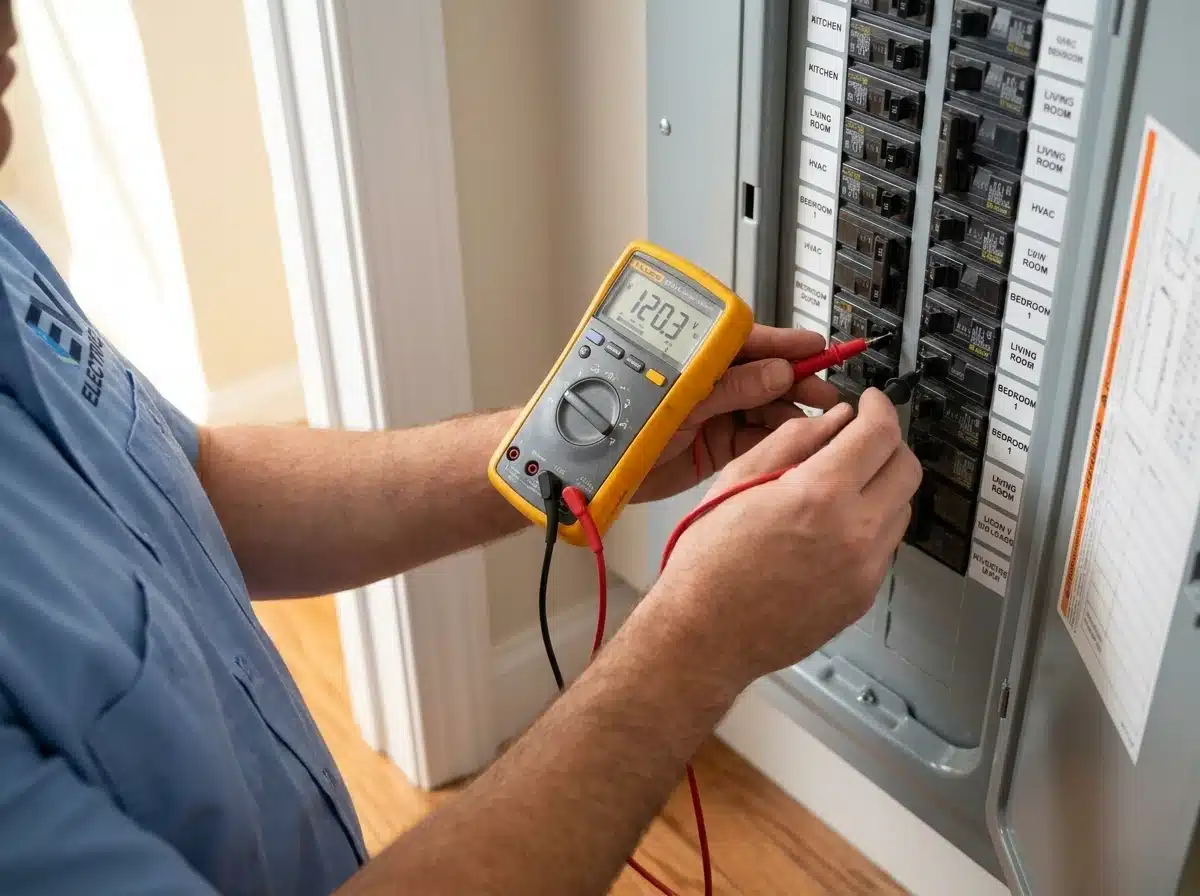
We arrive, walk to the affected area with you, and ask you to demonstrate the problem. Then we set up the diagnostic. Tools: multimeter, circuit tracer, AFCI/GFCI tester, IR thermal camera if heat is suspected. We open panels, test circuits at rest and under load, and trace the fault to its origin.
A plain-English explanation before any repair
Before we do a single repair, we sit down with you and show you what we found. We tell you the cause, the fix, the cost, and what happens if you defer the fix. You decide whether to proceed today or schedule a return visit.
The repair, if you authorize it
Most diagnostic visits include the repair on the same call. We carry common parts — breakers, GFCIs, outlets, switches, wire nuts, and standard sizes of wire. Larger jobs (panel replacement, sub-panel install, full circuit re-run) get a written estimate and a separate appointment.
A clean exit, with documentation
When we leave, you get a written record of what was diagnosed, what was repaired, and what (if anything) we recommend you address next.
How estimates work
We come to the house, look at the actual work, and give a written estimate before any job is scheduled. The estimate is firm — no surprise charges at the end. No charge for the diagnostic visit in our primary service area.
- Residential troubleshooting visit. A diagnostic visit (typically 1-2 hours) plus most minor repairs that can be done on the same call — replacement GFCI outlet, replacement breaker, tightened lug, re-pulled neutral. The written estimate covers parts plus labor and is given before any repair starts.
- Diagnostic-only visit. If you want a written estimate and a separate visit for the repair, we’ll diagnose the problem on the first visit and leave you with the estimate. You decide whether to schedule the repair.
- Major repairs — separate written estimate. Panel upgrades, sub-panel installs, full circuit re-runs, EV charger installs, whole-house rewires get a written estimate before we start. We don’t begin major work without your written authorization.
- After-hours service available on request. Most troubleshooting calls don’t need it. We mention it for visibility — if you need it, ask when you call.
About Ahmad Shaban, Master Electrician
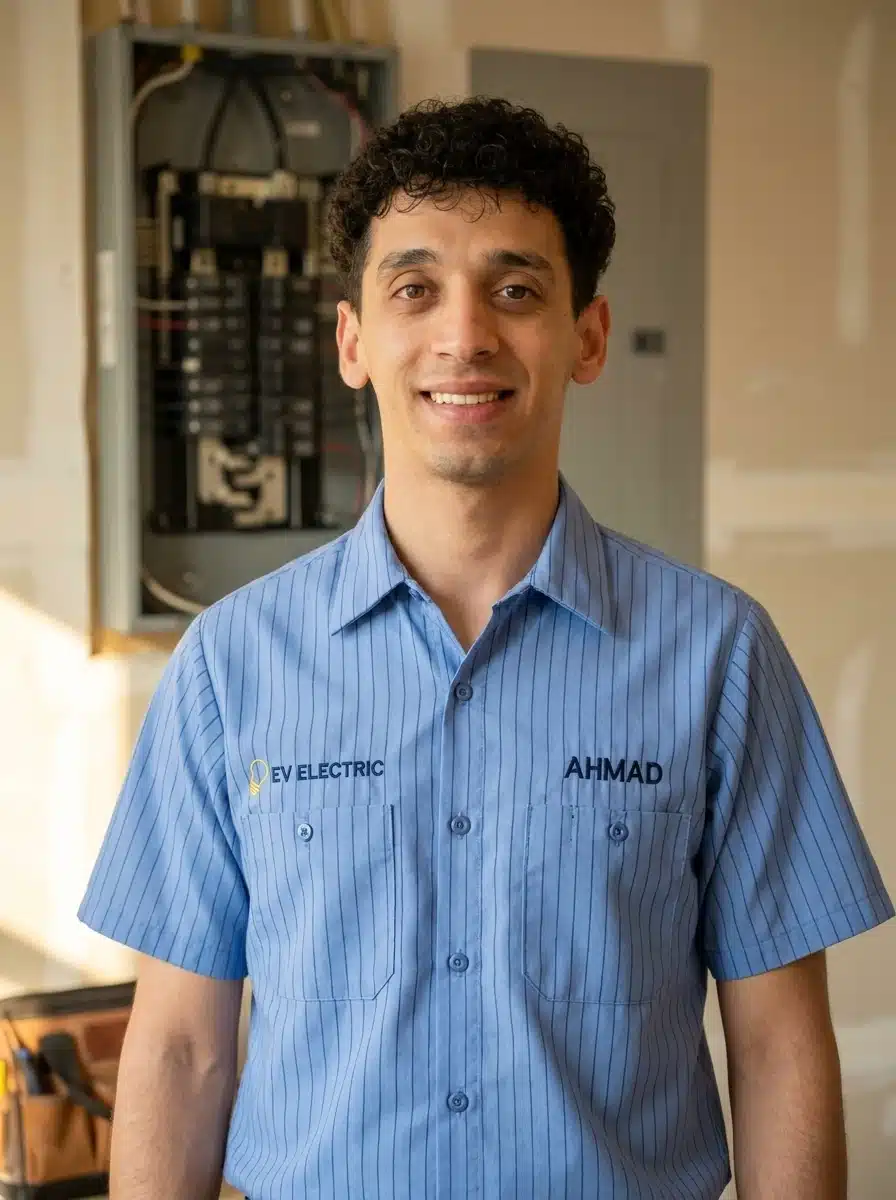
Ahmad Shaban is a Master Electrician licensed in Virginia. The Master tier is the highest electrician license the state issues — it requires several years of journeyman work, a passed state exam, and a clean record. Ahmad waited roughly four years for his Master license before opening EV Electric Services. He’s fully insured and runs a maintenance team, so when you call us you’re not waiting on one person’s calendar.
Ahmad is the person who shows up at most residential troubleshooting calls. He’s the diagnostician — the one who reads the panel, runs the tests, and explains what’s happening. His preference is to find the root cause and repair it once, rather than patch the symptom and come back next month.
EV Electric Services holds a 5.0-star average across 113 customer reviews. Our review base is real, recent, and from Northern Virginia homeowners. We don’t ghost-write reviews or recycle them across business directories.
Washington neighborhoods we serve
We cover all of Washington, DC, including:
- Georgetown — historic Federal and Georgian row houses from the 1800s along cobblestone streets — DC’s oldest residential neighborhood
- Tenleytown — 1920s–1950s colonials and brick Cape Cods near Wisconsin Avenue with Metro access and walkable amenities
- Cleveland Park — grand Victorians, Craftsman homes, and 1920s colonials on tree-lined streets near the National Cathedral
- Chevy Chase DC — 1920s–1940s colonials and Tudors at DC’s northern tip — architecturally continuous with Chevy Chase, MD
- Palisades — secluded 1920s–1960s neighborhood along MacArthur Boulevard overlooking the Potomac — a village within the city
- Spring Valley — 1930s–1940s estate-scale colonials on large wooded lots — one of DC’s most affluent neighborhoods
- American University Park — 1930s–1950s colonials and Cape Cods in a quiet residential enclave adjacent to American University
- Foxhall — large estate homes on secluded lots along Foxhall Road — some of DC’s most private residential properties
- Glover Park — 1920s–1940s row houses and detached homes on hillside streets between Georgetown and the National Cathedral
- Cathedral Heights — 1940s–1960s homes and apartment buildings on elevated terrain near the Washington National Cathedral
Outside Washington, DC, we serve Vienna, Fairfax, McLean, Falls Church, Bethesda, Chevy Chase, Potomac, Arlington, and all of Northern Virginia and Montgomery County, MD.
Related electrical services in Washington
Troubleshooting is the front door. If your diagnosis leads to a larger repair, these are the next steps we handle:
Frequently asked questions
How does pricing work for electrical troubleshooting in Washington, DC?
We come to the house, look at the actual work, and give a written estimate before any repair starts. Diagnostic visits include most minor on-the-spot repairs. Major repairs (panels, sub-panels, full circuit re-runs) get a separate written estimate. No charge for the diagnostic visit in our primary service area.
How quickly can you come out for a troubleshooting call in Washington?
Same-day or next-day in most cases during weekday business hours. Washington, DC (NW neighborhoods) is about 15–20 miles from our Fairfax Blvd office — roughly 25–40 minutes via I-66 or the George Washington Parkway depending on the neighborhood. If your situation is urgent (burning smell, sparking, warm walls), we’ll triage you to the earliest available slot and tell you what to shut off in the meantime.
What’s included in a troubleshooting visit?
A real diagnostic — not a guess. We use a multimeter, circuit tracer, AFCI/GFCI tester, and IR thermal camera if heat is suspected. We open panels, test circuits at rest and under load, trace the fault to its source, then explain what we found in plain English before any repair starts.
When should I call an electrician vs. trying to fix it myself?
Call an electrician if you smell burning, see sparking, feel warm walls or warm switch plates, have a breaker that trips daily, or have lost power to part of the house without a clear cause. Resetting a tripped breaker once is fine. Resetting it three times in a row is a fire risk. We’d rather you call us and have us tell you it’s a small fix than not call and have a real problem grow.
What’s the most common electrical problem in Washington homes?
Breaker trips on overloaded circuits. DC’s NW residential neighborhoods span nearly two centuries of construction — from Georgetown’s 1800s row houses with retrofitted electrical systems, to 1920s–1940s colonials in Chevy Chase DC and Spring Valley with 100-amp panels, to renovated homes where modern kitchens and home offices overload original wiring. The oldest homes have electrical systems that were never designed from scratch — they were retrofitted into masonry structures built before electricity existed. The second most common call is flickering lights — usually a loose neutral at the meter base or voltage drop from an aging PEPCO overhead connection.
Do you handle EV charger problems?
Yes. EV charging puts continuous high-amp draw on circuits that DC’s historic homes were not wired for. If your charger throttles, trips a breaker, or warms the outlet, the cause is almost always upstream — a feeder, a breaker, or a connection that can’t sustain the load. We diagnose the cause and either repair it or quote you for the right circuit. See our EV charger installation page for full installs.
Are you licensed and insured?
Yes. Ahmad holds a Master Electrician license issued by the Commonwealth of Virginia — the state’s highest electrician credential. EV Electric Services is fully insured. We’re happy to provide proof of license and insurance on request before any work begins.
Do you offer 24/7 emergency service?
We offer after-hours service when needed, but we don’t market ourselves as a 24/7 emergency company. Most residential troubleshooting is handled fastest by booking the earliest weekday or weekend appointment. If you have a genuine emergency — sparks, burning smell, fire risk — call us at 571-500-6637 and we’ll triage immediately.
Ready to get your problem diagnosed?
Same-day or next-day electrical troubleshooting in Washington, DC.
We respond within one business day.