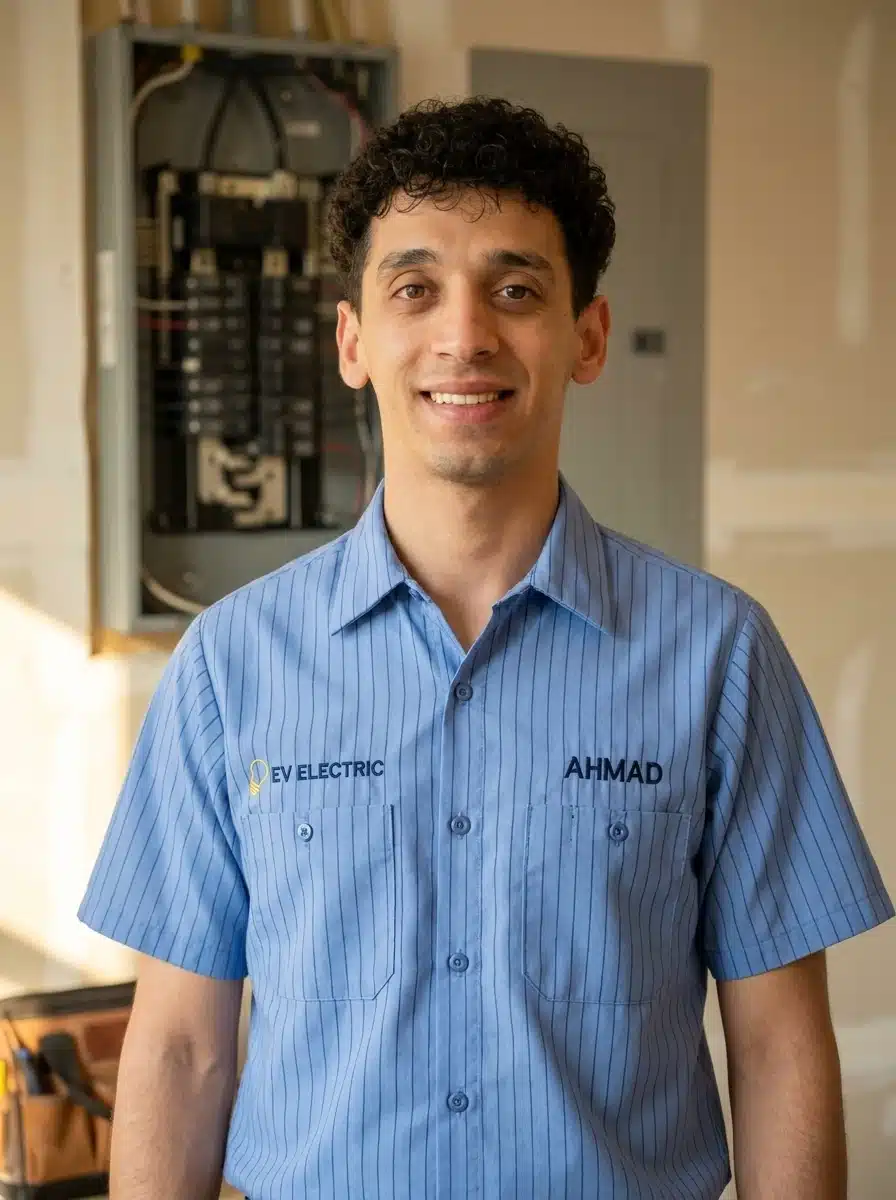
Before you commit to a full service upgrade, you need to know which of the three answers fits your house. Ahmad Shaban — Virginia-licensed Master Electrician — runs the load assessment, explains the options in plain English, and gives you a written estimate before any work starts. Permit pulled with Fairfax County. Vienna homes served from our Fairfax Circle shop, ~10 min via Rt 123.
The cost question is the first thing Vienna homeowners ask, and the honest answer is: it depends on what the load assessment finds. What we can tell you right now is what every panel replacement in Northern Virginia must include under the code currently in effect — because this is where estimates from unlicensed contractors go low and then balloon at the end.
Virginia adopted the 2021 Uniform Statewide Building Code (incorporating the 2020 NEC) effective January 2024. Any panel replacement in Vienna that doesn’t include the following is not code-compliant — and will fail the Fairfax County inspection:
We include the emergency disconnect, surge protection, permit, Dominion meter coordination, and final inspection in every panel estimate. A free written estimate before any work starts.
Call 571-500-6637 for a Free EstimateBeyond the baseline code requirements, these are the factors that determine where your estimate lands:
Call 571-500-6637 — Ahmad comes to the house, opens the panel, runs the load calculation, and gives you a written estimate on the spot. No trip fee and free estimates for Vienna, McLean, Oakton, Fairfax, or Falls Church.
For a large share of Vienna homeowners, the upgrade timeline isn’t driven by symptoms — it’s driven by a letter from an insurance carrier. Two panel brands are the primary trigger: Federal Pacific (Stab-Lok) and Zinsco. Both are common in Vienna’s mid-century housing stock. Both are problems insurers know about.
Federal Pacific Stab-Lok breakers fail to trip in fault conditions in roughly 25–50% of independent tests — meaning a short circuit or overload can overheat the wiring without ever cutting power. Zinsco breakers have bus bar corrosion that causes the breaker to fuse to the bus, so it can’t trip at all when it needs to. These are not “vintage” quirks. They are documented fire risks.
Home insurers know this. Many will either:
If your carrier sent you a letter, the clock is real. We’ve handled the pre-deadline replacement on tight timelines. A typical FPE or Zinsco replacement in Vienna runs 7–10 business days from first call to a passed inspection — if you call before the deadline, there’s usually time.
Where they appear in Vienna: FPE Stab-Lok and Zinsco panels are most common in Vienna Woods, Country Club Hills, and Westwood-area homes built or remodeled in the 1960s–1970s. If your home is in this era and you haven’t had the panel inspected, it’s worth checking the brand label on the door.
This question appeared specifically in Vienna’s panel-upgrade SERP — it did not surface in Fairfax’s. It’s a fair question, and you deserve an honest answer rather than a sales pitch.
The short answer: Virginia law technically allows it on your own home, but a panel upgrade has enough moving parts — utility coordination, new code requirements, insurance documentation — that hiring a Master Electrician is the practical choice for most homeowners. The free estimate tells you what it costs. Then you decide.
This is the V3 decision that most electrician websites skip — they default to “upgrade everything.” Here’s the honest framework Ahmad uses on every Vienna load assessment.
Right answer when: the panel is a known-safe brand (Eaton, Square D, Siemens, GE), the service size is adequate for your load, and the symptom is a single failing breaker or a tripped GFCI that won’t reset.
Ahmad will tell you “breaker swap” when that’s the right answer. It’s a fraction of the cost of an upgrade, and it’s done in an hour. See electrical troubleshooting in Vienna for the full diagnostic path.
Right answer when: the home is on 100-amp service, you’re adding high-draw loads (EV charger, heat pump, induction range, finished basement), OR the existing panel is Federal Pacific, Zinsco, or a fuse box.
This is the right call for most Vienna Woods, Country Club Hills, and Westwood-area homes on original 1950s–1970s service. The load calculation confirms it before you commit.
Right answer when: the main panel is a safe brand and has amperage headroom, but you’re adding a finished basement, detached garage, workshop, or outdoor EV charger that needs its own circuits without running individual feeds from the main.
A sub-panel is sometimes cheaper than a full service upgrade, but only when the main panel can carry the additional feeder load. The load calculation tells you which way it goes.
Not sure which of the three you need? That’s what the free on-site estimate is for. Ahmad opens the panel, runs the load calculation, and tells you — in plain English — which answer fits your house and why. Call 571-500-6637 to schedule.
Each one comes down to the repair/upgrade/sub-panel decision. Here’s how we approach the most common situations.
A Level 2 EV charger draws 30–50A continuously — often more than what’s left on a loaded 100A panel. A heat pump adds 20–30A. An NEC 220.82 load calculation confirms whether the existing panel has headroom or needs the upgrade first. Most Vienna Woods and Westwood homes on original service need the full upgrade before the charger circuit. See EV charger installation in Vienna.
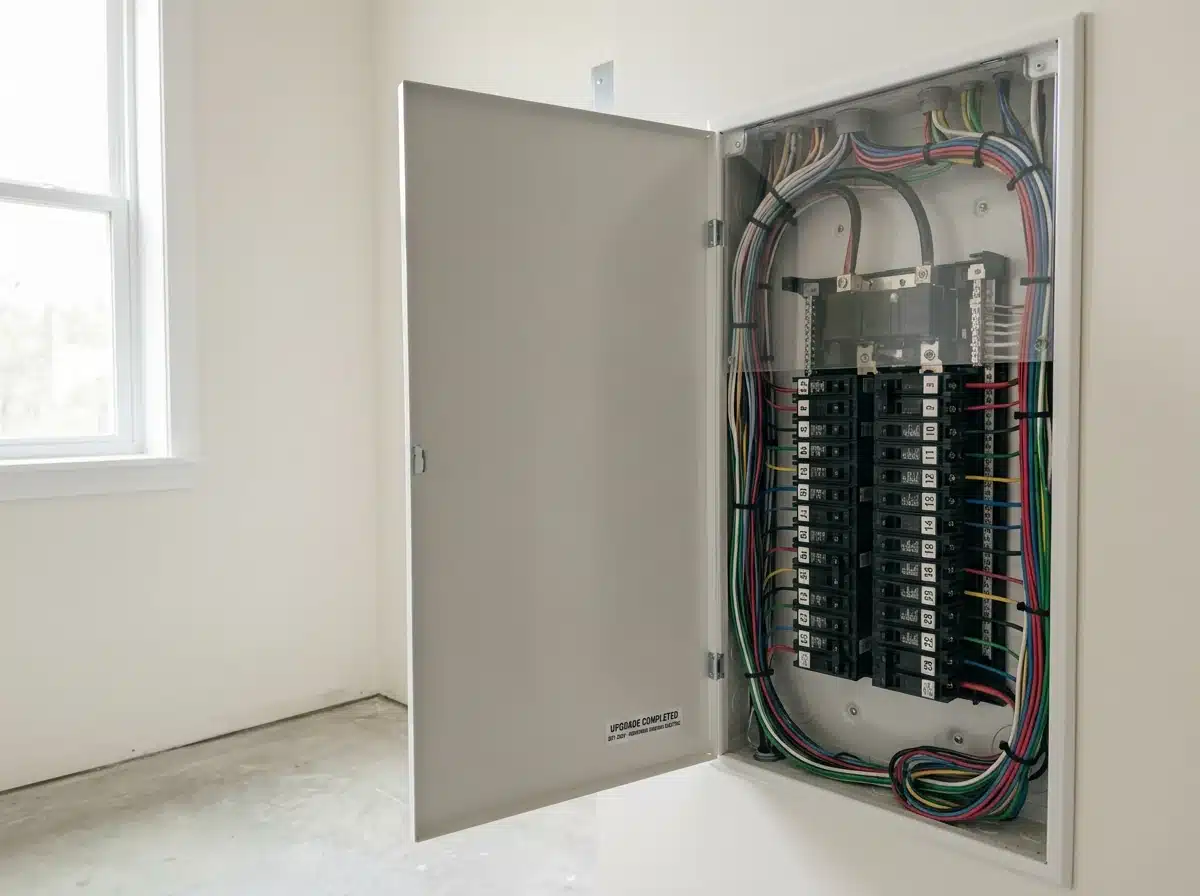
Full cabinet replacement — not a breaker swap. FPE Stab-Lok breakers can’t be made safe by replacing individual breakers; the bus bar design is the problem. We replace the entire enclosure with a current-code panel, re-terminate every circuit, and document the work for your carrier. 7–10 business day turnaround on pre-deadline jobs.
Same replacement protocol as FPE. Zinsco’s aluminum bus bars corrode at the breaker connections, preventing the breaker from tripping. Common in 1970s Hunter Mill District colonials. Some of these panels are labeled “Sylvania” — same hardware, different nameplate. Replacement, not repair.
The main panel has headroom but the basement remodel needs 8–10 new circuits. A sub-panel is the clean answer: one feeder to the sub-panel, individual breakers for each new circuit. Cleaner than running eight individual feeds from the main, and easier to diagnose later. Permit required; inspection by Fairfax County.
If you’re on 200A service in a Hunter Mill or Tysons-edge home, the panel likely has room for a dedicated 60A EV breaker without an upgrade — but the load calculation confirms it. We install the dedicated circuit, run the #6 copper conductor per NEC 625, and add the EVSE outlet or hardwire the charger. See EV charger installation in Vienna.
Fuse boxes predate modern breakers and are an insurance flag. Conversion replaces the entire enclosure with a new breaker panel — typically 200A — and often requires a meter base and weatherhead replacement alongside it. Common in the oldest Vienna Woods homes. Permit required; one-day install in most cases.
Home inspection surfaced a Federal Pacific, Zinsco, or fuse box and the buyer is asking for replacement before closing. We’ve compressed the permit-to-inspection cycle to 7–10 business days on Vienna pre-sale jobs when the timeline is real. Written estimate on the first visit, permit filed the same week.
A panel full of tandem breakers and double-taps is a panel that has run out of capacity. The decision: add a sub-panel for the overflow circuits (if the service has headroom) or upgrade to 200A. The load calculation tells you which. Either way, the double-taps are gone — every circuit gets its own breaker, torqued to spec and labeled.
Vienna’s housing stock runs from 1950s postwar ranches to 2020s townhomes. The decade your home was built tells you what panel risk you’re most likely carrying — and which of the three options (repair, upgrade, sub-panel) is most likely the right answer for you.
Original 60–100A panels. Federal Pacific Stab-Lok and Zinsco panels installed during 1960s–1970s remodels are common in this stock — the original panel was replaced by what was then a “modern” upgrade that turned out to be a fire risk. Modern load profile (central AC, EV charger, induction range, heat pump) overwhelms circuits the original builder sized for a window unit and a fridge.
Panel risk: FPE/Zinsco (insurance trigger) + undersized service. Likely path: full 100A→200A upgrade replacing the hazardous panel.
Mostly 200A service, often with a Square D, GE, or early Siemens panel. The panel itself is usually safe — but 25–30 years of basement finishes, kitchen remodels, and basement egress additions have piled circuits on the original breaker count. Double-taps, tandems, and panels at or over capacity are the signature here. Aluminum branch wiring (mid-1970s) is common in this era.
Panel risk: overloaded breaker count, aluminum wiring terminations. Likely path: sub-panel for the overflow OR a new 200A panel if the original is at capacity and aging.
200A+ service from the start, AFCI-protected circuits, modern breaker brands. The panel itself is rarely the bottleneck in this era. What these homes need is either a sub-panel for a finished basement or ADU addition, or a dedicated EV charger circuit on a panel that already has the capacity. AFCI nuisance trips (treadmill, vacuum, legacy dimmers) are the most common call from this era.
Panel risk: capacity bottleneck on specific circuits, not the service size. Likely path: sub-panel for new areas, or circuit addition + AFCI breaker swap for nuisance trips.
Your decade tells you the likely risk — the load calculation confirms the actual answer. Both are part of the free on-site estimate.
Vienna’s permitting structure is more nuanced than most electrician websites describe. Here’s the accurate version — which no competitor’s site states correctly.
For all Vienna homes — including those inside Town of Vienna corporate limits — Fairfax County is the electrical building official. The County issues the residential electrical trades permit (ELER) and performs the inspection.
EV Electric files the permit, schedules the inspection, and passes it closed. You get a copy of the signed inspection card for your records and your insurance carrier.
The Town of Vienna does not run its own electrical permitting. What the Town does add is a zoning approval step for properties inside Town corporate limits.
Important: a “Vienna, VA” mailing address (ZIPs 22180/22181/22182) does NOT tell you whether you’re inside Town limits. Many “Vienna” addresses are in unincorporated Fairfax County. The test is your tax bill and the Town GIS parcel map — not your ZIP code. We check this for every Vienna job.
NEC 230.85 (outdoor emergency disconnect) and NEC 230.67 (surge protection): Both are required under the 2020 NEC / 2021 Virginia USBC on any service panel replacement. These are not optional add-ons. A panel estimate that doesn’t include them will either fail inspection or get revised upward at the last minute. We include both in every written estimate — no surprises.
Vienna’s housing stock has four equipment patterns that come up repeatedly in panel assessments. Each one has a different answer.
Federal Pacific Stab-Lok panels were installed widely in U.S. homes from the 1950s through the 1980s. Independent testing has found that Stab-Lok breakers fail to trip in 25–50% of overcurrent fault conditions. The failure mode: the breaker contacts fuse to the bus bar from repeated thermal cycling, so when a fault happens, the breaker looks “on” but doesn’t open the circuit.
Home insurers and home inspectors have flagged FPE for decades. Many carriers won’t write coverage on a home with a Stab-Lok panel still in service. In Vienna, these are concentrated in Vienna Woods and Country Club Hills homes built or remodeled in the 1960s–70s.
The answer: full cabinet replacement. There is no re-breaker option that insurance carriers accept. We replace with Eaton, Square D, or Siemens — current-code panels with UL-listed breakers that trip when they’re supposed to.
Zinsco panels were manufactured through the 1970s and sold under the Sylvania brand after acquisition. The failure mode is bus bar corrosion: Zinsco’s aluminum bus bars corrode at the breaker slot, causing the breaker to physically bond to the bus. When a fault occurs, the bonded breaker can’t open. The same fire-risk scenario as FPE, via a different mechanical failure.
Common in Hunter Mill District colonials built in the 1970s. Often showing up in homes that have had no electrical work since original construction.
The answer: full cabinet replacement. Check the inside of the panel door — if it says “Zinsco” or “Sylvania” with the distinctive gold-and-orange coloring, call us before the next renewal.
Aluminum branch circuit wiring was used extensively in residential construction from roughly 1965 to 1973 when copper prices spiked. Aluminum expands and contracts more than copper under thermal cycling, loosening connections at outlets and switches over time. Loose connections = resistance = heat = fire risk.
Common in Hunter Mill District homes from the early 1970s. The wiring itself isn’t inherently the problem — it’s the terminations at every device and junction box. The remediation is CO/ALR-rated devices and anti-oxidant compound at every connection, not a full rewire in most cases.
The answer: a panel assessment determines whether the terminations at the panel are in safe condition, and an outlet-by-outlet remediation (CO/ALR devices) addresses the branch circuit connections. We scope both in the estimate.
AFCI (arc-fault circuit interrupter) breakers are required on most residential circuits under the 2020 NEC and have been required in bedrooms since 1999. They’re sensitive by design — they’re meant to detect arcing faults that a standard breaker wouldn’t trip on. The downside: they also respond to “noisy” loads: treadmills, older vacuum motors, LED dimmers wired with a neutral the dimmer doesn’t expect, and some power tools.
Common complaint in Tysons-edge and newer Vienna townhomes. The first step is distinguishing a genuine arc-fault trip (fix the wiring) from a nuisance trip on a noisy load (match the AFCI type to the load, or use a dual-function AFCI/GFCI on the affected circuit).
The answer: a troubleshooting visit first. If the issue is a nuisance trip, the fix is a targeted breaker swap or circuit correction — not a panel replacement.
We don’t post prices because the right price requires seeing the actual panel, the service entrance, and the wiring — not a zip code. What we can tell you is exactly what every written estimate covers so you can compare apples to apples when you get multiple quotes.
You call → Ahmad comes to the house, opens the panel, runs the load calculation, and gives you a written estimate on the spot → you decide → we pull the Fairfax County permit and schedule Dominion Energy for the meter drop → install day (6–10 hours, power off most of the day) → county inspection (same week or next) → you get a labeled panel, signed inspection card, permit copy, and before-and-after photos. Larger scope changes (FPE, Zinsco, aluminum wiring remediation) are itemized in the estimate with no surprises at close.
For the full step-by-step process including what to expect on install day, see our panel upgrade services hub.
Our shop is at 9488 Fairfax Blvd (Fairfax Circle). Vienna is ~10 minutes north via Route 123 (Chain Bridge Rd) or Nutley St / I-66. The trucks are here overnight — when you call for a same-week estimate or a pre-deadline replacement, we’re coming from around the corner, not from a franchise 20 miles south in Lorton.
Local, not a franchise. Ahmad owns the business. The shop address is real — not a virtual office in Sterling or a PO box. When you call 571-500-6637, a real person picks up, asks about your panel, and books the earliest available slot for the load assessment.
Why it matters for panel jobs: a panel replacement requires an on-site estimate — no quote-over-the-phone guessing at your service size. A local shop turns the estimate visit around fast. If you have an insurance deadline, that response time is the difference between making the timeline and missing it.
Mr. Electric operates from Lorton (~20 miles south) — Vienna is the furthest edge of their territory. Ahmad’s shop is 10 minutes away. On response time, local wins.
Ahmad Shaban holds a Master Electrician license issued by the Commonwealth of Virginia — the state’s highest electrician credential, requiring years of journeyman experience and a passed state exam. He’s the person who comes out for most panel assessments in Vienna, runs the load calculation, and explains what you actually need versus what you can defer.
Panel upgrades are the work where credentials matter most. The job touches the service entrance, the meter, and every circuit in the house — and it gets inspected by Fairfax County. Ahmad has been pulling permits, coordinating with Dominion Energy, and passing inspections across Northern Virginia for years. He hands you the documentation when the job is done so the upgrade is on the record for your insurer and your next buyer.
EV Electric Services holds a 5.0-star average across 122 Google reviews — real, recent reviews from Northern Virginia homeowners.
We cover all of Vienna and the surrounding area, with Vienna Woods and Country Club Hills leading in volume — those are the FPE/Zinsco-era neighborhoods where panel replacement demand is highest.
Outside Vienna, we serve Fairfax, McLean, Oakton, Tysons, Burke, Annandale, Falls Church, and the rest of Fairfax County. We also cover DC and Montgomery County, MD.
The panel upgrade is often the unlock for a larger project — or the result of a troubleshooting visit that found the root cause. Here are the adjacent services we handle:
We don’t post prices because the right number requires seeing your actual panel, service entrance, and wiring. What every Vienna panel replacement must include under current code: permit (Fairfax County ELER), outdoor emergency disconnect (NEC 230.85), whole-home surge protection (NEC 230.67), and Dominion Energy meter coordination. All of that is in our written estimate — no surprise add-ons at the end. The estimate is free. Call 571-500-6637 to schedule the on-site assessment.
Virginia law allows homeowners to pull an electrical permit for work on their own primary residence under the homeowner exemption — but this does NOT mean no permit and no inspection. The work still requires a Fairfax County ELER permit and must pass a county inspection. Additionally, Dominion Energy typically won’t drop the meter for a homeowner (they require a licensed contractor’s pull number), which means a DIY panel replacement usually can’t start. For FPE/Zinsco replacements, insurance carriers want documentation of licensed, inspected work — a homeowner-pulled permit carries less weight. The short version: it’s technically legal under some conditions, but a Master Electrician handles the utility coordination, code compliance, and insurance documentation that a homeowner can’t easily replicate.
Many carriers will. Federal Pacific Stab-Lok and Zinsco panels are widely flagged by home insurers because of documented failure-to-trip rates in fault conditions — meaning a short circuit can overheat wiring without cutting power. Some carriers refuse to write new policies on homes with these panels; others surcharge or cancel at renewal when a home inspection surfaces the brand. If your carrier sent a letter, call us — a typical pre-deadline FPE or Zinsco replacement in Vienna runs 7–10 business days from first call to passed inspection.
Yes. Fairfax County is the electrical building official for Vienna — including homes inside Town of Vienna corporate limits — and requires an ELER trades permit for any panel replacement or service upgrade. The permit is filed via the County PLUS portal. If your home is inside Town of Vienna limits and the work involves an exterior change (new service mast, outdoor disconnect, meter relocation), a Town of Vienna zoning approval is also required and must be uploaded to the County record before the County issues the permit. EV Electric handles both — you don’t need to navigate two separate offices.
Maybe. A Level 2 EV charger draws 30–50A continuously. The correct answer depends on an NEC 220.82 load calculation on your existing panel. Many Hunter Mill District and Tysons-edge homes on 200A service have enough headroom to add a dedicated 60A EV circuit without any panel work. Vienna Woods and Country Club Hills homes on 100A service typically cannot — the load calculation will show insufficient headroom before you add the charger draw. We run the calculation on the free estimate visit and tell you which way it goes before you commit to either job. See also: EV charger installation in Vienna.
Half-house power loss with breakers that look normal almost always means an open neutral — a failed connection at the service entrance where one of the two 120V legs has lost continuity. Voltage on that leg goes to zero while the other leg may spike. This can damage electronics. It requires an urgent diagnostic — not a reset. We test each leg of the panel, identify whether the failure is utility-side (Dominion’s problem) or panel-side (our fix). Panel-side open neutrals at the main lug connection are a common result of loose terminations in older Vienna panels. See electrical troubleshooting in Vienna.
Free on-site load assessment in Vienna, VA. Written estimate before any work starts. Permit, code, and Dominion coordination handled for you.
571-500-6637