
Light Fixture & Chandelier Installation in Vienna, VA
Licensed Electrician for Every Fixture in Your Home
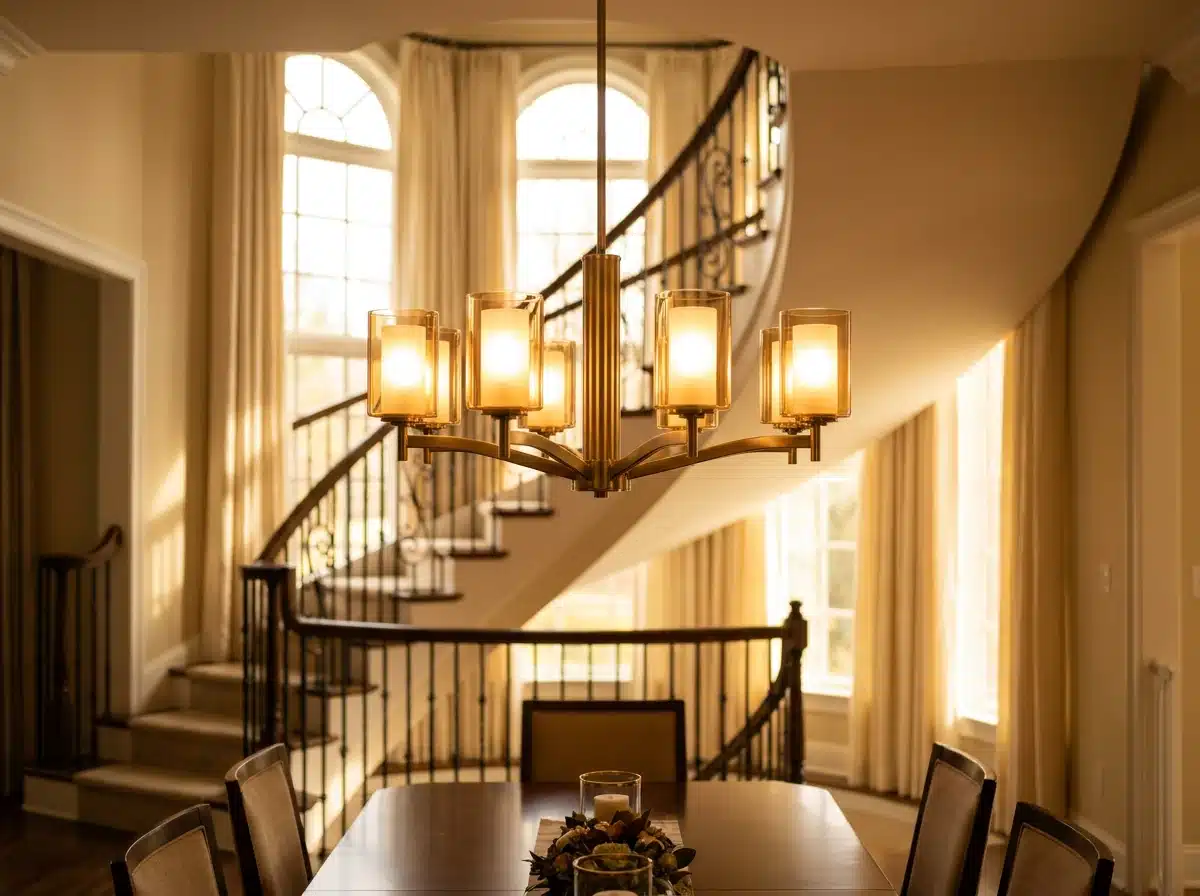
From a simple flush-mount swap to a 150-pound chandelier in a two-story foyer, Ahmad Shaban — Virginia-licensed Master Electrician — handles light fixture installation across Vienna and Northern Fairfax County. We work with fixtures you supply or help you choose the right one.
Key Takeaways
- Licensed: Master Electrician, Commonwealth of Virginia #2710086216 — the highest electrician credential the state issues
- Insured: Fully insured, with documentation available before any work begins
- Fan-rated boxes checked, not assumed: a standard junction box holds roughly 35-50 lbs; anything heavier, including ceiling fans and most chandeliers, needs a fan-rated box (one rated for the extra weight and vibration) or a bracket bolted to the joists
- No trip fee, free estimates — simple swaps are often quoted by phone, and nothing gets installed until you’ve approved a written estimate
- Response time: most on-site visits scheduled same-day or next-day, about 10 minutes from our Fairfax office
- Service area: Vienna, McLean, Oakton, Fairfax, and Tysons
Why this isn’t always a DIY swap
Every fixture in the house hangs off a junction box, and the box is where the actual risk lives — not the fixture itself. Rate it wrong for the weight, wire it loosely, or skip the ground, and the failure is invisible behind drywall until it overheats. That’s the whole reason Virginia requires a licensed electrician for new fixture wiring rather than treating it as a hardware-store project: swapping a flush-mount for a pendant, hanging a chandelier, or adding recessed cans where nothing existed before all come back to that same box. If your existing fixtures are already flickering or the switch plate runs warm, that’s electrical troubleshooting in Vienna territory, not an installation — worth ruling out first.
Homeowners tend to underestimate chandeliers specifically — a 75-pound fixture needs its own fan-rated or heavy-duty box bolted to the ceiling joists, not the drywall the flush-mount was hanging from, and the dimmer has to match the bulb type or an LED chandelier will flicker or buzz. If the dimmer or switch needs replacing as part of the install, our outlet and switch installation in Vienna service covers that in the same visit. Recessed lighting layouts require IC-rated housings where insulation touches the can, and proper spacing so the room lights evenly. If you bought a fixture at a showroom, Home Depot, or Wayfair, we install it — any brand, any style.
Ahmad Shaban is a Virginia-licensed Master Electrician and the owner of EV Electric Services. He runs a maintenance team covering Vienna, McLean, Oakton, Tysons, and the rest of Northern Fairfax County. Ahmad also handles light fixture installation in McLean for estate-scale homes along Georgetown Pike. Chandelier work in Vienna’s luxury home market — Windover Heights, the Westwood Country Club area, renovated colonials along Maple Avenue — is a regular part of his schedule. Ahmad is the person who shows up, assesses the ceiling, and installs the fixture to code.
Why Vienna homeowners call us for light fixture installation
Vienna, VA sits at an interesting electrical crossroads. The town runs roughly between the Wolf Trap area to the west, the Tysons-edge to the east, Hunter Mill Road as its southern spine, and the Maple Avenue corridor at the center, within a few minutes of the Vienna Town Green and Nottoway Park.
1950s-1970s split-levels & ranches
Vienna Woods, Country Club area, neighborhoods near WestwoodThe 100-amp panel that came with a Vienna Woods split-level was sized for a toaster, a fridge, and maybe a window unit — not the induction range, two refrigerators, tankless water heater, and garage EV charger a 2026 household actually runs. Nobody upgraded the panel along the way; the appliances just kept arriving.
Symptoms: persistent breaker trips, warm outlets, dimming lights when large appliances start. If your panel is the bottleneck, a panel upgrade in Vienna may be the first step before adding new fixture circuits.
1970s-1990s colonials & traditionals
Hunter Mill District, Vienna proper, north of Maple Avenue200-amp service but wired with the now-deprecated aluminum branch wiring for a window in the mid-1970s, or with GFCI gaps in kitchens and bathrooms that predate the 1996 code requirement.
Symptoms: outlets that worked yesterday and don’t today, intermittent power loss to one room, GFCIs that trip the moment a hairdryer plugs in.
2000s-2020s townhomes & newer detached
Tysons-edge, Wolf Trap area, newer subdivisionsNewer homes are not exempt. AFCI breakers (the arc-fault interrupters required by modern code) are sensitive by design and trip on any noisy load. Smart-home wiring done by the previous owner’s “handy friend” can leave neutral wires bonded incorrectly.
Symptoms: failed dimmers, dead three-way switches, outlets that test fine but won’t hold a plug. These wiring-era issues often surface during fixture work — our electrical troubleshooting service identifies the root cause before any fixture goes up.
Vienna’s median home was built in 1971. Whether you’re updating the original brass fixtures in a Vienna Woods split-level, installing a statement chandelier in a newly renovated Country Club Hills colonial, or adding recessed lighting to a Tysons-edge townhome — the wiring behind the ceiling tells us what the job actually requires. We look before we install.
What Vienna’s calls actually look like
Seven jobs make up most of what comes in from Vienna. See which one matches your house.
Hanging a heavy chandelier in a two-story foyer
This is the call we get most from Windover Heights and the renovated colonials near Westwood Country Club. A 50-200+ lb chandelier needs a fan-rated box bolted to ceiling joists, not the lightweight box that shipped with a 1971-built house. We assess the ceiling structure, add the bracket, and wire it to code. Two people, always — not a solo ladder job.
Swapping a decades-old builder-grade fixture for something current
Vienna’s median home was built in 1971, and a lot of them are still running their original builder-grade fixtures. The wiring is usually fine, but a 50-year-old junction box or dimmer often isn’t rated for what you’re hanging today. We check the box before we commit to the new fixture, not after.
Adding a fixture where no ceiling box exists yet
Common in Hunter Mill District basement finishes and additions, where there was never a ceiling box to begin with. We run wire from the nearest circuit, cut the opening, and install the box. It’s permitted work in Fairfax County, and since Vienna also requires its own Town approval on top of the county PLUS permit, we handle both filings up front rather than finding out mid-job. While the wiring is open, many Vienna homeowners add hardwired smoke alarms at the same time.
Laying out a recessed lighting job
A frequent request during Maple Avenue-area colonial kitchen and living-room remodels. Vienna’s 1970s-1990s homes typically have blown-in attic insulation, so every can needs an IC-rated housing to sit against it safely. We lay out 4-8 fixtures to actually light the room evenly, not the sparse builder-grade pattern that leaves the corners dark.
Lighting up a wooded or exposed yard
Wooded lots near the Wolf Trap area take more of a beating than a typical suburban yard — falling branches, ground moisture, tree cover holding in humidity. Sconces, soffit lights, and landscape lighting all need weatherproof boxes and GFCI protection rated for that, not the fixtures sold for a dry, open lot. Outdoor outlets get the same treatment under outdoor outlet installation in Vienna.
Swapping a ceiling fan for a light fixture, or the other way around
The box behind a fan and the box behind a light fixture look the same until you check the rating — a fan needs one built for the vibration and extra weight, and in Vienna Woods and the Country Club-area split-levels (built in the 1950s-60s for window units, not ceiling fans) that rating is usually missing on both sides of the swap. We check the box first, add the second circuit a fan’s switch needs, then mount whichever direction you’re going.
Already bought the fixture yourself? We’ll put it up
Plenty of Vienna homeowners — especially in the Country Club Hills and Hunter Mill renovations — show up to the call with the fixture already sitting in the box. That’s fine: brand, style, and weight class don’t change how we install it. What matters is whether the mounting hardware and instructions actually arrived with it, which we check before we start rather than finding out halfway up the ladder.
What happens when you call
Call 571-500-6637 or request a quote online. Simple swaps are often quoted right there on the phone; chandeliers, new locations, and recessed layouts get a quick on-site look first (no charge, about 10 minutes from our Fairfax base to most of Vienna). Installation itself runs 30-60 minutes for a straightforward swap up to half a day for a full recessed layout, and dimmer or switch swaps are included in the same visit — no separate appointment. Need EV charger work too? We can bundle it. See the full step-by-step process.
How estimates work
Vienna’s mix of older split-levels and newer custom colonials means two very different pricing conversations: a straightforward swap on an existing box, or a heavier install that needs a look before we can quote it honestly. We give you a written estimate before any work starts, either way.
A simple swap on an existing junction box — most Vienna calls — is often quotable over the phone, since there’s no structural work involved. A chandelier in one of the two-story Country Club-area foyers is a different conversation: price depends on weight, height, and whether the ceiling needs a reinforced box, so that one gets a written estimate after we’ve seen it in person, same as a brand-new fixture location where the estimate has to cover the circuit run, junction box, switch, and mount (plus a permit where the work requires one). Recessed lighting is priced by the actual layout — how many cans, plus the dimmer — after we measure the room, not off a flat per-fixture rate.
About Ahmad Shaban, Master Electrician
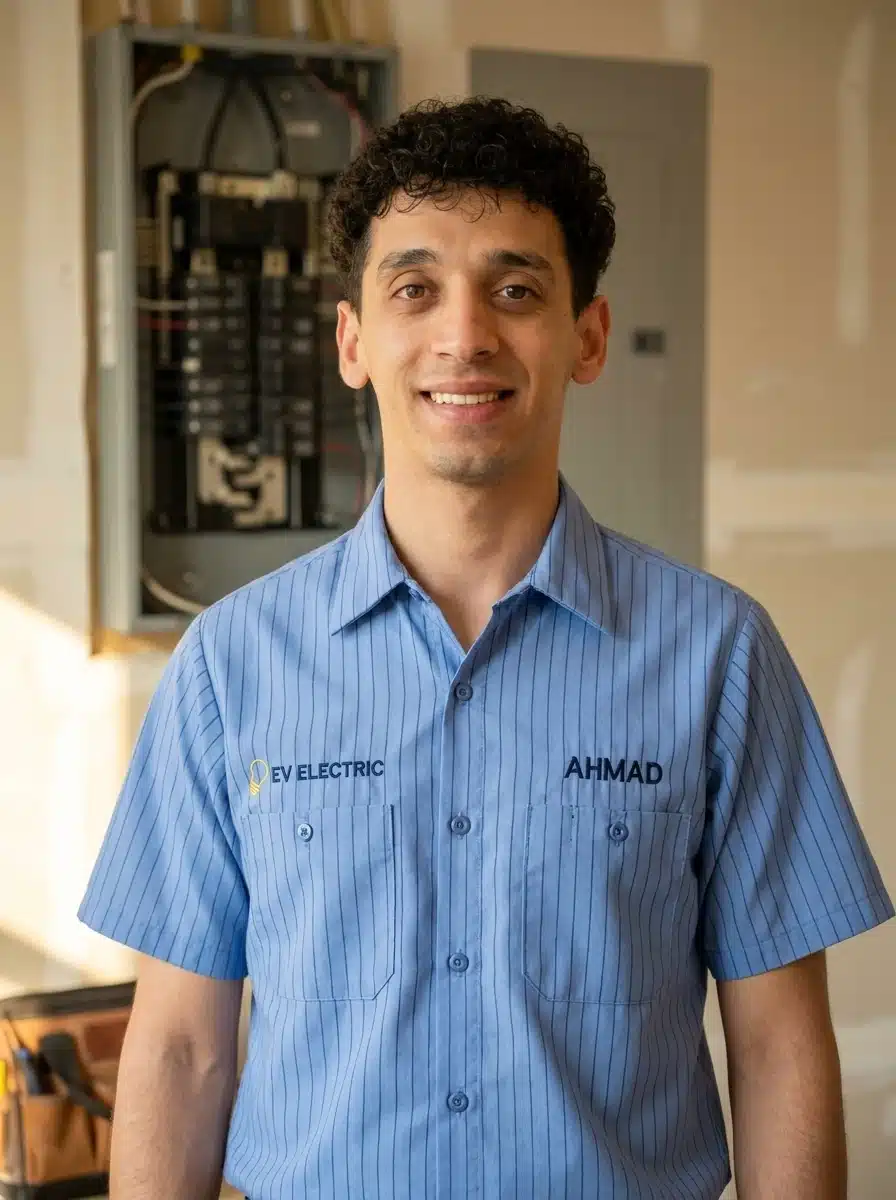
Ahmad Shaban is a Virginia-licensed Master Electrician who handles Vienna’s chandelier and decorative-fixture work personally — the ceiling assessment, the junction box reinforcement, the dimmer compatibility, all of it, rather than handing it to whoever’s free. EV Electric Services is fully insured and holds a 5.0-star average across 122 customer reviews from Northern Virginia homeowners.
Vienna neighborhoods we serve
We cover all of Vienna, VA, including:
- Vienna Woods — the postwar neighborhood north and west of Maple Avenue
- Country Club Hills / Westwood Country Club area — mid-century homes near the Westwood golf grounds
- Hunter Mill District — south of the Vienna town line, between the W&OD trail and Hunter Mill Road
- Tysons-edge — the Vienna sliver of the Tysons commercial district, including newer townhomes off Route 7
- Wolf Trap area — the western edge of Vienna near the Wolf Trap National Park boundary
- Maple Avenue corridor — the central commercial spine, plus the adjacent residential blocks
- Dunn Loring-edge — the southern Vienna blocks near Dunn Loring Metro
Outside Vienna, we serve Fairfax, McLean, Oakton, Tysons, Burke, Annandale, Falls Church, and the rest of Fairfax County. We also cover DC and Montgomery County, MD (Rockville, Bethesda, Chevy Chase, Potomac). If you’re in Fairfax, see our Fairfax light fixture installation page for that area’s own pricing and photos.
What Vienna homeowners usually book alongside this
Vienna’s older colonials near Hunter Mill and Maple Avenue tend to surface a second project once we’re in the ceiling or the panel. In no particular order of urgency, the ones we see most:
Frequently asked questions
Why does a fan-rated junction box matter?
A standard junction box is rated for roughly 35-50 lbs of static weight — enough for a typical flush-mount or small pendant. A fan-rated box (sometimes called a “fan brace box”) is engineered to handle both heavier weight (up to 70+ lbs, depending on the model) and the continuous vibration that ceiling fans produce. NEC code requires a fan-rated box for ceiling fans and any fixture heavy enough to exceed the standard box’s rating. For large chandeliers that exceed even fan-rated limits, we install a heavy-duty mounting bracket bolted directly to ceiling joists. We check the box before every installation — if it needs upgrading, we replace it as part of the job.
Is hanging my own chandelier a bad idea?
A small, lightweight chandelier (under 35 lbs) on an existing junction box is technically a DIY swap if you’re comfortable turning off the breaker, testing with a voltage tester, and matching wires. But most chandeliers worth calling “chandeliers” weigh 50-200+ lbs and require a fan-rated or heavy-duty junction box secured to ceiling joists — not just drywall anchors. Two-story foyer installations add height risk and typically need two people plus scaffolding. If the fixture is heavy, the ceiling is high, or you’re uncertain about the box rating, hire a licensed electrician. The cost of doing it right is far less than repairing a fallen fixture.
Do you handle recessed lighting jobs too?
Yes. Recessed (can) lighting is one of the most popular upgrade requests we get from Vienna homeowners — especially in kitchens, living rooms, and finished basements. We use IC-rated housings (insulation-contact rated) so the cans can sit against attic insulation without creating a fire hazard. We lay out the fixture positions to light the room evenly — not the builder-grade pattern that clusters lights near walls and leaves the center dim. Every recessed layout includes a compatible dimmer switch. We price recessed lighting per layout (number of fixtures plus the dimmer) and give you a written estimate after measuring the room.
What if there’s no fixture there at all right now?
Yes. Adding a new ceiling light where none existed means running wire from the nearest circuit to the new location, cutting a hole in the ceiling, installing a junction box, and connecting the fixture. If there’s attic access above the ceiling, the job is straightforward — we run Romex through the attic and drop it to the new box. If the ceiling is finished with no access above (common in Vienna’s two-story colonials), we fish wire through wall cavities or run surface conduit. Either way, it’s permitted work in Fairfax County and typically requires an electrical permit filed through the PLUS system.
Does a fixture install need a permit?
For a straightforward fixture replacement — swapping one fixture for another on existing wiring with no new circuits — a permit is typically not required in Fairfax County. When the job involves running new wire, adding a new circuit, or installing a fixture where none existed before, an electrical permit is required through Fairfax County’s PLUS system. Vienna is one of two Fairfax County towns that also requires a separate Town of Vienna approval uploaded to the same PLUS record. We handle the permit paperwork when it’s needed and factor it into the timeline. If you’re also upgrading your electrical panel in Vienna as part of the project, the permit covers both.
How much of my day does a fixture install take?
A simple fixture swap — removing the old unit and connecting a new one to existing wiring with a standard junction box — takes 30-60 minutes per fixture. Chandelier installations and new-location installs (where we run wire, install a junction box, and add a switch) take 2-3 hours. Recessed lighting layouts with 6-8 fixtures plus a dimmer take half a day. If you’re scheduling multiple fixtures in one visit, we can usually knock out 3-5 simple swaps in a single morning. We confirm the time estimate before we arrive so you know what to expect.
What if I already bought the fixture somewhere else?
Yes — we install customer-supplied fixtures every week. You pick the fixture from Home Depot, Wayfair, Restoration Hardware, Amazon, or anywhere else; we install it. We work with any brand, any style, and any weight class. Just make sure the fixture arrives with its mounting hardware, wire connectors, and installation instructions. If parts are missing or the fixture isn’t UL-listed for its intended location (wet-rated for outdoor, damp-rated for bathrooms), we’ll flag it before we start so you’re not surprised mid-install. Buying the fixture yourself and hiring us to install it is the most common way Vienna homeowners handle this.
Do I need an electrician to install a light fixture?
For a simple swap on existing wiring, some homeowners do it themselves if they’re comfortable killing the breaker and matching wires correctly. Virginia requires a licensed electrician once the job involves new wiring, a new circuit, or anything beyond a like-for-like swap — and mistakes at the junction box are the kind that stay hidden behind drywall until they overheat. If you’re unsure which category your job falls into, that’s exactly what the phone call is for.
How much does it cost to install a light fixture in Vienna, VA?
It depends on the fixture type, the condition of your existing wiring, and whether the junction box needs upgrading. A straightforward fixture swap — removing the old unit and connecting a new one to existing wiring — is the most affordable option and can often be quoted over the phone. Chandelier installations, new fixture locations that require running wire, and recessed lighting layouts are more involved and priced after an on-site assessment. We give you a written estimate before work begins so there are no surprises. No trip fee and free estimates for Vienna, McLean, Oakton, Tysons, or Fairfax.
Have a fixture, a foyer, or a flickering light in Vienna?
Call 571-500-6637 and tell Ahmad what you’re working with. Most Vienna calls get a same-week appointment.
571-500-6637