
Level 2 EV Charger Installation in Vienna, VA
Most Vienna Homes Don’t Need a Panel Upgrade. We’ll Run the Load Calc and Tell You Before We Quote a Dollar.
Ahmad Shaban — Virginia-licensed Master Electrician — installs Tesla Wall Connectors, ChargePoint, JuiceBox, and any UL-listed Level 2 charger across Vienna, Wolf Trap, Hunter Mill, and Tysons-edge. Dedicated circuit, permit included, permit and Town zoning sign-off handled.
Do I need a panel upgrade for a Level 2 charger?
This is the first question Vienna homeowners ask — and the honest answer depends on one number: what your panel can actually carry.
The load-calc answer for Vienna homes
Most 200-amp Vienna homes do NOT need a panel upgrade to add a Level 2 charger. An NEC 220.82 load calculation usually shows enough headroom. Older 100-amp homes — Vienna Woods, Westwood — often do need an upgrade.
How the math works (NEC 220.82): We add up your existing loads at their code-weighted values (HVAC, water heater, appliances), subtract the allowable demand reduction, and compare the total to your panel’s rated capacity. A 200-amp panel feeding a typical Vienna home — central AC, electric water heater, range, dryer — usually has 40–60 amps of headroom available for a continuous EV load.
The EV circuit requirement (NEC 625): A Level 2 charger requires its own dedicated branch circuit. A 48A charger (Tesla Wall Connector, ChargePoint Home Flex at max) is a continuous load — multiply by 1.25 per NEC continuous-load rules. That means a 60A breaker and #6 copper wire. The panel either has room for that breaker and load, or it doesn’t. The load calc tells you which.
If the calc shows you need a panel upgrade first, we handle both jobs in a single project — one permit, one day, one estimate. See panel upgrades in Vienna for what that entails.
What drives install cost (no dollar figures — here’s why)
We don’t publish install ranges on this page because they genuinely vary by your house — and a number that’s accurate for a 200A attached-garage install in Hunter Mill is wrong for a 100A Vienna Woods detached-garage run requiring a panel upgrade. Here’s what actually shapes the cost:
- Panel capacity. 200A with headroom = charger-only project. 100A or full panel = panel upgrade required first. The load calc tells you in 20 minutes.
- Circuit distance. A 10-foot run from a garage sub-panel is fast. A 60-foot conduit run through a finished basement to a detached garage takes longer and uses more material.
- Indoor vs. outdoor mount. Outdoor installs (Wolf Trap detached garages, driveway pedestals) need weather-rated conduit and hardware; the run is typically longer.
- Hardwired vs. NEMA 14-50. A hardwired 48A Wall Connector and a NEMA 14-50 outlet are different scopes of work.
- Permit. Fairfax County requires an EVCS permit for a new dedicated circuit. We pull it — fee is included in our estimate.
Call 571-500-6637 for a free on-site estimate — we come to the house, run the load calc, and give you a written number before any work is scheduled.
Tax credits and rebates for EV chargers in Virginia
Two incentive angles are worth knowing about before you install. We’re not a tax advisor — confirm current terms with the utility or a CPA before you rely on either. What we can tell you is that the permit documentation we provide is typically required for both.
Dominion Energy Residential Charger Program
Dominion Energy runs a Residential Charger Program for Virginia homeowners. Instead of paying upfront, the program covers the charger, electrical installation (breaker, wiring, outlet), and a five-year warranty — billed through your Dominion account at $40.27 per month for five years. Eligibility: you must have an existing Virginia residential Dominion account in good standing, own a single-family home, have panel capacity, and install within 30 feet of your main panel.
If you’re interested, submit a program interest form on Dominion’s website. We handle the installation side and provide the signed County inspection card Dominion requires.
Federal Form 8911 — Alternative Fuel Vehicle Refueling Property Credit
The federal Section 30C credit (IRS Form 8911) covered 30% of the cost of residential EV charging equipment and installation, up to $1,000 per item. However, this credit terminated on June 30, 2026 (per P.L. 119-21) — charger installations placed in service after that date do not qualify. If you installed before the cutoff and haven’t yet filed, you may still claim the credit on your return. Confirm eligibility with a tax professional.
What we provide for past or pending claims: a written invoice that itemizes labor and materials separately, and the signed permit / inspection card — both typically required for the Form 8911 calculation.
EV charger install scenarios we handle in Vienna
Here are the eight jobs Ahmad gets most often from Vienna homeowners. If your situation matches one of these, you’re in the right place.
Tesla Wall Connector — hardwired, 48A
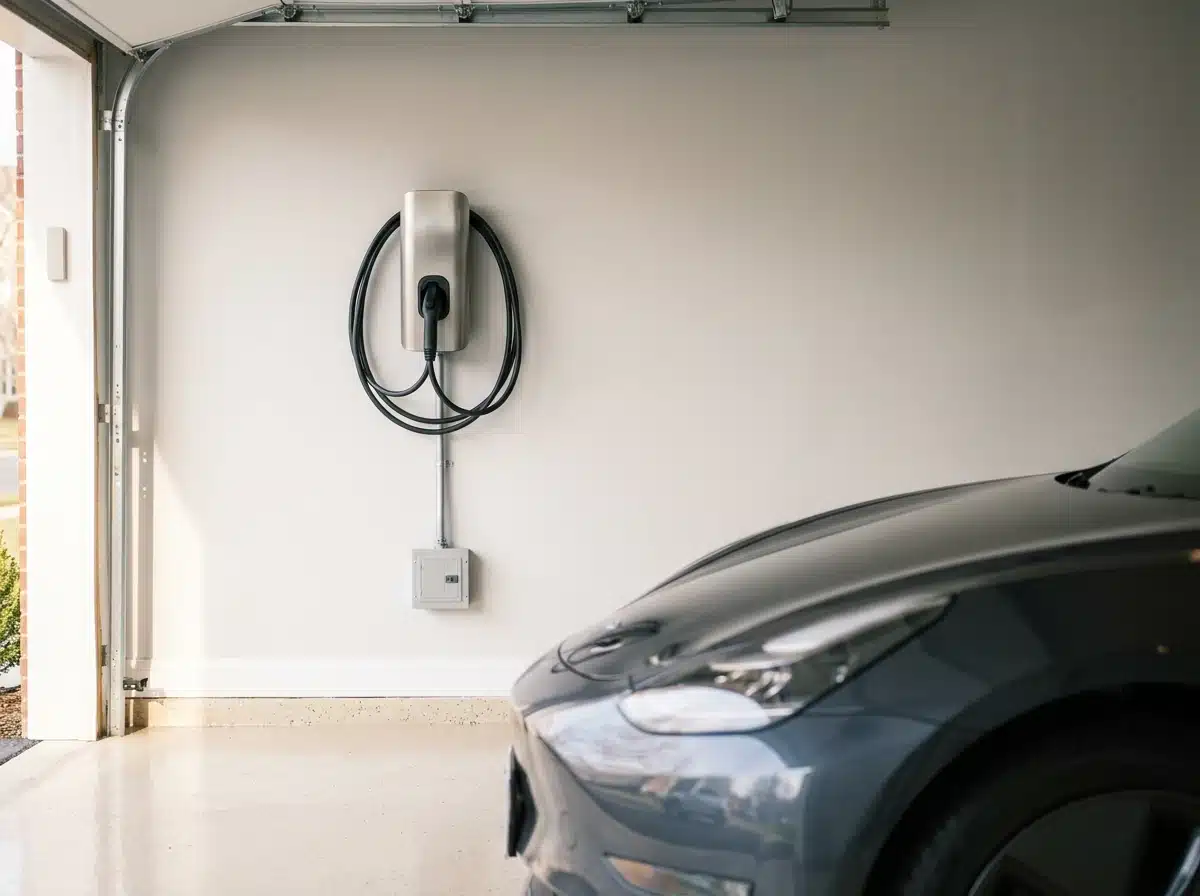
The default install for new Tesla owners. Hardwired at 48 amps for the fastest residential charge speed. NEC 625 dedicated circuit: 60A breaker, #6 copper. We mount the unit, run the circuit from your panel, terminate, commission, and pair to your Tesla account. Typical Vienna job: 3–4 hours in an attached garage.
NEMA 14-50 outlet for portable Level 2
The flexible option. Lets you plug in the portable Level 2 cord that came with your car — most makes now ship one. Cheaper than hardwired. Most often used with Tesla Mobile Connectors, Ford Mobile Chargers, and plug-in JuiceBox 32 units. Good fit for homeowners who may want to take the cord on road trips or haven’t committed to a charger brand yet.
ChargePoint Home Flex install
Smart charger with app control, hardwired up to 50 amps or plug-in at 40 amps. Popular with Ford Lightning, Rivian, and Mustang Mach-E owners who want load-sharing and remote monitoring. We handle the electrical install and walk you through the app setup and any utility program enrollment steps.
JuiceBox or Wallbox Pulsar Plus
Smart chargers with utility-program integration — some support Dominion Energy’s EV time-of-use rate programs. Available hardwired or plug-in. We install the electrical side; you configure the app and the utility enrollment. Good fit for homeowners who want to shift charging to off-peak hours automatically.
Two-charger household
Common in Vienna and McLean. Two chargers can share a feeder if the equipment supports load sharing (Wallbox, ChargePoint, Tesla via Powershare), or each can have its own circuit if panel capacity allows. We run the load calc for the combined draw, size the feeder, and install both in one project. See panel upgrades if the dual load calculation shows you need more capacity first.
Outdoor / detached-garage install
For Wolf Trap large lots, driveway pedestals, or detached garages. Requires weather-rated charger and conduit, a properly mounted disconnect, and a longer wire pull. Most major chargers are rated for outdoor install — we verify the model, plan the conduit route, and install to match the outdoor exposure. Town of Vienna zoning sign-off may apply for exterior equipment on in-town-limits parcels (we handle it).
Charger plus panel upgrade — combo project
When the NEC 220.82 load calculation shows the existing panel can’t carry the EV load. We do both in the same project: panel upgrade during the Dominion meter-drop window, charger install once the new panel is live, single permit covers both. One day of disruption instead of two visits.
Feeder or circuit repair on an existing EV install
If your current charger throttles, trips a breaker, or warms the outlet, the problem is almost always upstream — a feeder, breaker, or termination that can’t sustain the continuous load. We diagnose the cause and repair it. See our Vienna troubleshooting page for the symptom-to-cause breakdown.
Why Vienna EV owners call us — housing by era, install profile by era
Vienna has one of the higher EV adoption rates per square mile in Fairfax County. Tesla, Rivian, Ford Lightning, Ioniq 5, Kia EV6 — they’re all in the neighborhood. The house they charge in tells you what kind of install project you’re looking at before Ahmad ever opens the panel.
1950s–1970s: the panel-capacity constraint
Vienna Woods, Westwood Country Club area — 100-amp original serviceMost of these homes are still on the original 100-amp service panel. A 100-amp panel feeding central AC, an electric water heater, a range, and a dryer is already close to its limit — adding a continuous 48A EV draw usually pushes the NEC 220.82 calc over the safe threshold.
Typical install profile: panel upgrade to 200A first (see Vienna panel upgrades), then a hardwired 48A Wall Connector or a NEMA 14-50 on a 40A circuit. Both done in one project.
1970s–1990s: the clean 200A garage install
Hunter Mill District, Vienna proper, neighborhoods north of Maple Ave200-amp service in most cases. These homes often have a detached garage or an under-house garage with a run from the basement panel. Many already have a sub-panel in the garage — that makes the EV circuit install dramatically simpler because the wire run shortens to a few feet.
Typical install profile: 50A circuit, hardwired ChargePoint Home Flex or Tesla Wall Connector, conduit run from the basement panel or the existing garage sub-panel. The cleanest project type we do at this era.
2000s–2020s: the fastest installs
Tysons-edge, Wolf Trap area newer subdivisions, Dunn Loring-edge townhomes200A or 225A panels, garage right next to the panel, plenty of capacity. The load calc almost always confirms headroom for a 60A EV circuit without any panel work. Some HOAs and townhome rows have communal driveway or exterior-mount constraints — we work around them.
Typical install profile: 48A hardwired Wall Connector or smart charger, short conduit run, finished-wall mount, done in 3–4 hours. If it’s an outdoor Wolf Trap lot install, add conduit and a longer wire pull — still a one-day project.
If your home matches one of these profiles, the load calculation is what settles whether it’s a charger-only job or a panel-plus-charger job. We’d rather quote you the smaller job when the smaller job is the right answer.
Code and permit requirements for EV charger installation in Vienna
Every licensed EV charger install in Vienna touches two bodies of code and two permitting layers. No competitor explains both accurately. Here’s the complete picture.
NEC requirements — what the code mandates
NEC 625 (Electric Vehicle Power Transfer Systems): every EVSE requires its own dedicated branch circuit — no shared loads, no piggybacking on an existing circuit. The circuit must be sized for continuous use.
- 48A charger × 1.25 continuous-load multiplier = 60A breaker minimum
- 60A circuit requires #6 copper conductors (or equivalent aluminum)
- 40A charger × 1.25 = 50A breaker; 40A charger = #8 copper
NEC 220.82 (Dwelling Unit Load Calculation): panel adequacy for the new EV circuit is determined by a residential load calculation — not a guess or a “looks okay.” We run it on every job before we quote the scope. This is the code basis for telling a homeowner they do or don’t need a panel upgrade.
Permit requirements — Fairfax County + Town of Vienna
Fairfax County is the electrical building official for all Vienna-area properties, including those inside the Town of Vienna corporate limits. The County issues the residential electrical trades permit (ELER) and EVCS permit via the PLUS portal (plus.fairfaxcounty.gov, 703-222-0801). We file it.
Town of Vienna zoning layer: if your parcel is inside the Town of Vienna corporate limits, exterior electrical changes — an outdoor EV disconnect, an exterior-mounted charger, a service mast relocation — require a Town of Vienna zoning approval (Planning & Zoning Dept, mss.viennava.gov). That approval document is uploaded to the County PLUS record before the County issues the permit. We handle this step.
ZIP ≠ town limits (CR-140 guard): a “Vienna, VA” mailing address (ZIPs 22180/22181/22182) does not mean your parcel is inside the Town of Vienna corporate limits. Many “Vienna” addresses are in unincorporated Fairfax County. The distinction only affects whether the Town zoning step applies — the County is the electrical building official either way. We verify your parcel status before we file.
How estimates work — what’s included, no surprises
We come to the house, open the panel, walk the conduit route from panel to charger location, run the NEC 220.82 load calculation, and give you a written estimate before any work is scheduled. The estimate is firm. Here’s the structure:
- Hardwired Level 2 charger install (40–48A). Covers permit (EVCS via Fairfax County PLUS portal), dedicated 60A or 50A breaker, conduit and wire run (typical 15–40 feet from panel to charger mount), charger termination, mount, inspection coordination, and Town of Vienna zoning sign-off if applicable. Written estimate before scheduling — you decide whether to proceed.
- NEMA 14-50 outlet install. Covers permit, breaker, conduit, wire, outlet box, and inspection. Simpler scope than hardwired — no charger mount required. Good fit for homeowners using a portable cord-set or who want flexibility on the charger brand.
- Outdoor / detached-garage install. Longer wire pull, weather-rated conduit, exterior mounting surface. Scope depends on distance and mounting surface — itemized in the written estimate. Add Town of Vienna zoning step for in-town-limits parcels (included in project management, no extra charge).
- Charger plus panel upgrade combo. When the load calc says you need both. Single permit covers both jobs. One day of work. See the panel upgrade page for what the panel side of the project involves.
- Two-charger install. Two dedicated circuits if panel capacity allows, or a shared-feeder install with load-sharing equipment. Scope itemized in the estimate based on each charger’s amperage and route.
- Permit and inspection — always included. We pull the County EVCS permit, file Town zoning sign-off where required, meet the inspector, and give you the signed inspection card at closeout.
How the project goes — quick version
You call → we ask about your car, charger, and panel location → we come to the house, run the load calc, and give a written estimate → permit filed with Fairfax County (Town of Vienna zoning sign-off attached if your parcel requires it) → install day: breaker in, conduit run, wire pull, charger mount, termination, test → Fairfax County inspection → you get the signed inspection card.
For the full step-by-step breakdown — what happens at each stage and what documents you receive — see our EV charger installation services page.
Around the corner for the install and inspection — not a franchise dispatched from Lorton
Our shop is at 9488 Fairfax Blvd, right at Fairfax Circle — roughly 10 minutes south of Vienna via Route 123 (Chain Bridge Rd) or Nutley St / I-66. When you book an EV charger estimate, we’re not routing a crew from 20 miles away. Vienna is one of our highest call-volume areas, which means we’re there frequently and we know the housing stock well.
Drive times from our shop to Vienna
- Vienna / Maple Avenue corridor ~10 min
- Vienna Woods / Westwood area ~12 min
- Hunter Mill District ~11 min
- Wolf Trap area ~14 min
- Tysons-edge (Rt 7 corridor) ~15 min
- Dunn Loring-edge ~13 min
- City of Fairfax ~5 min
Local, not a franchise. Ahmad owns the business. The shop address is real. The crew lives and works in Fairfax County. When you call 571-500-6637, a real person picks up, asks about your car and charger, and tells you when the earliest estimate appointment is.
Mr. Electric’s nearest location is in Lorton — about 20 miles south. For a Vienna EV charger install, that’s the difference between a same-week appointment and a 2–3 week wait for a franchise crew to route north. We’re already up here.
Your electrician: Ahmad Shaban
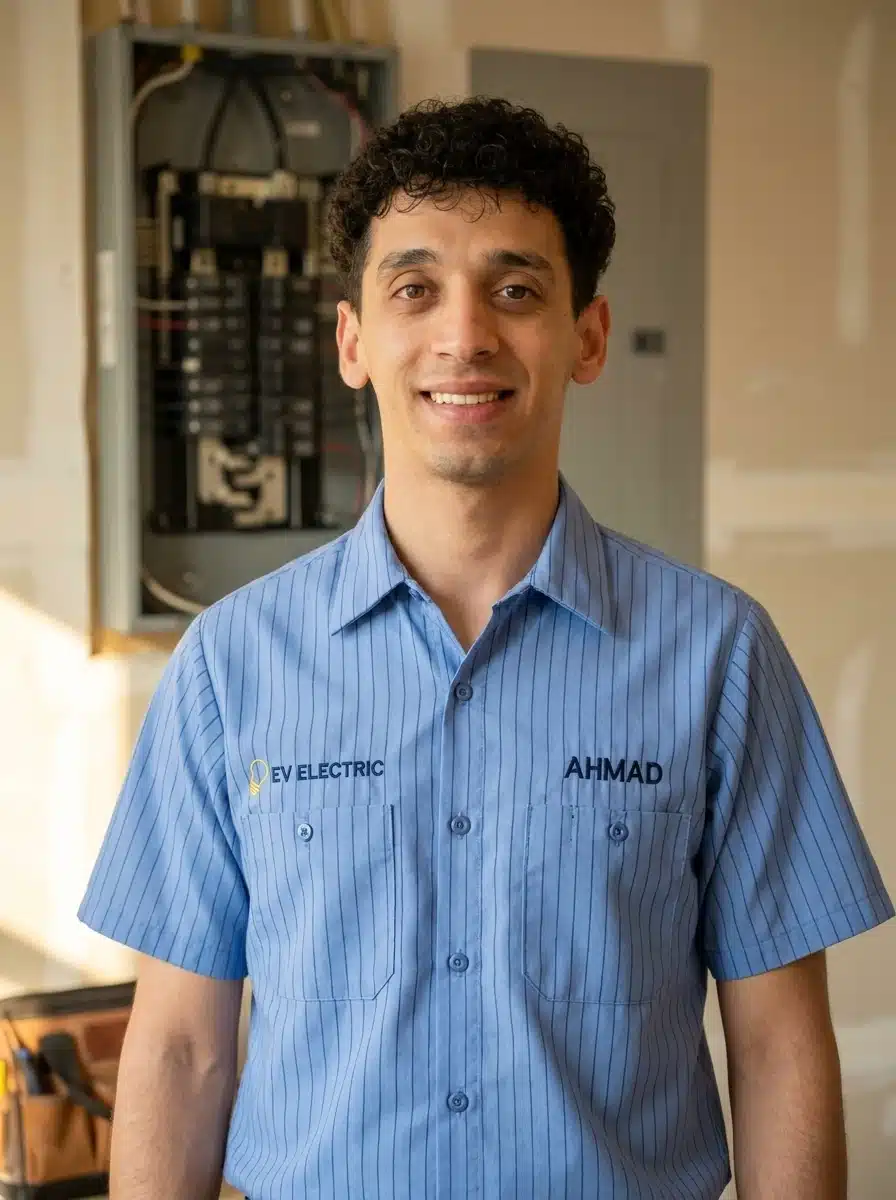
Ahmad Shaban holds a Master Electrician license issued by the Commonwealth of Virginia — the state’s highest electrician credential. EV charger installation is one of his signature service lines. He’s the person who shows up at most Vienna estimates, runs the load calculation, explains the scope in plain English, and oversees the install.
EV Electric Services holds a 5.0-star average across 122 Google reviews. Our review base is real, recent, and from Northern Virginia homeowners — not imported or ghost-written. Ahmad is fully insured and runs a maintenance team, so you’re not waiting on one person’s calendar.
Vienna neighborhoods we serve — EV density by area
Vienna has a high concentration of Tesla, Rivian, and other EV owners spread across neighborhoods with very different housing profiles. Here’s where we install most often and what we typically see in each:
- Wolf Trap area — large lots, detached garages, longer outdoor runs common; Tesla and Rivian owners on generous lot sizes; Town zoning step may apply for exterior installs
- Tysons-edge (Rt 7 corridor) — newer townhomes and mixed-use, 200+ amp panels, some HOA exterior-mount constraints; cleanest installs in the portfolio
- Vienna Woods — postwar 100-amp homes; most installs here pair a panel upgrade with the charger; EV owners in this neighborhood are well aware of the constraint
- Hunter Mill District — 1970s–1990s colonials with 200A service; garage sub-panels common; typically clean installs once we verify the run distance
- Country Club Hills / Westwood area — mid-century homes, mixed 100A and 200A; Rivian and Tesla visible on driveways throughout; same constraint story as Vienna Woods
- Maple Avenue corridor — central Vienna, mixed housing stock, both Town-of-Vienna-limits and unincorporated parcels
- Dunn Loring-edge — near Dunn Loring Metro; townhome and detached mix; newer stock, 200A panels
Outside Vienna, we install EV chargers in Fairfax, McLean, Oakton, Tysons, Burke, Annandale, Falls Church, and the rest of Fairfax County. We also cover DC and Montgomery County, MD.
Related electrical services in Vienna
The EV charger is often one piece of a larger project. Here’s what we handle alongside it:
Frequently asked questions
How much does it cost to install an EV charger in Vienna, VA?
We don’t publish ranges because they genuinely vary by house — panel capacity, circuit distance, indoor vs. outdoor mount, and whether a panel upgrade is needed all affect the scope. We come to your house, run the NEC 220.82 load calculation, walk the conduit route, and give you a written estimate before any work is scheduled. The estimate is firm. No trip fee and free estimates for Vienna. Call 571-500-6637 for a free estimate.
Is there a tax credit or rebate for EV chargers in Virginia?
Dominion Energy’s Residential Charger Program covers the charger, installation, and a five-year warranty for $40.27/month over five years (instead of a lump-sum payment) — eligibility requires a Virginia residential Dominion account and a single-family home. The federal Form 8911 credit (30%, up to $1,000) terminated June 30, 2026 for new installations, but if you installed before that date you may still claim it on your return. The signed permit and inspection card we provide at closeout is the documentation both programs require. Confirm tax credit eligibility with a CPA.
Do I need a panel upgrade for a Level 2 EV charger?
Most 200-amp Vienna homes don’t. An NEC 220.82 load calculation usually shows enough headroom for the 60A dedicated circuit a 48A charger requires. Older 100-amp homes in Vienna Woods and Westwood often do need an upgrade — the existing panel can’t carry the continuous draw on top of modern residential loads. We run the calc before we quote anything. If both are needed, we handle them in one project. See panel upgrades in Vienna.
NEMA 14-50 vs. hardwired — which is better for my Vienna home?
A NEMA 14-50 outlet is more flexible — you plug in the portable cord that came with your car and can take it on road trips. Hardwired is faster (no plug-load derating, so a Tesla Wall Connector delivers its full 48A), cleaner-looking, and the only option for some chargers at maximum output. If you’re a Tesla owner who wants the fastest overnight charge, hardwired is usually the call. For other EVs or households that want portability, a NEMA 14-50 works fine. We’ll recommend based on your specific car and charger.
Can I install my own EV charger in Virginia?
Virginia allows licensed homeowners to do some electrical work on their own primary residence, but an EV charger install at 40–60 amps requires a permit — and Fairfax County’s EVCS permit is issued to a licensed contractor. Even if the DIY were legally permissible, an unpermitted EV charger circuit can affect your homeowner’s insurance, your ability to sell the house, and your eligibility for utility and federal incentive programs. A Master Electrician pulling the permit and passing the County inspection is the cleanest path for any of those reasons.
How long does EV charger installation take?
Most residential Vienna installs are a 3–5 hour job on install day. Panel to charger location in an attached garage runs on the shorter end; long outdoor or in-ground runs to a detached garage take longer. If a panel upgrade is also needed, plan on a full day. Permit filing takes 2–5 business days before we schedule install day. We give you the full timeline with the written estimate.
Do you pull the permit for Vienna EV charger installations?
Yes. We file the Fairfax County EVCS permit via the PLUS portal. For homes inside the Town of Vienna corporate limits where exterior equipment (outdoor charger, disconnect) is involved, we also file the Town of Vienna zoning approval and upload it to the County record. Permit and zoning fees are included in our estimate. You get the signed County inspection card at closeout — the document most utility programs and tax credit applications require.
Ready to charge at home in Vienna?
Level 2 EV charger installation — load calculation, permit, inspection, Town zoning sign-off. Free written estimate before any work is scheduled.
571-500-6637