
Electrical Troubleshooting in Oakton, VA
Know What’s Urgent Before You Call
Burning smell, sparking, a breaker that won’t stay reset — some electrical symptoms mean stop and call now. Ahmad Shaban, a Virginia-licensed Master Electrician minutes from Oakton via Route 123, tells you what to do immediately, then diagnoses the actual cause.
Key Takeaways
- Licensed: Master Electrician, Commonwealth of Virginia #2710086216 — the highest electrician credential the state issues
- Insured: Fully insured, with documentation available before any work begins
- Built to code, not just to look right: GFCI (the outlet or breaker that shuts off power when it senses a current leak) and AFCI (the breaker that shuts off power at the first sign of a dangerous arc) protection checked and confirmed on every diagnostic visit
- No trip fee, free estimates — the diagnostic visit costs nothing in our primary service area, and nothing gets repaired until you’ve approved a written estimate
- Response time: same-day or next-day for most calls, about 10 minutes from our Fairfax office via Route 123
- Service area: Oakton, Vienna, Fairfax, McLean, and Tysons
Why “troubleshooting” is its own step, not just a repair call
In Oakton, the same symptom can have two completely different causes depending on which decade your home was built in. A breaker that trips repeatedly means something different in a 1960s Berryland Farm ranch on its original 100-amp panel than it does in a 2015 teardown-rebuild near Fair Oaks. “Troubleshooting” is the diagnostic step that tells the two apart before anyone touches a wire.
Two Oakton houses can trip a breaker for opposite reasons, and guessing wrong means paying for a repair that doesn’t fix anything. A well pump added to a garage sub-panel in the 1980s, a detached horse barn wired on its own run in the 1990s, an original 1960s ranch still carrying aluminum branch wiring under a coat of drywall — each of these fails differently, and the fix for one would do nothing for the other, and guessing wrong means paying twice: once for the wrong repair, and again for the real one.
Ahmad Shaban is a Virginia-licensed Master Electrician with a maintenance team behind him, and he runs this same diagnostic-first process on residential systems across Oakton and the rest of Northern Fairfax County. Not “swap and pray” — read the panel, test the circuits, trace the fault to where it actually starts, then explain what’s happening in plain English before any repair begins.
Why Oakton homeowners call us for diagnostics
Oakton is an unincorporated community in Fairfax County, VA, centered where Chain Bridge Road (Route 123) meets Hunter Mill Road — the same crossroads that gave the community its name in 1883. The area covers roughly 10 square miles between Vienna to the east, the City of Fairfax to the south, Fair Oaks to the west, and the Wolf Trap area to the north, with I-66 running along the southern edge. From Oakton, most Fairfax County reference points are 10-15 minutes away, and downtown DC is a 30-45 minute drive depending on traffic.
1960s-1970s ranches & split-levels
Berryland Farm, the Blake Lane corridor near Blake Lane Park, older pockets near Hunter Mill RoadThe earliest wave of Oakton’s suburban development. Built with 100-amp panels (occasionally upgraded to 150-amp by prior owners) and circuits sized for the appliances of the era — a window AC unit, a refrigerator, a color TV. Wiring is cloth-insulated copper in the 1960s builds and PVC-insulated copper in the 1970s, with a window of aluminum branch wiring in the late 1960s through early 1970s (NEC deprecated aluminum branch circuits in 1972, but installation continued for several years). Plumbing is original galvanized steel supply lines running to copper at fixtures. Insulation is thin — R-13 walls at best, often less. These homes are now 50-60 years old, running modern loads (central AC, induction ranges, EV chargers, home offices with multiple monitors) on infrastructure never designed for them.
Symptoms: Persistent breaker trips when running the AC or a space heater on the same circuit as the kitchen. Warm outlet cover plates on original receptacles with backstabbed connections. Flickering lights throughout the house when the HVAC compressor kicks on — a voltage-drop signal from undersized service entrance wiring or a loose neutral at the meter base. Aluminum branch wiring connections oxidizing at switches and outlets, producing intermittent arcing.
1970s-1990s colonials & traditionals
Fox Mill Estates, Waples Mill Manor, Hunt Valley, Taylor Run, Foxvale EstatesThe dominant housing era in Oakton — these neighborhoods define the community’s suburban character. Most have 200-amp service as original equipment (the 1990s builds almost universally). The 1970s-early-1980s homes may have 150-amp or early 200-amp panels. GFCI coverage varies: homes built before the 1996 NEC requirement (which mandated GFCIs at every kitchen counter receptacle) typically have GFCIs only at outdoor and garage circuits, if at all. Plumbing transitions from copper (1970s-1980s) to early PEX (1990s). Central AC is standard in all of these. Gas furnaces with Washington Gas service are the dominant HVAC configuration. These homes are 30-50 years old — old enough that original panels, breakers, and wiring connections are showing their age, but young enough that most homeowners assume everything is fine until a symptom appears.
Symptoms: Outlets that worked yesterday and don’t today — usually a tripped GFCI upstream that the homeowner doesn’t know exists, or a wire-nut connection that loosened inside a buried junction box. Intermittent power loss to a single room when the dryer or dishwasher runs (circuit sharing on a panel that looked fine at 150 amps but can’t sustain today’s loads). GFCIs in kitchens and bathrooms that nuisance-trip because pre-1996 homes were retrofitted with GFCI outlets but the downstream wiring has grounding defects.
2000s-2020s townhomes, condos & newer detached
Newer developments near Fair Oaks, I-66 corridor townhomes, teardown-rebuilds on Blake LaneOakton’s newer housing stock includes both purpose-built townhome/condo communities (contributing to the 37% multi-unit share) and teardown-rebuild custom homes on older lots. All have 200-amp service minimum, AFCI breakers per NEC 2008+ requirements, and modern PEX plumbing. The issues here are different from older stock: AFCI breakers are sensitive by design and trip on noisy loads (arc-fault nuisance tripping is the most common callback in newer homes); smart-home wiring installed by the previous owner may have neutral-bonding issues; and townhome owners face HOA approval requirements for visible exterior work (EV chargers on garage walls, generator pads). Some teardown-rebuilds sit on lots where the Dominion Energy service drop was sized for the original 1960s ranch and hasn’t been upgraded to match the 4,000+ sq ft replacement home.
Symptoms: AFCI breakers that nuisance-trip on vacuum cleaners, treadmills, or LED dimmer switches — the most common callback in post-2008 homes. Smart-home devices (smart switches, video doorbells, whole-house audio) causing neutral-bonding faults that trip breakers or produce buzzing at switch plates. Townhome EV charger circuits tripping because the Dominion service drop was sized for the original building load and hasn’t been upgraded. Teardown-rebuild homes where the 4,000+ sq ft replacement draws more than the original 1960s-era service entrance can deliver — voltage sags under peak load.
Oakton (ZIP 22124) also has a share of larger, semi-rural lots toward Hunter Mill Road and Great Falls, some with well pumps, detached garages, or barns wired decades apart from the main house — a different diagnostic starting point than a standard tract home, and one we size up before quoting anything. If your home falls in any of these patterns, the diagnostic step is what tells you whether you need a quick fix, a bigger repair, or a panel upgrade. Guessing costs more than knowing. That’s why people call.
First — is this urgent?
Eight calls make up most of what Ahmad sees in Oakton. Each one below is tagged for how urgent it really is, not how alarming it sounds.
The same breaker keeps popping, no matter how many times you reset it
In Oakton’s older ranches near Berryland Farm and the Blake Lane corridor, a breaker that pops repeatedly usually means a 100-amp panel from the 1960s carrying a modern kitchen, a window AC unit, and a home office it was never sized for. In newer Fox Mill Estates and Waples Mill homes, the more common cause is one failed breaker, not the whole panel. We test the load before we touch a wire, so you’re not paying to replace a panel that’s actually fine.
One room’s outlets are dead while the rest of the house is fine
This is almost always a tripped GFCI upstream, not a dead outlet. In Oakton’s 1970s-1990s colonials — Fox Mill Estates, Waples Mill, Hunt Valley — a single GFCI in a garage or bathroom often protects several rooms’ worth of receptacles, and most homeowners don’t know which one. We trace the circuit map instead of opening every box in the house, and usually find the reset point in under half an hour.
Lights dim every time the AC or fridge kicks on
Oakton’s original 1960s service entrances run smaller than the 200-amp service most 1990s-and-newer homes have, so a big motor kicking on — the AC, the fridge, a well pump — pulls the whole system down for a second and you see it in the lights. Ignore it long enough and that same strain shortens the AC compressor’s life along with everything else on the circuit. Rather than guess from the panel, we go straight to the service entrance and measure it under load.
You smell something burning, or a switch plate feels warm
In an older Oakton ranch or colonial, a loose connection at a backstabbed outlet or an aging panel lug builds heat quietly for months before anyone notices — and heat inside a wall is how house fires start. Sparking, an actual burning smell, or a switch plate that’s warm to the touch means the circuit stays off until we’ve looked at it. We’re close enough to be on-site within the hour for these.
The EV charger keeps tripping or throttling itself
A detached garage in Fox Mill Estates or Waples Mill often means the charger’s circuit run is longer than a builder-grade panel was ever sized for, and a Level 2 charger pulls continuous high-amp current for hours, not minutes — so a marginal run that never mattered for a drill or a shop light shows up fast once a car’s plugged in every night. Throttling, a tripped breaker, or a warm outlet almost always trace back upstream of the car itself. See our EV charger installation page in Oakton for a permanent fix.
Power’s out on one side of the house, not the other
An open neutral at the service entrance is the usual culprit when power splits unevenly through the house — one side dead, the other fine — and it’s a condition Oakton’s original 1960s-70s service drops are especially prone to after decades untouched. Left alone, it slowly cooks electronics on whichever leg is running hot. Before you plug anything back in, we check the voltage on both legs to confirm exactly where it failed.
A hallway or staircase switch that only works from one end
Hallway and staircase switches wired years apart — common in Oakton’s older ranches after a remodel touched one end but not the other — use a traveler-wire setup that’s easy to get wrong. When someone before us scrambled the travelers, you get a switch that only works from one end, buzzes, or seems to have a mind of its own. It’s usually a 1-2 hour fix once we’re looking at the right junction box.
An added sub-panel that’s never worked quite right
A finished basement or a garage workshop in Foxvale Estates or Taylor Run often came with a sub-panel added along the way, and those add-on jobs are where we find most of our intermittent-fault calls, especially the ones done before Fairfax County LDS ever inspected the work. Before we call it done, we check three things: is the feeder wire actually sized for the load, is the grounding and bonding correct, and does it hold up against the code in effect today, not the code in effect when it was installed.
What happens when you call
Call 571-500-6637 or request a quote online. Ahmad asks about the symptom and, since Oakton is about 10 minutes away via Route 123, usually gets you a same-day or next-day appointment. He diagnoses the fault on site, tells you the cause and the cost in plain English, and most repairs — a breaker swap, a GFCI or outlet replacement — finish the same visit. Bigger jobs like a panel upgrade get their own written estimate and, since Oakton is unincorporated Fairfax County, a single ELER trade permit filed through Fairfax County Land Development Services’ PLUS portal (703-222-0801) — not the extra Town layer some neighboring jurisdictions require. See the full step-by-step process.
How estimates work
We don’t quote troubleshooting over the phone, not because we’re being cagey, but because Oakton’s wiring varies too much by decade to guess honestly. A 1960s Berryland Farm ranch and a 2010s teardown-rebuild near Fair Oaks present completely different panels and completely different fault patterns. Ahmad sees the actual wiring before he writes a number.
Most Oakton calls are a 1-2 hour diagnostic that ends with the fix already done — a GFCI outlet, a swapped breaker, a re-terminated connection — with the written estimate covering parts and labor before anything’s touched. If you’d rather think it over first, ask for a diagnostic-only visit: Ahmad still finds the problem and writes up the cost, but the scheduling call is yours. A panel upgrade in an original 1960s Berryland Farm home, a Fox Mill Estates sub-panel, or a Fair Oaks circuit re-run is bigger than a same-visit fix, so those get their own written estimate and, where Fairfax County requires it, a permit filed before work starts. After-hours service is available too — mention it when you call if a breaker won’t hold or something smells like it’s burning.
About Ahmad Shaban, Master Electrician
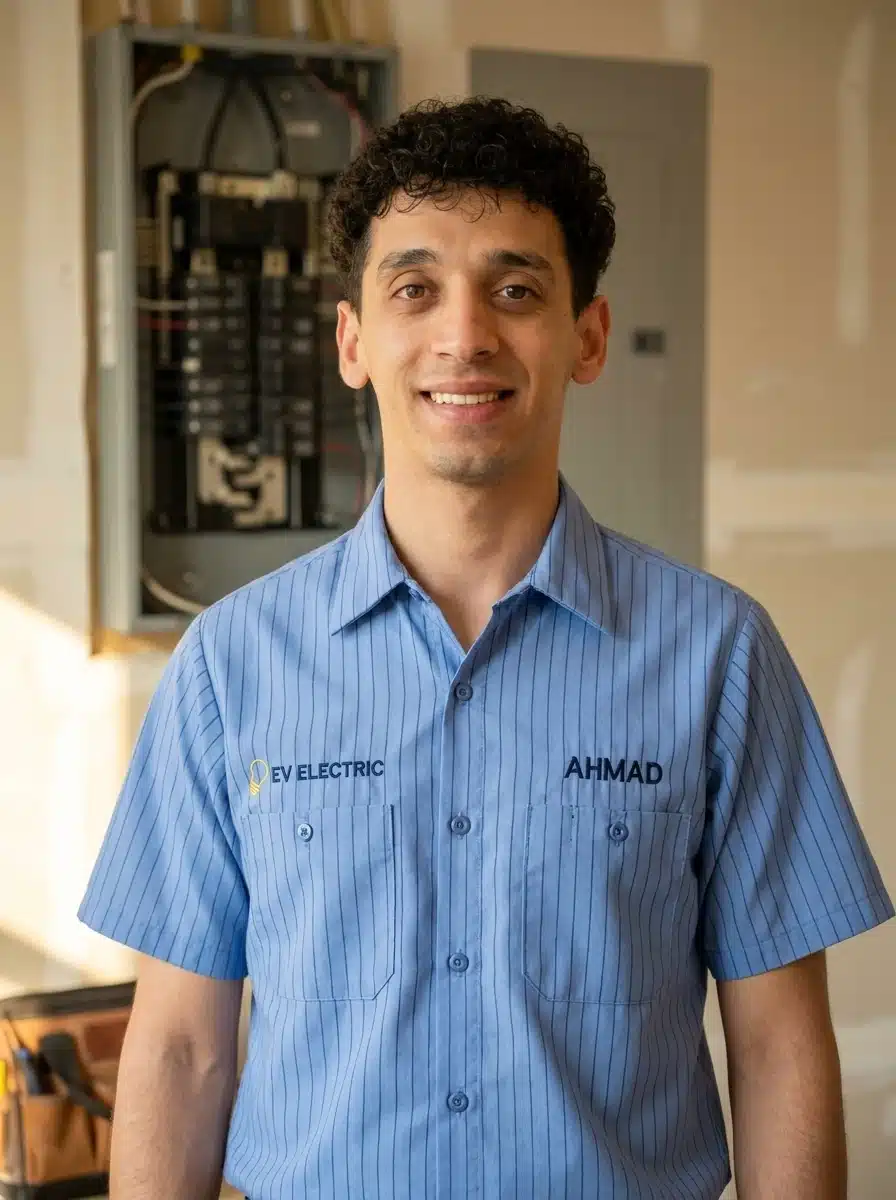
Ahmad Shaban is a Virginia-licensed Master Electrician — the state’s highest residential electrician credential — and he’s the one who shows up to Oakton calls, not a rotating crew. EV Electric Services is fully insured and holds a 5.0-star average across 127 customer reviews from Northern Virginia homeowners.
Oakton neighborhoods we serve
We cover all of Oakton, VA, including:
- Fox Mill Estates — family-oriented neighborhood near Fox Mill Elementary
- Waples Mill Manor / Waples Mill Estates — established homes along the Waples Mill Road corridor
- Hunt Valley — quiet subdivision south of Route 123
- Clarks Crossing — wooded lots near the Difficult Run stream valley
- Taylor Run — family-friendly neighborhood with community pool access
- Foxvale Estates — spacious single-family homes near Oakton High School
- Berryland Farm — established community near the Vienna-Oakton border
- Blake Lane corridor — the eastern Oakton residential strip along Blake Lane
Outside Oakton, we serve Vienna, Fairfax, McLean, Tysons, Burke, Annandale, Falls Church, and the rest of Fairfax County. We also cover DC and Montgomery County, MD (Rockville, Bethesda, Chevy Chase, Potomac).
Once we’ve found the fault
Oakton’s mix of 1960s ranches, 1970s-1990s colonials, and larger estate lots toward Hunter Mill Road means the “bigger job” a diagnosis turns up isn’t the same house to house. These are the ones we see most from this area:
Frequently asked questions
Are you licensed and insured?
Yes — Virginia requires anyone doing this work to be licensed through the Department of Professional and Occupational Regulation, and licenses come in tiers. Ahmad holds the Master Electrician license, the highest tier the state issues, which requires years of journeyman work, a passed state exam, and a clean record. EV Electric Services is fully insured. We’re happy to provide proof of license and insurance on request before any work begins.
Do you offer 24/7 emergency service?
Not as a marketed 24/7 line, no — but after-hours help is available when you genuinely need it. For most Oakton troubleshooting calls, the fastest path is still booking the earliest weekday opening. If it’s a real emergency (sparks, burning smell, fire risk), call 571-500-6637 and say so — we’ll triage it immediately instead of putting you in the normal queue.
Is my electrical problem an emergency?
Treat it as one if you smell burning, see sparking, feel warm walls or warm switch plates, or a breaker trips repeatedly and won’t stay reset. Shut off the circuit at the panel and call us — we’ll triage those calls to the front of the line. Everything else on this page (a dead outlet, a flickering light, a switch that’s wired wrong) is a normal appointment, not an emergency.
What’s the most common electrical problem in Oakton homes?
Two patterns dominate in Oakton. In the 1960s-1970s ranches and split-levels (Berryland Farm, Blake Lane corridor), the most common issue is circuit overload — original 100-amp panels and wiring carrying modern loads like central AC, home offices, and EV chargers they were never sized for. In the 1970s-1990s colonials that make up most of Oakton (Fox Mill Estates, Waples Mill, Hunt Valley), the most common call is intermittent power loss from aging connections — wire nuts, backstabbed outlets, and panel lugs that have loosened over 30-40 years of thermal cycling.
Do you handle EV charger problems?
Yes. A Level 2 charger draws continuous high-amp current for hours, which exposes weak links in a service entrance that predates EV ownership — especially in Oakton’s older Fox Mill Estates and Waples Mill homes. If your charger throttles itself, trips a breaker, or the outlet runs warm, the fault is almost always upstream of the car. See our EV charger installation page for a permanent fix.
When should I call an electrician vs. trying to fix it myself?
Call right away for a burning smell, sparking, or warm switch plates — those are fire-risk signals, not annoyances. A breaker that trips once and resets fine is normal. One that trips three times in a row, or a room that loses power for no clear reason, is worth a call. When in doubt, it costs nothing to ask.
What’s included in a troubleshooting visit?
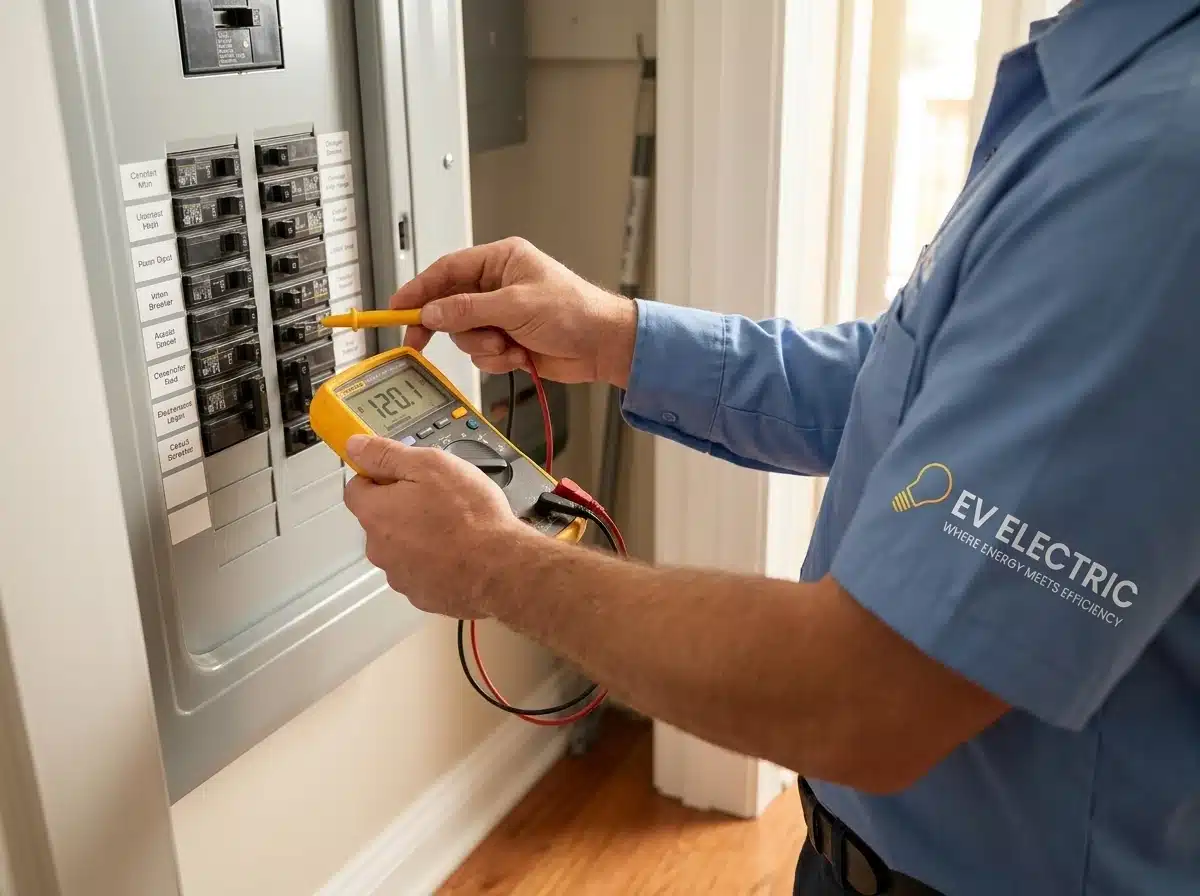
Not a guess — an actual diagnostic. Ahmad brings a multimeter, a circuit tracer, an AFCI/GFCI tester, and an IR thermal camera if heat is part of the complaint. He opens the panel, tests circuits both at rest and under load, and traces the fault back to where it actually starts before explaining any of it in plain English.
How quickly can you come out for a troubleshooting call in Oakton?
Weekday troubleshooting calls in Oakton are usually same-day or next-day — we’re about 10 minutes away via Route 123, so scheduling is rarely the holdup. If what you’re describing sounds urgent (burning smell, sparking, warm walls), we move you to the front of the queue and tell you what to shut off until we arrive.
How does pricing work for electrical troubleshooting in Oakton, VA?
Ahmad comes to your house, looks at the actual wiring, and writes up the estimate before any repair starts. Diagnostic visits usually include the minor repair right there. A panel, sub-panel, or full circuit re-run gets its own separate written estimate. The diagnostic visit itself is free anywhere in our primary Fairfax County service area, which covers all of Oakton.
Have an Oakton electrical problem you can’t pin down?
Ahmad looks at the actual wiring before naming a price — most Oakton calls get seen same-day or next-day.
571-500-6637