
Panel Upgrades in Oakton, VA
Panel Upgrades in Oakton, VA — From Your Neighborhood Electrician, 8 Minutes Away
Ahmad Shaban — Virginia Master Electrician — is about 8 minutes from Oakton on Route 123. Code-complete upgrades with permit, inspection, and Dominion coordination included.
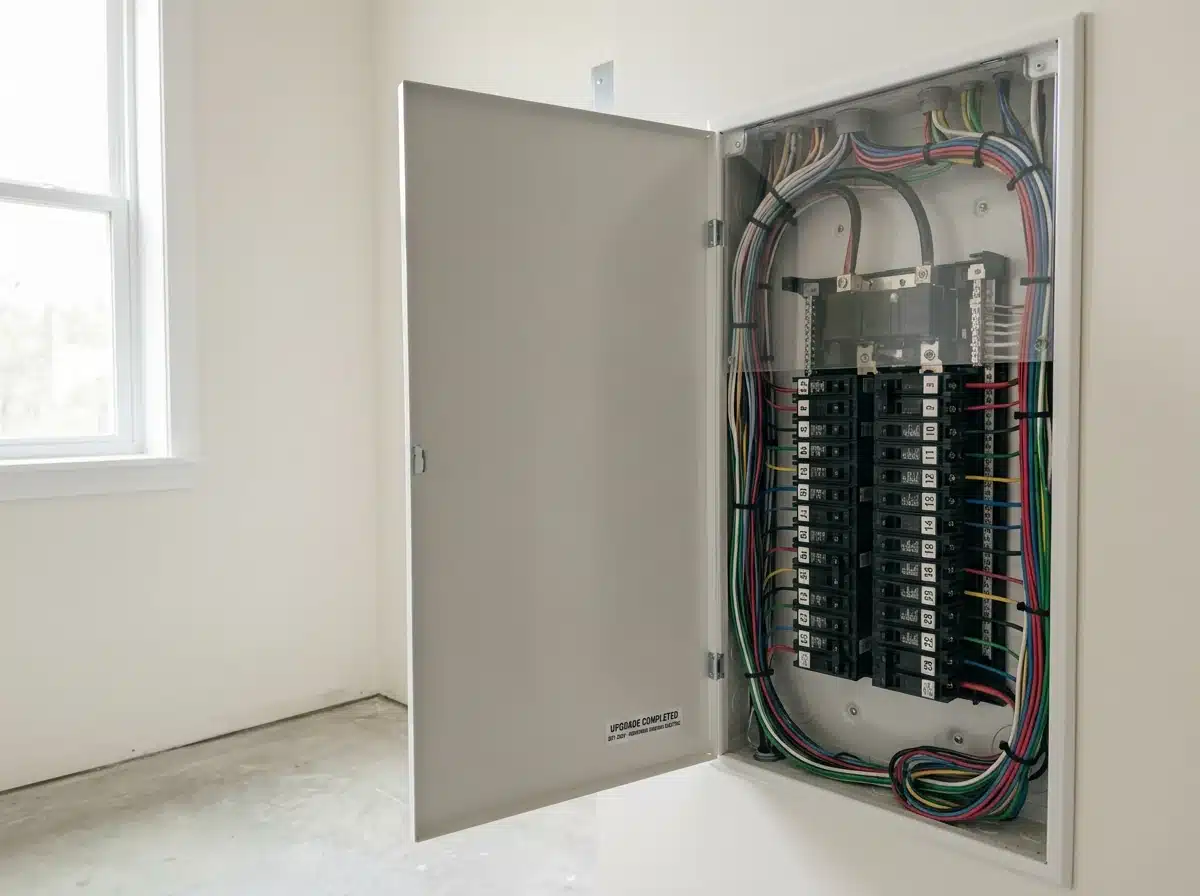
What a code-complete panel upgrade looks like in Oakton
EV Electric Services is about 8 minutes from Oakton on Route 123 — and a code-complete panel upgrade here includes the now-required outdoor disconnect (NEC 230.85) and whole-home surge protection (NEC 230.67). Permit, inspection, and Dominion coordination included — no surprise add-ons.
If you have a Federal Pacific Stab-Lok panel — common in Oakton’s 1960s-70s ranches on Blake Lane and Sutton Road — your insurer may already be requiring this.
What Oakton homes actually need varies by when they were built. Here is what we typically see in three eras of Oakton housing.
Six signs your Oakton panel needs replacement
These six triggers consistently lead to a replacement — not a repair — in Oakton homes. Oakton’s mix of 1960s ranches and 1990s colonials means items 1–2 (FPE/undersized panels on Blake Lane) and item 3 (EV charger headroom in Fox Mill Estates) account for most of the calls we take here.
If none of these match your situation, your issue may be branch-wiring or a breaker fault rather than the panel itself. We diagnose the root cause on-site before recommending a scope.
Does your panel match any of these?
Each sign points to a common Oakton housing scenario.
Fuse box or 60A/100A panel
Original 60- or 100-amp panels in Oakton’s 1960s-70s ranches and split-levels cannot support today’s combined loads — central AC, EV charger, home office, and kitchen appliances. A full service upgrade to 200A is the standard recommendation.
FPE Stab-Lok or Zinsco panel (insurer flag)
Independent testing shows these breakers can fail to trip on overload. Insurers refuse or cancel coverage. Common in Oakton’s Blake Lane corridor and Sutton Road ranch stock from the 1960s-70s.
Adding EV charger with no panel headroom
A Level 2 EV charger draws 40A-50A continuous. Many Oakton panels — especially in Fox Mill Estates and Waples Mill — have no spare breaker slots or headroom for this load without a sub-panel addition.
Breaker trips on every large-appliance start
AC compressor inrush, electric dryer, or microwave on the same leg — if the breaker trips on startup, the panel is undersized for the connected load. Common in 100A ranches throughout Oakton proper.
Pre-sale inspection flag on aging panel
Home inspectors routinely flag FPE, Zinsco, and undersized panels. A code-complete replacement before listing removes the buyer objection and keeps the sale timeline on track.
Finished basement or home office expansion
Adding circuits for a finished basement, home office, or workshop in Oakton colonials and townhomes can exceed the existing panel capacity. A load calculation determines whether a sub-panel or full upgrade is needed.
What Oakton homes need — by era and neighborhood
No competitor names Oakton neighborhoods or maps panel issues to housing eras. We do, because the era your home was built determines what you are most likely facing.
1960s-70s ranches and split-levels
Blake Lane corridor, Sutton Road, Oakton properOriginal 100-amp panels sized for mid-century loads. FPE Stab-Lok panels are common in this era — documented fire risk, insurer denial trigger. Mid-1970s builds may also have aluminum branch wiring at the terminations.
Typical scenario: A 1968 ranch on Blake Lane with a 100-amp FPE Stab-Lok panel — the insurer flagged it. Upgrade to 200A with outdoor disconnect, surge protection, and full code adders cleared the insurance issue and brought the service current for an EV charger.
1980s-2000s colonials and townhomes
Fox Mill Estates, Waples Mill, Oakton Village200-amp service was standard by this era, but GFCI gaps on kitchen and bathroom circuits remain common. The panel itself is usually adequate — the issue is headroom when adding an EV charger or heat pump circuit.
Typical scenario: A 2001 colonial in Fox Mill Estates — homeowners adding a Level 2 EV charger. The 200A panel had no headroom for a 50A continuous circuit. Added a 60A sub-panel to handle the charger plus a future heat pump without replacing the main panel.
2000s+ custom builds
Vale area, Miller HeightsModern 200A service with AFCI breakers that are sensitive by design. Failure modes: nuisance AFCI trips from smart-home miswiring by prior owners, bonded-neutral errors from DIY device installs, and EV-charger circuits installed without a load calculation.
Typical scenario: A 2008 custom build in the Vale Road area — nuisance AFCI trips on two circuits. Prior-owner DIY wiring had a bonded neutral in the sub-panel. Corrected the bonding and resolved the trips without a full panel replacement.
Common panel jobs across Oakton’s housing mix
Oakton’s three eras of housing produce eight distinct panel scopes. The neighborhood tags show where each scenario appears most, but a Blake Lane issue can show up in Oakton proper too — the era is the driver, not the street name.
100A to 200A service upgrade
Blake Lane, Sutton Road — original 100-amp panels on 1960s-70s ranches with modern load demands. Full service upgrade with NEC 230.85 outdoor disconnect and NEC 230.67 surge protection. See the full panel upgrade process.
FPE Stab-Lok replacement
Blake Lane corridor, Oakton proper — insurer flagged the panel. We remove the FPE unit, install a modern 200A panel with all code-required adders, and provide documentation for your insurance carrier.
Zinsco replacement
Same 1960s-70s era stock as FPE. Zinsco breakers can fuse to the bus and fail to trip — same insurance pressure, same replacement scope. Often confused with FPE; both require full replacement.
Fuse box to breaker conversion
Older Oakton proper homes still on fuse panels. Full service conversion: new 200A breaker panel, Dominion meter-base coordination, Fairfax County ELER permit.
EV charger circuit / sub-panel
Fox Mill Estates, Waples Mill — the panel has no headroom for a 40A or 50A continuous-draw circuit. Load calculation first, then dedicated circuit or sub-panel install.
Load expansion — home office + heat pump
Oakton Village colonials and townhomes adding home office circuits, heat pumps, or finished basements. A load calculation determines whether the existing panel can absorb the new circuits or needs a sub-panel.
Pre-sale inspection flag
All Oakton neighborhoods — the home inspector flags the panel brand, age, or capacity. A code-complete replacement before listing removes the buyer objection and keeps the sale timeline on track.
Smart-home correction / AFCI nuisance trips
Vale area, Miller Heights — modern AFCI breakers tripping from smart-home miswiring or bonded-neutral errors. We diagnose whether the issue is the panel or the branch wiring before recommending a scope.
One permit office — Oakton’s simplified permitting
Unlike Fairfax (which splits between City and County jurisdictions), Oakton has a simple answer: everything goes through Fairfax County. No dual offices, no jurisdictional detective work.
Where your permit is filed
Fairfax County LDS — the sole authority for residential electrical permits in Oakton. We file online through the County’s PLUS system at plus.fairfaxcounty.gov so you never touch the portal.
- Permit type: ELER (electrical trade) — standard residential panel work needs no architectural plans
- County office: 12055 Government Center Pkwy, Fairfax 22035
- Direct line: 703-222-0801
What the current code adds to every upgrade
The 2020 NEC (adopted statewide via the 2021 Virginia USBC) added two components that were not required a few years ago:
- An outdoor emergency disconnect at the meter (NEC 230.85) — mandatory on every service upgrade for houses and townhomes
- A surge protector at the panel (NEC 230.67) — mandatory whenever the panel or service is replaced
- Ahmad’s Virginia Master Electrician license satisfies the County’s ≥600A plan-signing requirement — relevant for larger Oakton estate properties
We handle the entire permit process. From filing the ELER application through the County’s online portal to scheduling the post-install inspection and coordinating the Dominion meter pull — none of that lands on your plate. Oakton’s ZIP 22124 is a mailing-code reference, not a jurisdictional boundary — every Oakton parcel permits through Fairfax County regardless of ZIP.
Reading an estimate — what belongs on the line items
When you compare quotes from different electricians for an Oakton panel job, the total number matters less than what is behind it. A lower number that omits code-required components is not a better deal — it is an incomplete scope.
- Full 200A service upgrade (most Oakton ranch conversions). Includes the breaker panel, meter base, service conductors, the now-mandatory outdoor disconnect, and the surge protector. Every one of those items is required by the current Virginia code — a quote missing any of them is incomplete.
- Brand-only panel swap. When the amperage is fine but the panel brand is not (FPE or Zinsco flagged by an insurer), the scope drops to the panel itself, breaker migration, surge protector, and permit. The service entrance stays.
- Sub-panel for added load. Fox Mill and Waples Mill homeowners adding EV charger circuits or workshop feeds often need a dedicated sub-panel rather than a main-panel swap. Separate load calc, separate ELER permit.
- Permit and coordination fees. We fold the County ELER filing, the post-install inspection scheduling, and the Dominion meter-pull coordination into the estimate — they do not appear as surprise invoices after the fact.
DIY vs. call a licensed electrician
Safe to handle yourself
- Resetting a tripped breaker (once)
- Identifying your panel brand by label
- Checking whether your panel has spare slots
Call a licensed electrician
- Any panel replacement, upgrade, or sub-panel install
- Any work inside the panel enclosure
- Adding circuits, breakers, or load connections
- Anything requiring a Fairfax County ELER permit
Panel work in Virginia requires a licensed contractor and a permit. There is no safe DIY path for panel replacement — the consequences of an error are fire, shock, or an uninsurable home. Call 571-500-6637 for a professional assessment.
About 8 minutes from Oakton — on-site assessments, typically same morning
Our shop is at 9488 Fairfax Blvd, near Fairfax Circle. Oakton is about 8 minutes north via Route 123 and Jermantown Road. I-66 connects the western Oakton neighborhoods. No competitor is closer.
Drive times from our shop
- Blake Lane corridor ~8 min
- Sutton Place ~8 min
- Oakton proper ~8 min
- Fox Mill Estates ~10 min
- Waples Mill ~10 min
- Oakton Village ~9 min
- Vale area ~12 min
- Miller Heights ~11 min
A local master electrician, not a franchise dispatched from 22 miles south. Mr. Electric of Fairfax dispatches from Lorton — roughly 22 miles south of Oakton. Moore Power has a dedicated Oakton page but does not disclose a local shop address or drive time. AJ Long has no Oakton panel page at all. Ahmad’s shop is on the Route 123 corridor that runs straight into Oakton — when you call for a panel assessment, we can usually be on-site that same morning.
On-site load assessment + written estimate — we drive to Oakton, inspect the panel, measure the load, and hand you a written estimate before any work begins. The estimate trip is free.
Seasonal panel stress in Oakton
Oakton’s housing mix creates two seasonal spikes in panel upgrade calls:
Summer: AC compressor inrush on 100A ranches
Oakton’s 1960s-70s ranches on Blake Lane and Sutton Road run original 100-amp panels. When central AC compressors kick on in July and August, the inrush current can trip breakers or — on FPE panels — fail to trip at all. This is the peak season for 100A-to-200A upgrade calls.
If your breaker trips every time the AC starts, or if you notice lights dimming on compressor startup, the panel is undersized for the load.
Winter: space heater + EV + heat pump on colonials
Fox Mill Estates and Oakton Village colonials with 200A service hit headroom issues in winter when a heat pump, EV charger, and portable space heaters run simultaneously. The panel has capacity on paper — but the actual connected load exceeds the available breaker slots or the bus rating.
A load calculation determines whether a sub-panel addition solves the headroom issue or whether the service needs an upgrade.
Your electrician: Ahmad Shaban
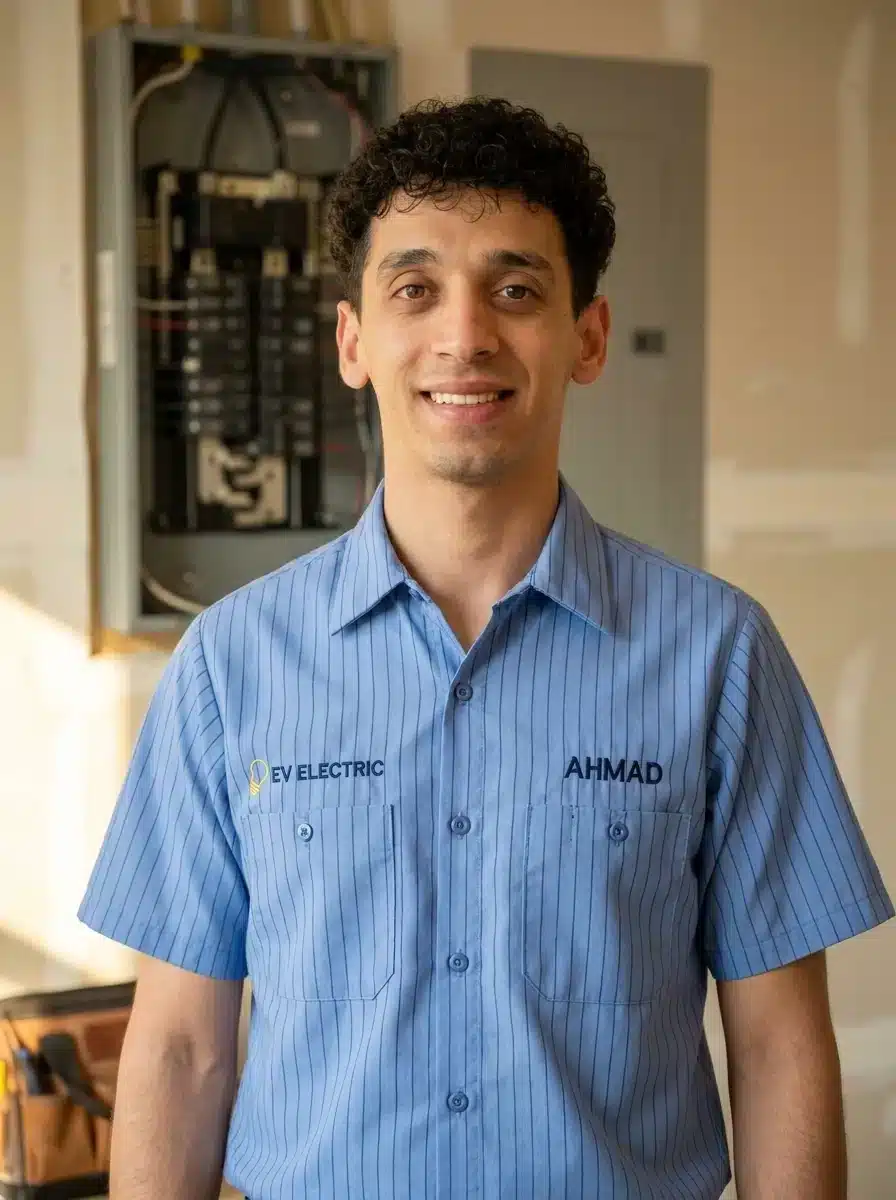
Ahmad Shaban is a Virginia Master Electrician — the highest credential the state issues to an electrician. His shop on Fairfax Blvd is closer to Oakton than to any other Wave-3 service area, which is why same-morning panel assessments here are the norm rather than the exception. He brings a maintenance crew, so scheduling does not bottleneck on one person.
113 Google reviews at a 5.0-star average. Residential work only — houses, townhomes, condos. No commercial contracts competing for the calendar.Oakton neighborhoods we serve for panel upgrades
Oakton is unincorporated Fairfax County — all neighborhoods permit through Fairfax County LDS. We serve every Oakton neighborhood, including:
- Blake Lane corridor — 1960s-70s ranches and split-levels; FPE Stab-Lok panels common; prime 100A-to-200A territory
- Sutton Place — same era ranch stock; insurance-driven FPE/Zinsco replacements frequent
- Fox Mill Estates — 1980s-2000s colonials; EV charger headroom and sub-panel additions
- Waples Mill — similar era to Fox Mill; GFCI gaps and load expansion calls
- Oakton Village — colonials and townhomes; home office and heat pump circuit additions
- Oakton proper — mixed eras near the Rt 123 / Jermantown Rd intersection
- Vale area — 2000s+ custom builds; AFCI nuisance trips and smart-home corrections
- Miller Heights — newer construction; diagnostic and sub-panel work
ZIP 22124 is a geographic reference — not a jurisdiction determinant. We also serve Fairfax, Vienna, McLean, and the rest of Fairfax County.
Related electrical services near Oakton
A panel upgrade is often the starting point. These are the services Oakton homeowners commonly pair with or discover during the assessment:
Frequently asked questions — panel upgrades in Oakton
How much does a panel upgrade cost in Oakton?
The price depends on the scope — a brand-only swap (FPE out, modern panel in) is less than a full 100-to-200A service conversion. Every estimate we write for Oakton homes covers the code-required components (disconnect, surge, permit, Dominion coordination) so the number you see is the number you pay. Call 571-500-6637 for a written quote.
Can I upgrade my electrical panel without rewiring my house?
Almost always. The panel and service entrance are replaced; the branch circuits that run to your outlets, switches, and appliances stay in place and reconnect to the new panel. Rewiring is a separate scope — we only recommend it if the assessment reveals a branch-wiring issue like aluminum terminations or damaged insulation.
How much does it cost to upgrade from 100 amp to 200 amp?
This is the most common job on Blake Lane and Sutton Road ranches. The scope covers the panel, service entrance conductors, meter base, outdoor disconnect, surge protector, the County ELER permit, and Dominion coordination. We quote after inspecting your specific panel — no two houses are identical, and a range published online would not account for your wiring condition.
Is upgrading your electrical panel worth it?
Three situations make it clear-cut: (1) your insurer is requiring it because of an FPE or Zinsco panel — no upgrade means no policy; (2) your loads exceed your panel’s capacity (EV charger, heat pump, AC all running at once) and the breaker trips weekly; (3) you are selling and the inspector flagged the panel. In all three, the cost of not upgrading is higher than the cost of upgrading.
Do I need a permit for a panel upgrade in Oakton?
Yes — Oakton is unincorporated Fairfax County, and the County requires an ELER trade permit for any panel or service work. We file it electronically through the County’s PLUS portal, handle the inspection scheduling, and coordinate the Dominion meter pull. You sign the estimate; we handle the paperwork.
How long does a panel upgrade take?
On-site work is typically a single full day for a standard 200A upgrade. The County inspection follows within a few business days, and Dominion reconnects the meter on the same timeline. End-to-end — from the day you approve the estimate to the day the inspection is signed off — expect roughly one to two weeks.
Will my insurance cover the cost of replacing an FPE panel?
Homeowners insurance generally does not pay for elective upgrades. But if your carrier is the one requiring the replacement (because the panel is FPE or Zinsco), the upgrade is a condition of keeping your coverage — not a voluntary improvement. After the work, we supply the documentation your insurer needs to close the requirement. Some carriers also reduce premiums once the new panel is in.
What is an FPE Stab-Lok panel and why is it a problem?
Federal Pacific Electric built Stab-Lok breaker panels through the 1980s. Independent lab testing found that these breakers can fail to disconnect the circuit during an overload — the exact scenario a breaker is designed to prevent. Carriers treat this as a documented fire risk and frequently require replacement before they will underwrite the property. Oakton’s 1960s–70s ranch stock is one of the most common places we encounter them.
Get a written estimate — we are 8 minutes from Oakton
On-site assessment, code-complete scope, written estimate before any work starts. Serving Blake Lane, Sutton Place, Fox Mill Estates, Waples Mill, Oakton Village, Vale, Miller Heights, and all Oakton neighborhoods.
571-500-6637