
EV Charger Installation in Oakton, VA
Level 2 Charging. Done Right the First Time.
Ahmad Shaban is a Virginia-licensed Master Electrician who installs EV chargers across Oakton every week. Dedicated 240V circuit, proper panel assessment, permitted and inspected — so your car charges overnight, every night, without tripping a breaker.
What “EV charger installation” actually means
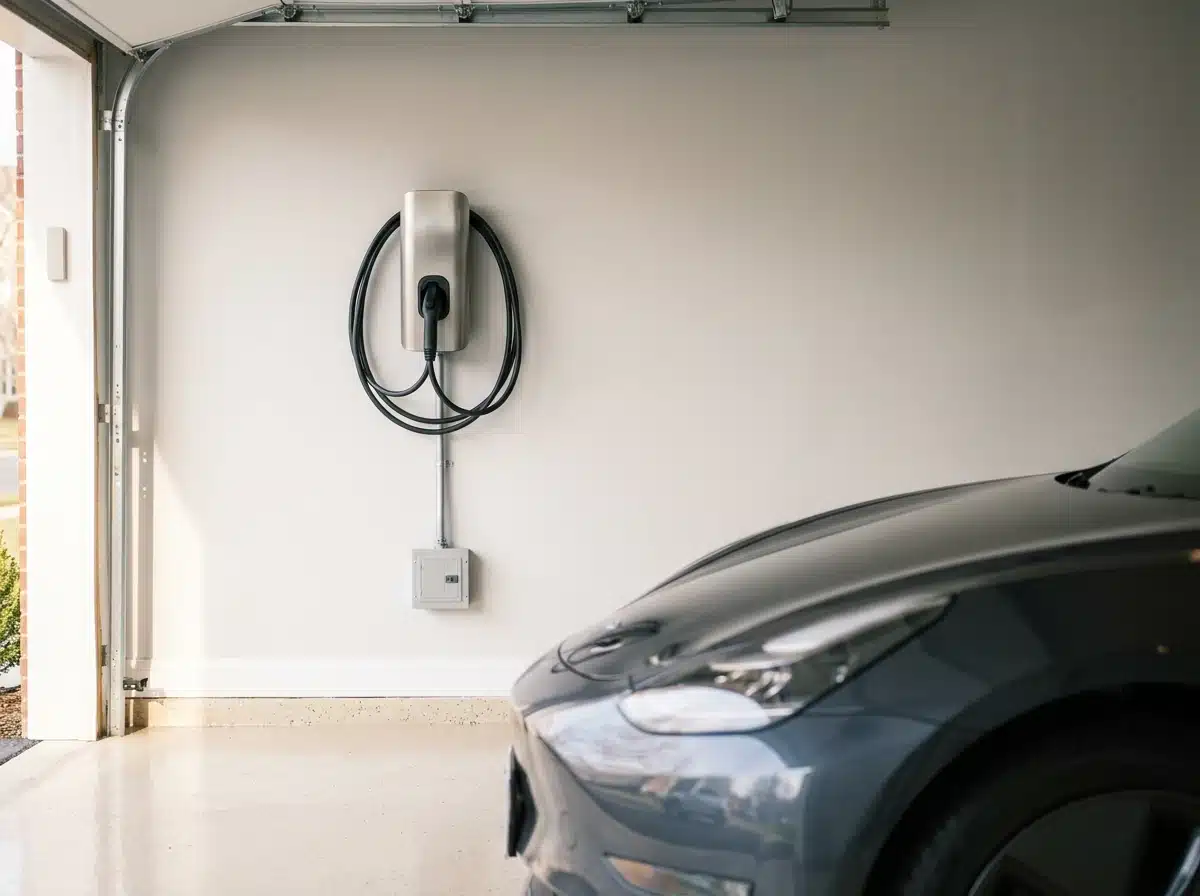
EV charger installation means adding a dedicated 240-volt circuit from your electrical panel to your garage or parking spot so you can charge your car at Level 2 speed — roughly 25-30 miles of range per hour instead of the 4-5 miles you get from a standard 120V outlet. The charger manufacturer makes the box. The electrician’s job is the circuit: the breaker, the wire, the conduit run, the mounting, and making sure your panel can handle the continuous draw without starving the rest of the house.
Most home EV charger installs require a 240V circuit with a 40-50 amp breaker. You can go hardwired (Tesla Wall Connector, ChargePoint Home Flex) or plug-in with a NEMA 14-50 outlet. Hardwired units deliver slightly more power and look cleaner; plug-in gives you portability. Either way, the circuit needs to be dedicated — not shared with anything else — and most Northern Virginia jurisdictions require a permit for new 240V circuits. We assess your panel’s available capacity before we quote, because adding 50 amps to a panel that’s already near its limit means a panel upgrade comes first.
Ahmad Shaban owns EV Electric Services and holds a Virginia Master Electrician license. EV charger installations have been a core specialty since 2024 — we install multiple units every week across Oakton, Vienna, Fairfax, and McLean. Our office is on Fairfax Blvd, about 10 minutes from most Oakton neighborhoods. Ahmad is on every install personally: assessing the panel, running the circuit, configuring the charger, and meeting the inspector. One electrician, start to finish.
Why Oakton homeowners call us for EV charger installation
Oakton is an unincorporated community in Fairfax County, VA, centered where Chain Bridge Road (Route 123) meets Hunter Mill Road — the same crossroads that gave the community its name in 1883. The area covers roughly 10 square miles between Vienna to the east, the City of Fairfax to the south, Fair Oaks to the west, and the Wolf Trap area to the north, with I-66 running along the southern edge. From Oakton, most Fairfax County reference points are 10-15 minutes away, and downtown DC is a 30-45 minute drive depending on traffic.
1960s-1970s ranches & split-levels
Berryland Farm, eastern Blake Lane corridor, older pockets near Hunter Mill RoadThe earliest wave of Oakton’s suburban development. Built with 100-amp panels (occasionally upgraded to 150-amp by prior owners) and circuits sized for the appliances of the era — a window AC unit, a refrigerator, a color TV. Wiring is cloth-insulated copper in the 1960s builds and PVC-insulated copper in the 1970s, with a window of aluminum branch wiring in the late 1960s through early 1970s (NEC deprecated aluminum branch circuits in 1972, but installation continued for several years). Plumbing is original galvanized steel supply lines running to copper at fixtures. Insulation is thin — R-13 walls at best, often less. These homes are now 50-60 years old, running modern loads (central AC, induction ranges, EV chargers, home offices with multiple monitors) on infrastructure never designed for them.
Symptoms: Persistent breaker trips when running the AC or a space heater on the same circuit as the kitchen. Warm outlet cover plates on original receptacles with backstabbed connections. Flickering lights throughout the house when the HVAC compressor kicks on — a voltage-drop signal from undersized service entrance wiring or a loose neutral at the meter base. Aluminum branch wiring connections oxidizing at switches and outlets, producing intermittent arcing.
1970s-1990s colonials & traditionals
Fox Mill Estates, Waples Mill Manor, Hunt Valley, Taylor Run, Foxvale EstatesThe dominant housing era in Oakton — these neighborhoods define the community’s suburban character. Most have 200-amp service as original equipment (the 1990s builds almost universally). The 1970s-early-1980s homes may have 150-amp or early 200-amp panels. GFCI coverage varies: homes built before the 1996 NEC requirement (which mandated GFCIs at every kitchen counter receptacle) typically have GFCIs only at outdoor and garage circuits, if at all. Plumbing transitions from copper (1970s-1980s) to early PEX (1990s). Central AC is standard in all of these. Gas furnaces with Washington Gas service are the dominant HVAC configuration. These homes are 30-50 years old — old enough that original panels, breakers, and wiring connections are showing their age, but young enough that most homeowners assume everything is fine until a symptom appears.
Symptoms: Outlets that worked yesterday and don’t today — usually a tripped GFCI upstream that the homeowner doesn’t know exists, or a wire-nut connection that loosened inside a buried junction box. Intermittent power loss to a single room when the dryer or dishwasher runs (circuit sharing on a panel that looked fine at 150 amps but can’t sustain today’s loads). GFCIs in kitchens and bathrooms that nuisance-trip because pre-1996 homes were retrofitted with GFCI outlets but the downstream wiring has grounding defects.
2000s-2020s townhomes, condos & newer detached
Newer developments near Fair Oaks, I-66 corridor townhomes, teardown-rebuilds on Blake LaneOakton’s newer housing stock includes both purpose-built townhome/condo communities (contributing to the 37% multi-unit share) and teardown-rebuild custom homes on older lots. All have 200-amp service minimum, AFCI breakers per NEC 2008+ requirements, and modern PEX plumbing. The issues here are different from older stock: AFCI breakers are sensitive by design and trip on noisy loads (arc-fault nuisance tripping is the most common callback in newer homes); smart-home wiring installed by the previous owner may have neutral-bonding issues; and townhome owners face HOA approval requirements for visible exterior work (EV chargers on garage walls, generator pads). Some teardown-rebuilds sit on lots where the Dominion Energy service drop was sized for the original 1960s ranch and hasn’t been upgraded to match the 4,000+ sq ft replacement home.
Symptoms: AFCI breakers that nuisance-trip on vacuum cleaners, treadmills, or LED dimmer switches — the most common callback in post-2008 homes. Smart-home devices (smart switches, video doorbells, whole-house audio) causing neutral-bonding faults that trip breakers or produce buzzing at switch plates. Townhome EV charger circuits tripping because the Dominion service drop was sized for the original building load and hasn’t been upgraded. Teardown-rebuild homes where the 4,000+ sq ft replacement draws more than the original 1960s-era service entrance can deliver — voltage sags under peak load.
Oakton has one of the highest EV adoption rates in Fairfax County — the combination of high household income, long commutes on I-66, and attached garages makes Level 2 home charging the obvious next step after buying the car.
EV charging situations we handle every week in Oakton
Here are the calls Ahmad gets most often from Oakton homeowners. If your situation matches one of these, you’re in the right place.
New EV, no Level 2 charger yet
You bought a Tesla, Rivian, BMW, Hyundai, or any other EV and realized the trickle charger on a standard 120V outlet adds 4-5 miles of range per hour. A dedicated 240V Level 2 circuit delivers 25-30 miles per hour — overnight charging instead of all-weekend charging. We install the circuit, mount the charger, and handle the permit.
Panel doesn’t have room for a 50-amp breaker
An EV charger draws 40-50 amps continuously. If your panel is 100-amp with a full breaker box, there’s no space to add the circuit without an upgrade. We assess whether you need a full panel upgrade to 200-amp or whether a sub-panel or load-management device is the right call.
Charger in a detached garage or outdoor parking spot
Running a 240V circuit from the main panel to a detached garage or carport requires an outdoor-rated conduit run, a sub-panel or disconnect, and weatherproof hardware. We size the feeder, trench or surface-mount the conduit, and install the charger with proper grounding.
Tesla Wall Connector installation
The Tesla Wall Connector is the most common charger we install. It’s hardwired (no plug), delivers up to 48 amps, and requires a dedicated 60-amp circuit. We mount it at the right height, run the circuit, and configure the Wi-Fi so you can monitor charging from the Tesla app.
Charger trips the breaker or throttles
If your existing charger throttles itself down or trips the breaker every few hours, the cause is usually upstream — an undersized circuit, a loose connection, or a panel that can’t sustain the continuous load. We diagnose the electrical cause, not the charger. See our troubleshooting page for more.
Multi-EV household — two chargers, one panel
Two EVs charging simultaneously can draw 80-100 amps. Most homes need a panel upgrade or a load-sharing device to handle this. We calculate the load, recommend the right solution, and install both circuits so neither car has to wait.
NEMA 14-50 outlet for a portable charger
Some homeowners prefer a NEMA 14-50 outlet (the same plug as a dryer) so they can use a portable Level 2 charger. It’s simpler and cheaper than a hardwired unit. We install the dedicated 50-amp circuit and the outlet, and you plug in your own charger.
Our EV charger installation process — what happens when you call
When you call 571-500-6637 or request a quote online, here’s what happens.
A real conversation about your setup
We ask about your vehicle (make, model, onboard charger amperage), your current panel (age, amperage, available slots), where you park (garage, driveway, street), and what charger you want. If you already bought the charger, we work with it. If not, we recommend one based on your car and your electrical capacity.
On-site assessment and written estimate
We come to the house, look at the panel, measure the distance to the charging location, and run a load calculation. You get a written estimate with the circuit, the conduit run, the charger mount, the permit fee, and the labor laid out clearly. No surprise pricing.
Permit and scheduling
Most jurisdictions require a permit for a new 240V circuit. We pull the permit, schedule the install, and coordinate with you on timing. Most installs are a half-day to full-day job depending on the run distance.
Installation — typically half a day
We install the breaker, run the circuit, mount the charger or outlet, and test the full system. For hardwired chargers, we configure the charger’s amperage setting and verify the app connection. You drive away charging that night.
Inspection and sign-off
The county inspector visits. We meet them, walk through the work, and they sign off. You get the permit and inspection record — important for your home insurance and for EV tax credit documentation.
How estimates work
Every EV charger install is different — panel capacity, run distance from panel to garage, conduit type, charger model. We don’t quote over the phone. An on-site assessment comes first, and you get a written estimate with every line item before we schedule the work.
- An on-site assessment comes first. We look at the panel, the run distance, and what you’re adding. You get a written estimate before any work starts.
- The estimate covers the breaker, the circuit run, the charger mount (if hardwired), the permit fee, and the labor. No add-ons on the work day.
- Panel upgrades — if your panel can’t support the new circuit — get a separate line item. You see what each piece costs.
- Tax credits: the federal Section 30C credit for home charger installation ended for property placed in service after 30 June 2026, so a new install no longer qualifies. We give you the itemized invoice and permit record either way.
We don’t post fixed prices because every installation is different — panel capacity, run distance, conduit type, permit fees. The estimate after a real on-site assessment is the only honest number.
About Ahmad Shaban, Master Electrician
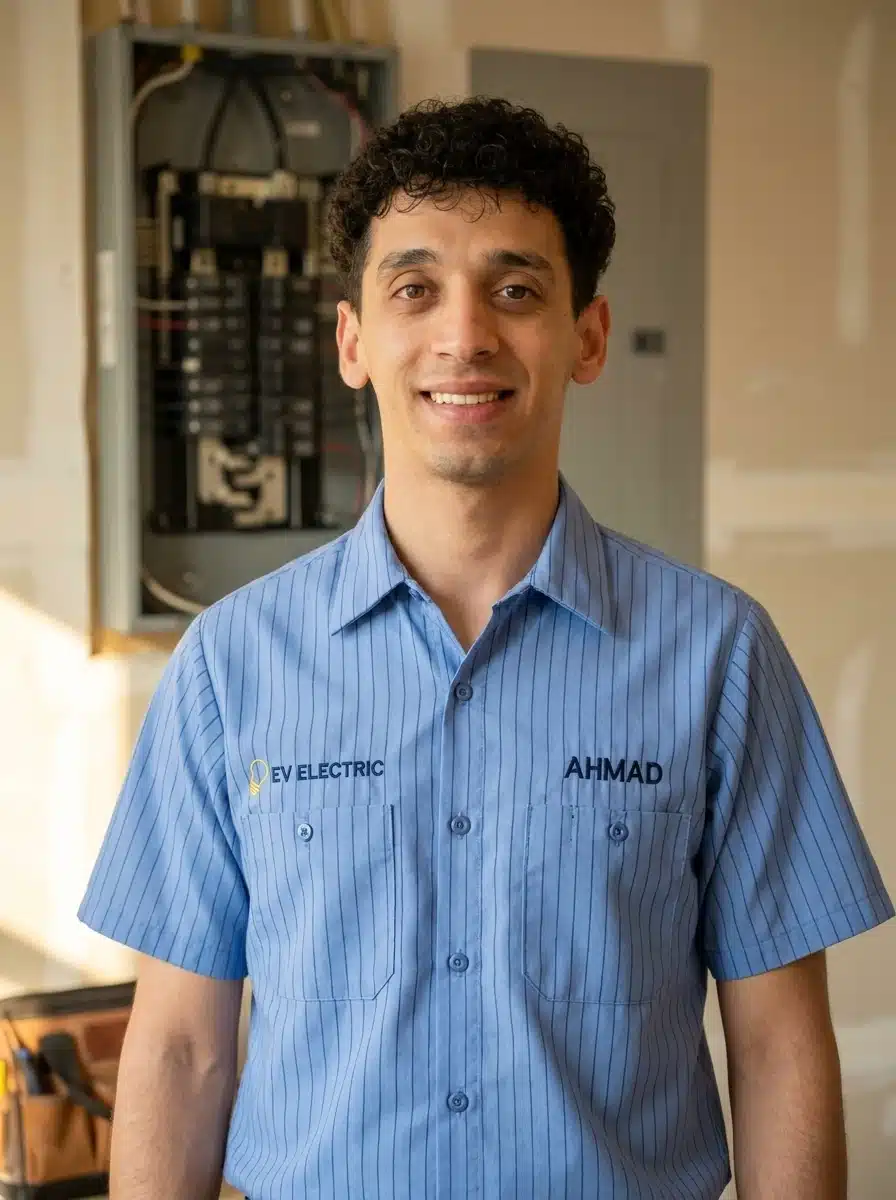
Ahmad Shaban holds a Virginia Master Electrician license — the highest credential the Commonwealth issues for electrical work. EV charger installations have been a core specialty since 2024, and we install multiple units every week across Northern Virginia. EV Electric Services is fully insured, and every job is permitted and inspected through the local jurisdiction.
Ahmad is on every EV charger install personally. He assesses the panel, runs the circuit, mounts or connects the charger, configures the app, and meets the inspector. You’re not getting a rotating crew or a subcontractor — you’re getting the licensed owner who knows your panel and your setup from start to finish.
EV Electric Services holds a 5.0-star average across 113 customer reviews. Our review base is real, recent, and from Northern Virginia homeowners. We don’t ghost-write reviews or recycle them across business directories.
Oakton neighborhoods we serve
We cover all of Oakton, VA, including:
- Fox Mill Estates — family-oriented neighborhood near Fox Mill Elementary
- Waples Mill Manor / Waples Mill Estates — established homes along the Waples Mill Road corridor
- Hunt Valley — quiet subdivision south of Route 123
- Clarks Crossing — wooded lots near the Difficult Run stream valley
- Taylor Run — family-friendly neighborhood with community pool access
- Foxvale Estates — spacious single-family homes near Oakton High School
- Berryland Farm — established community near the Vienna-Oakton border
- Blake Lane corridor — the eastern Oakton residential strip along Blake Lane
Outside Oakton, we serve Vienna, Fairfax, McLean, Tysons, Burke, Annandale, Falls Church, and the rest of Fairfax County. We also cover DC and Montgomery County, MD (Rockville, Bethesda, Chevy Chase, Potomac).
Related electrical services in Oakton
EV charger installation often connects to other electrical work — a panel upgrade to make room for the circuit, troubleshooting on an existing charger that trips, or outlet work elsewhere in the garage.
Frequently asked questions
How much does an EV charger installation cost in Oakton, VA?
Cost depends on three main variables: your panel’s available capacity (whether you need a panel upgrade first), the run distance from panel to charger location, and whether you’re going hardwired or plug-in. A short run in an attached garage with available panel capacity is the simplest install. A long conduit run to a detached garage with a panel upgrade is on the higher end. We don’t quote over the phone — you get a written estimate after an on-site assessment with every line item visible. No surprise charges on the install day.
Do I need a panel upgrade to install an EV charger?
It depends on your current panel’s amperage and available capacity. If you have a 200-amp panel with open breaker slots, you can usually add a 50-amp EV circuit without an upgrade. If you have a 100-amp or 150-amp panel — common in Oakton homes built before 1990 — you likely need an upgrade first because the EV charger’s continuous 40-50 amp draw pushes the total load past what the panel can safely deliver. We run a load calculation during the on-site assessment and tell you definitively whether your panel can handle it or not.
What’s the difference between Level 1 and Level 2 charging?
Level 1 charging uses a standard 120-volt household outlet and the portable charger that came with your car. It delivers about 4-5 miles of range per hour — fine for plug-in hybrids, painfully slow for full EVs. Level 2 charging uses a dedicated 240-volt circuit (the same voltage as a dryer or oven) and delivers 25-30 miles of range per hour. That means a full overnight charge instead of a full weekend. Level 2 is what we install — it’s the practical solution for anyone who drives their EV daily and wants to start every morning at full charge.
Can you install a Tesla Wall Connector?
Yes — it’s the most common charger we install. The Tesla Wall Connector is hardwired (no plug), delivers up to 48 amps, and requires a dedicated 60-amp circuit. We mount it at the right height for your vehicle’s charge port, run the dedicated circuit from your panel, and configure the Wi-Fi connection so you can monitor charging from the Tesla app. The Wall Connector also works with non-Tesla EVs via a J1772 adapter, so it’s a good choice for multi-EV households. We carry the mounting hardware and can usually install same-week after the estimate.
Do I need a permit for an EV charger installation in Oakton, VA?
Yes. Fairfax County requires an electrical permit for any new 240-volt circuit, which is what an EV charger installation involves. The permit must be pulled by a licensed electrician — not the homeowner. We handle the permit application, include the fee in your estimate, and schedule the inspection after the install. The inspector verifies the circuit, the breaker sizing, and the installation meets code. Once signed off, the work is on the county’s books — which protects your homeowner’s insurance and documents the installation for any future EV tax credit claims.
How long does an EV charger installation take?
Most EV charger installations take half a day to a full day. A short run in an attached garage with available panel capacity — breaker install, 15-20 feet of wire, charger mount — is typically 3-4 hours. A longer run to a detached garage with conduit, a disconnect, and trenching can take a full day. If a panel upgrade is needed first, that’s a separate day of work before the charger install. We tell you the expected timeline at the estimate stage so you can plan accordingly. You’ll be charging your car the same evening the install completes.
Can I install an EV charger outdoors or in a detached garage?
Yes. Many Oakton homeowners charge in detached garages, carports, or outdoor parking spots. The installation requires outdoor-rated conduit for the wire run, a weatherproof disconnect near the charger, and a charger unit rated for outdoor use (most major brands offer NEMA 4 or IP65-rated enclosures). The run distance from your main panel to the charging location determines the wire gauge and conduit length — longer runs cost more but work the same way electrically. We trench underground or surface-mount along the building depending on your lot layout and preference.
Is there a tax credit for EV charger installation?
No. The federal Alternative Fuel Vehicle Refueling Property Credit (Section 30C) terminated for property placed in service after 30 June 2026, under P.L. 119-21. A charger installed today does not qualify. Many cost guides and AI-generated answers still describe the credit as active and are out of date. If your charger was placed in service before that date and you have not yet filed, ask your tax preparer. We provide the documentation either way: itemized invoice, permit record, and proof of installation.
Ready to charge at home?
Permitted, inspected EV charger installations in Oakton, VA — from a Master Electrician who does the work himself.
We respond within one business day.