
Electrical Troubleshooting — Tysons, VA
Electrical Troubleshooting in Tysons, VA
Flickering lights, tripping breakers, warm outlets — we diagnose the root cause on-site and fix it the same visit when possible. ~10–15 minutes from our Fairfax Circle shop.
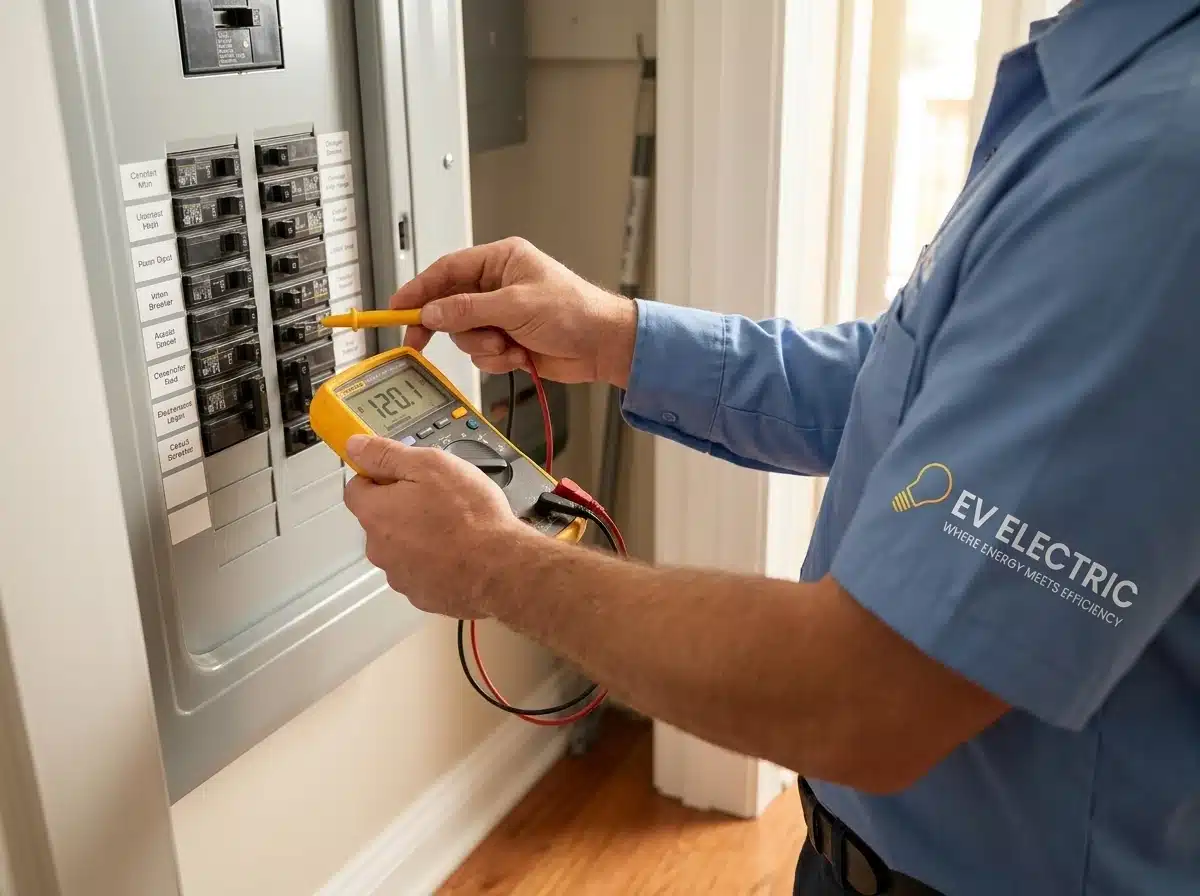
Burning smell, hot panel, or sparking in your Tysons home?
Shut the breaker off and call us. If there is fire or injury, call 911 first. For house-side electrical emergencies in Tysons — call 571-500-6637 and we triage you to the earliest same-day slot.
Symptoms that mean you should stop and call now:
- Burning plastic smell from an outlet, switch, or panel
- Sparking when you plug in or flip a switch
- An outlet or switch plate that is hot to the touch or scorched
- A breaker that trips the instant you reset it
- Panel door is warm or discolored — common in 1960s Tysons ramblers with FPE Stab-Lok panels
- Buzzing or humming from inside the panel
What Drives Troubleshooting Cost
Every troubleshooting call is different. Cost depends on diagnostic complexity, how many circuits are involved, and whether the repair can happen the same visit or requires a follow-up with parts or a permit.
Our diagnose-then-quote model
We do not charge you for a repair before we know what is wrong. Ahmad diagnoses the root cause on-site, explains what he found, and gives you a written estimate before any repair work starts. You know the cost before you approve anything.
- Single-circuit issue (dead outlet, one tripping breaker) — typically diagnosed and quoted within 30 minutes
- Multi-circuit or intermittent fault (flickering across rooms, half-house outage) — may require load testing and circuit mapping
- Panel-level diagnosis (repeated trips, warm panel, FPE evaluation) — full panel inspection with written findings and next-step options
- Same-call repair — if the fix is straightforward (loose connection, failed GFCI, undersized breaker), we repair it the same visit after you approve the quote
Tysons homes span 70 years of construction — a 1950s rambler with an original 100-amp FPE panel and a 2020 teardown rebuild with AFCI breakers require completely different diagnostic approaches. We price the work, not a template.
Symptom → Cause → What We Do
Eight electrical symptoms we diagnose in Tysons homes every week — with cause notes specific to the rambler/teardown housing mix.
| Symptom | Likely Cause in Tysons | What EV Does |
|---|---|---|
| Breaker trips repeatedly | Overload on 100A panel (1950s rambler) OR AFCI nuisance trip (2010s rebuild) — different fix paths | Isolate overload vs short vs nuisance trip. Tysons panel upgrade if capacity is the root cause. Breaker replacement for individual swaps. |
| Lights flicker on AC / heat pump start | Voltage drop from undersized service entrance (1950s–60s homes) OR loose neutral (any era) | Meter-base + service-entrance load test. Panel upgrade if service is undersized. |
| Warm / scorched outlet or switch | Loose connection at termination — fire risk. Aluminum wiring in 1970s Scotts Run / Westpark stock. | IR-camera find + CO/ALR re-terminate or replace device. |
| Burning smell / hot panel | Overheated insulation at a loose lug — FPE Stab-Lok common in 1960s Tysons ramblers | Urgent same-day triage; full panel inspection; escalate to panel evaluation if needed. |
| Outlets dead in one room | Tripped GFCI upstream / backstab failure / failed splice — especially in 1980s–90s townhomes | Circuit-map trace, typically diagnosed in 15–30 minutes. |
| EV charger trips / throttles | Upstream breaker undersized for continuous 40A draw — common in Tysons driveways with Level 2 chargers | Load check + right-size circuit + verify NEC 625 compliance. Tysons EV charger page for install details. |
| Half the house has no power | Open neutral at service entrance — one leg of 240V drops out | Per-leg panel test; confirm house-side before Dominion call. Panel upgrade if service entrance is failing. |
| Smart switch buzzes / fails | Scrambled travelers or missing neutral from DIY smart-home install (2010s+ luxury homes) | Re-wire circuit topology, verify neutral presence, confirm compatible dimmer/switch. |
Why Tysons Homes Fail the Way They Do
Tysons has two distinct housing populations with completely different electrical failure modes — plus a transitional middle era. We diagnose all three.
1950s–1960s Ramblers & Early Colonials
Pimmit Hills border · Chain Bridge Rd corridor · Tysons WoodsOriginal 100-amp panels sized for pre-AC loads. FPE Stab-Lok breakers appear in 1960s stock — a known fire-risk panel that does not reliably trip on overload. Ungrounded 2-prong outlets throughout. These homes are the diagnostic workhorses: multiple failure modes stack (panel capacity + aging connections + missing grounds). When you add modern AC, an EV charger, or a home office, the 60-year-old wiring protests.
1970s–1990s Colonials, Split-Levels & Townhomes
Scotts Run · Westpark · Spring Hill · Rotonda200-amp service is standard, but mid-1970s homes may have aluminum branch wiring — a latent fire hazard at every outlet and switch connection. GFCI coverage gaps in kitchens and bathrooms. Townhome shared-wall wiring limits access for tracing faults. Intermittent problems dominate: backstab connections that work for years then fail, GFCI trips in humid months, three-way switches that stop working after a remodel.
2010s–2020s Luxury Teardown Rebuilds
International Drive area · Spring Hill Station · Tysons infillBrand-new 200A+ panels with AFCI breakers on every branch circuit. These homes do not need panel upgrades — they need circuit-level diagnosis. AFCI nuisance trips from smart-home device harmonics. Bonded-neutral errors from DIY smart-switch installs. EV charger circuits that trip under continuous load because they were undersized (40A on a 30A breaker). Modern panels, modern problems — different diagnostic approach than a 1960s rambler.
DIY or Call a Pro?
Some electrical issues are safe to check yourself. Others need a licensed electrician — especially in Tysons homes with aluminum wiring or aging panels.
Safe to Try Yourself
- Reset a tripped breaker once — if it holds, monitor it
- Check if a lamp is dead (swap the bulb, try another outlet)
- Press the reset button on a GFCI outlet — one attempt
- Check if your neighbors also lost power (utility outage, not house-side)
- Verify a smart switch has power at the app level before calling
Call 571-500-6637
- Breaker trips twice in 24 hours — stop resetting, call
- Dead outlet plus a warm faceplate — loose connection, fire risk
- GFCI trips again within an hour of resetting
- Any burning smell, scorching, or sparking — shut off, call immediately
- Half the house lost power (other half still works)
- Aluminum wiring caution: in Tysons’ 1970s stock (Scotts Run, Westpark), do NOT replace outlets or switches yourself — standard CO/CU-only devices on aluminum wiring create a latent fire hazard. This requires CO/ALR-rated devices and proper torque.
Your Complete Tysons Electrical Hub
Three Tysons pages, all rebuilt with substance — cross-linked so you find exactly what you need.
Panel Upgrade — Tysons, VA
If your 1950s–60s rambler still has a 100-amp panel (or worse, an FPE Stab-Lok), a panel upgrade is the long-term fix. Already rebuilt and indexed.
EV Charger Installation — Tysons, VA
Level 2 charger tripping or throttling? The circuit may be undersized for continuous 40A draw. Our Tysons EV charger page covers install specs and NEC 625 compliance.
Permits & Code in Tysons
Tysons is unincorporated Fairfax County — not a city or town. All electrical permits go through Fairfax County LDS.
When a Permit Is Required
Diagnostic work and simple repairs (replacing a switch, re-terminating a connection) do not require a permit. These do:
- Panel replacement or upgrade (100A → 200A)
- New circuit installation (EV charger, sub-panel)
- Service entrance replacement
- Whole-house rewire or aluminum wiring remediation
We pull the permit, schedule the County inspection, and close it out. You do not have to manage the process.
Fairfax County LDS
Permit type: ELER (electrical trade permit)
Portal: PLUS (plus.fairfaxcounty.gov)
Office: 12055 Government Center Pkwy, Fairfax, VA 22035
Phone: 703-222-0801
Why this matters: Tysons is not incorporated — there is no “Town of Tysons” building department. If a contractor tells you they need a “Tysons permit,” that is a red flag. All permits are Fairfax County.
Seasonal Patterns in Tysons Troubleshooting Calls
Summer: AC-Start Voltage Drop + Storm Recovery
When Tysons hits 95°F, AC compressors draw heavy inrush current. In 1950s–60s ramblers with 100-amp service, that inrush causes visible light flicker and occasional breaker trips. After Dominion storm outages, open neutrals at the service entrance can leave half the house dead — often misdiagnosed as a utility problem when it is actually house-side.
Winter: Heat Pump + EV Charger Combined Draw
Tysons’ luxury rebuilds with dual-zone heat pumps and a Level 2 EV charger can approach panel capacity during cold snaps. Space heaters plugged into bedroom circuits add another layer. The result: repeated trips on circuits that worked fine in October. We load-test the panel and identify which circuits are competing for capacity.
Electrical Troubleshooting in Tysons
Tysons’ housing mix — 1950s ramblers alongside 2020s luxury rebuilds — creates electrical problems you will not find in a generic troubleshooting guide. The diagnosis depends on when your home was built, what panel you have, and what loads you have added since construction.
Whether it is an FPE panel in a Pimmit Hills-border rambler that has never been upgraded, aluminum wiring in a 1975 Scotts Run colonial, or AFCI nuisance trips in a brand-new International Drive build — Ahmad diagnoses the root cause on-site and explains it before quoting the fix.
We serve all of Tysons: Westpark, Scotts Run, Spring Hill, Chain Bridge Road corridor, Pimmit Hills border, International Drive area, Tysons Woods, and Rotonda. ~10–15 minutes from our Fairfax Circle shop.
Tysons Troubleshooting Q&A
Tap any question for a Tysons-specific answer.
My breaker trips every time I run the AC — is my panel too small?
In 1950s–60s Tysons ramblers with 100-amp panels, yes — the panel was sized before central AC existed. In 2010s+ rebuilds, the panel is likely fine but the individual circuit breaker may be undersized or an AFCI nuisance trip. We test both scenarios on-site.
I have aluminum wiring in my Scotts Run townhome — is it dangerous?
Aluminum wiring itself is not illegal, but the connections at outlets and switches are the fire risk. Standard CO/CU-only devices on aluminum expand and contract at different rates, loosening over time. We inspect every connection and re-terminate with CO/ALR-rated devices where needed.
My new smart switches keep tripping the AFCI breaker — why?
AFCI breakers detect arc-fault signatures. Some smart switches and LED dimmers produce electrical noise that AFCI breakers misread as an arc. We identify which device is causing the nuisance trip and either swap to a compatible device or re-circuit to isolate the conflict.
Half my house lost power but my neighbors are fine — what happened?
Most likely an open neutral at your service entrance — one leg of the 240V supply dropped out. We test both legs at the panel before you call Dominion. If it is house-side, we fix it same-day. If it is line-side, we confirm and document so Dominion dispatches correctly.
My EV charger started tripping after a few months — did it break?
Usually not the charger. The upstream breaker was likely sized for intermittent use, not continuous 40A draw (NEC 625 requires 125% rating for continuous loads). We load-test the circuit and right-size the breaker. See our Tysons EV charger page for install details.
Is my FPE panel in my 1960s Tysons rambler a fire hazard?
FPE Stab-Lok panels have a documented history of failing to trip on overload. We do not condemn every FPE panel on sight — we inspect the bus bars, test breaker response, and give you a written finding. If replacement is warranted, see our Tysons panel upgrade page.
How a Troubleshooting Call Works
From your first call to a diagnosed, quoted repair — here is the process.
Call 571-500-6637
Ahmad answers — not an answering service. Describe the symptom and we triage on the phone: safety-critical calls go to the earliest same-day slot.
Phone Triage
We narrow the likely cause before arriving so we bring the right test equipment. Burning smell or sparking? We tell you exactly what to shut off while we are en route.
Same-Day Diagnostic Visit
On-site in Tysons in ~10–15 minutes from Fairfax Circle. We arrive with meters, IR camera, and circuit-mapping tools — not a clipboard.
Root-Cause Diagnosis
We find the actual cause — not just the symptom. Overload, short, loose connection, nuisance trip, failed splice, or service-entrance problem. You get a clear explanation of what is wrong and why.
Written Estimate
You see the cost before any repair work starts. No surprises.
Same-Call Repair (When Feasible)
If the fix is straightforward — a loose connection, a failed GFCI, an undersized breaker — we repair it the same visit after you approve. If it requires parts, a panel swap, or a permit, we schedule the follow-up before we leave.
~10–15 Minutes from Tysons
We are based at Fairfax Circle — not dispatched from across the county.
Drive Times from Our Shop
- Tysons (via Rt 123) ~10 min
- Spring Hill / Scotts Run ~12 min
- Westpark / Rotonda ~13 min
- International Drive area ~11 min
- Pimmit Hills border ~14 min
- Chain Bridge Rd corridor ~15 min
Beats a Lorton-dispatched franchise. The nearest national franchise dispatches from Lorton — roughly 18 miles south of Tysons. We are 6 miles away on Route 123. When a breaker is tripping or an outlet is warm, 10 minutes matters.
Shop address: 9488 Fairfax Blvd, Fairfax, VA 22031 (near Fairfax Circle). Routes to Tysons via Rt 123 or I-495.
Tysons Neighborhoods We Serve
Tysons spans parts of 22102 and 22182. We serve every neighborhood in the Tysons census-designated area.
- Westpark — 1970s–80s townhomes and condos; backstab connections, shared-wall access limitations
- Scotts Run — 1970s–90s colonials and split-levels; aluminum wiring in mid-70s units
- Spring Hill — mixed era; older colonials alongside Metro-era new construction
- Chain Bridge Road Corridor — 1950s–60s ramblers; original 100A panels, FPE risk
- Pimmit Hills Border — 1950s ramblers, some with ungrounded 2-prong outlets throughout
- International Drive Area — 2010s–20s luxury builds; AFCI, smart-home, EV charger circuits
- Tysons Woods — older parcels with 1960s stock mixed with teardown rebuilds
- Rotonda — 1970s–80s condos and townhomes; GFCI coverage gaps, aging connections
Frequently Asked Questions
Common questions about electrical troubleshooting in Tysons, VA.
How much do electricians charge to troubleshoot?
Cost depends on diagnostic complexity — a single tripping breaker is faster to diagnose than intermittent flickering across multiple rooms. We use a diagnose-then-quote model: Ahmad finds the root cause on-site, explains it, and gives you a written estimate before any repair work starts. You know the cost before you approve anything.
Who do you call for electrical problems?
If there is fire, smoke, or someone has been shocked, call 911. If power is out for the whole neighborhood, call Dominion Energy (1-866-366-4357). For house-side electrical problems — tripping breakers, dead outlets, flickering lights, warm outlets, burning smell — call a licensed electrician. In Tysons, call EV Electric at 571-500-6637.
Do electricians troubleshoot?
Yes — troubleshooting is the core diagnostic skill. A Master Electrician uses meters, IR cameras, and circuit-mapping tools to find the root cause of an electrical problem, not just the symptom. Diagnosis drives the fix: an overloaded panel, a loose connection, a nuisance AFCI trip, and a failed splice are all different problems with different solutions.
What is the most common electrical problem in Tysons homes?
It depends on the era. In 1950s–60s ramblers, the most common issue is an overloaded 100-amp panel — the panel was sized before central AC, EV chargers, and home offices existed. In 2010s–20s teardown rebuilds, AFCI nuisance trips from smart-home devices are the top call. In 1970s–90s colonials, intermittent faults from aging backstab connections dominate.
Can I reset a tripping breaker myself?
You can reset it once. If it holds, monitor it. If it trips again within 24 hours, stop resetting and call an electrician — repeated trips mean there is an underlying fault (overload, short, or arc) that the breaker is protecting you from. Repeatedly forcing a breaker back on can overheat the wiring behind the wall.
How long does electrical troubleshooting take?
A single-circuit issue (one dead outlet, one tripping breaker) is typically diagnosed in 15–30 minutes. Multi-circuit or intermittent faults (flickering across rooms, half-house outage) may require load testing and circuit mapping, which can take an hour or more. We give you a time estimate on the phone during triage.
Do you serve the Tysons Corner area?
Yes — we serve all of Tysons, including Westpark, Scotts Run, Spring Hill, Chain Bridge Road corridor, Pimmit Hills border, International Drive area, Tysons Woods, and Rotonda. Our shop at Fairfax Circle is ~10–15 minutes from anywhere in Tysons via Route 123 or I-495. We also serve neighboring Falls Church.
What if the problem is the power company’s fault?
We test both legs at your panel before you call Dominion. If the problem is line-side (utility meter is dead, downed service drop), we confirm it and document it so Dominion dispatches correctly. If it is house-side (open neutral, failed main breaker, service-entrance damage), we diagnose and repair it. You do not waste a day waiting for a utility truck that cannot help.
About EV Electric Services
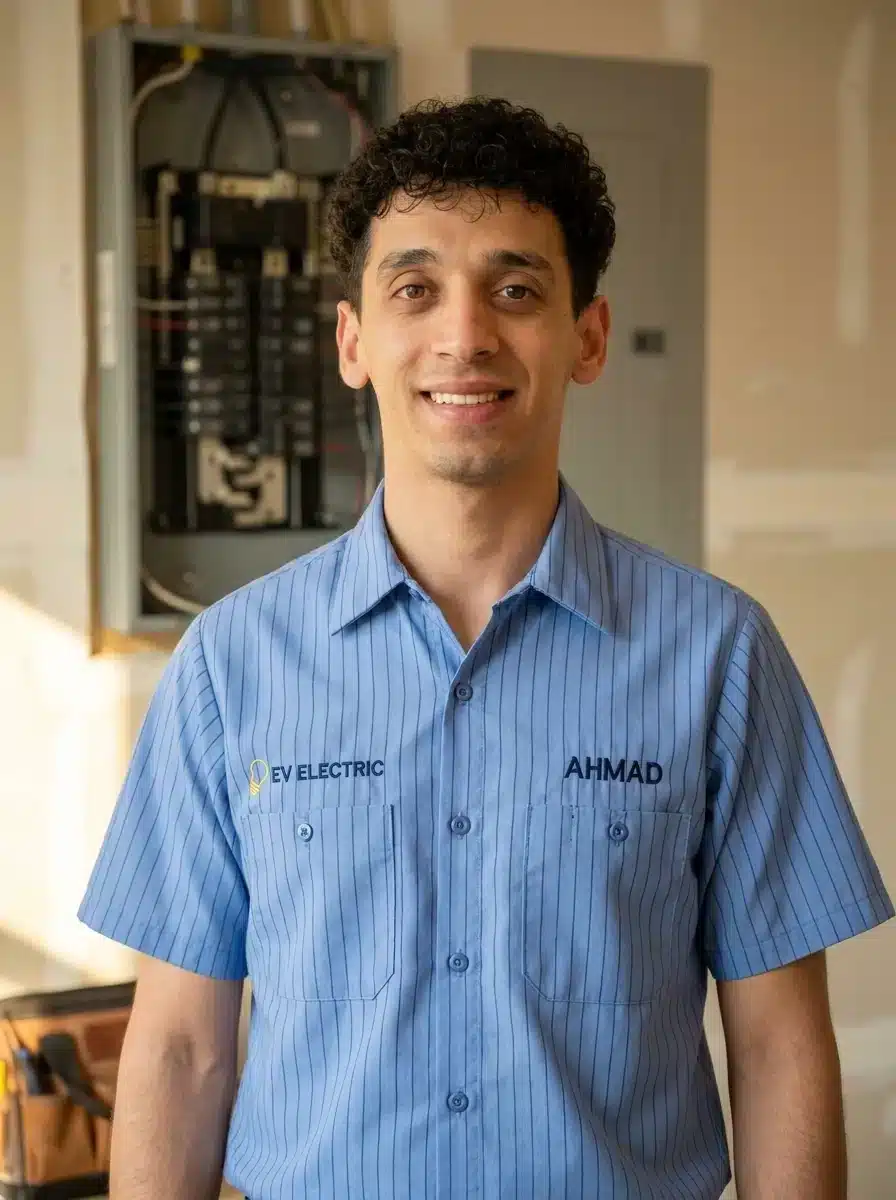
Ahmad Shaban — Master Electrician, Virginia-Licensed
Ahmad owns and operates EV Electric Services from 9488 Fairfax Blvd, Fairfax, VA 22031 — near Fairfax Circle. He answers the phone, runs the diagnosis, and does the work. No subcontractors, no call center, no layers between you and the person who fixes the problem.
Rated 5.0 stars across 113 reviews. When you call 571-500-6637, Ahmad picks up.
Related Services
Troubleshooting often leads to one of these — all served in Tysons and surrounding areas.
Electrical Problem in Tysons? Call Now.
Same-day diagnosis from a Master Electrician — ~10–15 minutes from our Fairfax Circle shop. We find the root cause and quote the fix before any work starts.
571-500-6637