
Smoke Alarm Installation — Fairfax, VA
Smoke Alarm Installation & Replacement in Fairfax, VA
Do your Fairfax smoke alarms meet Virginia code? Hardwired, interconnected, 10-year sealed — installed by a Master Electrician near Fairfax Circle.
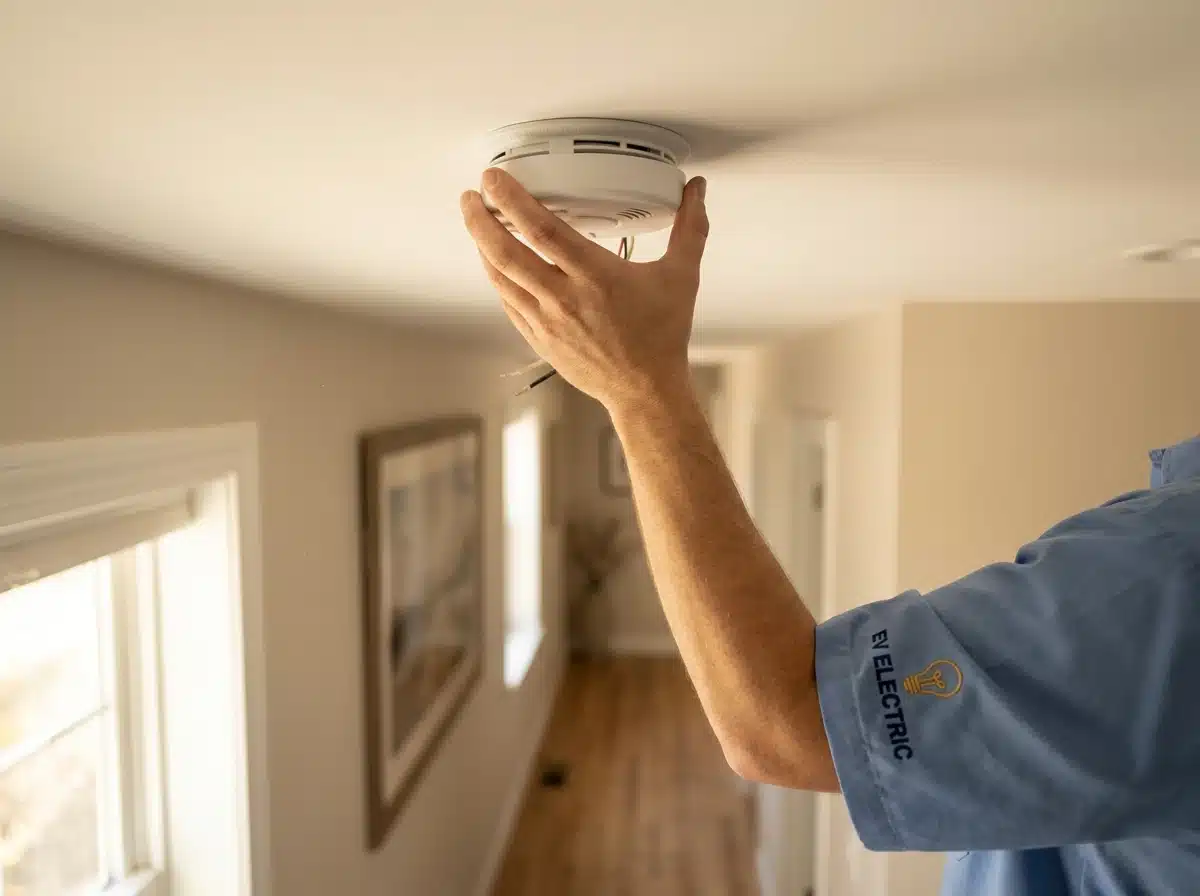
Do Your Fairfax Smoke Alarms Meet Virginia Code?
If you are pulling a permit for any electrical or renovation work in Fairfax — a panel upgrade, a rewire, an addition — Virginia Residential Code requires your smoke alarms to come up to current standards: hardwired, interconnected, with battery backup.
If your home has battery-only alarms, alarms older than 10 years, or hardwired alarms that are not interconnected, they need to be upgraded before your inspection passes. This code-at-permit trigger is the most common reason Fairfax homeowners call for a smoke alarm upgrade.
- New construction / gut renovation: hardwired + interconnected + battery backup — no variance
- Permitted work (panel, rewire, addition): smoke alarms must meet current code at inspection
- Existing homes (no permit): state law requires working alarms on every level, in every bedroom, and outside each sleeping area
What Drives Smoke Alarm Installation Cost
Every home is different. Here is what determines the scope and cost of your smoke alarm installation — no generic price list, just the factors Ahmad evaluates on-site.
- Number of alarms: Virginia requires alarms on every level, inside each bedroom, and outside each sleeping area. A 4-bedroom colonial needs more alarm heads than a 2-bedroom ranch.
- Battery-only vs. hardwired: Battery-only swaps are straightforward. Running new 14/2 wire for a hardwired-interconnected system is a larger scope — especially in homes that never had hardwired alarms.
- Wiring access: Homes with accessible attics (most 1950s–1970s ranches in Mantua and Kings Park) allow overhead wire runs without cutting drywall. Finished ceilings on every level require fishing wire through walls.
- Interconnection: If your home already has hardwired alarms that are not interconnected, adding the interconnect wire between existing locations is a mid-scope job — the wiring exists, but needs to be linked.
- Alarm type: Dual-sensor (photoelectric + ionization) and combination smoke-CO units cost more per head than single-sensor alarms, but provide broader protection.
- Permit requirement: A new hardwired alarm circuit requires an electrical permit. Like-for-like alarm head replacements on existing wiring generally do not.
Battery-Only vs. Hardwired-Interconnected
The core decision Fairfax homeowners face when upgrading smoke alarms. Here is how the two approaches compare — and why Ahmad recommends hardwired-interconnected for most homes.
Battery-Only Alarms
- Power source: 9V replaceable or 10-year sealed lithium battery
- When one alarm triggers: only that alarm sounds — other alarms stay silent
- Code compliance: meets Virginia state law minimum for existing homes with no permit pulled
- Best for: existing homes with no upcoming permitted work and no accessible wiring path
- Limitation: if a fire starts in the basement and your bedroom alarm is battery-only, you may not hear it until smoke reaches your floor
Hardwired + Interconnected
- Power source: 120V house circuit + sealed lithium battery backup (alarms work even during a power outage)
- When one alarm triggers: every alarm in the house sounds simultaneously
- Code compliance: required for new construction, gut renovation, and any permitted electrical work
- Best for: every home — especially multi-story houses where hearing an alarm on a different floor matters
- EV’s recommendation: this is the system Ahmad installs in Fairfax homes unless wiring access makes it impractical
Fairfax Homes by Era: What Kind of Smoke Alarms Do You Have?
The decade your Fairfax home was built determines what kind of smoke alarm system you are likely starting with — and what the upgrade path looks like.
1950s–1970s Split-Levels & Ranches
Mantua • Old Town Fairfax • Kings Park • Mosby WoodsMany of these homes were built before smoke alarm requirements existed. Original installs are battery-only alarms added by homeowners — often expired (10+ years old), not interconnected, and mounted in non-code locations. The wiring in these homes typically runs through accessible attics, making a hardwired-interconnected retrofit feasible without major drywall work. Highest-need era for a full smoke alarm upgrade.
1970s–1990s Colonials & Traditionals
Penderbrook • Greenbriar • Country Club HillsUsually have hardwired alarms installed at construction — but often not interconnected (built before the interconnect code requirement). The wiring exists; the upgrade is replacing the alarm heads with interconnected units and adding alarms in bedrooms (the bedroom requirement was added later). Mid-effort upgrade — wiring exists, add heads + interconnect.
2000s–2020s Townhomes & Newer Detached
Fair Oaks • Fair Lakes • Fairfax CornerBuilt to modern code: hardwired, interconnected, battery backup. These homes are now entering the 10-year replacement window — the original alarm heads are reaching end-of-life. The job is swapping heads with current dual-sensor units on the existing wiring. Lowest complexity — replacement-cycle service.
Smoke Alarm Types We Install
Each detection technology suits a different location in your home. Ahmad recommends placement based on where false alarms happen and where the fastest response matters.
Photoelectric
Detects slow, smoldering fires — the kind that build behind walls or in upholstery. Best near kitchens and living areas because it is less prone to false alarms from cooking. Standard recommendation for hallways adjacent to kitchens in Fairfax homes.
Ionization
Detects fast-flaming fires — fires that spread rapidly with visible flame. Fastest response to flaming fire. Best in bedrooms and interior hallways away from kitchens (ionization alarms near cooking areas are the leading cause of nuisance trips).
Dual-Sensor (Photoelectric + Ionization)
Both detection types in one unit. Covers smoldering and flaming fires without needing separate alarms. Ahmad’s default recommendation for most Fairfax homes — one alarm type covers all scenarios, simplifying placement and reducing false alarms.
Combination Smoke + CO Detector
Smoke detection plus carbon monoxide monitoring in a single unit. Required in any home with gas appliances, an attached garage, or fuel-burning equipment (furnace, water heater, fireplace). Eliminates the need for separate CO alarms at each location.
The 10-Year Sealed Battery Rule
If your Fairfax smoke alarms still take replaceable 9V batteries, this is what has changed — and why the alarm itself gets replaced, not just the battery.
What Changed and Why
UL 217 (the standard governing smoke alarms in the US) now requires all new smoke alarms to use 10-year sealed lithium batteries. You cannot replace the battery — when the alarm chirps at end-of-life, you replace the entire unit. Virginia follows this standard.
What this means for Fairfax homeowners:
If your alarms have replaceable 9V batteries, they are either older than 10 years (the unit itself is expired and should be replaced) or a non-sealed model that is being phased out of production.
If your alarms were installed in 2016 or earlier, they have reached or are approaching the manufacturer’s 10-year replacement date — regardless of whether the battery still works.
Ahmad checks manufacturing dates on every alarm during an assessment. If your alarm heads are at end-of-life, he recommends replacing them with hardwired-interconnected units: “While we are replacing the unit, we can wire it into the house circuit so all alarms sound together.”
Smoke Alarm Installation & Upgrade Scenarios
Eight scenarios we handle in Fairfax homes — from full battery-to-hardwired conversions in 1960s ranches to 10-year head swaps in newer townhomes.
Full Battery-Only to Hardwired Upgrade
Mantua • Old Town Fairfax
1960s ranches with no original alarm wiring. Ahmad runs new 14/2 circuit through the attic, installs interconnected heads in every bedroom, hallway, and level. The attic access in these homes makes the wire run feasible without cutting drywall. If your alarms trip repeatedly, start with an electrical diagnostic first.
Add Bedroom Alarms (Code Gap)
Kings Park • Mosby Woods
1970s homes built before the bedroom alarm requirement was added. The hallway alarms exist; the bedrooms have none. Ahmad adds alarm heads inside each bedroom and interconnects them with the existing hardwired circuit.
Replace Expired Hardwired Heads
Penderbrook • Greenbriar
1980s–1990s homes where the original hardwired alarms are hitting their 10-year expiration. Same wiring, new dual-sensor interconnected heads. The simplest upgrade — Ahmad swaps the alarm units and verifies interconnection.
Interconnect Existing Hardwired Alarms
Country Club Hills
1980s homes with hardwired alarms that were installed before interconnection was required. Each alarm sounds independently. Ahmad adds the interconnect wire between existing locations so all alarms sound together when any one triggers.
Combination Smoke + CO Install
Any home with gas appliances
Homes with a gas furnace, gas water heater, attached garage, or fireplace need carbon monoxide detection. Combination smoke-CO units serve both functions at each location. Ahmad installs separate CO alarms near fuel-burning equipment when combination units are not appropriate.
Code-at-Permit Upgrade
Any Fairfax home (permit-triggered)
Pulling a permit for a panel upgrade or any renovation triggers a code-required smoke alarm upgrade. Ahmad does a full alarm survey, upgrades all alarms to current code, and coordinates with the primary permit so your inspection passes.
New Construction / Gut Renovation
Fairfax Corner • Fair Lakes
Full alarm layout per current Virginia Residential Code: hardwired, interconnected, battery backup, in every bedroom, outside every sleeping area, on every level. No variance. Ahmad handles the complete alarm circuit from panel to final head.
False Alarm / Nuisance Trip Diagnosis
Any Fairfax neighborhood
Alarms that trip repeatedly without a fire usually have one of three causes: expired unit (replace it), wrong type for the location (ionization alarm near a kitchen), or a wiring issue causing phantom triggers. Ahmad diagnoses the cause before recommending a fix. Start with an electrical diagnostic.
Permits & Virginia Smoke Alarm Code
Virginia has a statewide smoke alarm law and a separate code-at-permit requirement. Here is how they differ and what applies to your Fairfax home.
City of Fairfax (Corporate Limits)
- Permit authority: City of Fairfax Code Administration
- New hardwired alarm circuit: electrical permit required
- Like-for-like head replacement: generally no separate permit
- Code-at-permit trigger: any building or electrical permit for renovation, addition, or system upgrade requires smoke alarms to meet current Virginia Residential Code (R314)
The City of Fairfax is an independent city — not part of Fairfax County for permitting purposes. Ahmad files with the City directly.
Fairfax County (Surrounding Areas)
- Permit authority: Fairfax County Land Development Services (LDS), ELER trade permit
- New hardwired alarm circuit: electrical permit required
- Like-for-like head replacement: generally no separate permit
- Code-at-permit trigger: same as City — any permitted work triggers smoke alarm code compliance at inspection
Most Fairfax-area neighborhoods (Mantua, Kings Park, Penderbrook, Fair Oaks) are in Fairfax County, not the City. Ahmad handles the County LDS permit process.
VA statewide smoke alarm law (separate from code-at-permit): Virginia requires working smoke alarms on every level of a dwelling, inside each bedroom, and outside each sleeping area. This applies to all homes regardless of permit status. The code-at-permit rule adds the hardwired-interconnected-with-battery-backup requirement when permitted work is being done.
The Daylight Saving Reminder — and When It Reveals a Bigger Problem
Every March and November, the “change your clocks, change your batteries” reminder sends Fairfax homeowners to their smoke alarms. For battery-only homes, this is when dead alarms and expired units get discovered. For hardwired homes, it is the “test your alarms” moment — and the moment homeowners find out that pressing the test button produces silence instead of sound.
March and November are our busiest months for smoke alarm calls. If your daylight saving check reveals alarms that do not sound, alarms with manufacturing dates older than 10 years, or alarms that are not interconnected (only one sounds when you press the test button), those are the three signals that your system needs attention — not just a battery swap.
Call 571-500-6637 after your next test. Ahmad will assess your entire system, not just the alarm that failed.
Smoke Alarm Quick Reference
Quick answers to the smoke alarm questions Fairfax homeowners ask most often. For a full assessment of your home, call 571-500-6637.
Your smoke alarm system is only as reliable as its weakest alarm. A single expired unit in a bedroom can leave a gap in coverage that interconnected alarms are designed to close. Ahmad checks every alarm in the house — not just the one that prompted the call.
If you are planning a panel upgrade, a whole-house rewire, or any permitted renovation, ask about smoke alarm requirements at the same time. The code-at-permit upgrade is easier and less expensive when bundled with the primary electrical work.
Smoke Alarm Essentials
Common questions from Fairfax homeowners.
How often should smoke alarms be replaced?
Every 10 years regardless of whether they still sound when tested. The sensing element degrades over time. Check the manufacturing date on the back of each alarm — if it is 2016 or earlier, it is due for replacement.
Do I need hardwired smoke alarms in Virginia?
State law requires working alarms but does not mandate hardwired in existing homes without a permit. However, if you pull any building or electrical permit, Virginia Residential Code requires bringing alarms up to current standards: hardwired, interconnected, with battery backup.
Can I install smoke alarms myself?
Battery-only alarms are a straightforward DIY project. Hardwired alarms require working with 120V wiring and may require a permit — hire a licensed electrician. Interconnecting alarms across multiple locations involves running wire between them, which is electrical work.
Why does my smoke alarm keep going off for no reason?
Three common causes: (1) the alarm is expired and malfunctioning, (2) an ionization alarm is mounted near a kitchen and cooking triggers it, or (3) a wiring issue is causing phantom triggers. A diagnostic identifies which cause applies.
What is the difference between smoke alarms and smoke detectors?
Functionally, homeowners use the terms interchangeably. Technically, a smoke detector is the sensing component; a smoke alarm includes the detector and the audible horn in one unit. Residential installations use smoke alarms (self-contained units), not standalone detectors connected to a fire alarm panel.
How do I dispose of old smoke alarms in Fairfax?
Ionization smoke alarms contain a small amount of radioactive material (Americium-241). Most can go in household trash in Virginia, but check with Fairfax County’s I-66 Transfer Station or the City of Fairfax for current disposal guidance. Photoelectric alarms have no radioactive component and can be discarded normally.
How a Smoke Alarm Installation Works
From call to code-compliant coverage — here is what to expect when Ahmad handles your smoke alarm project.
Full Alarm Assessment
Ahmad inspects every existing alarm in the house — checking manufacturing dates, type (photoelectric/ionization/dual), wiring status (battery-only or hardwired), and whether alarms are interconnected. He maps which locations meet code and which have gaps.
Scope & Recommendation
Based on the assessment, Ahmad recommends the right alarm type for each location, identifies wiring runs (attic vs. wall fishing), and provides a clear scope. If a permit is needed, he explains what triggers it.
Installation & Interconnection
Ahmad runs the wiring (if upgrading to hardwired), installs alarm heads at code-required locations, and interconnects all alarms so they sound together. Typical install: 2–4 hours depending on alarm count and wiring access.
Test & Verify
Every alarm is individually tested. Ahmad confirms that triggering any single alarm causes all interconnected alarms to sound. If a permit was pulled, the system is ready for inspection.
For the full scope of our electrical services, visit our Fairfax electrician hub.
Your Fairfax Electrician — Not a Battery-Change Service
EV Electric is based near Fairfax Circle. Ahmad handles the wiring, the alarms, and the permit — not a franchise that replaces batteries and leaves.
Drive Times from Fairfax Circle
- Old Town Fairfax 5 min
- Mantua 7 min
- Kings Park 8 min
- Penderbrook 10 min
- Country Club Hills 8 min
- Mosby Woods 6 min
- Fair Oaks / Fair Lakes 12 min
- Fairfax Corner 14 min
Same-day scheduling available. Most smoke alarm installs are 2–4 hour jobs. Ahmad can often fit a full assessment + install in one visit.
5.0 stars from 122 reviews. Fairfax homeowners trust EV Electric for residential electrical work — from smoke alarms to panel upgrades.
Master Electrician on every job. Ahmad Shaban is a Virginia-licensed Master Electrician. He does the work himself — no subcontracted crews.
Fairfax Neighborhoods We Serve
Ahmad installs and upgrades smoke alarms across Fairfax — City and County. Each neighborhood has its own housing era and alarm profile.
- Old Town Fairfax — 1950s–1960s originals, most need full hardwired upgrade
- Mantua — 1960s split-levels, battery-only to hardwired-interconnected conversion
- Kings Park — 1960s–1970s, add bedroom alarms + interconnect existing
- Mosby Woods — 1960s–1970s ranches, accessible attics for wire runs
- Country Club Hills — 1980s colonials, hardwired but not interconnected
- Penderbrook — 1980s–1990s, original hardwired heads hitting 10-year expiration
- Greenbriar — 1980s–1990s traditionals, same replacement-cycle profile
- Fair Oaks / Fair Lakes — 2000s+, modern code-compliant, 10-year head swap
- Fairfax Corner — 2000s–2020s townhomes, replacement-cycle service
- Brecon Ridge — 1970s homes, mid-era upgrade (add bedrooms + interconnect)
Smoke Alarm FAQ — Fairfax, VA
Answers to the most common smoke alarm questions from Fairfax homeowners.
Do I need hardwired smoke alarms in Virginia?
Virginia state law requires working smoke alarms on every level, inside each bedroom, and outside each sleeping area — but it does not mandate hardwired in existing homes unless you pull a permit. When you get a permit for any renovation, addition, panel upgrade, or electrical work, Virginia Residential Code (R314) requires upgrading your alarms to hardwired, interconnected, with battery backup before your inspection passes.
How often should smoke alarms be replaced?
Every 10 years, per manufacturer guidelines and code. The sensing element degrades over time even if the alarm still responds to the test button. Check the manufacturing date printed on the back of each unit. Alarms manufactured in 2016 or earlier are due now.
Can I install my own smoke alarms in Fairfax?
Battery-only alarms are a straightforward homeowner project — mount the bracket, snap in the alarm. Hardwired alarms involve 120V wiring and may require an electrical permit, especially if you are adding a new circuit or interconnecting alarms across multiple locations. Licensed electrician work.
What triggers a required smoke alarm upgrade in Fairfax?
Pulling any building or electrical permit. A panel upgrade, a whole-house rewire, a kitchen renovation, a room addition — any permitted work triggers a code-at-permit review. The inspector will check that your smoke alarms meet current Virginia Residential Code before signing off. This is the most common reason Fairfax homeowners call for a smoke alarm upgrade.
How many smoke alarms does my house need?
Virginia requires alarms on every level of the home (including basement), inside each bedroom, and outside each sleeping area (typically the hallway adjacent to bedrooms). A typical 4-bedroom, 3-level Fairfax colonial needs 7–9 alarms. Ahmad counts the exact requirement during the assessment.
What is the difference between photoelectric and ionization smoke alarms?
Photoelectric alarms detect slow, smoldering fires and are less likely to false-alarm from cooking. Ionization alarms detect fast-flaming fires and respond fastest to open flame. Dual-sensor alarms combine both technologies in one unit — Ahmad’s default recommendation for Fairfax homes because they cover both fire types without needing separate alarms.
Do I need a separate carbon monoxide detector?
If your home has any fuel-burning equipment (gas furnace, gas water heater, fireplace) or an attached garage, you need CO detection. Combination smoke-CO alarms handle both in one unit. In some cases, a separate CO alarm near the fuel-burning equipment is also recommended. Ahmad assesses your home’s specific needs during the visit.
How long does smoke alarm installation take?
A like-for-like alarm head swap on existing wiring typically takes 1–2 hours. A full battery-only to hardwired-interconnected upgrade with new wiring runs takes 3–5 hours depending on alarm count and attic access. Ahmad provides a time estimate during the assessment so you know what to expect.
About EV Electric Services
Your Fairfax electrician for smoke alarms, panel work, and everything residential.
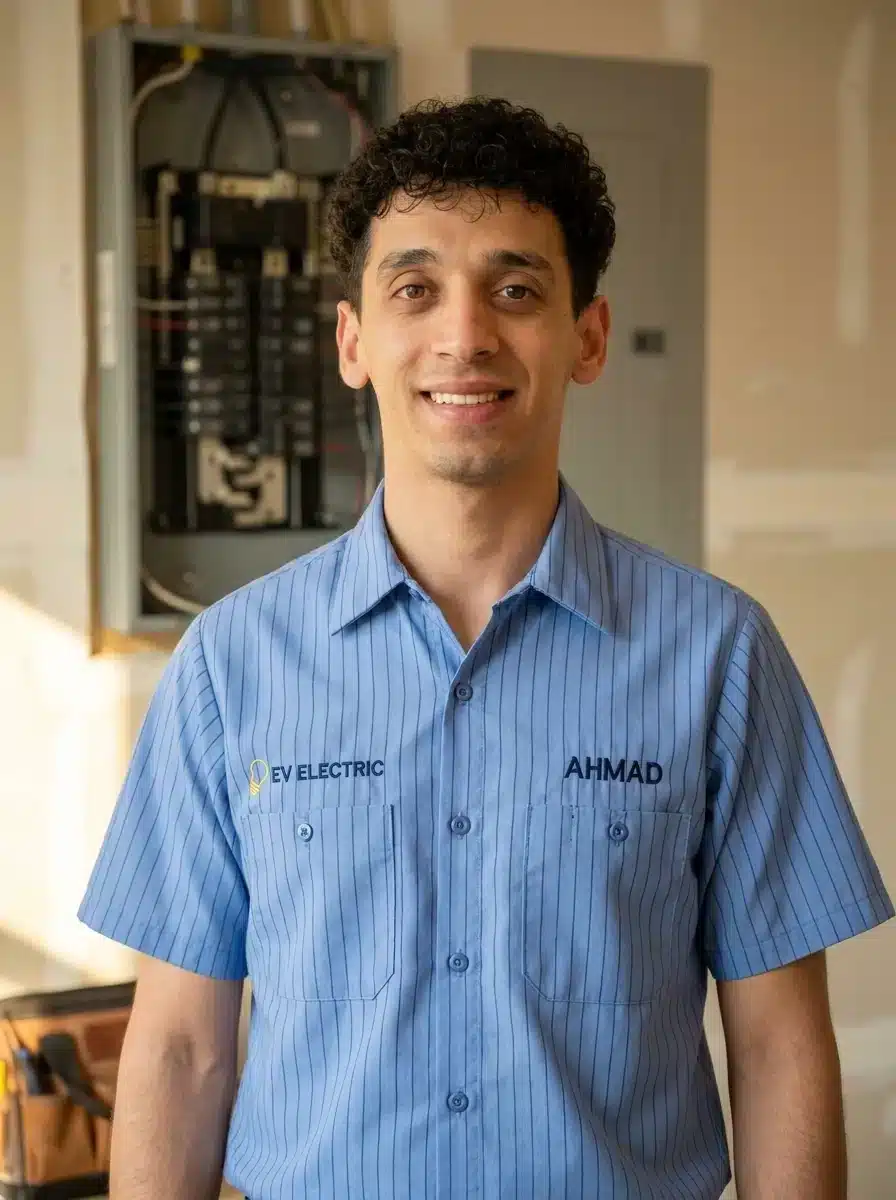
Ahmad Shaban, Master Electrician
Ahmad is a Virginia-licensed Master Electrician and the owner of EV Electric Services at 9488 Fairfax Blvd, Fairfax, VA 22031. He does the work himself — no subcontracted crews, no technicians learning on your house.
Smoke alarm installation is one of the most common residential electrical jobs Ahmad handles in Fairfax. He knows which neighborhoods still have battery-only alarms, which eras have hardwired-but-not-interconnected systems, and which homes are entering the 10-year replacement cycle. That local knowledge means a faster, more accurate assessment and installation.
5.0 stars from 122 reviews.
Related Electrical Services in Fairfax
Smoke alarm work often connects to other electrical projects. Here are the services Fairfax homeowners commonly pair with a smoke alarm upgrade.
Ready to Upgrade Your Fairfax Smoke Alarms?
Whether you need a full hardwired-interconnected system, expired alarm heads replaced, or a code-at-permit upgrade — Ahmad handles the entire project.
571-500-6637