
Circuit Breaker Replacement — Fairfax, VA
Circuit Breaker Replacement in Fairfax, VA
Circuit breaker replacement in Fairfax, VA — diagnosis first, then the right fix. A tripping breaker is a symptom. We find the cause before replacing anything.
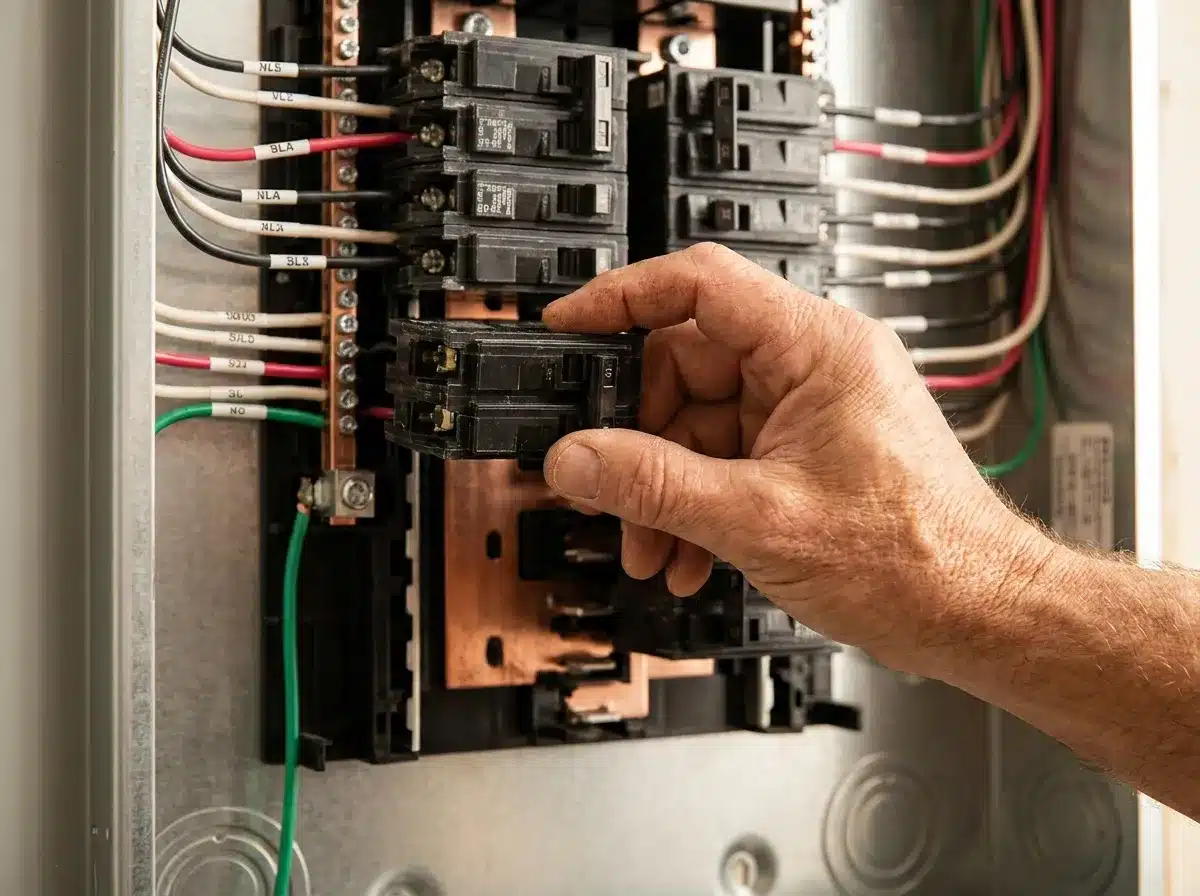
Is the Breaker the Problem, or Just the Symptom?
A tripping breaker is doing its job — protecting your wiring from overload, short circuit, or ground fault. The question is whether the breaker itself has failed, or whether it is telling you something else is wrong on the circuit.
Most homeowners in Fairfax call about a “bad breaker” when the real issue is an overloaded circuit, a short in the wiring, or a ground fault at an outlet. Replacing the breaker without diagnosing the cause means the new breaker trips too — because the problem was never the breaker.
That is why every circuit breaker call at EV Electric starts with a diagnostic. We identify what is tripping the breaker and why before we replace anything. If the breaker is the problem, we replace it. If the circuit is the problem, we fix the circuit. If you are not sure what is causing the trip, start with a full diagnostic.
Ahmad Shaban, Virginia-licensed Master Electrician, runs every diagnosis from our shop near Fairfax Circle — same-day for most breaker calls.
Circuit Breaker FAQ
Common breaker questions from Fairfax homeowners:
Why does my breaker keep tripping?
The three most common causes are circuit overload (too many devices on one circuit), a short circuit in the wiring, and a ground fault. The breaker is doing its job by tripping — the fix depends on which cause is present.
Is a tripping breaker dangerous?
A breaker that trips is protecting you — that part is working. The danger is when a breaker FAILS to trip (common with FPE Stab-Lok panels found in 1960s-70s Fairfax homes). A breaker that trips repeatedly signals an underlying issue that needs diagnosis.
How do I know if the breaker itself is bad?
Signs of a failed breaker: the handle feels loose or does not snap firmly on and off, the breaker feels hot to the touch, it trips with nothing plugged into the circuit, or it will not reset at all. A diagnostic confirms whether it is the breaker or the circuit.
What is an AFCI breaker and why does it keep tripping?
AFCI (arc-fault circuit interrupter) breakers detect electrical arcs — they are code-required in bedrooms and living areas in homes built after 2002. Nuisance trips are common with certain appliances and dimmer switches. Diagnosis determines whether the trip is a real arc fault or a nuisance.
Do I need a permit to replace a circuit breaker?
In Fairfax, a like-for-like breaker swap (same amperage, same type, same slot) generally does not require a permit. A new circuit, panel modification, or service change requires a permit through the City of Fairfax Code Administration or Fairfax County LDS.
Can I replace a breaker myself?
Swapping a standard breaker in a modern panel with the main off is technically possible for a handy homeowner. But if you have an FPE or Zinsco panel, need an AFCI breaker, or the breaker trips because of a wiring problem — you need a licensed electrician. If you are not sure, a diagnostic call answers that question.
How Much Does Circuit Breaker Replacement Cost in Fairfax?
Circuit breaker replacement cost depends on three factors: the type of breaker, what the diagnostic reveals, and the labor required to install it safely. A standard thermal-magnetic breaker costs less than an AFCI or GFCI breaker. A straightforward swap costs less than a job that uncovers a wiring issue or a panel that needs replacement.
What Goes Into the Total
- Diagnostic: We identify whether the breaker is the problem or the symptom. This step determines the scope of the job before any parts are ordered.
- Breaker type: Standard breakers are the most common. AFCI and GFCI breakers are more expensive because of the electronics inside. Double-pole 240V breakers (for dryers, ranges, EV chargers) vary by amperage.
- Labor: A like-for-like swap in a modern panel is straightforward. Replacing a breaker in an FPE or Zinsco panel is a different job entirely — often a full panel upgrade, not a breaker swap.
- Panel condition: If the bus bar is damaged, connections are corroded, or the panel is an obsolete brand, the scope changes from “replace one breaker” to “address the panel.”
Do You Need an Electrician to Replace a Circuit Breaker?
Some breaker replacements are within reach of a handy homeowner. Others require a licensed electrician — and getting this wrong can cause a fire, void your insurance, or violate Fairfax building code.
Technically DIY-Possible
- Swapping a standard breaker of the same amperage in a modern panel (Siemens, Square D, Eaton)
- Main breaker turned completely OFF before touching anything
- You can confirm the replacement breaker is the correct brand and bus type for your panel
- No signs of heat damage, corrosion, or melted plastic on the bus bar
Call a Licensed Electrician
- FPE Stab-Lok or Zinsco panel — the breaker is not the problem; the panel is. This is a full panel upgrade, not a breaker swap.
- AFCI breaker replacement — requires understanding arc-fault diagnostics and nuisance-trip isolation
- The breaker trips because of a wiring problem — replacing the breaker does not fix a short, ground fault, or overloaded circuit
- Double-pole (240V) breaker — higher amperage, higher risk if miswired
- Any work requiring a permit — new circuit, panel modification, or service change
- If you are not sure whether the breaker is the problem or the symptom, that is what a diagnostic call is for
Breaker Diagnostic Tree: Symptom, Cause, and Fix
Use this table to understand what your breaker behavior means — and whether the breaker itself needs replacement or the real problem is elsewhere on the circuit.
| What You Observe | Likely Cause | The Fix | Is It the Breaker? |
|---|---|---|---|
| Breaker trips when you run a specific appliance | Circuit overload — too many amps on one circuit | Move loads to other circuits; add a dedicated circuit if needed | NO — the breaker is doing its job |
| Breaker trips randomly, no pattern | Intermittent short in the wiring (nail through wire, damaged insulation) | Trace and repair the short | NO — the breaker is protecting you |
| Breaker trips immediately on reset | Dead short or ground fault on the circuit | Isolate the fault — may be a bad device, damaged wire, or water intrusion | MAYBE — could also be a failed breaker |
| Breaker feels hot to the touch | Loose connection at the breaker lug or bus bar | Re-torque or replace breaker; inspect bus bar | YES (or the connection) |
| Breaker handle is loose or won’t snap | Mechanical failure — breaker internals worn | Replace the breaker | YES |
| Breaker is an FPE Stab-Lok | Design defect — may not trip on overload | Replace the PANEL (not just the breaker) | YES — but the fix is bigger |
| AFCI breaker trips frequently in a newer home | Nuisance trip OR real arc-fault | Diagnose: real arc (loose connection) vs nuisance (certain appliances, dimmer switches) | MAYBE — diagnose before replacing |
Not sure which row describes your situation? Start with a full diagnostic — we identify the cause before recommending a fix.
Types of Circuit Breakers in Fairfax Homes
The right replacement breaker depends on what your panel uses, what the circuit powers, and what current electrical code requires. Here are the six breaker types we see most in Fairfax.
Standard (Thermal-Magnetic)
The most common breaker in residential panels. Protects general circuits — lighting, outlets, and small appliances. Replacement is straightforward: match the amperage and the panel brand/bus type (Siemens, Square D, Eaton, etc.).
AFCI (Arc-Fault)
Code-required in bedrooms since the 2002 NEC, expanded to living areas in 2008 and later editions. Detects electrical arcs that standard breakers miss. Nuisance trips are common — diagnose before replacing. Often the cause is a dimmer switch or arc-sensitive appliance, not a bad breaker.
GFCI Breaker
Protects against ground faults — required for kitchens, bathrooms, outdoor circuits, and garages where GFCI outlets are not used instead. Has a built-in test button. Replacement must be the same type — a standard breaker will not provide ground-fault protection.
Double-Pole (240V)
Powers high-draw appliances: dryers, ranges, water heaters, HVAC systems, and EV chargers. Higher amperage than single-pole breakers. Replacement requires verifying wire gauge matches the breaker rating — miswiring a 240V circuit is a fire risk.
FPE Stab-Lok
Found in 1960s-70s Fairfax homes — Mantua, Old Town, Country Club Hills. Known design defect: breakers may fail to trip on overload. Do not replace with another FPE breaker. The entire panel needs replacement. See our panel upgrade page.
Zinsco
Similar era to FPE, less common in Fairfax. Breakers can fuse to the bus bar and fail to trip. Same rule as FPE: panel replacement, not breaker replacement. If your panel says “Zinsco” or “Sylvania” on the door, call for an evaluation.
FPE Stab-Lok and Zinsco Panels: Why a Breaker Swap Is Not Enough
If you live in a 1960s or 1970s home in Fairfax — particularly in Mantua, Old Town Fairfax, or Country Club Hills — your panel may be an FPE Stab-Lok or Zinsco. These are not just old panels. They are panels with documented failure-to-trip defects that create fire risk.
Federal Pacific Electric (FPE) Stab-Lok
Fire Risk — Panel Replacement RequiredFPE Stab-Lok breakers were found in independent testing to fail to trip on overload up to 60% of the time. This means the breaker allows dangerous current to flow through the wiring without interrupting it — exactly the condition that starts electrical fires.
Replacing one FPE breaker with another FPE breaker does nothing to solve the problem. Third-party replacement breakers marketed as “compatible” have their own reliability concerns. The fix is a full panel upgrade to a modern panel (Siemens, Square D, or Eaton).
Common in: Mantua split-levels, Old Town Fairfax ranches, Country Club Hills (1960s-70s construction).
Zinsco (GTE-Sylvania)
Fire Risk — Panel Replacement RequiredZinsco breakers can fuse to the bus bar, making them impossible to trip manually or automatically. When a Zinsco breaker welds itself to the bus, it provides zero overcurrent protection — the circuit has no safety cutoff.
Some Zinsco panels were relabeled as “Sylvania” after acquisition. If the panel door says either name, the issue is the same. Like FPE, the correct action is a panel replacement — not a breaker swap.
Less common than FPE in Fairfax, but present in some 1970s subdivisions. Insurance carriers increasingly decline coverage for homes with Zinsco panels.
Not sure what panel you have? Send us a photo of the panel door label — we can identify the brand and advise whether a breaker replacement or panel replacement is the right path. Call 571-500-6637.
Fairfax Housing Eras and the Breaker Issues They Bring
The age of your home determines the type of panel and breakers installed — and the failure modes you are most likely to encounter.
1950s-1970s Split-Levels and Ranches
Old Town Fairfax, Mantua, Kings Park, Mosby Woods, Country Club HillsFPE Stab-Lok panels are common in these neighborhoods. Original 100A panels with limited bus space for modern electrical loads. If a homeowner calls about “replacing a breaker” in one of these homes, the real answer is often “replace the panel.” These panels also predate AFCI and GFCI requirements — any circuit work triggers code-upgrade obligations.
1970s-1990s Colonials and Traditionals
Penderbrook, Greenbriar, south MantuaStandard breakers from this era are often still reliable but showing age at 30-50 years. GFCI breaker retrofits may be needed for code compliance in kitchens and bathrooms. Aluminum wiring connections can cause breaker-adjacent issues — loose terminations at the bus bar generate heat and cause trips that look like bad breakers but are really connection problems.
2000s-2020s Townhomes and Newer Construction
Fair Oaks, Fair Lakes, Fairfax CornerAFCI breakers are code-required in these homes. Nuisance AFCI trips are the number-one breaker call from these neighborhoods — the breaker trips with no apparent overload. Diagnosis determines whether the trip is a real arc fault (loose connection in the wall) or a nuisance caused by an arc-fault-sensitive appliance or dimmer switch. Replace only after diagnosis confirms the breaker is defective.
Permits and Electrical Code for Breaker Work in Fairfax
Whether you need a permit depends on the scope of the work — not the size of the breaker. Fairfax has two separate permitting authorities depending on whether your property is inside the City of Fairfax corporate limits or in unincorporated Fairfax County.
City of Fairfax (Inside Corporate Limits)
Permits issued through City of Fairfax Code Administration.
- Like-for-like breaker swap (same amperage, same type, same slot) — generally no permit required
- New circuit addition — electrical permit required
- Panel replacement or service upgrade — electrical permit + inspection required
The City enforces the 2021 Virginia Uniform Statewide Building Code (VA USBC), which incorporates the 2020 NEC with Virginia amendments.
Fairfax County (Unincorporated Areas)
Permits issued through Fairfax County Land Development Services (LDS) — ELER trade permit for electrical work.
- Like-for-like breaker swap — generally no permit required
- New circuit, panel modification, or heavy-up — ELER electrical permit required
- FPE/Zinsco panel replacement — permit required (this is a panel upgrade, not a breaker swap)
Same code base (VA USBC / 2020 NEC) — different permitting office and inspection scheduling.
Not sure whether your address is City or County? The corporate limits of the City of Fairfax are smaller than most people assume. Many addresses with “Fairfax” in the mailing address are actually in unincorporated Fairfax County. We verify jurisdiction as part of every job scope.
Circuit Breaker Replacement Scenarios We Handle in Fairfax
Every breaker call is different. Here are eight scenarios we see regularly — each one starts with a diagnostic to confirm the cause before we replace anything.
Standard Breaker Replacement
Any Fairfax neighborhood — The most common call. Breaker handle is worn, loose, or will not snap on and off. We diagnose, match the breaker type and brand to your panel, replace it, and test the circuit under load.
FPE Stab-Lok Panel Replacement
Mantua, Old Town, Country Club Hills — Homeowner calls about a single breaker, but the real issue is the entire FPE panel. We scope a full panel upgrade — not a breaker swap — because replacing one FPE breaker does not fix the failure-to-trip defect.
AFCI Nuisance Trips
Fair Oaks, Fair Lakes, Fairfax Corner — AFCI breaker trips repeatedly in a 2000s-era home with no apparent overload. We diagnose whether it is a real arc fault (loose wire in the wall) or a nuisance trip (appliance or dimmer) before replacing the breaker.
GFCI Breaker Won’t Reset
Kings Park, Penderbrook — GFCI breaker protecting a kitchen or bathroom circuit fails to reset. We test the GFCI function, replace the breaker if it has failed, and check downstream wiring for ground faults that caused the failure.
Overloaded Circuit (Not the Breaker)
Any neighborhood — especially older 15A circuits — Breaker trips under load, but the breaker is fine — the circuit is carrying more amps than it was designed for. Fix: add a dedicated circuit (permit required) rather than replacing the breaker.
Hot Breaker / Loose Connection
Mosby Woods, Greenbriar — Breaker or panel area feels warm. Usually a loose lug connection at the bus bar in an aging panel. We re-torque connections, inspect the bus bar for damage, and replace the breaker if heat has degraded it. Burning smell? That is an emergency call.
Double-Pole 240V Breaker
Any Fairfax home — Replacing or adding a 240V breaker for a dryer, range, water heater, or EV charger. We verify wire gauge matches the breaker amperage rating and confirm the panel has capacity for the new load.
Breaker Trips After a Storm
Any neighborhood — especially exterior panels — Water intrusion after a storm causes ground faults that trip breakers. We diagnose the water entry path, dry and inspect the panel, replace any breakers damaged by moisture, and seal the entry point to prevent recurrence.
How We Handle a Circuit Breaker Call
Every circuit breaker job follows the same diagnostic-first process.
You call → we ask about the symptom and book the earliest slot → we arrive, diagnose on-site with real tools (multimeter, circuit tracer, IR camera), and explain the cause in plain English → you get a written estimate before any work begins → if the breaker is the problem, we replace it and test the circuit on the same visit. If the diagnostic reveals a bigger issue — overloaded circuit, wiring fault, or an FPE panel that needs full replacement — we explain what we found and scope the right fix. No surprises, no work without your approval.
Most standard breaker replacements are completed same-day from our shop near Fairfax Circle. For a full overview of how we work, see our process and approach.
Same-Day Breaker Diagnosis from Fairfax Circle
EV Electric operates from 9488 Fairfax Blvd — near Fairfax Circle. When a breaker trips and part of your house goes dark, you need someone close. We are not dispatched from 20 miles away.
Drive Times from Our Shop
- Old Town Fairfax 4 min
- Mantua 5 min
- Kings Park 7 min
- Mosby Woods 6 min
- Penderbrook 8 min
- Fair Oaks 10 min
- Greenbriar 9 min
- Country Club Hills 5 min
Why proximity matters for breaker calls: A tripping breaker can mean no power to your kitchen (food spoiling), no lights in half the house, or a circuit you cannot reset. Same-day diagnosis and repair from around the corner means the problem gets solved before it becomes an emergency.
Ahmad Shaban, Virginia-licensed Master Electrician, diagnoses every breaker issue personally — not a technician dispatched from a franchise location.
Fairfax Neighborhoods We Serve for Circuit Breaker Work
We handle breaker diagnostics and replacements across Fairfax — City and County. Each neighborhood has its own housing stock, panel vintage, and typical breaker issues.
- Old Town Fairfax — 1950s-60s ranches and colonials. FPE Stab-Lok panels common. Breaker calls often become panel replacement conversations.
- Mantua — 1960s-70s split-levels. High concentration of FPE panels. Original 100A service with limited bus space.
- Kings Park — 1960s-70s construction. Mix of FPE and early-generation panels. GFCI retrofits needed in kitchens and bathrooms.
- Mosby Woods — 1960s ranches and split-levels. Aging panels with loose bus connections. Hot breakers are a common call.
- Country Club Hills — 1960s-70s homes. FPE panels present. Same failure-to-trip risk as Mantua and Old Town.
- Penderbrook — 1980s-90s townhomes and condos. Standard breakers showing age. GFCI breaker retrofits in wet areas.
- Greenbriar — 1980s-90s colonials. Panels at 30-40 years. Aluminum wiring connections can cause breaker-adjacent heat issues.
- Fair Oaks — 2000s-era townhomes and singles. AFCI breakers standard. Nuisance AFCI trips are the primary breaker call.
- Fair Lakes — 2000s-2010s construction. Same AFCI nuisance-trip pattern as Fair Oaks.
- Fairfax Corner — Newer construction (2010s+). Modern panels with AFCI and dual-function breakers. Trips usually indicate a real wiring issue, not a bad breaker.
Circuit Breaker Replacement FAQ — Fairfax, VA
Answers to the most common circuit breaker questions from Fairfax homeowners.
How much should it cost to have a circuit breaker replaced?
Circuit breaker replacement cost depends on the breaker type (standard, AFCI, GFCI, or double-pole), what the diagnostic reveals about the underlying cause, and the labor required. A straightforward like-for-like swap in a modern panel is less involved than a job that uncovers wiring issues or a panel that needs replacement. We provide a written estimate on-site before beginning any work — you know the full scope and cost upfront.
Do I need an electrician to replace a circuit breaker?
Swapping a standard breaker of the same amperage in a modern panel with the main off is technically possible for a handy homeowner. However, if you have an FPE Stab-Lok or Zinsco panel, need an AFCI breaker, the breaker trips because of a wiring problem, or any permit-required work is involved — you need a licensed electrician. If you are not sure whether the breaker is the problem or the symptom, a diagnostic call answers that question.
What is the average cost of a circuit breaker?
The breaker itself is only one part of the total. Standard thermal-magnetic breakers cost less than AFCI or GFCI breakers, which have electronics inside. Double-pole 240V breakers vary by amperage. The total also includes the diagnostic (identifying whether the breaker is the actual problem) and the labor to install and test. We quote the complete job, not just the part.
Can I replace a circuit breaker on my own?
A standard breaker swap in a modern panel (Siemens, Square D, Eaton) with the main breaker completely off is within reach of a handy homeowner. But this only applies when you know the breaker is the problem, you can match the exact brand and bus type, and there are no signs of damage in the panel. For FPE/Zinsco panels, AFCI breakers, wiring-related trips, or 240V circuits — call a licensed electrician.
Why does my breaker keep tripping even after I replaced it?
Because the breaker was not the problem. The three most common causes of repeated tripping are circuit overload (too many amps on one circuit), a short circuit in the wiring, and a ground fault. A new breaker will trip on the same fault the old one did. The fix is to diagnose and address the underlying cause — not to keep replacing breakers.
Is an FPE Stab-Lok panel dangerous?
Yes. Independent testing found that FPE Stab-Lok breakers fail to trip on overload up to 60% of the time. This means dangerous overcurrent can flow through your wiring without interruption — exactly the condition that causes electrical fires. FPE panels are common in 1960s-70s Fairfax homes (Mantua, Old Town, Country Club Hills). The fix is a full panel replacement, not a breaker swap.
Do I need a permit to replace a circuit breaker in Fairfax?
A like-for-like breaker swap (same amperage, same type, same slot) generally does not require a permit. Adding a new circuit, modifying the panel, upgrading the service, or replacing an FPE/Zinsco panel all require an electrical permit — through the City of Fairfax Code Administration (inside corporate limits) or Fairfax County Land Development Services (unincorporated areas). We handle permitting and inspections as part of the job.
What is the difference between a circuit breaker and a fuse?
Both protect circuits from overcurrent, but a breaker can be reset after it trips — a fuse must be replaced each time. Fuse panels (fuse boxes) are rare in Fairfax homes built after the 1960s. If your home still has a fuse box, a panel upgrade to a modern breaker panel is the recommended path — it provides better protection and supports modern electrical loads.
Your Fairfax Circuit Breaker Specialist
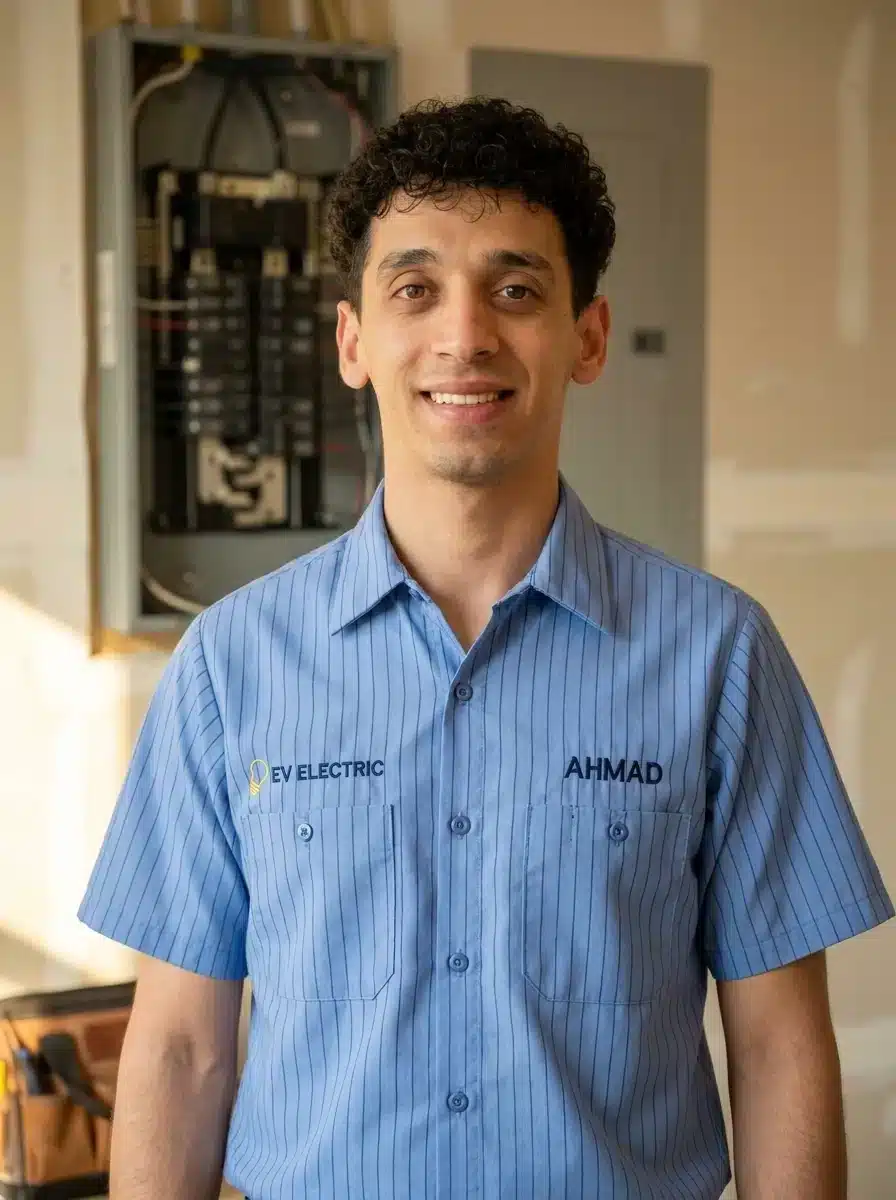
Ahmad Shaban — Virginia-Licensed Master Electrician
EV Electric Services is owned and operated by Ahmad Shaban, a Virginia-licensed Master Electrician based at 9488 Fairfax Blvd, near Fairfax Circle. Every breaker diagnostic, every panel evaluation, and every replacement is performed or directly supervised by Ahmad — not delegated to a junior technician.
With 122 five-star reviews and a 5.0-star rating, EV Electric has built its reputation on getting the diagnosis right before recommending a fix. Circuit breaker calls are one of the most common reasons Fairfax homeowners reach out — and the diagnostic-first approach means you never pay for a breaker replacement when the real problem is somewhere else on the circuit.
Residential-focused. Fairfax-based. Licensed, insured, and permitted for every scope of electrical work in the City of Fairfax and Fairfax County.
Related Electrical Services in Fairfax
Circuit breaker issues often connect to broader electrical work. These are the services Fairfax homeowners most commonly need alongside breaker diagnostics.
Breaker Won’t Reset?
A breaker that won’t stay on is telling you something. We find out what — and fix the right problem. Call for same-day diagnosis from Fairfax Circle.
571-500-6637