
EV Charger Installation in Tysons, VA
Level 2 EV Charger Installation in Tysons, VA — Load Calc First, Then the Right Install
Ahmad Shaban — Virginia-licensed Master Electrician — installs Tesla Wall Connectors, ChargePoint, JuiceBox, and any UL-listed Level 2 charger across Tysons, Pimmit Hills, Spring Hill, The Boro, and McLean-adjacent neighborhoods. Dedicated circuit, Fairfax County EVCS permit handled.
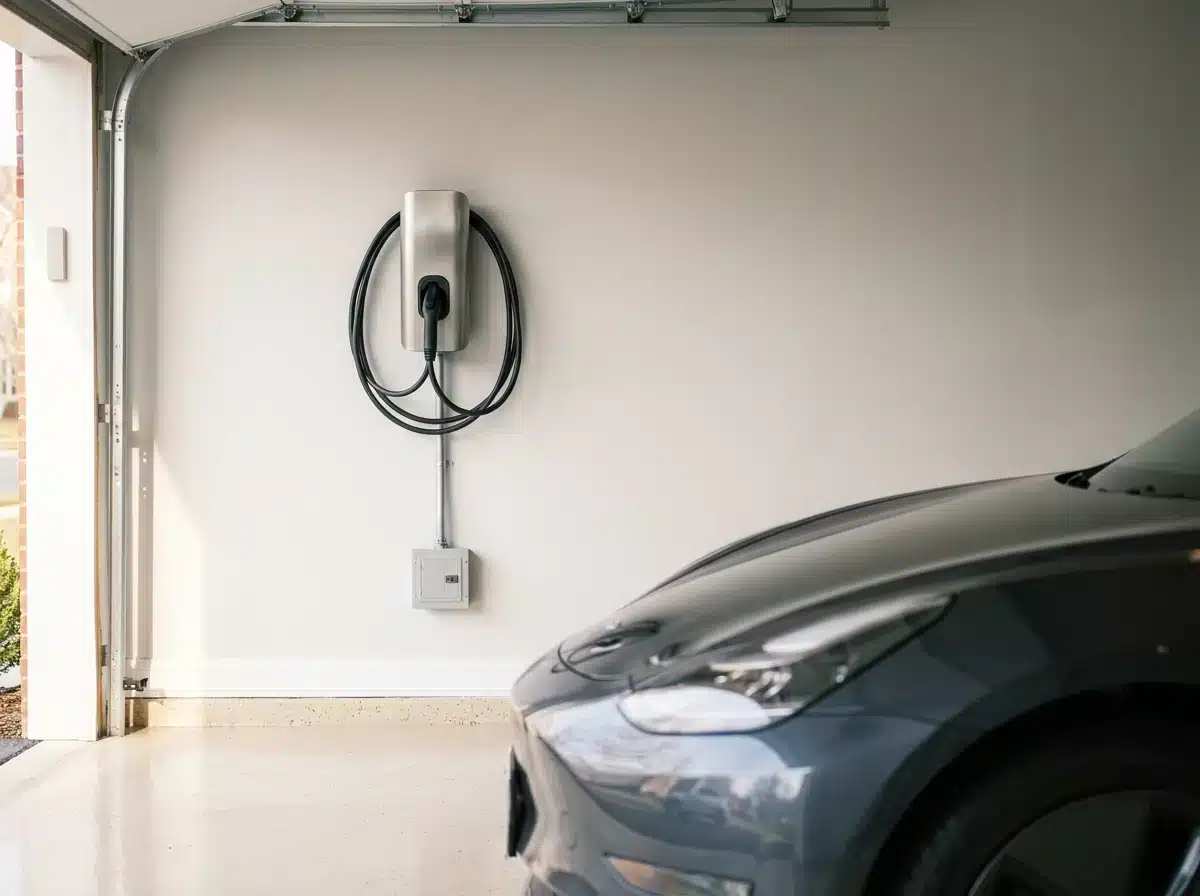
Do I need a panel upgrade to install a Level 2 charger in my Tysons home?
That is the first question every Tysons EV owner asks — and the honest answer comes from a single calculation, not a sales pitch.
The load-calc answer for Tysons homes
Most 200-amp Tysons homes do NOT need a panel upgrade to add a Level 2 charger. If your home was built from the 1970s onward — Spring Hill, The Boro, McLean-adjacent north Tysons — an NEC 220.82 load calculation typically shows 40-60 amps of available headroom. Older 100-amp homes in Pimmit Hills, Westgate, and Idylwood often DO need an upgrade before the charger.
How the math works (NEC 220.82): We total your existing electrical loads at their code-weighted demand values — HVAC compressor, water heater, range, dryer, general lighting — apply the allowable demand reduction, and compare the result to your panel’s rated ampacity. If the remaining capacity exceeds the charger’s continuous draw (48A x 1.25 = 60A), the panel can handle it without an upgrade.
The EV circuit requirement (NEC 625): Every EVSE must have its own dedicated branch circuit — no shared loads. A 48A charger (Tesla Wall Connector, ChargePoint Home Flex at max output) is a continuous load: 48A x 1.25 = 60A breaker and #6 copper wire. The load calculation tells you whether your panel has room for that breaker and that draw.
If the calc shows you need a Tysons panel upgrade first, we handle both jobs in a single project — one permit, one day, one written estimate.
What drives install cost — and why we don’t publish a number
We don’t print price ranges because a number that fits a 200A townhome in The Boro with a 10-foot garage run is wrong for a 100A Pimmit Hills rambler that needs a panel upgrade and 50 feet of outdoor conduit. Here is what actually shapes your project cost:
- Panel capacity. 200A with headroom = charger-only project. 100A or a full panel = panel upgrade required first. The load calc settles it in 20 minutes.
- Circuit run length. A 10-foot run from a garage sub-panel is fast and material-light. A 60-foot conduit run from a utility closet in a Boro townhome to a parking-level charger mount takes more labor and wire.
- Indoor vs. outdoor mount. Outdoor installs — Wolf Trap-adjacent lots, driveway pedestals, detached garages — need weather-rated conduit and hardware. The run is typically longer.
- Hardwired vs. NEMA 14-50. A hardwired 48A Wall Connector and a NEMA 14-50 outlet are different scopes. One requires charger termination; the other is an outlet box.
- Permit. Fairfax County requires an electrical trades permit (ELER) for a new dedicated circuit. We pull it and include the fee in your estimate.
Call 571-500-6637 for a free on-site estimate — we come to the house, run the load calc, and give you a written number before any work is scheduled.
EV charger install scenarios we handle in Tysons
Eight jobs Ahmad gets most often from Tysons-area homeowners. If your situation matches one of these, you are in the right place.
Tesla Wall Connector — hardwired, 48A
The standard install for Tesla owners across Tysons. Hardwired at 48 amps on a dedicated NEC 625 circuit: 60A breaker, #6 copper. We mount the unit, run the circuit from your panel, terminate, commission, and pair to your Tesla account. Most 200A Tysons homes — Spring Hill, Tysons West, Arbor Row — clear the load calc easily. Typical job: 3-4 hours in an attached garage or parking-level wall.
NEMA 14-50 outlet for portable Level 2
The flexible option. Plug in the portable Level 2 cord that shipped with your car — Tesla Mobile Connector, Ford Charge Station Pro cord, Rivian portable charger. No hardwired mount required. Good fit for Tysons homeowners who haven’t committed to a wall unit yet, or who want to take the cord on road trips. Dedicated 50A circuit, #6 wire, same permit process.
ChargePoint Home Flex — smart charger, HOA-ready
Popular with Tysons condo and townhome owners who need HOA approval documentation. Hardwired up to 50 amps or plug-in at 40 amps. App-based scheduling lets you shift charging to Dominion’s off-peak hours. We handle the electrical install, walk you through the app, and provide the permit paperwork HOA boards typically request. Common in Spring Hill and Arbor Row townhome communities.
Two-charger household
Common in affluent Tysons households with two EVs. Two chargers can share a feeder with load-management equipment (Tesla Powershare, Wallbox Power Boost, ChargePoint load sharing), or each gets its own dedicated circuit if panel capacity allows. We run the NEC 220.82 calc for the combined draw and size the installation accordingly. May require a panel upgrade if both chargers draw 48A continuously.
Outdoor install — no attached garage
For Wolf Trap-adjacent large lots, driveway pedestals, and detached-garage setups. Requires a weather-rated charger enclosure, outdoor-rated conduit, and a properly mounted disconnect. Longer wire pull than a garage-wall mount. Most major chargers are NEMA 4 rated for outdoor exposure — we verify the model, plan the conduit route, and install to match the site conditions.
Charger plus panel upgrade — combo project
When the NEC 220.82 load calculation shows the existing panel can’t carry the EV load — common in Pimmit Hills and Westgate 100A homes. We do both in one project: panel upgrade during the Dominion meter-drop window, charger circuit installed once the new panel is live. Single permit covers both jobs. One day of disruption, not two separate visits.
Long conduit run — panel far from charger location
Typical in Tysons townhomes and newer mixed-use buildings where the electrical panel sits in a utility closet on a different level from the parking area. The Boro and Spring Hill layouts often require 40-60 feet of conduit routing through finished walls or ceilings. We survey the route, determine whether a sub-panel at the parking level makes more sense than a long home run, and scope it in the written estimate.
Feeder repair on an existing EV install
If your current charger throttles, trips a breaker, or warms the outlet, the problem is almost always upstream — a feeder, breaker, or termination that can’t sustain the continuous load. We diagnose the root cause and repair it. See our Tysons troubleshooting page for the symptom-to-cause breakdown.
NEC 220.82 load calculation — how we determine panel adequacy
This is the section no Tysons competitor publishes. A load calculation is a code-mandated formula — NEC 220.82 for dwelling units — not a guess, not a visual inspection. It is the only defensible way to answer “does my panel have room for this charger?”
What the load calc actually calculates
NEC 220.82 takes your home’s total connected load — every permanently wired appliance, your HVAC system, general lighting and receptacles — applies code-specified demand factors that account for the fact that not everything runs simultaneously at full draw, and produces a calculated demand in amps. We compare that number to your panel’s rated ampacity. The difference is your available headroom.
200A panel, typical Tysons home (Spring Hill, Tysons West, McLean-adjacent): Central AC (4-ton, ~30A running), heat pump or gas furnace, electric water heater (4,500W), range (12,000W), dryer (5,400W), general lighting. After NEC 220.82 demand reductions, calculated demand typically falls between 140-160A — leaving 40-60A of headroom. A 48A charger at continuous duty (60A breaker) fits within that margin.
100A panel, older Tysons-adjacent home (Pimmit Hills, Westgate, Idylwood): Same appliance load compressed into a 100A service. Calculated demand often hits 85-95A before the EV circuit. Adding a continuous 48A draw pushes the total well past the panel’s rating. Result: panel upgrade to 200A before the charger, or a load-management device.
When a load-management device avoids a full upgrade
A load-management device (DCC-9, Span panel, or charger-integrated load sharing) monitors real-time panel current and throttles the EV charger when other large loads — AC compressor startup, dryer, oven — are drawing heavily. This can keep a 100A panel within its rating without a full upgrade. It is a legitimate NEC-compliant solution for some homes, and we’ll recommend it when the numbers support it. But it is not always the right call — a home that routinely runs AC, dryer, and EV simultaneously may still need the full upgrade for reliable charging speed.
We run the load calc on every Tysons job before we quote. It takes about 20 minutes at the panel. You get a clear answer — charger-only, charger plus load management, or charger plus panel upgrade — before any money changes hands. Call 571-500-6637 to schedule the site assessment.
Tysons housing by era — what the install looks like at your home
Tysons has a housing stock unlike anywhere else in Fairfax County: a rapidly urbanizing core ringed by older residential neighborhoods that predate the Tysons identity. The era your home was built determines the install profile before Ahmad ever opens the panel.
1950s-1960s: the panel-capacity constraint
Pimmit Hills, Westgate, Idylwood — 100-amp original servicePost-war ramblers and split-levels on the perimeter of modern Tysons. Most still carry the original 100-amp service panel. A 100A panel feeding central AC, an electric water heater, a range, and a dryer is already near its rated capacity — adding a continuous 48A EV draw pushes the NEC 220.82 calculation past the safe threshold in most cases.
Typical install profile: panel upgrade to 200A first (Tysons panel upgrades), then a hardwired 48A Wall Connector or a NEMA 14-50 on a dedicated circuit. Both jobs in a single project, one permit, one day.
1970s-1990s: the clean 200A garage install
McLean-adjacent north Tysons, south Tysons colonials200-amp service in nearly every case. Colonial and split-level homes with attached garages — the panel is often in the basement, directly below or adjacent to the garage wall. Some already have a garage sub-panel that shortens the EV circuit run to a few feet. The load calc almost always confirms headroom for a 60A EV circuit without any panel work.
Typical install profile: dedicated 60A circuit, hardwired ChargePoint Home Flex or Tesla Wall Connector, conduit run from the basement panel or existing garage sub-panel. The cleanest project type we handle in the Tysons area.
2000s-2020s: routing challenges in new construction
The Boro, Spring Hill, Tysons West, Arbor Row200A or 225A panels with ample capacity — the load calc is rarely the issue. The challenge is routing: in many Tysons townhomes and high-rise condos, the electrical panel sits in a utility closet on a different level from the parking space. A 40-60-foot conduit run through finished walls or ceilings adds labor and material. HOA approval is often required for condos and some townhome communities.
Typical install profile: 48A hardwired Wall Connector or smart charger, longer conduit route (possibly with a parking-level sub-panel), HOA documentation package. Still a one-day project in most cases.
Whichever era your Tysons home falls into, the load calculation is the step that settles whether it is a charger-only job or a panel-plus-charger project. We would rather quote you the smaller scope when the smaller scope is the right answer.
Code and permit requirements for EV charger installation in Tysons
Every permitted EV charger install in the Tysons area touches the Virginia electrical code and the Fairfax County permitting process. Here is the complete picture — the two bodies of code and the permitting path.
NEC requirements — what the code mandates
Virginia enforces the 2021 USBC, which incorporates the 2020 NEC.
NEC 625 (Electric Vehicle Power Transfer Systems): every EVSE requires its own dedicated branch circuit — no shared loads, no piggybacking on an existing circuit. The circuit must be sized for continuous use.
- 48A charger x 1.25 continuous-load multiplier = 60A breaker minimum
- 60A circuit requires #6 copper conductors (or equivalent aluminum)
- 40A charger x 1.25 = 50A breaker; requires #8 copper
NEC 220.82 (Dwelling Unit Load Calculation): panel adequacy is determined by a code-mandated load calculation — not a guess. We run it on every job before we quote the scope.
NEC 230.85 / 230.67: if the EV install triggers a panel or service upgrade (common on 100A Pimmit Hills and Westgate homes), the outdoor emergency disconnect and surge protection requirements apply to the new service.
Permit requirements — Fairfax County LDS
Tysons is unincorporated Fairfax County. There is no independent city or town overlay — permits go directly through Fairfax County Land Development Services (LDS).
Fairfax County LDS issues the residential electrical trades permit (ELER) and has a dedicated EV Charging Stations (EVCS) permit information section. File via the PLUS portal (plus.fairfaxcounty.gov) or call 703-222-0801.
Standard residential Level 2 installs (240V dedicated circuit, no structural modifications) do not require plans — the permit application and inspection are the full process. We file the permit, schedule the County inspection after install, and give you the signed inspection card at closeout.
Unincorporated — no town zoning layer: Unlike Vienna (where parcels inside the Town of Vienna corporate limits require a separate Town zoning approval for exterior electrical changes), Tysons is fully unincorporated. The Fairfax County ELER/EVCS permit is the only permit required. One filing, one inspection, one inspection card.
Can I just use the Level 1 cord that came with my car?
Yes — but understand the trade-off before you settle for it.
Level 1 (120V, standard outlet)
- Uses the cord that shipped with your car — no installation, no permit
- Charges at 3-5 miles of range per hour
- A full overnight charge (10 hours) adds 30-50 miles
- Fine if you drive under 30 miles/day and charge every night
- Costs nothing beyond the cord you already own
Level 2 (240V, dedicated circuit)
- Requires a licensed electrician, dedicated circuit, and Fairfax County permit
- Charges at 25-30 miles of range per hour
- A typical overnight charge fills from 20% to 100%
- Required for daily commutes over 30 miles, two-EV households, or anyone tired of range anxiety
- Virginia requires a permitted 240V circuit for a new dedicated branch circuit — a licensed electrician pulls the permit
Most Tysons EV owners who call us started on Level 1 and realized within a month that 3-5 miles per hour was not enough for their commute. A permitted Level 2 install gives you 25-30 miles per hour — an overnight charge that covers anything Tysons-to-DC, Tysons-to-Dulles, or a weekend trip. Call 571-500-6637 for a free estimate on the Level 2 upgrade.
EV charger incentives for Tysons homeowners
Two incentive angles are worth knowing about. We are not tax advisors — confirm eligibility with the utility or a CPA. What we provide is the permit and inspection documentation these programs typically require.
Dominion Energy Residential Charger Program
Dominion Energy offers a Residential Charger Program for Virginia homeowners. The program covers the charger, electrical installation, and a multi-year warranty — billed through your Dominion account instead of a lump-sum payment. Eligibility requirements include an existing Virginia residential Dominion account and a qualifying home type.
Check dominionenergy.com for current terms and eligibility. We handle the installation side and provide the signed County inspection card Dominion requires.
Federal Form 8911 — Alternative Fuel Vehicle Refueling Property Credit
The federal Alternative Fuel Vehicle Refueling Property Credit (Form 8911) expired June 30, 2026. Charger installations placed in service after that date do not qualify for the Section 30C credit. If you installed before the cutoff and haven’t yet filed, you may still claim the credit on your return.
Check IRS.gov for any renewal or extension. For past or pending claims, we provide an itemized invoice (labor and materials separated) and the signed permit/inspection card — both typically required for the Form 8911 calculation.
How estimates work — what is included, no surprises
We come to the house, open the panel, walk the conduit route, run the NEC 220.82 load calculation, and give you a written estimate before any work is scheduled. The estimate is firm. Here is the structure:
- Hardwired Level 2 charger install (40-48A). Covers Fairfax County ELER/EVCS permit, dedicated 60A or 50A breaker, conduit and wire run (typical 15-60 feet depending on your Tysons home layout), charger termination, wall mount, inspection coordination. Written estimate before scheduling — you decide whether to proceed.
- NEMA 14-50 outlet install. Covers permit, breaker, conduit, wire, outlet box, and inspection. Simpler scope than hardwired — no charger mount. Good fit for homeowners using a portable cord-set or who want flexibility on the charger brand.
- Townhome / condo long-run install. For The Boro, Spring Hill, and Arbor Row layouts where the panel and parking area are on different levels. We survey the conduit route, determine if a parking-level sub-panel makes sense, and itemize the scope. HOA documentation package included at no extra charge where applicable.
- Outdoor / detached-garage install. Longer wire pull, weather-rated conduit, exterior mounting surface. Scope depends on distance and mounting surface — itemized in the written estimate.
- Charger plus panel upgrade combo. When the load calc says you need both. Single permit covers both jobs. One day of work. See the Tysons panel upgrade page for what the panel side of the project involves.
- Two-charger install. Two dedicated circuits if panel capacity allows, or a shared-feeder install with load-management equipment. Scope itemized based on each charger’s amperage and route.
- Permit and inspection — always included. We pull the County ELER/EVCS permit via the PLUS portal, meet the inspector, and give you the signed inspection card at closeout.
How the project goes — quick version
You call → we ask about your car, charger, and panel situation → we come to the house, run the NEC 220.82 load calc, and give a written estimate → permit filed with Fairfax County LDS via the PLUS portal → install day: breaker in, conduit run, wire pull, charger mount, termination, test → County inspection → you get the signed inspection card.
For the full step-by-step breakdown — what happens at each stage and what documents you receive — see our EV charger installation services page.
12 minutes from our shop — not a franchise dispatched from Lorton
Our shop is at 9488 Fairfax Blvd, right at Fairfax Circle — roughly 12 minutes south of Tysons via Route 123 (Chain Bridge Rd) or I-66 to I-495. When you book an EV charger estimate, we are not routing a crew from 20 miles away. Tysons is core service territory.
Drive times from our shop to Tysons
- Tysons (Rt 7 / Rt 123 core) ~12 min
- Pimmit Hills ~14 min
- The Boro / Spring Hill ~13 min
- Tysons West / Arbor Row ~12 min
- McLean-adjacent north ~15 min
- Wolf Trap-adjacent west ~14 min
- Westgate / Idylwood ~11 min
- Vienna (Maple Ave) ~10 min
Local, not a franchise. Ahmad owns the business. The shop address is real. The crew lives and works in Fairfax County. When you call 571-500-6637, a real person picks up, asks about your car and charger, and tells you when the earliest estimate appointment is.
Mr. Electric’s nearest location is in Lorton — about 25 miles south. For a Tysons EV charger install, that is the difference between a same-week appointment and a multi-week wait for a franchise crew to route north. We are already up here.
Your electrician: Ahmad Shaban
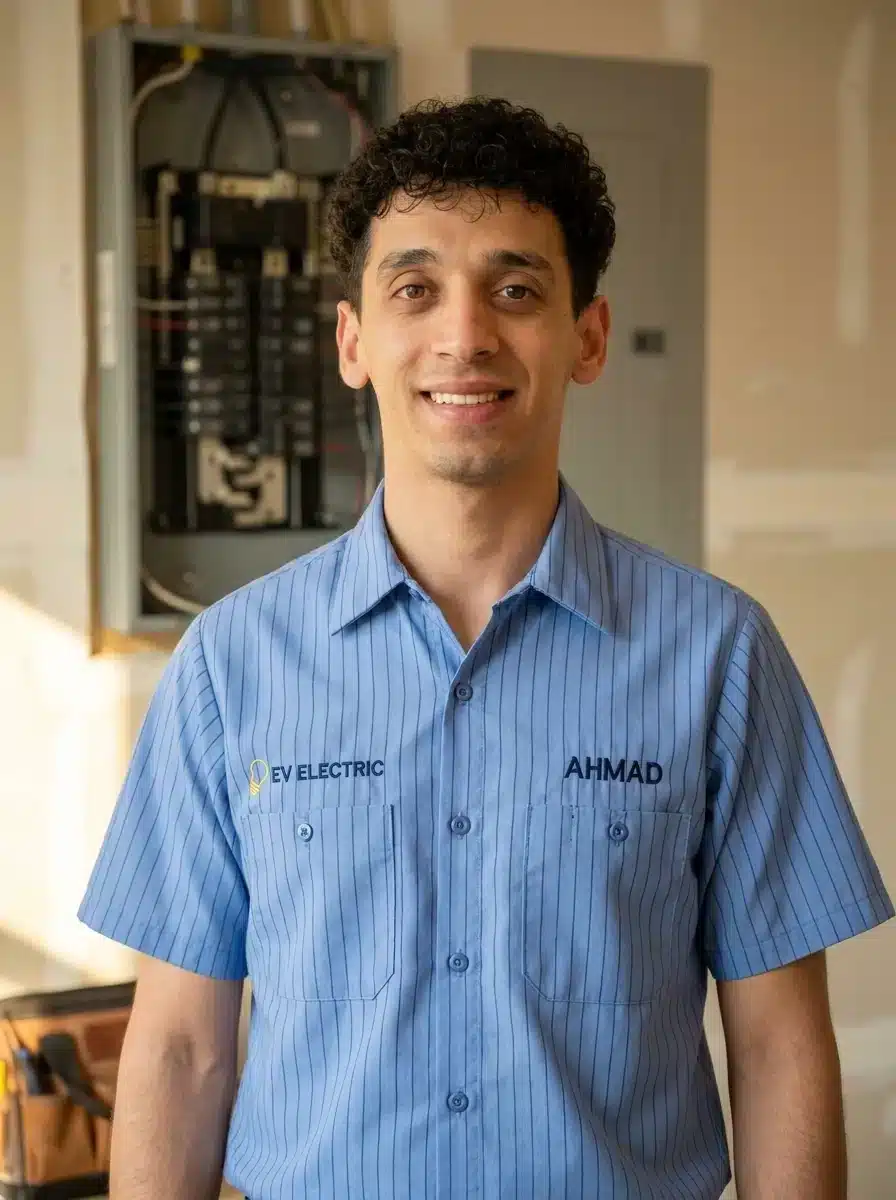
Ahmad Shaban holds a Master Electrician license issued by the Commonwealth of Virginia — the state’s highest electrician credential. EV charger installation is his signature service line. He is the person who shows up at most Tysons-area estimates, runs the NEC 220.82 load calculation, explains the scope in plain English, and oversees the install.
EV Electric Services holds a 5.0-star average across 113 Google reviews. Our review base is real, recent, and from Northern Virginia homeowners — not imported or ghost-written. Ahmad is fully insured and runs a maintenance team, so you are not waiting on one person’s calendar.
Tysons neighborhoods we serve — EV density by area
Tysons has one of the highest EV ownership densities in Northern Virginia — Tesla, Rivian, BMW i, Ioniq 5, Kia EV6 — spread across neighborhoods with very different housing profiles and install requirements. Here is where we install most often:
- Pimmit Hills — 1950s-60s ramblers west of Tysons core; 100A panels common; most installs pair a panel upgrade with the charger; EV owners here already know they have a capacity constraint
- Westgate — 1960s homes south of Rt 7; similar 100A constraint as Pimmit Hills; split-levels with basement panels
- The Boro — new mixed-use near Tysons Corner Metro; 200A+ panels, ample capacity; the install challenge is conduit routing from utility closets to parking-level mounts
- Spring Hill — newer condos and townhomes near Spring Hill Metro; HOA approval often required for visible charger mounts; clean installs once routing is solved
- Tysons West — newer development west of Rt 7 / Rt 123 interchange; 200A panels, garage-adjacent panels, fast installs
- Arbor Row — luxury townhomes; 200A service, HOA documentation typically needed; we provide the permit and inspection paperwork boards request
- McLean-adjacent north — 1970s-90s colonials north of Tysons; 200A service, attached garages, garage sub-panels common; typically the cleanest install profile
- Wolf Trap-adjacent west — larger lots, detached garages; outdoor installs with longer conduit runs; weather-rated enclosures required
- Idylwood — 1950s-60s south of I-66, Falls Church border; 100A panels, similar constraint profile to Pimmit Hills
Outside Tysons, we install EV chargers in Vienna, McLean, Falls Church, Fairfax County-wide, and the rest of Northern Virginia. We also cover DC and Montgomery County, MD.
Related electrical services in Tysons
The EV charger is often one piece of a larger electrical project. Here is what we handle alongside it:
Frequently asked questions
Do I need a panel upgrade to install a Level 2 EV charger in Tysons?
Most 200-amp Tysons homes do not. An NEC 220.82 load calculation usually shows 40-60 amps of headroom — enough for a 60A dedicated EV circuit. Older 100-amp homes in Pimmit Hills, Westgate, and Idylwood often do need an upgrade because the existing panel cannot sustain a continuous 48A draw on top of modern residential loads. We run the load calc before quoting anything. If both are needed, we handle them in one project. See panel upgrades in Tysons.
What drives the cost of an EV charger installation?
Four factors: (1) panel capacity — 200A with headroom means charger-only, 100A or a full panel means a panel upgrade first; (2) circuit run length — 10 feet from a garage sub-panel costs less than 60 feet through a townhome utility closet; (3) indoor vs. outdoor mount — outdoor installs need weather-rated conduit and hardware; (4) hardwired vs. NEMA 14-50 — different scopes of work. We come to the house, run the load calc, and give you a written estimate before any work is scheduled. No trip fee and free estimates for Tysons. Call 571-500-6637.
Which charger brand should I choose?
Tesla Wall Connector for Tesla owners — fastest home charge speed (48A hardwired), pairs to your Tesla account. ChargePoint Home Flex for Ford, Rivian, and multi-brand households — smart scheduling, app control, up to 50A hardwired. JuiceBox or Wallbox for homeowners who want Dominion time-of-use integration. Or a simple NEMA 14-50 outlet for the portable cord that shipped with your car — the most flexible option. We install any UL-listed Level 2 charger.
Does Dominion Energy offer an EV charger program?
Yes. Dominion Energy offers a Residential Charger Program for Virginia homeowners — check dominionenergy.com for current terms and eligibility. The program covers charger hardware, installation, and a warranty billed through your Dominion account. We handle the installation side and provide the signed County inspection card the program requires.
Do I need a permit for an EV charger in Tysons?
Yes. Fairfax County requires an electrical trades permit (ELER) for a new dedicated 240V circuit. Tysons is unincorporated Fairfax County — there is no additional town zoning layer. We file the permit via the County PLUS portal, coordinate the inspection after install, and give you the signed inspection card at closeout. Permit fee is included in the estimate.
NEMA 14-50 outlet vs. hardwired — which is better?
A NEMA 14-50 outlet is more flexible — you plug in the portable cord that came with your car and can unplug it for road trips. Hardwired is faster (no plug-load derating, so a Tesla Wall Connector delivers its full 48A), looks cleaner, and is required for some chargers at their maximum output rating. If you are a Tesla owner who wants the fastest overnight charge, hardwired is usually the right call. For portability or brand flexibility, a NEMA 14-50 works well. We recommend based on your car and usage.
Is there still a federal tax credit for EV charger installation?
The federal Alternative Fuel Vehicle Refueling Property Credit (Form 8911) expired June 30, 2026. Charger installations placed in service after that date do not qualify. If you installed before the cutoff and haven’t filed yet, you may still claim the credit on your return. Check IRS.gov for any renewal or extension. We provide the itemized invoice and signed inspection card typically required for the claim.
How long does an EV charger install take in Tysons?
Most residential Tysons installs are a 3-5 hour job on install day. A garage-wall mount with a short panel run is on the shorter end; a long conduit run through a townhome or an outdoor detached-garage install takes longer. If a panel upgrade is also needed, plan on a full day. Permit filing takes 2-5 business days before install day is scheduled. The full timeline is given with the written estimate.
Ready to charge at home in Tysons?
Level 2 EV charger installation — NEC 220.82 load calculation, dedicated circuit, Fairfax County permit, County inspection. Free written estimate before any work is scheduled.
571-500-6637