
Fairfax County & Northern Virginia
Bathroom Exhaust Fan Installation in Fairfax, VA
Most calls about a bathroom fan are one of three jobs: replacing a fan that already works, putting a fan into a bathroom that never had one, or fixing a fan that has been quietly blowing damp air into the attic for years. They are priced differently, they take different amounts of time, and only one of them is a straight swap.
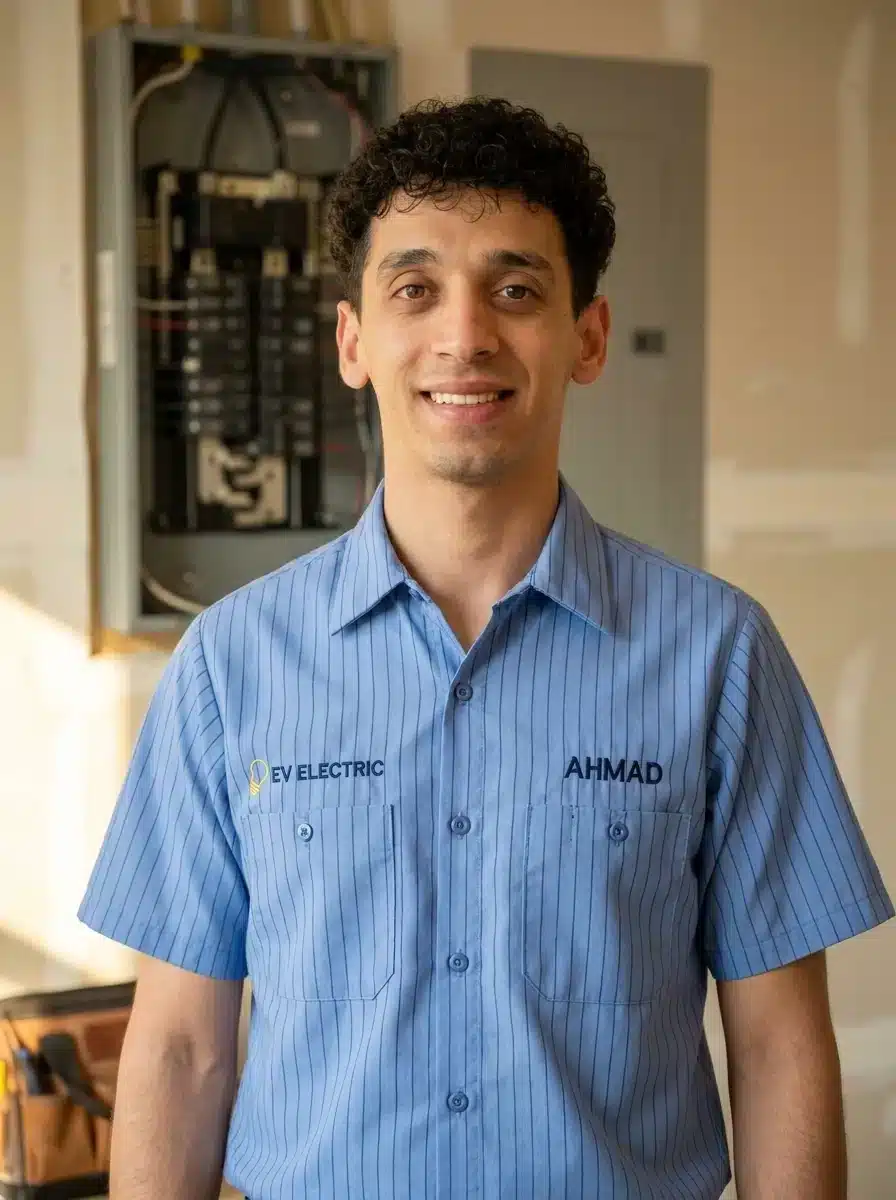
Work is done by Ahmad Shaban, a licensed Virginia Master Electrician who does every job himself. No trip fee, free estimates.
Rated 5.0 from 122 Google reviews · Virginia Master Electrician · Fairfax County and surrounding cities

Which bathroom fan job is yours?
Before anyone can tell you what a bathroom fan costs, someone has to establish which of these three situations you are in. They look identical from inside the bathroom. They are not the same job.
There is a fan, it runs, and it is being replaced
The housing is already in the ceiling, the duct is already run, and there is already a circuit feeding it. The fan is being changed because it is loud — which is a different complaint from a noisy ceiling fan, since this one is a sealed motor in a duct rather than a blade balance problem — because it has stopped moving much air, or because a bathroom is being refreshed and the old unit looks its age.
This is the shortest of the three jobs, and it is the one most people picture when they search. What decides whether it stays short is what is found above the ceiling once the old housing comes out — the duct that was adequate for a builder-grade fan decades ago is often the reason the new one underperforms too. That gets checked before the new unit goes in, not after.
There is no fan in the bathroom at all
Common in older Northern Virginia housing where the bathroom has a window, and in powder rooms and basement bathrooms that were finished later. There is nothing in the ceiling, so everything has to be created: an opening, a housing, a duct route to the outside of the building, a termination cap, and in most cases a circuit to power it.
This is a substantially larger job than a replacement and it is where the price range genuinely widens. It usually involves working in an attic or a joist bay, and it is the job where the permit question has to be settled before anything starts.
The fan runs, but it vents into the attic
From inside the bathroom this is indistinguishable from a working fan. It switches on, it makes noise, air moves. The duct simply stops short of the outside of the house and discharges into the attic, a soffit, or a joist bay — so all the moisture the fan pulls out of the bathroom is deposited into the insulation above it.
This is the most consequential of the three and the least visible. It is covered in its own section below, because the fix is not a fan and the damage it causes is not electrical.
Putting a fan in a bathroom that never had one
When a bathroom has no existing fan, the ceiling opening is the smallest part of the work. What determines the scope is everything behind it — where the air is going to go, and where the power is going to come from.
Bathrooms in this situation are usually one of two kinds. Either the house is old enough that a window was considered adequate ventilation when it was built, or the bathroom was added later, in a basement or a converted space, where running a duct to an exterior wall was awkward and got skipped. Both are common across Fairfax County, and both are straightforward to solve once the route is established.
The duct route
The exhaust has to reach the outside of the building. On a top-floor bathroom that usually means up through the attic and out through the roof or a gable wall. On a lower floor it means finding a joist bay that runs to an exterior wall without crossing a beam or a bathtub. The route is worked out first, because it decides everything else.
The termination
Where the duct exits, it needs a proper cap with a damper — a fitting that opens when the fan runs and closes when it stops. Without one you have an open hole into a conditioned building, and in winter you get a cold draft and condensation dripping back down the duct.
The circuit
A new fan needs power. Sometimes there is capacity on an existing bathroom circuit and sometimes a dedicated circuit has to be run from the panel. If the fan has a heater or a light, that changes the load calculation and often forces the dedicated circuit. This is assessed on site, not guessed.
The switch
A fan that only runs while somebody remembers to hold the switch does not dry a bathroom out. Timers and humidity-sensing switches keep the fan running after the room is empty, which is when most of the moisture actually leaves. Worth deciding at installation, because the wiring differs.
If your fan vents into the attic, it is not doing its job
A bathroom exhaust fan exists to move damp air out of the building. A fan whose duct ends inside the attic moves that damp air a few feet and then releases it into the coldest, most absorbent part of your house.
This is not rare. It shows up constantly in homes where a fan was added by a previous owner, where a roof was replaced and the duct was disconnected and never reattached, or where the original installer ran the duct to a soffit vent on the assumption that a vent is a vent. The residential code is explicit that exhaust air has to be discharged outdoors, and equally explicit that it must not be discharged into an attic, a soffit, a ridge vent, or a crawl space — the provisions covering this are M1501.1 and M1505.2. A soffit is not “outside” for this purpose, because a soffit vent is an intake: air leaving there is drawn straight back under the roof deck.
The duct is disconnected, or it ends in open attic space
The single most common version. The flexible duct has pulled off the fan housing, off the roof cap, or was never attached to either. Every shower puts warm, wet air directly into the insulation. Over a winter that shows up as damp insulation, dark staining on the underside of the roof sheathing, and in bad cases frost forming on the nails inside the attic.
The duct runs to a soffit
Looks finished from the ground and looks finished from the attic. But soffit vents are how the roof assembly draws air in, so exhaust dumped there is pulled straight back into the attic. This one usually surprises people, because visibly the duct goes somewhere.
The duct is uninsulated across a cold attic
Here the duct genuinely does reach outside, but warm wet air traveling through a bare duct in a freezing attic condenses on the inside of that duct. The water runs back down and drips out of the fan grille. People generally assume the fan is leaking or that there is a roof leak above the bathroom.
What you can look at without tools
Run the fan and go outside. On a still day you should be able to feel or hear air coming out of a cap on the roof or on a gable wall. If you have safe attic access, look at where the duct from the bathroom ceiling goes and follow it — if it ends in open space, in insulation, or at a soffit, that is the problem. If you find any of that, the honest next step is to stop guessing about the fan itself.

Fixing this properly means re-routing or reconnecting the duct to a genuine exterior termination and, where the run crosses unconditioned space, insulating it. It is worth separating this from attic ventilation as a whole: an attic fan moves air through the attic itself and has no duct at all, which is a different system solving a different problem. A bathroom fan is defined by its duct.
What your duct run allows
The fan on the box is rated in a laboratory attached to a short, straight, smooth pipe. Your house is not that. The shape of the run is what decides how much air actually leaves the building, and it is the part of the job that is worth deciding deliberately rather than accepting by default.
Every foot of duct, every bend, and every ripple in flexible ducting costs airflow. A powerful fan on a long, sagging, corrugated run can move less air than a modest fan on a short, smooth, well-supported one. That is why two houses with the same fan get different results, and why replacing a fan without looking at the duct sometimes changes nothing at all.
Short run, straight out a gable wall
The bathroom sits near an exterior wall and the duct can travel a short distance with one bend or none. No roof penetration, no flashing, nothing cut into the roof covering.
If your layout allows this, take it. It is the cheapest to install, the least intrusive, and it performs the best.
Up and out through the roof
The bathroom is interior, or the wall route is blocked. The duct rises through the attic to a dedicated roof cap. It works well and it is often the only honest option, but it means an opening in the roof, correctly flashed.
Choose this when there is no reasonable wall route — not as a default. The run should still rise steadily rather than dip.
A long run across the attic
Sometimes unavoidable in a large or awkwardly laid out house. Once the run gets long, the specification has to change to compensate: smooth-wall rather than corrugated where possible, a larger diameter, proper support so it cannot sag, and insulation across the cold space.
Viable, but it changes the fan you should be fitting. A long run and a small fan is the most common reason a new fan disappoints.
Into a soffit, a ridge vent, or open attic
This is what already exists in a lot of houses, and it is what the code sections above prohibit. It is not a route, it is the absence of one.
Not an option. If this is what you have, the work is a re-route, and a new fan on its own will not fix it.
One practical detail that costs nothing and matters: the run should rise gently toward the termination and be supported so it cannot form a dip. A sag in a duct collects condensate, and standing water in a duct eventually finds its way back to the fan.
Why an undersized fan leaves the room damp
If the mirror is still fogged ten minutes after a shower, or the room smells musty a day later, the usual cause is not a broken fan. It is a fan that was never big enough for the room it was put in, or one whose duct run is eating its capacity.
The rate an inspector checks is set by the size of the bathroom, so a fan that is perfectly adequate for a powder room is not adequate for a large bathroom with a separate shower enclosure. Ceiling height counts, because the volume of air is what has to be moved. And as above, the duct run has to be included in the calculation rather than treated as an afterthought — the number on the box is the fan’s best case, not your bathroom’s.
That measurement happens on site, against the actual room and the actual run, before any unit is recommended.
Signs your current fan is undersized rather than broken
The fan runs and you can feel it pulling, but the mirror stays fogged well after the shower. Paint or wallpaper near the ceiling is lifting. There is a musty smell that returns even after cleaning. Condensation collects on the window or the cold wall of the bathroom rather than leaving through the fan. A fan that has genuinely failed usually announces itself differently: it gets loud, it hums without turning, or it stops entirely.
Does a quieter fan mean a weaker fan?
No, and this is worth knowing before you buy. Noise is measured separately from airflow. Quiet units generally achieve it with a larger, slower impeller and a better-designed housing, which is why they tend to cost more rather than move less. A cheap fan is often loud and weak. If the fan is above a bedroom or in an open-plan upper floor, the noise rating is worth paying attention to, because a fan people find unpleasant is a fan people switch off early.
Is a humidity-sensing switch worth it?
Often, yes — most of the moisture leaves the room after the shower has finished, which is exactly when the fan usually gets switched off. A humidity sensor or a simple timer keeps it running through that period without anyone having to remember. It changes the switch wiring, so it is cheaper to decide at installation than to add later.
Why two bathroom fan jobs quote differently
The reason nobody can quote this over the phone with any honesty is that the three jobs above are genuinely different pieces of work, and the variables below can move a job from an hour to most of a day. Here is what actually moves it, so you can tell roughly where yours will sit before anyone comes out.
- Which of the three jobs it is. Replacing an existing fan on an existing duct and circuit is the short end. Creating a duct route and a circuit where neither exists is the long end.
- Whether the duct already reaches outside. If it does, and it is in good condition, that is most of the difficult work already done. If it stops in the attic, the re-route is the job.
- The length and difficulty of the run. A short hop to a gable wall is not comparable to a long run across an attic that needs upsizing, support and insulation.
- Roof versus wall termination. Cutting and flashing a roof penetration is more involved than fitting a wall cap, and it has to be weathertight.
- Whether a circuit has to be run. Spare capacity nearby is very different from a new run back to the panel, and a fan with an integrated heater usually forces the latter.
- Attic access. A walkable attic with decking is straightforward. A shallow truss attic with blown insulation and no boards is slower and more careful work.
- The unit itself. Quiet, humidity-sensing and heater models cost more than builder-grade units. That is your choice to make, and it is worth making deliberately.
No trip fee, free estimates. If the problem needs diagnosing first, we tell you what that costs before we begin.
Duct condition in Northern Virginia bathrooms
What varies between houses around here is less the fan and more what is above the ceiling — whether a duct was ever run, what it was made of, and whether anyone reconnected it the last time work was done up there. These are the conditions the local housing stock tends to produce.
No duct was ever run
Bathrooms that relied on an opening window, and powder rooms and basement bathrooms finished after the fact. There is nothing above the ceiling to work with, so this is a Job B from the start. Frequently the ceiling has been painted several times over a blanked-off opening where somebody once intended to.
Original flexible duct, still in place
Thin corrugated duct, often undersized, usually sagging between joists and sometimes crushed where something was stored on top of it. It technically connects. It moves far less air than the fan is rated for, and it is the reason a straight fan swap sometimes changes nothing.
Disconnected during later work
Roof replacement, insulation top-ups, solar, or anything else that put people in the attic. The duct gets moved aside and not reattached. Everything looks normal from the bathroom, and the fan has been venting into the roof space ever since.
Terminated at a soffit
Installed deliberately, by someone treating a soffit vent as an exit. Common enough that it is worth checking specifically. Because it looks like a finished installation from both ends, it tends to survive several owners.
Reaches outside, no insulation
The route is right and the termination is right, but the duct crosses a cold attic bare. Water condenses inside it and drips back through the grille in winter. Usually reported as a leak rather than a ventilation issue.
Correctly run and still underperforming
Everything is connected and terminated properly, and the room still stays damp. At that point it is a sizing question — the fan is too small for the room, the run, or both, and the answer is a correctly specified unit rather than more ducting.
Permits for bathroom fan work in Fairfax
People ask whether a bathroom fan needs a permit, and the honest answer is that it depends on the work and on where exactly you live. Rather than paraphrase it, here is what Fairfax County publishes on its own residential electrical permit page:
“A residential electrical permit is required for new residential service, new electrical equipment and/or fixtures, replacement of electrical equipment or fixtures, and electrical vehicle charging station circuits and outlets.”
“Property owners may obtain permits in their own name, however, it is strongly recommended a properly licensed contractor pull the permits as the responsible party so the county can better assist in gaining compliance for defective work.”
Nothing in that wording carves out a straight swap, and we are not going to invent an exemption the county has not written down. What we do instead is establish which authority your address falls under and what that authority requires for your specific job, and then pull the permit when it is needed. That is part of the work, not an extra.
One situation is different: condos, co-ops, and other multi-unit buildings. The exterior wall or roof a duct has to pass through there is usually shared property, not yours to authorize a hole in — Fairfax County’s electrical permit does not cover it, the building’s own rules do. There, the building’s own contractor pulls that permit and makes the opening. We come in once it exists and handle the duct, the circuit and the fan. If you are not sure which situation your building falls under, ask us before you call anyone else — it is a five-minute answer.
Worth knowing, because it catches people out: a Fairfax mailing address does not tell you which permit office you are dealing with. The City of Fairfax is an independent city and runs its own, separate from Fairfax County. The line follows the city’s corporate limits, and your property tax bill is the reliable way to tell which side of it you are on — not the ZIP code, which straddles both. We work in both and confirm it against your address before anything is filed.
One visit, more than one fixture
Bathroom fans are rarely the only thing on the list. Because the same person quotes the work and does the work, anything else in the room can usually be handled in the same visit rather than becoming a second appointment and a second trip.
Fan and vanity lighting together
If the fan is coming out anyway and the light over the mirror is dated or badly placed, doing both at once means one set of switch changes and one visit. Light fixture work shares most of the same access.
Outlets by the sink
Bathroom receptacles need GFCI protection, and a lot of older bathrooms around here still have an unprotected outlet beside the basin. If a dead or ungrounded outlet turns up while the fan is being done, it can be sorted in the same visit.
A fan that keeps tripping the breaker
If a fan trips the breaker as it starts, the fan is usually the symptom and the circuit is the cause. That is a troubleshooting job rather than a fan job, and it is worth identifying before a new unit gets fitted onto the same fault.
Switches worth changing while the wall is open
Timers, humidity sensors and separating a fan from a light onto their own controls are all much simpler while the existing switch is already out. Deciding at the same time avoids paying twice for the same access.
A recent bathroom fan replacement in Fairfax
“Ahmad did an outstanding job! He replaced the master bathroom fan in a quick and efficient manner. Professional, timely, and responsive. Highly recommend EV Electric Services and Ahmad!”
Bathroom exhaust fan questions we get asked
Do bathroom exhaust fans need to be vented outside?
Yes. The residential code requires exhaust air to be discharged to the outdoors, and specifically prohibits discharging it into an attic, a soffit, a ridge vent or a crawl space — that is the substance of M1501.1 and M1505.2. The practical reason is simple: the fan’s entire purpose is to remove moisture from the building, and a duct that stops inside the building just relocates it somewhere more damaging.
Is it legal to vent a bathroom fan into an attic?
No. It is prohibited, and it is one of the defects that turns up most often once somebody actually looks in the attic. It usually is not malice — a duct comes loose during other attic work, or somebody terminates at a soffit believing that counts as outside. The result either way is warm, wet air being deposited into the insulation and against the underside of the roof, which over time produces damp insulation, staining on the sheathing and, in the worst cases, rot.
Do I need an electrician to install a bathroom fan?
It depends which of the three jobs it is. Fitting a new fan into an existing housing on an existing circuit is at the simpler end. Creating a new duct route to the outside of the building, cutting and flashing a roof or exterior-wall penetration, or running a new circuit back to the panel is licensed work, usually ours. The one exception is a condo or multi-unit building: when the opening has to go through a shared exterior wall or roof, that’s the building’s own contractor’s permit to pull and their cut to make — we come in after and handle the duct, the circuit, and the fan. Fairfax County’s published permit wording covers new and replacement electrical fixtures, and the county recommends a licensed contractor pull the permit as the responsible party. Which of these applies to your address is something we confirm before anything is filed.
How much does it cost to have a bathroom fan installed?
It depends on four things: which of the three jobs above applies, whether the duct already reaches outside, how long and difficult the run is, and whether a circuit has to be run back to the panel. A replacement on a sound duct and an existing circuit sits at the short end; creating a duct route, a roof or wall termination and a circuit where none exist sits at the long end. Rather than quote a range that would be meaningless for your house, we look at it and give you a free written estimate. No trip fee, free estimates.
Can you install a bathroom exhaust fan yourself?
The mounting is rarely what stops people. Three things do. The first is the duct: getting a run to the outside of the building, at the right diameter, supported so it cannot sag, is the part that decides whether the fan works at all — and getting it wrong is how the attic-venting problem above gets created. The second is the penetration: a hole through a roof or a wall has to stay weathertight for the life of the building. The third is the circuit, which is licensed work. If none of those three apply to your bathroom, it is a small job. If any of them do, the risk is not the fan falling down — it is water, either in your attic or in your ceiling.
Do you need an insulated duct for a bathroom fan in an attic?
Where the duct crosses unconditioned space, yes — and it is worth doing properly. Warm, moist air traveling through a bare duct in a cold attic condenses on the inside of that duct. The water collects, runs back down the run and eventually drips out through the fan grille into the bathroom. It gets reported as a roof leak or a leaking fan surprisingly often, and it is neither.
Can you replace a bathroom exhaust fan without going into the attic?
Sometimes. Some housings allow the motor and grille assembly to be changed from below, and where the existing duct and housing are sound that can be enough. But it means nobody has looked at the duct — and given how often the duct is the actual problem, a below-ceiling swap can leave you with a new fan and the same damp bathroom. Where there is safe attic access, we check the run before fitting anything.
How do I know which bathroom exhaust fan to buy to replace an old one?
The three things that matter are the airflow rating relative to the size of your bathroom, the noise rating, and whether the housing suits your ceiling and joist spacing. The most common mistake is matching the new fan to the old one — if the old one was undersized, or the duct run is long, you will reproduce the problem exactly. If you would rather not work it out, we size it against the room and the run and tell you what to get, whether or not you have us fit it.
Who does the work
Ahmad Shaban is a licensed Virginia Master Electrician and carries out every job personally — the person who quotes your bathroom fan is the person who fits it. Ventilation work in particular benefits from that, because the decisions that matter get made in the attic, at the time, by whoever is going to stand behind the result.
Virginia Master Electrician license
VA MELE #2710086216
What happens when we come out
We find the duct
Before anything else, we establish where the existing duct goes, or whether one exists. That single answer decides which situation you are in and what the work will take.
We size it to the room and the run
The bathroom’s dimensions and the shape of the duct run together determine what unit is appropriate. Fitting the wrong size correctly still leaves you with a damp bathroom.
You get a free written estimate
Scope, unit, and whether a permit applies to your address. No trip fee, free estimates. Nothing starts until you have agreed to it.
Fitted and checked while running
The unit goes in, the duct is properly connected and supported, and the termination is confirmed to be discharging outside with the fan running.
Where the duct usually runs, by neighborhood
We cover Fairfax County and the surrounding cities. What changes from one neighborhood to the next is not the fan — it is the route the exhaust has to take to get out of the building, which is what decides the scope of the work.
If your bathroom needs more than a fan
Get a free estimate on your bathroom fan
Tell us what the bathroom is doing — fogged mirror, musty smell, noisy fan, or no fan at all — and we will work out which situation you are in before quoting anything.
EV-Electric Services · 9488 Fairfax Blvd, Fairfax, VA 22031 · (571) 500-6637
No trip fee, free estimates. Licensed Virginia Master Electrician.