
Fairfax County & Northern Virginia
Security Camera Installation in Fairfax, VA
Anyone can hang a camera on a wall. The part that decides whether it still works in two years is what is behind it — where the power comes from, how the cable is run, and how the hole through your wall was sealed.
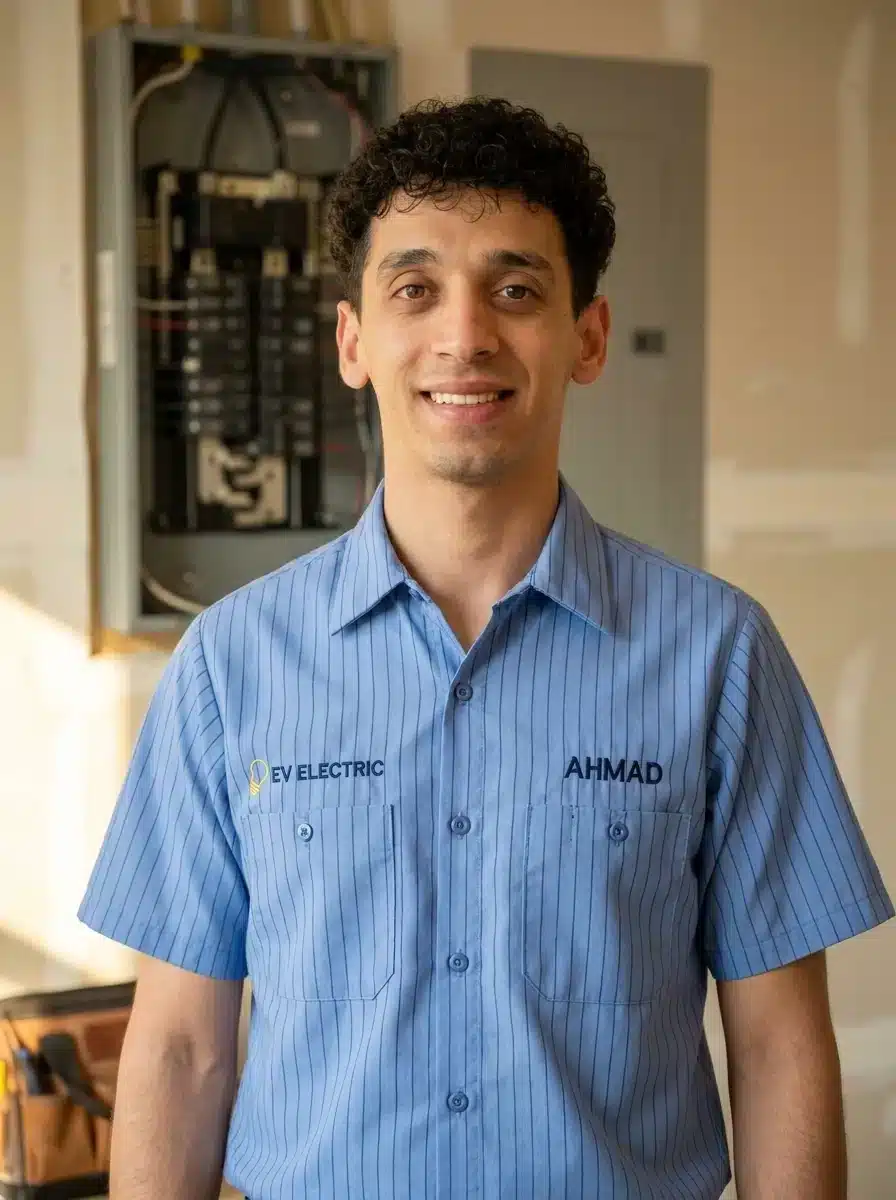
Cameras, floodlight cams and video doorbells, installed and wired by Ahmad Shaban, a licensed Virginia Master Electrician who does every job himself. No trip fee, free estimates.
Rated 5.0 from 122 Google reviews · Virginia Master Electrician · VA MELE #2710086216

Key Takeaways
- Licensed: Master Electrician, Commonwealth of Virginia #2710086216
- Insured: $1 million per-occurrence, $2 million aggregate general liability
- Hardwired camera installation with dedicated electrical circuits where needed
- No trip fee, free estimates — on-site assessment, written quote before work starts
- Service area: Fairfax County, Northern Virginia, Washington DC, and Montgomery County, Maryland
Who installs security cameras, and what changes with each
Most people searching for this are not deciding whether they want cameras. They have already decided. What they are actually trying to work out is who should put them up — and the options are genuinely different, in ways that are hard to see until something goes wrong.
You install it yourself
Battery and wireless units are designed for this and there is nothing wrong with it. You charge or swap batteries, you live with wherever the wifi reaches, and you accept that the camera is only as reliable as your signal at the far corner of the house.
Fine for a doorbell or one battery camera. It stops being fine the moment a camera needs line power or a cable through a wall.
A national installation service
Book a slot, a technician arrives, the camera goes up. Fast and standardized, and they are good at the standard job. What they generally will not do is add a circuit, run cable through a finished wall, or take responsibility for a penetration through your building envelope.
Works when the power is already there. If the answer involves the panel or the fabric of the house, it is out of scope.
A gig-marketplace handyman
Cheapest option and often perfectly competent at mounting. The variable is who turns up, whether they are licensed for electrical work, and whether the person who drilled the hole is reachable in six months when water is getting in behind it.
Price is the reason to choose this. Accountability is what you are trading away, and it only matters if something goes wrong.
A licensed electrician
The right answer when the job includes electrical work — a new circuit, a transformer, a run through a finished wall, an exterior penetration that has to stay watertight. The same person quotes it, wires it and is accountable for it.
Overkill for sticking a battery camera on a porch. The correct choice for anything hardwired.
A specialist security company
Cameras all day, every day, and they are genuinely good at the camera part — system design, recorders, coverage planning. Some install the equipment and bring in an electrician for the wiring; others design around needing one.
The right call for a large or complex system. For a handful of cameras on a house, you are paying for design capability you do not need.
We are the electrician on that list, and the difference is narrow but real: where a specialist sub-contracts the electrical side, we do it ourselves. On a big multi-camera system that trade-off favors them. On a house, it favors us.
We will also say the unglamorous thing plainly: if what you want is one battery camera by the front door, you do not need an electrician, and we will tell you that on the phone rather than sell you a visit.
What actually has to be wired
A camera is a small thing bolted to a wall. Everything that makes it work is behind that wall, and it is the part quotes tend to skip over.
A power source that is meant to be there
A hardwired camera needs permanent power. Sometimes there is a suitable supply nearby — an existing exterior fixture, a soffit outlet, a light circuit with capacity. Sometimes there is not, and a circuit has to be run. What there should never be is an extension cord threaded through a soffit and forgotten about. Where a position needs a proper supply, that is outlet and circuit work before it is camera work.
The hole through the building
Every exterior camera involves at least one penetration through the envelope of your house. Drilled at the wrong angle it channels water inward. Sealed with the wrong material it fails in two winters. A penetration that was drilled uphill and sealed with the wrong compound is the failure that shows up long after whoever made it has gone.
Where the cable actually goes
Between the camera and wherever the recorder or router lives, there is a route. Through an attic, down a stud bay, along a joist line. Planning it before drilling is the difference between a clean install and cable stapled along the outside of your siding.
A transformer, if there is a doorbell involved
Video doorbells run off the existing doorbell transformer, and a lot of older ones cannot supply what a modern camera doorbell draws. That is why doorbells work for a month and then start dropping offline. The fix is at the transformer, not at the doorbell.
Running one cable instead of two
Power over Ethernet — one cable carrying both the electricity and the video, from a switch inside the house to the camera outside it.
It is the setup most people end up wanting once they understand it, because it removes the two things that make camera systems annoying: batteries, and wifi that drops at the end of the driveway. It also happens to be the version that needs an electrician, because it is a cable run through your building rather than a plug in an outlet.
Where the cable starts
A network switch, usually near the router or in a basement or utility area. It supplies power down the same cable that carries the video, so each camera needs one run back to that point rather than an outlet of its own.
The run itself
Category cable, routed through the structure rather than round it. Distance matters, bend radius matters, and running it alongside line-voltage cable for any length is asking for interference. Getting this right is ordinary work for an electrician and awkward for anyone else.
Where it comes out
At the camera position, through a sealed penetration, with enough slack to work on the unit later without stripping the whole run back. A drip loop where the cable meets the housing so water runs away from the connection instead of into it.
What you get for the extra work
No batteries. No wifi dead spots. A camera that keeps recording when the internet drops, if the recorder is local. And a cable you can reuse when you replace the camera in five years, which is usually sooner than people expect.
Cameras that live outside
An outdoor camera spends its whole life in weather. Most of what shortens that life is decided at installation, not by the camera you bought.

Height and angle
High enough to be out of reach, low enough to record a face rather than the top of a head. Cameras mounted at gutter height because that is where the power was tend to produce footage that identifies nobody.
Soffit, wall or eave
Soffits are easy to drill and give good shelter, but they are also ventilation, and cable through one has to be sealed without blocking airflow. Brick and stone change the fixings and the route entirely. Siding is the simplest to drill and the easiest to seal badly.
Sun, not just rain
A camera pointed at where the sun sits in the afternoon will give you a silhouette for two hours a day, every day. Weatherproofing is the obvious problem; glare is the one people find out about later.
Floodlight cameras draw more
A camera with lights on it is a lighting load as well as a camera. On an old exterior circuit that already runs several fixtures, that is worth checking before it is added rather than after the breaker starts tripping. It is the same calculation as adding any exterior light fixture, because that is what half of it is.
The doorbell that stops working
A video doorbell is the camera most people install first, and the one most likely to fail in a way nobody notices until they need the footage. When one keeps failing, the supply behind it is the first thing worth checking, not the unit.
The transformer cannot supply what the doorbell wants
Older chime transformers were sized for a bell and a button. A camera doorbell records, streams and stays awake. Underfed, it works when it is quiet and drops out exactly when something triggers it — which is when you needed it.
The transformer is somewhere nobody can see it
Doorbell transformers get fitted wherever was convenient at the time — a basement joist, the back of a closet, occasionally buried behind drywall. A transformer with no air around it runs hot, and one that has been running hot for years fails gradually rather than all at once — which is exactly what an intermittent doorbell looks like.
Finding it is the job. That is a diagnostic call rather than an installation, and it is the reason this page talks about supply as much as it talks about cameras. Electrical troubleshooting covers that side of the work.
Before you buy a replacement doorbell
If your doorbell has started dropping offline, going flat, or working intermittently, the unit is probably not the problem. Replacing it with the same model on the same supply reproduces the fault. Worth having the supply checked before spending money on hardware.

What changes the price of a camera installation
Cost questions dominate this subject and there is no useful single number, because a doorbell swap and a four-camera wired system are not the same job. Here is what actually moves it.
- How many cameras, and where. Not just the count — each position is its own cable route. Four cameras on one elevation is a very different job from four spread around the house.
- Wired, PoE or battery. Battery is the quickest. PoE means a cable run per camera. Hardwired line voltage means a supply at each position.
- Whether power already exists there. An existing exterior fixture you are replacing is the cheap case. A position with nothing near it means a new run.
- The route and its length. Open attic above the ceiling is straightforward. Fishing through a finished two-story wall is slow, careful work.
- What the wall is made of. Siding, brick, stone and stucco each change the fixing, the drilling and the sealing.
- Access. Ground-floor eaves versus a three-story gable end is a ladder question that turns into a time question.
- Whether a recorder or switch has to be set up. A local recorder needs somewhere to live, power, and a connection back to the network.
No trip fee, free estimates. We look at the positions you want, tell you which are straightforward and which are not, and price it before anything starts.
One thing worth saying plainly: we install and wire the equipment. We do not sell monitoring contracts or subscriptions. If what you want is a monitored alarm service with a monthly fee, that is a different kind of company and we will say so rather than take the visit.
Where cameras go in Northern Virginia homes
Camera positions are decided by how a house is laid out and where people actually approach it, not by where the mounting is easiest. Around here the housing stock falls into a few patterns and each one has its own obvious answers.
Post-war ranches and split-levels
Low eaves, generous soffits and usually a side door nobody thinks about. Easy mounting heights, short cable routes into an accessible attic, and a back elevation that is often completely uncovered.
Colonials and two-story traditionals
The front is straightforward. The awkward one is a second-story gable where the run has to come down inside a finished wall. Worth deciding early whether that position is worth the work or whether a lower angle covers it.
Townhomes
Party walls remove most routing options, so cables usually go up into the attic and back down. Front and rear only, and the rear is often where the value is — patios, sheds and back gates.
Newer detached construction
Homes built once structured cabling became a standard option are sometimes pre-wired with category cable back to a central panel, which makes a PoE system substantially cheaper. It is worth checking what is already in the walls before anyone quotes new runs.
Brick and masonry frontages
Common on older stock and it changes everything about fixing and drilling. Cable is normally routed to avoid the masonry entirely rather than through it, which affects which positions are realistic.
Detached garages and outbuildings
The position that most often needs real electrical work rather than just mounting — a supply out to the building, or a wireless link back with power at the far end.
What needs a permit, and who issues it
Low-voltage cabling and a camera on an existing supply are a different proposition from adding a circuit. Here is what Fairfax County publishes on its residential electrical permit page:
“A residential electrical permit is required for new residential service, new electrical equipment and/or fixtures, replacement of electrical equipment or fixtures, and electrical vehicle charging station circuits and outlets.”
“Property owners may obtain permits in their own name, however, it is strongly recommended a properly licensed contractor pull the permits as the responsible party so the county can better assist in gaining compliance for defective work.”
Read against a camera job, that wording is about the electrical side. Pulling category cable to a PoE camera is data, not power, and the county’s electrical permit language is about equipment and fixtures rather than low-voltage cabling. What moves a camera job squarely into it is the electrical work: adding a circuit, replacing a doorbell transformer, putting a floodlight camera on an exterior fixture position. So the honest line is not “cameras need a permit” or “cameras do not” — it is that the cabling generally is not the trigger and the power generally is.
We establish which authority covers your address and what it requires for your specific job, then pull the permit when one is needed. That is part of the work rather than an extra line on the bill.
Worth knowing because it catches people out: a Fairfax mailing address does not tell you which office you are dealing with. The City of Fairfax is an independent city running its own permitting, separate from Fairfax County. The boundary follows the city’s corporate limits and your property tax bill is the reliable way to tell which side you are on — not the ZIP code, which covers both.
Booking more than one thing at once
Camera work tends to surface other jobs, because the moment you start looking at exterior power you notice what else is out there. The same person quotes and does all of it, so it can go on one visit.
Exterior outlets and GFCI
Outdoor receptacles need GFCI (Ground Fault Circuit Interrupter — the type of outlet that cuts power instantly if it senses a shock hazard) protection, and a lot of older exteriors around here still have unprotected ones. If the camera work reveals one, it can be handled the same day.
Floodlights and exterior lighting
Cameras and lighting share positions, supplies and mounting problems. Exterior fixture work is often the sensible thing to combine with a camera install.
A circuit that keeps tripping
If the exterior circuit you want to use already misbehaves, adding a camera to it will not help. Finding the fault first is cheaper than finding it afterwards.
Data runs while the walls are open
If cable is being routed anyway, adding a run for a wired access point or a hard-wired workstation costs far less at the same time than as a separate job later.
A recent job
The doorbell had stopped, and the reason was behind the drywall
The customer’s video doorbell had stopped working and they assumed the doorbell itself was faulty. The transformer feeding it had been fitted buried against drywall, where nothing about it was visible or reachable.
Rather than open the wall up looking for it, Ahmad located it with a thermal camera and replaced it. The doorbell had never been the problem.
We do not have a Google review specifically about camera work yet, so there is no customer quote on this page. When one arrives it will go here, in the customer’s own words.
Common security camera questions
How much does it cost to install a camera security system?
It depends on how many cameras, where they go, and whether power and cabling already exist at those positions. A doorbell on an existing chime circuit and a four-camera wired system with a recorder are not comparable jobs. We look at the positions you want and give you a free written estimate. No trip fee, free estimates.
How much should it cost to install security cameras?
Anyone quoting a flat figure without seeing the property is guessing at the two things that decide it: the cable route to each position, and whether there is usable power there already. A camera replacing an existing exterior fixture is a short job. The same camera on a bare gable end with no supply is not. Ask for the estimate in writing and ask what happens if the route turns out to be harder than expected.
How much does it cost to install security cameras in a house?
The house itself matters more than most people expect. An open attic above a single-story means short, easy runs. A finished two-story with masonry frontage means fishing cable inside walls and working around brick. Newer homes are sometimes already wired with category cable to a central panel, which can cut the cost of a PoE system substantially — worth checking before anyone quotes.
Does Geek Squad install home security cameras?
Large retail and national installation services do offer camera installation, and for a straightforward mount where power already exists they are a reasonable option. The limit is electrical scope: adding a circuit, running cable through a finished wall, or taking responsibility for a penetration through the exterior of your house generally sits outside what a standardized install covers. If your job is only mounting, that route is fine. If it involves the wiring, you want someone licensed for the wiring.
How much does it cost to have a video doorbell installed?
Usually the smallest job on this page, and often quicker than people expect where there is an existing wired chime. What changes it is the transformer — if the existing one cannot supply a camera doorbell, that gets replaced too, and on some houses it is in an awkward place. We check the supply before quoting rather than after.
Do I need an electrician to install a doorbell camera?
Not always. A battery doorbell needs nobody. A wired one on a healthy existing chime circuit is within reach of a confident homeowner. You want an electrician when the transformer needs replacing or relocating, when there is no existing doorbell wiring, or when the doorbell keeps dropping out and nobody has established why — that last one is a supply problem and swapping the unit will not fix it.
How much does it cost to have someone install a doorbell?
Less than most camera work, and the honest answer is that the doorbell itself is rarely the expensive part. If the existing wiring and transformer are sound it is a short visit. If the transformer is undersized, buried, or missing entirely, the cost is in sorting that out — which is also the difference between a doorbell that works and one that works until it matters.
Do I need an electrician to install security cameras?
It depends entirely on the power. A battery or plug-in camera needs nobody. You want an electrician when a camera needs permanent power where there is none, when cable has to be routed through a finished wall, when a hole goes through the exterior of your house and has to stay watertight, or when a floodlight camera is being added to a circuit that is already loaded. A useful way to decide: if the job is only mounting, almost anyone can do it. If the job involves the wiring or the building fabric, you want someone licensed for both.
Who does the work
Ahmad Shaban is a licensed Virginia Master Electrician and carries out every job himself. On camera work that matters more than it sounds — the person deciding where to drill through your wall is the person who has to stand behind it, and there is nobody to hand the problem to.
Virginia Master Electrician license
VA MELE #2710086216
122 Google reviews, averaging 5.0 — none of them about camera work yet, which is why there is no quote on this page.
From the walkthrough to the last screw
We walk the outside with you
You point at where you want coverage. We tell you which of those positions are straightforward, which need a cable route you might not want, and which will not give you the footage you are imagining.
We work out power and route
What supply exists near each position, what has to be run, and where the cable can realistically travel. This is the part that decides the price, so it happens before the number does.
A free written estimate
Positions, what each involves, and whether a permit applies at your address. No trip fee, free estimates. Nothing begins until you have said yes to it.
Installed, sealed and checked live
Mounted, wired, penetrations sealed properly, and every camera confirmed working and aimed where you wanted before we leave.
Neighborhoods, and what each one makes easy or hard
We cover Fairfax County and the surrounding cities. What changes between them is less the equipment and more which approaches to the house actually need watching.
Related electrical work
Book a camera walkthrough
Tell us where you want coverage and we will tell you what each position actually involves before quoting anything. If a job does not need an electrician, we will say so.
EV-Electric Services · 9488 Fairfax Blvd, Fairfax, VA 22031 · (571) 500-6637
No trip fee, free estimates. Licensed Virginia Master Electrician.