
Fairfax, VA and Northern Virginia
Whole-House Surge Protector Installation in Fairfax, VA
A whole-house surge protector guards the electrical system in your home from voltage spikes. Ahmad Shaban of EV-Electric Services explains what it does, what it does not do, and how it fits with your electrical panel. No trip fee, free estimates.
Last updated September 30, 2026.

Whole-house surge protection, in five lines
- A surge is a brief spike in voltage that can damage, degrade or destroy electronics.
- A power strip protects only what is plugged into it. A whole-home device protects the entire electrical system.
- It is usually installed at or next to your main electrical panel, and ESFI recommends a qualified, licensed electrician for the job.
- Section 230.67 of the 2020 National Electrical Code calls for one where a home’s service equipment is replaced.
- Type 2 devices go in or next to the breaker box. Type 3 is the plug-in kind.
The Short Answer
What is it? A power surge is a brief spike in voltage. It can damage, degrade or destroy the electronics in your home. A whole-house surge protector is a device that protects your entire electrical system, where a plug-in strip only protects what is plugged into it.
Who installs it? ESFI, the Electrical Safety Foundation International, recommends hiring a qualified, licensed electrician to install surge protective devices. It usually goes at or next to your main electrical panel.
Is a Whole-House Surge Protector Worth It?
It can be, depending on what is plugged in around your home. Three plain facts help you decide.
Where surges come from
According to ESFI, most surges start inside the home, for example when an air conditioner turns on in summer. The National Electrical Manufacturers Association estimates that 60 to 80 percent of surges start inside a home or business. Surges from outside come from the electric utility and from lightning.
What a whole-house unit covers
According to ESFI, a whole-home device protects your entire electrical system, including large appliances, outlets and light switches. Plug-in devices like power strips only protect what is plugged into them. That is the main difference between the two.
Small surges add up
ESFI says repeated small surges may slowly damage electronic equipment and shorten the life of appliances and electronics.
Timing note. According to Google Trends, searches for surge protection in Virginia peak in the summer storm season. That is a good reason to look into it ahead of time. It is not a reason to feel rushed.
How It Works, and What Type 1, 2 and 3 Mean
Type 1 and Type 2 are the permanently connected kinds that go at your service. Type 3 is the plug-in kind. Here they are in plain words.
Where it goes. According to ESFI, a whole-system protector is mounted in or on your main electrical panel, or at the base of the electric meter, and it protects your entire electrical system. It is usually installed at or next to your main electrical panel.
What it does with a spike. ESFI describes a plug-in protector as one that does not stop a surge but diverts it to ground.
Permanently connected
It protects against external and internal surges. According to ESFI, it may be installed inside or outside the home.
In or next to the breaker box
It is permanently connected and installed in, or next to, the breaker box. It protects against internal or external surges.
The plug-in kind
Extra protection at the point of use. ESFI says it must be used together with a Type 1 or Type 2 to meet the 2020 code.
What the code says. ESFI says the 2020 National Electrical Code calls for new and renovated homes to be protected by a listed and approved Type 1 or Type 2 device, and recommends using Type 1, 2 and 3 together for the best level of protection. Which one fits your house depends on your panel and how it is set up. We choose it with you at the estimate.
Whole-House Protector or the Strip in Your Outlet?
They do different jobs, and one does not replace the other. ESFI ranks whole-home protection above plug-in protection, and recommends using all the types together. Here they are side by side.
| Plug-in protector | Whole-house protector | |
|---|---|---|
| What it protects | Only the electronics plugged into it. | Your entire electrical system, including large appliances, outlets and light switches. |
| Where it goes | At the outlet. You plug it in. | In, on or next to your main electrical panel, or at the base of the electric meter. |
| Who installs it | You. It is easy to use. | A qualified, licensed electrician. |
| When it needs replacing | Over time, or after a major surge. ESFI says to choose one with an indicating light or audible alarm that tells you when. | After a large surge, it may need replacing. ESFI says whole-home protection is longer lasting than plug-in protection, and we do not put a number of years on it. |
| Surge size | Not as much as whole-home, per ESFI. | ESFI says it protects against larger surges. |
One warning from ESFI: power strips and surge protectors are not the same, and not all power strips offer surge protection. For outlet work, see our outlet installation page.
What a Surge Protector Cannot Do
Honest limits are part of choosing well. Here are two limits and one tip.
A direct lightning strike
ESFI says no surge protection can handle a direct lightning strike. Lightning is one source of surges, along with the electric utility and things inside the home.
It can be used up
ESFI says that after a large surge or spike, such as a lightning strike, a surge suppressor “is a one-time-use protector and will likely have to be replaced.”
Plug-in protectors work together with it
ESFI says a Type 3 plug-in protector must be used together with a Type 1 or Type 2 to meet the 2020 code, and not all power strips offer surge protection.
Two habits. If you think a surge is coming, ESFI says to disconnect sensitive electronics. And if a big storm has gone through, take a look at your protector.
How Long One Lasts, and Signs It Is Used Up
A surge protector wears down as it takes hits. Here is what the makers and ESFI say.
There is no one number
Schneider Electric, an electrical equipment maker, says the answer is that it depends. It names the environment, the protector’s kA rating and how it was installed as factors, and says repeated surges degrade the parts inside over time. ESFI says that after a large surge or spike, such as a lightning strike, a surge suppressor “is a one-time-use protector and will likely have to be replaced.”
What kA means
Schneider Electric says the amount of current a protector can safely handle is its surge current rating, written in thousands of amps (kA). Eaton says the kA rating can be related to how long a protector lasts. Ask what the rating is on the unit in your quote.
Signs it may be used up
Some panel-mounted units have a status light, and one maker’s manual says a protection light that should be lit and is not means protection has been lost. Your unit’s own manual says what its light means. Schneider Electric also lists burn marks, melted plastic, heat and a burning smell as signs a surge protector needs replacing.
After a big storm, look at your protector. If its light looks different from before, or there is any damage, that is the time to have it looked at. If you smell burning, our emergency electrician page explains what to do.
Do I Need an Electrician to Install It?
Short version: yes. A whole-house protector is usually installed at or next to your main electrical panel. ESFI recommends hiring a qualified, licensed electrician to install surge protective devices, and we agree.
Permits. We confirm what permit applies to your address before any work starts.
Worried about a problem right now? If an outlet or switch plate is unusually hot to the touch, unplug what is plugged into it and do not use the switches. Have a qualified, licensed electrician check the wiring as soon as possible. Our emergency electrician page explains what to do next, and our electrical troubleshooting page covers dead outlets, GFCIs that will not reset, and breakers that keep tripping.
How a Surge Protector Fits with Your Electrical Panel
The protector goes at or next to your main panel, so the two jobs often come up together. Which path fits you depends on where your panel stands today.
Ask us about adding one
Section 230.67 of the 2020 National Electrical Code calls for a surge protective device where a home’s service equipment is replaced. Virginia’s current building code adopts that code. We confirm what permit applies to your address before any work starts.
If a panel replacement is on your list, bring up a surge protector at the estimate. Our panel upgrade page covers that job in full.
Panel work by town: Fairfax, Vienna, Falls Church, Tysons, McLean, Oakton, Annandale.
You can add one on its own
Call, and Ahmad will look at the panel you have and go over the options with you.
No trip fee, free estimates.
Where Virginia stands. Virginia’s current building code took effect January 18, 2024, and it adopts the 2020 National Electrical Code (Virginia Department of Housing and Community Development). We confirm what permit applies to your address before any work starts.
Which Situation Sounds Like Yours?
Find your case, and see the next step.
| Your situation | What to do next |
|---|---|
| You are replacing your main electrical panel | Ask about a surge protector at the estimate. Section 230.67 of the 2020 National Electrical Code calls for one where a home’s service equipment is replaced. |
| Your panel is staying | Call, and Ahmad will look at the panel you have and go over the options with you. |
| You only want to protect a desk or a TV setup | A plug-in protector with an indicating light or audible alarm, per ESFI. It only protects what is plugged into it. |
| A storm is on the way | ESFI says to disconnect sensitive electronics if you suspect a surge is coming. |
| A big storm or surge just hit | ESFI says that after a large surge, a surge suppressor will likely have to be replaced. |
What to Ask, and What a Good Quote Should Spell Out
Bring this list to us, or to anyone you are thinking of hiring. Ask to see each item in writing before work starts.
- Which type is it, and where will it go? Type 1 or Type 2, and where it will be mounted.
- Is the device listed and approved? That is the wording ESFI uses for the 2020 code.
- What is its surge current rating? It is written in kA. The section above explains what it means.
- What permit applies to my address? We confirm what permit applies to your address before any work starts.
- What does the price include, and what would change it? Ask about a panel replacement, your panel and where it sits, and the unit chosen.
- What is the warranty? Ask what it covers, for how long, and what you have to do to make a claim. Get the terms in writing.
- Who will do the work at my home?
What Changes the Quote
We do not print a price for this job on this page, because the number depends on the house. Here is what moves it.
Where the number comes from
- Whether it comes with a panel replacement. Adding one during a panel job is not the same visit as adding one on its own.
- Your panel, and where it sits. What is already in place decides how the protector goes in.
- The unit chosen. We pick it with you for your setup.
Quoted per job. No trip fee, free estimates. Call 571-500-6637 or request an estimate.
What a Visit Looks Like
Nothing complicated here. If you want the walkthrough for every kind of job, it is on our services page.
Reach out
Phone 571-500-6637 or fill in the contact form. Tell us what is in your home that you would hate to replace.
A look at the panel
Ahmad comes out, checks the panel and its surroundings, and confirms what permit applies to your address before any work starts.
The number, on paper
You get one written price for the entire job first.
Ahmad installs it
Ahmad does the installation himself.
What a Customer Said
Kent’s visit covered a GFCI problem and surge protectors. Here is what he wrote on Google.
I received very prompt service for troubleshooting a GFCI problem and installing surge protectors. Ahmad was excellent at explaining what the issues could be and how to resolve them.
Where We Work
Ahmad works out of Fairfax and serves homes across Northern Virginia.
- Fairfax. Home base, at 9488 Fairfax Blvd.
- Vienna and Oakton. Both have their own panel pages on this site.
- Falls Church and Annandale. Both have their own panel pages on this site.
- Tysons and McLean. Both have their own panel pages on this site.
- Arlington. See our Arlington page.
Ask if you are not sure your address is inside our service area.
Who You Are Hiring
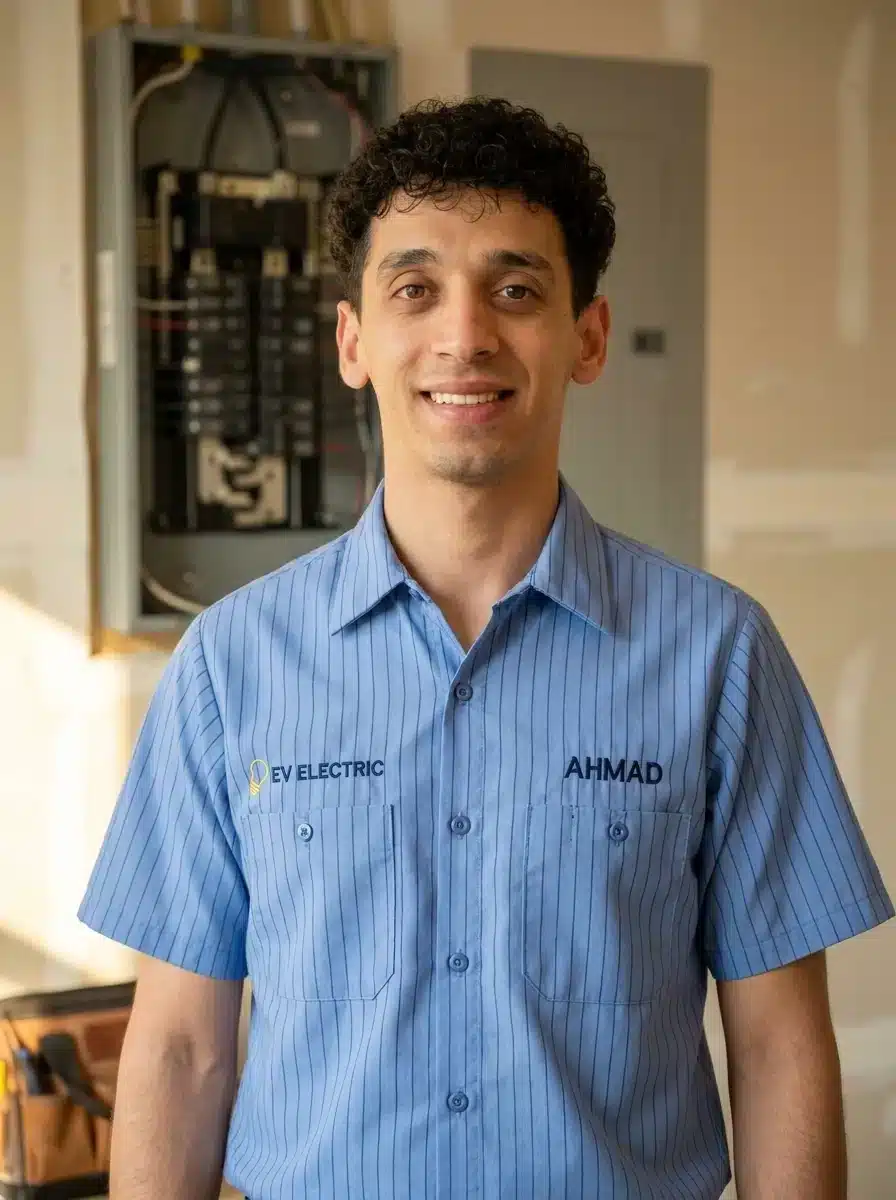
Ahmad Shaban
EV-Electric Services is Ahmad’s own company, based at 9488 Fairfax Blvd in Fairfax, VA 22031. When you call about a surge protector, he is the one who answers your questions and the one who comes to your house.
Customers rate the business 5.0 stars across 122 Google reviews.
Questions People Ask About Surge Protectors
These are the questions that come up most, in the words people use.
Is it worth it to get a whole house surge protector?
It can be, depending on what is plugged in around your home. A surge is a brief spike in voltage that can damage, degrade or destroy electronics. ESFI says most surges start inside the home, for example when an air conditioner turns on in summer, and others come from the electric utility and from lightning. A whole-home device protects the entire electrical system, where a power strip only protects what is plugged into it.
Do I need an electrician to install a whole house surge protector?
ESFI recommends hiring a qualified, licensed electrician to install surge protective devices. A whole-house protector is usually installed at or next to your main electrical panel. We confirm what permit applies to your address before any work starts.
How much does a whole house surge protector typically cost, including installation?
We do not print prices for this job, because they depend on the house. The quote changes with whether it comes with a panel replacement or goes in on its own, your panel and where it sits, and the unit chosen. Ahmad quotes by the job. No trip fee, free estimates.
How long will a whole house surge protector last?
There is no fixed number of years we can honestly give you. Schneider Electric, an electrical equipment maker, says it depends, and names the environment, the protector’s kA rating and how it was installed as factors. ESFI says that after a large surge or spike, such as a lightning strike, a surge suppressor “is a one-time-use protector and will likely have to be replaced.”
Can I install my own whole-house surge protector?
We do not recommend it. It is work at or next to your main electrical panel, and ESFI recommends a qualified, licensed electrician for surge protective devices. If you would like it done properly, call and Ahmad will look at your panel.
What is the best surge protector for a whole house?
A whole-home device protects the entire electrical system, where a power strip only protects what is plugged into it. The right unit depends on your panel and how it is set up. We choose it with you at the estimate.
What is the difference between Type 1 and Type 2 surge protectors?
According to ESFI, both are permanently connected. A Type 1 protects against external and internal surges and may be installed inside or outside the home. A Type 2 is installed in, or next to, the breaker box and protects against internal or external surges. A Type 3 is the plug-in kind, and ESFI says it must be used together with a Type 1 or Type 2 to meet the 2020 code.
How much does it cost to have a surge protector installed?
It depends on the job, so we quote it before work starts and we do not print a figure here.
Does a whole-house surge protector protect against lightning?
ESFI says no surge protection can handle a direct lightning strike. Lightning is one source of surges, along with the electric utility and things inside the home. ESFI also says that after a large surge or spike, such as a lightning strike, a surge suppressor “is a one-time-use protector and will likely have to be replaced.”
Do I still need surge protector power strips if I have a whole-house surge protector?
ESFI recommends using Type 1, 2 and 3 together for the best level of protection. A Type 3 plug-in protector must be used together with a Type 1 or Type 2 to meet the 2020 code. ESFI also says not all power strips offer surge protection, so check that yours does.
What does a whole-house surge protector protect?
According to ESFI, a whole-home device protects your entire electrical system, including large appliances, outlets and light switches. ESFI says it protects against larger surges and gives longer lasting protection than plug-in devices.
Where is a whole-house surge protector installed?
It is usually installed at or next to your main electrical panel. ESFI describes a whole-system device as mounted in or on the main electrical panel, or at the base of the electric meter.
What causes power surges in a home?
A surge is a brief spike in voltage. ESFI says most surges start inside the home, for example when an air conditioner turns on in summer, and the National Electrical Manufacturers Association estimates that 60 to 80 percent start inside a home or business. Others come from the electric utility and from lightning. ESFI says repeated small surges may slowly damage electronic equipment and shorten the life of appliances and electronics.
How do I know when a surge protector needs to be replaced?
ESFI says to choose plug-in protectors that have an indicating light or audible alarm that tells you when they need replacing. Some panel-mounted units also have status lights, and what the light shows is in the unit’s own manual. Schneider Electric lists burn marks, melted plastic, heat and a burning smell as signs a surge protector needs replacing. ESFI says that after a large surge or spike, such as a lightning strike, it “is a one-time-use protector and will likely have to be replaced.”
What does the kA rating on a surge protector mean?
Schneider Electric says the amount of current a surge protective device can safely handle is its surge current rating, written in thousands of amps (kA). Eaton says the kA rating is a value that can be related to a surge protector’s life expectancy. Ask what the rating is on the unit in your quote.
Does a whole-house surge protector wear out?
Yes, it can. Schneider Electric says repeated exposure to surges will degrade the parts inside over time. ESFI says that after a large surge or spike, such as a lightning strike, a surge suppressor “is a one-time-use protector and will likely have to be replaced.”
Is a whole-house surge protector required in Virginia?
Section 230.67 of the 2020 National Electrical Code calls for a surge protective device where a home’s service equipment is replaced. Virginia’s current building code adopts that code. We confirm what permit applies to your address before any work starts.
Where to Go Next
Pages that pair with this one, depending on what is going on at your house.
Thinking About Surge Protection? Call Ahmad.
Tell him about your panel and what you want to protect. He will go over the options, and the price is settled before any work starts. No trip fee, free estimates.
571-500-6637