
Electrical Safety Guide
Hot Outlet or Warm Light Switch: What Is Normal and When to Call
An outlet, plug, switch or dimmer that feels warm or hot. What the safety agencies say is normal, what is not, and what to do right now. Safety steps name their source, or say plainly when they are our advice.
Sources checked October 31, 2026.
Do not touch it. Leave the house. Then call 911.
Source: US Fire Administration, Fire Safety for Older Adults (FA-221): get out, stay out, call 911 once out.
No Smoke? What to Do Right Now
Stop using it and call an electrician if
- The outlet, plug or cover plate is hot: painful to touch, or discolored from heat (CPSC).
- It feels unusually warm. CPSC’s home checklist says unusually warm outlets or switches may mean an unsafe wiring condition, such as a loose connection.
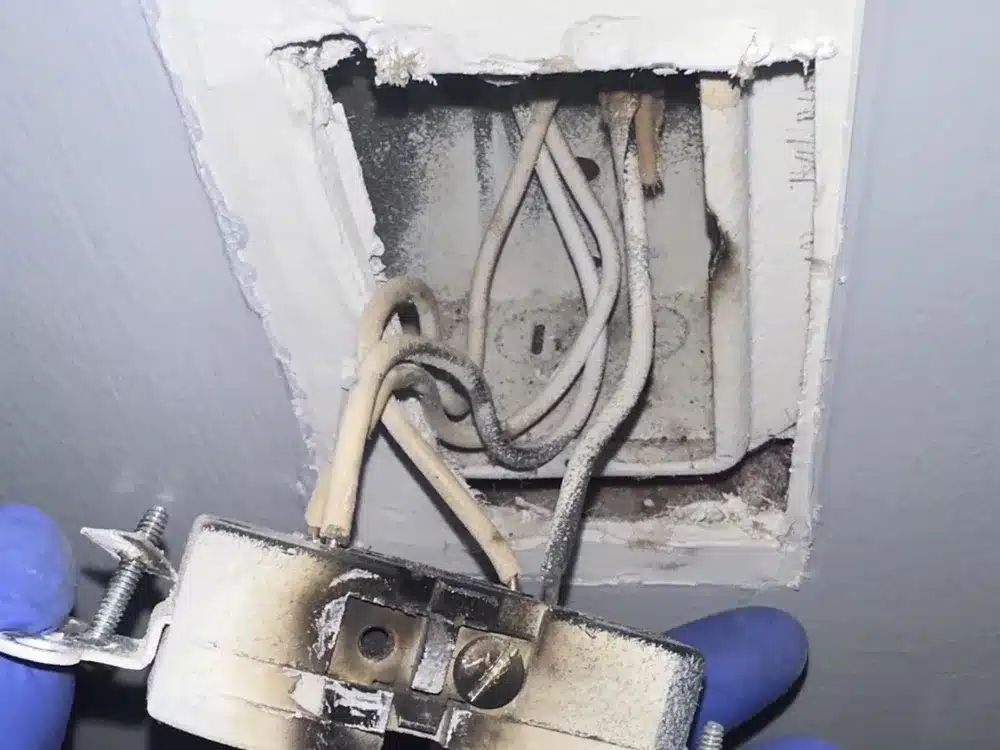
- You see dark, tear-drop shaped marks around or above the plate (ESFI), or melted plastic on a plug (CPSC).
- You smell hot plastic right at it (CPSC). Not sure if it is smoke? Use the red box.
- You hear crackling, sizzling or buzzing (ESFI, CPSC).
- Plugs pull out of the outlet easily (CPSC warning-signs poster).
- You saw a spark from the outlet (NFPA).
Then, while you wait
- Sparking, crackling or sizzling: do not touch or unplug anything. Step away. If it keeps sparking, or you see smoke, use the red box.
- Hot but quiet: if you can do it safely, turn the appliance off with its own switch (CPSC), then unplug the cords from that outlet (ESFI). We recommend calling an electrician instead of doing this yourself.
- Plug too hot to hold: do not touch it. Keep people and pets away, and call us.
- Hot wall switch plate: do not flip that switch (ESFI).
- Want the power off? Our advice: leave the panel alone and call an electrician. Why sources differ.
- Do not use that outlet again until it has been checked (CPSC).
The sparking, too-hot-to-hold and power-off lines are our advice. Everything else names its source.
For an emergency, we dispatch an electrician within about 45 minutes, 24 hours a day, 7 days a week.
Warm can be normal. Hot, discolored, smelly or buzzing is not.
- Warm: CPSC and ESFI say it may be okay. NFPA says call. See how they differ.
- Hot or discolored: stop using it and call a qualified electrician (CPSC, ESFI).
- Why it happens: CPSC says a loose connection is likely to overheat, and an outlet can heat up from power passing through it to other outlets. Where the heat is.
- Two quick checks for an outlet that is only warm. See them.
Where Is the Heat? Plug, Outlet, Switch or Dimmer
Where you feel the heat changes who you call.
| Where you feel it | What it can mean | What to do |
|---|---|---|
| The plug is hot, the outlet is not | CPSC says a plug that feels unusually warm or hot may melt, smoke or give off odors. | Our advice: leave the plug alone and call an electrician. Do not touch it if it is too hot to hold. Stop using the appliance and have the cord replaced by a qualified repair person. If a new plug still overheats in that outlet, CPSC says the outlet is probably worn or defective: call an electrician. |
| The outlet face or plate is hot while in use | CPSC says it “indicates a potential fire hazard” in the outlet, switch or wiring. | Stop using it immediately. Get a qualified electrician as soon as possible. |
| An outlet feels hot with nothing plugged in | CPSC says power for one outlet often passes through the connections of other outlets, so an unused one can heat up. | Same as above. Our reading of CPSC: the fault may be in that outlet or in another outlet it is wired to. |
| A light switch plate is hot | CPSC treats hot switch plates the same as hot outlets. | Do not flip the switch. Call an electrician. |
| The outlet is warm with a lot plugged in | CPSC’s home checklist says a cord, plug or outlet that feels warm may be overloaded. The US Fire Administration says to plug only one high-wattage appliance into an outlet at a time. | CPSC says make sure appliances are not overloading the outlet, and stop using them until an electrician checks the problem. |
| A dimmer is warm | CPSC’s home checklist says some dimmer switches may become warm during normal use. It gives no limit. | Warm only: usually fine. Hot, buzzing, flickering or a smell: stop using it and call. That last rule is ours. |
| A space heater’s plug or outlet is hot | CPSC says stop using the heater and have a qualified electrician check the plug or outlet. | See our space heater safety guide. |
Why an outlet or switch heats up
- A loose connection. CPSC says a plug that slips out easily may have a loose connection that is likely to overheat, and that unusually warm outlets or switches may mean a loose electrical connection that can start a fire.
- Push-in (“backwire”) connections. CPSC says newer homes may have wires pushed into the back of outlets and switches instead of tightened under a screw, and these connections may tend to loosen and overheat. If you know you have them, CPSC says to feel your outlet and switch plates regularly and consult a qualified electrician if you detect overheating.
- Aluminum wiring. CPSC’s wiring guide (Pub. 518) says aluminum wire connections to outlets and switches tend to loosen and overheat. Its aluminum wiring guide (Pub. 516) lists hot-to-the-touch plates and the smell of burning plastic at outlets or switches as signs, and says: do not try to fix it yourself.
- Too much plugged in. See the last row of the table above.
Sources: CPSC Pub. 518, 513, 516 and 098, USFA FA-221. Where a line says “our advice” or “our reading”, it is ours.
Two Quick Checks for an Outlet That Is Only Warm
1. Look from across the room
ESFI says discoloration is another sign of potentially dangerous heat build-up at the connections. Stand across the room and look for a tear-drop shaped darkening around and above outlet and switch cover plates.
Also check that no plate is cracked, broken or missing. ESFI says to replace any that are, so no wiring is exposed.
2. Check if plugs fit firmly
CPSC says a plug that slips out easily, or pulls out from the weight of its cord, may have a loose connection that is likely to overheat. CPSC describes trying plugs from two or three other cords. If most fit firmly, the first cord is worn out. If most fit loosely, CPSC says the outlet probably needs to be replaced by a qualified electrician.
Do not bend the blades of a plug to make it fit. CPSC says this usually causes worse overheating later.
We recommend calling an electrician instead of testing plugs yourself.
Sources: ESFI safety check booklet, CPSC Pub. 518.
Warm or Hot? What Each Safety Source Says
The safety agencies do not all say the same thing, so here are their own words. A cover plate is the plastic cover around an outlet or switch.
| Source | What it says | What it means for you |
|---|---|---|
| CPSC (Pub. 518) | Switch plates, outlet covers, cords and plugs “may be warm but should never be hot”, meaning painful to touch or discolored from heat. | A little warmth can be normal. Hot is a warning. |
| ESFI (safety check booklet) | “With outlet and switch cover plates, warm to the touch may be okay, but hot is not.” | Same line as CPSC. |
| CPSC home safety checklist (Pub. 513) | Asks “Are all outlets and switches cool to the touch?” If not: make sure appliances are not overloading the outlet, and stop using them until an electrician checks the problem. Notes that some dimmer switches may become warm during normal use. | Stricter than Pub. 518: not cool means take the load off and have it checked. |
| NFPA | Lists “Discolored or warm wall outlets” as a reason to call a qualified electrician. | Stricter: warm is enough to call. |
| CPSC warning-signs poster | Lists “Hot Switch Plates and Outlet Covers” as a hazard warning sign, and says to have a licensed electrician check your system. | Hot means call. |
What a Hot Outlet Can Turn Into

This is why we take “it’s been getting warm for a while” seriously. Most of an outlet sits inside the wall box, where you cannot see it.
From a customer whose outlets we repaired:
“EV Electric did a great job repairing my broken outlets. He identified a possible fire hazard and made preemptive safety repairs.”
Google review, October 2026, 5 stars
Keep an Eye on It, or Call?
OK to keep an eye on if
- It feels like your other outlets: only slightly warm, and only while something big is running.
- There is no smell, no marks, no buzzing.
- Plugs fit firmly.
Keeping an eye on it means: do not run the big appliance there for long stretches, look at the plate each time, and call if anything on the right shows up.
Call us if
- It is hot, unusually warm, or warm every single time you use it.
- You see marks, smell something, or hear buzzing.
- Plugs are loose, or an outlet with nothing plugged in feels warm.
- A switch or dimmer is hot, or the lights flicker.
- You are not sure.
These two lists are our advice, built on CPSC’s and ESFI’s “warm may be okay, hot is not” and their warning signs.
Want an Electrician to Look at It?
Hot plate, dark marks, a buzz you cannot explain, or plugs that will not stay in: we can find the cause. A real person answers.
For an emergency, we dispatch an electrician within about 45 minutes, 24 hours a day, 7 days a week. Virginia-licensed master electrician. Fully insured. 127 Google reviews, 5.0 stars.
What happens when Ahmad comes out
- Call any hour and Ahmad answers. Say which outlet or switch feels hot; he will tell you what to keep away from until he is there.
- He checks the outlet or switch and the wiring behind it, and makes sure nothing is damaged by the heat.
- You hear the price before he starts anything you would pay for.
Helpful to tell us on the phone
- Where you feel the heat: plug, outlet, switch or dimmer.
- Whether it is warm or hot, and how long it has been happening.
- What is plugged in, or what the switch controls.
- Any smell, marks, buzzing, or a breaker that tripped.
Based in Fairfax, we take hot outlet and switch calls from Vienna, McLean, Falls Church, Arlington and the rest of Fairfax County.
Hot Outlet and Switch Questions
Short answers, with the source named.
Is it normal for an outlet or plug to feel warm?
A little warmth can be normal. CPSC says plugs, outlet covers and switch plates may be warm but should never be hot, meaning painful to touch or discolored from heat. ESFI says warm may be okay, but hot is not. NFPA is stricter and lists warm wall outlets as a reason to call a qualified electrician.
Can a hot outlet cause a fire?
CPSC says a switch or outlet plate that feels hot “indicates a potential fire hazard” in the outlet, switch or wiring. Stop using it and get a qualified electrician as soon as possible.
What if my outlet sparks?
NFPA lists sparks from an outlet as a reason to call a qualified electrician, and CPSC lists flashes or showers of sparks as a warning sign. Our advice: do not touch or unplug anything while it is sparking. Step away, and if it keeps sparking or you see smoke, leave and call 911.
Why is my light switch hot?
CPSC treats a hot switch plate like a hot outlet: stop using it and call a qualified electrician. CPSC also says an outlet or switch can heat up from power passing through it to other outlets, so the cause may not be where you feel the heat.
Is a warm dimmer switch normal? Can I leave it on all night?
CPSC’s home safety checklist says some dimmer switches may become warm during normal use. None of the sources we read says whether to leave one on overnight. Our advice: if a dimmer is hot to touch, buzzes, makes the lights flicker, or smells, stop using it (ESFI says not to use a hot switch) and call an electrician.
Can an outlet be hot with nothing plugged in?
Yes. CPSC says an unused outlet can feel hot because the power delivered to one outlet often passes through the connections of other outlets. CPSC says a hot plate like that indicates a potential problem in the outlet, switch or wiring, so stop using it and call a qualified electrician.
Can I still use an outlet that looks burnt?
No. ESFI says discoloration is a sign of potentially dangerous heat build-up at the connections, and CPSC says outlet covers should never be discolored from heat. Stop using it and have a qualified electrician look at it.
Why does my outlet smell like burning plastic?
CPSC says burned or overheated wires often give off an odor of hot insulation, and its warning-signs poster lists an odor of overheated plastic. If you are not sure whether it is smoke, treat it as smoke: leave and call 911. A faint smell at one outlet with no smoke: stop using it and call an electrician. That split is our advice. None of the sources we read says how long the smell lasts or whether it is harmful.
Should I turn off the breaker for a hot outlet?
Sources differ. The American Red Cross, on its page about checking your home after a disaster, says that if you see sparks, broken or frayed wires, or smell hot insulation, turn off the electricity at the main fuse box or circuit breaker, and if there is water on the floor between you and the panel, do not step or stand in it. ESFI’s advice for a hot outlet or switch is to unplug cords from it, not use the switches, and have a qualified electrician check the wiring as soon as possible. We recommend calling an electrician instead of switching anything off yourself. Our advice: leave the panel alone. If there is smoke or fire, do not go to the panel at all: get out and call 911.
Where These Facts Come From
We read each source on October 31, 2026. This is general safety information. It does not replace 911 or an electrician who can see your wiring.
- CPSC, Guide to Home Wiring Hazards (Pub. 518): warm versus hot, hot faceplates, unused outlets that feel hot, loose plugs, hot plugs, odors. Open the source
- CPSC, Electrical Safety warning-signs poster (NSN-06-3): hot switch plates and outlet covers, odor of overheated plastic, sizzling or buzzing, plugs that pull out easily. Open the source
- ESFI, Indoor Electrical Safety Check booklet: warm may be okay but hot is not, unplug cords, discoloration, the look-from-across-the-room check. Open the source
- CPSC, Home Electrical Safety Checklist (Pub. 513, July 2008): outlets and switches cool to the touch, overloading, dimmers that may become warm. Open the source
- CPSC, Repairing Aluminum Wiring (Pub. 516, June 2011): signs of aluminum wiring problems at outlets and switches. Open the source
- NFPA, Electrical Home Fire Safety: discolored or warm wall outlets as a reason to call a qualified electrician. Open the source
- American Red Cross, Checking Your Home’s Utilities (after a disaster): turn off electricity at the panel for sparks, frayed wires or a hot-insulation smell, without stepping in water. Open the source
- US Fire Administration, Fire Safety for Older Adults (FA-221): get out, stay out, call 911. Open the source
- CPSC, Reducing Fire Hazards for Portable Electric Heaters (Pub. 098): a hot plug, outlet or faceplate with a heater. Open the source
Related guides: Electrical emergencies (smoke, sparks, power lines) · Space heater safety (heater trips the breaker) · Breaker keeps tripping (what the sources say) · Electric shock (when to go to the ER) · Water and electricity (leaks, wet outlets, floods)
That Outlet Is Telling You Something
Leave the outlet and any hot wall switch alone, and let us find the cause. If you ever see smoke, 911 comes first.
