
Electrical Safety Guide
Electric Shock at Home: What to Do Right Now and When to Go to the ER
Medical steps from medical sources. General information, not medical advice. Sources checked October 31, 2026.
Do not touch them until the power is off. If they are hurt, call 911.
What the medical sources say, step by step:
- Hurt, or still stuck to the source? Call 911. MedlinePlus says to call 911 if a person has been injured by electricity.
- Still touching the source? Hands off. Household current can make muscles clench, so they may not be able to let go (ACEP).
- MedlinePlus says to cut the power if you safely can: pull the plug, remove the fuse or switch off the circuit breakers. It says switching off the appliance alone may not stop the current. Cleveland Clinic says not to use electrical devices, switches or outlets when you are wet or standing in water, so do not go to the panel then (our advice).
- Cannot cut it? MedlinePlus says to push them free with something dry that does not conduct electricity, such as a broom, chair, rug or rubber doormat, never anything wet or metal. It also says to stand on something dry if you can.
- Once they are free, check breathing and pulse. MedlinePlus says CPR should be started if the person is unconscious and you cannot feel a pulse. Do not move them unless there is a fire or explosion risk, and do not move the head or neck if the spine may be hurt. Stay with them until help arrives.
Our advice: do not touch the person yourself. Call 911. The 911 operator will tell you what to do until help arrives.
A power line is involved? Stay at least 35 feet back (American Red Cross) and call 911. Our electrical emergency guide covers downed lines.
Felt a zap, but you are fine? Still get checked: see the short answer below.
Sources: MedlinePlus (National Library of Medicine), Electrical injury; American College of Emergency Physicians (ACEP); Cleveland Clinic.
Everyone who gets shocked should be checked by a doctor.
- Even if you feel fine. Cleveland Clinic says anyone who gets a shock should get medical care, even without symptoms. MedlinePlus says you may have internal damage and not realize it.
- When in doubt, go. Cleveland Clinic says to err on the side of caution: call your healthcare provider or go to the hospital after you get shocked.
- Most shocks are minor, but not all. Cleveland Clinic says most of the time electric shocks are minor, but they can cause damage inside your body that you cannot see. How fast to get checked.
- Nobody hurt, but something shocked you? After you have been checked, find the cause.
911, the ER, or a Doctor: How Fast to Get Checked
Call 911 now if
The person was hurt by the shock (MedlinePlus says call 911 if a person has been injured by electricity). Our advice is to also call 911 for any of these serious symptoms Cleveland Clinic lists: chest pain, passing out, seizures, shortness of breath, a weak, irregular or missing pulse, vision or hearing trouble, headaches, abdominal pain, broken bones or dislocated joints. MedlinePlus also lists changes in alertness, trouble swallowing and breathing problems. A burn on its own: Cleveland Clinic says go to the emergency room.
Treating each of those as a 911 call, and not driving yourself, is our advice. Cleveland Clinic lists them as serious symptoms.
For everyone else, here is Cleveland Clinic’s advice, lightly shortened:
| Cleveland Clinic’s category | What Cleveland Clinic says |
|---|---|
| High-voltage shocks | Call 911 or go to your nearest hospital or emergency room immediately. |
| Lightning | Always need emergency care. Call 911. |
| Low-voltage shocks with burns | Go to the emergency room. Don’t try to treat the burn at home. |
| Low-voltage shocks without burns | See a healthcare provider within 48 hours. Treatments for internal injuries are most effective within that window. |
| Children with mouth or face injuries | Always need emergency care. |
| Children without injuries | See a pediatrician within 48 hours. |
ACEP adds that even when a burn on the skin looks minor, severe internal damage may have happened, especially to the heart, muscles or brain. This is general information, not medical advice.
Electrical Burns: What to Do on the Way to Care
Do
- Take off clothing that comes off easily.
- Rinse the burn with cool running water until the pain eases.
- Rinsing is first aid while you get help, not a treatment. Cleveland Clinic says go to the ER and not to treat an electrical burn at home.
Do not
- Put ice, butter, ointments or medicines on it.
- Use fluffy cotton dressings or sticky bandages.
- Break blisters or pull off dead skin.
Sources: MedlinePlus, Electrical injury; Cleveland Clinic.
If a Child Was Shocked
- Not breathing, or no pulse? Call 911 now. MedlinePlus says CPR should be started if the person is unconscious and you cannot feel a pulse.
- What AAP says about the power. The American Academy of Pediatrics (AAP) says to disconnect the power before touching a child who is still receiving current: pull the plug or turn off the main switch. We recommend calling 911 and letting the operator guide you instead of doing this yourself.
- Check for burns, then call right away. AAP says to call 911 or your pediatrician right away, and that a shocked child should be seen by a pediatrician, because shock may cause internal damage that only an exam can find.
- Mouth burns are deeper than they look. AAP says burns from biting a cord are often much deeper than they appear, and bleeding can start hours or even days later. If it bleeds, AAP says apply a clean pad and call your pediatrician immediately. Cleveland Clinic says a child with a mouth or face injury always needs emergency care.
- Prevent the next one. MedlinePlus advises child safety plugs in outlets and keeping cords out of children’s reach.
Sources: American Academy of Pediatrics (HealthyChildren.org, page dated September 2019), Cleveland Clinic, MedlinePlus.
After Everyone Has Been Checked: Find What Shocked You
CPSC says any shock, even a mild tingle, may be a warning of danger. Cleveland Clinic lists common causes: damaged, exposed or worn wiring; faulty electronics and appliances; and water on household appliances, outlets or switches. Until it is checked, do not use that outlet, switch, lamp or appliance again. That last line is our advice.
| Where the shock came from | What CPSC says | Our advice |
|---|---|---|
| A metal outlet or switch plate, or its screws | Turn off that branch circuit at the panel unless it runs an essential appliance, and avoid touching the plate until a qualified electrician helps. | Leave the plate alone and call us instead of switching breakers off yourself. |
| The metal shell of a lamp socket | Unplug the lamp. Check that the plug and outlet are polarized (one blade wider). If the plug is polarized and you still got a shock, the lamp or the outlet is miswired. | Leave the lamp unplugged and call. We can check the plug, the outlet and the wiring. |
| Any appliance, even a slight shock or tingle | CPSC’s home checklist: do not touch the appliance until an electrician has checked it, and turn its power off at the circuit breaker. A shock indicates an extremely hazardous wiring condition, such as an internal short or ground fault. NFPA also lists a tingling feeling from an appliance as a reason to call a qualified electrician. | Do not touch the appliance. Call us instead of unplugging it or switching off its breaker yourself. |
| An appliance near water: kitchen, bathroom, basement, garage | Shocks can be more serious where people can touch water pipes, radiators or water in sinks and tubs along with a faulty appliance. Without GFCIs, consult a qualified electrician about adding them. | Stop using the appliance. Ask us about GFCI protection. |
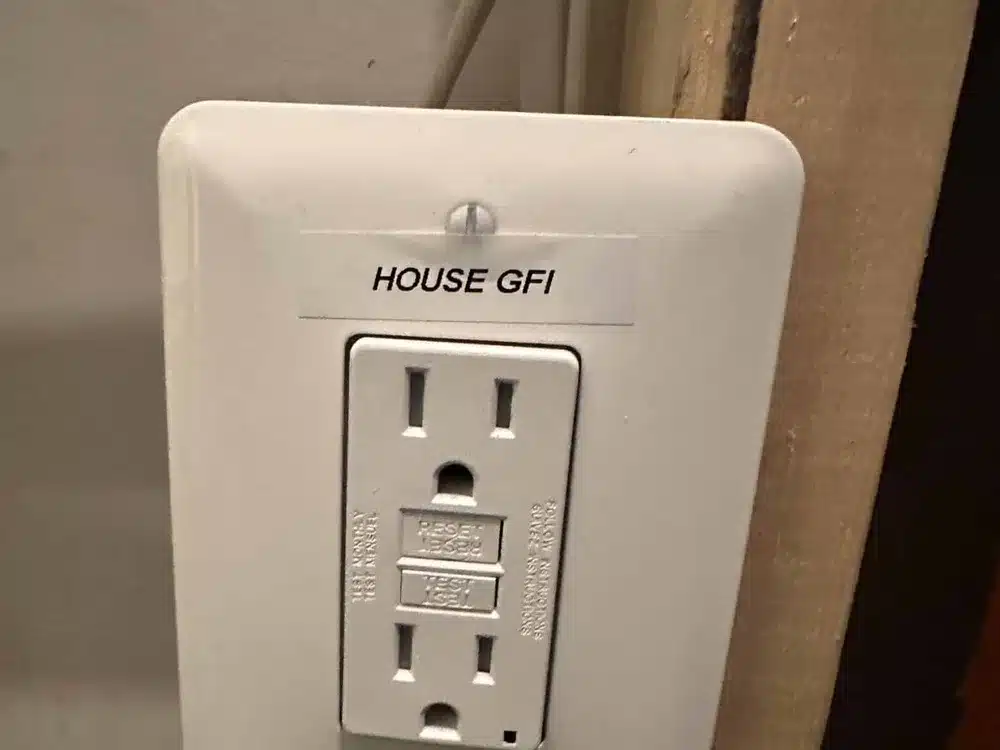
| A GFCI outlet that shocked you anyway | A GFCI cuts the power before severe injury can occur, but you may still get a painful shock in the time it takes. | Stop using that outlet and call. We can check the GFCI and what is plugged into it. |
Sources: CPSC, Guide to Home Wiring Hazards (Pub. 518) and Home Electrical Safety Checklist (Pub. 513); NFPA; Cleveland Clinic. The last column is our advice, built on CPSC’s steps.
After the Shock: Let Us Track Down the Cause
Medical care comes first. Once everyone has been checked, call us and we will look at the outlet, switch, lamp, appliance circuit or wiring that did it. A real person answers. For an urgent visit, see our emergency electrician page.
For an emergency, we dispatch an electrician within about 45 minutes, 24 hours a day, 7 days a week. Virginia-licensed master electrician. Fully insured. 127 Google reviews, 5.0 stars.
“I received very prompt service for troubleshooting a GFCI problem and installing surge protectors. Ahmad was excellent at explaining what the issues could be and how to resolve them.”
Google review, September 2026, 5 stars
What happens when Ahmad comes out
- Get the person checked first. Then call, and Ahmad answers, day or night. Tell him where the shock came from, and he tells you what to leave alone until he gets there.
- He finds where the shock came from, then checks that outlet, switch or appliance and the wiring behind it, and makes sure nothing is damaged.
- He explains what caused the shock and quotes the repair before doing any paid work.
Useful to tell us
- What you touched: an outlet plate, switch, lamp, appliance or cord.
- Which room, and whether anything was wet.
- Whether a breaker tripped or a GFCI clicked off.
- Whether it has happened before.
From our base in Fairfax we cover shock and wiring calls in Fairfax, Vienna, McLean, Falls Church and Arlington.
Electric Shock Questions
Short answers, with the source named. General information, not medical advice.
What should I do right after an electric shock?
If someone was hurt, call 911. MedlinePlus says to call 911 if a person has been injured by electricity. If they are still touching the source, MedlinePlus says to cut the power at the plug, fuse or breakers if you safely can, or push them free with something dry like a broom or rubber mat. Our advice: do not touch the person yourself. Call 911. The 911 operator will tell you what to do until help arrives. If you are the one who was shocked and you feel fine, Cleveland Clinic still says to get medical care, even without symptoms.
How do I know if I am OK after an electric shock?
You cannot tell for sure on your own. MedlinePlus says you may have internal damage and not realize it. Cleveland Clinic says shocks can cause damage inside your body that you cannot see, that delayed effects are possible, most likely irregular heart rhythms or infections, and that when in doubt you should call your healthcare provider or go to the hospital.
What does a minor electric shock feel like?
Cleveland Clinic lists the common symptoms as muscle spasms, numbness or tingling, and pain. It also says shocks can cause damage inside your body that you cannot see, so get checked even if it was only a tingle.
I got shocked by a regular 120-volt outlet. Do I need the ER?
Get checked either way. Go to the ER if there is any burn or any serious symptom on this page. Cleveland Clinic says a low-voltage shock with burns needs the emergency room, and one without burns needs a healthcare provider within 48 hours, but it also says the low-to-high voltage line is drawn anywhere from 100 to 500 volts, and homes use 120 volts. Our advice: call a doctor today, and go to the ER if you are unsure.
What should I do if a toddler gets shocked by an outlet?
The American Academy of Pediatrics says to disconnect the power before you touch a child who is still receiving current, then check for burns and call 911 or your pediatrician right away. Cleveland Clinic says children with mouth or face injuries always need emergency care, and children without injuries should see a pediatrician within 48 hours. Our advice: call the pediatrician the same day.
Can a shock from a wall outlet kill you?
Asked whether a shock from a plug can kill you, Cleveland Clinic says yes, but it does not happen very often. US outlets are on 120-volt circuits, and 240 volts for larger appliances like clothes dryers, which is enough to cause serious injury or death under the right circumstances. It adds that GFCI outlets can make a huge difference in protecting you from outlet-related shocks.
I felt a small tingle from an appliance. Is that serious?
Yes, for the appliance. CPSC’s home checklist says that after even a slight shock from an appliance, other than static electricity, do not touch it until an electrician has checked it, because a shock indicates an extremely hazardous wiring condition. NFPA lists a tingling feeling from an appliance as a reason to call a qualified electrician. For you, Cleveland Clinic says get medical care even without symptoms.
What is an electrical injury?
MedlinePlus defines it as damage to the skin or internal organs when a person comes into direct contact with an electrical current. Some electrical burns look minor but hide serious internal damage, especially to the heart, muscles or brain.
What should I do if I get a shock from a light bulb socket?
Get yourself checked first; that is our advice. Then, CPSC says to unplug the lamp and check that the lamp plug and outlet are polarized, with one blade wider than the other. If the plug is polarized and you still got a shock, CPSC says either the lamp or the outlet is miswired, and a qualified electrician should find and fix it. We recommend calling an electrician instead of unplugging and checking it yourself.
Why do I keep getting shocks from outlets, switches or appliances?
Cleveland Clinic lists common causes: damaged, exposed or worn wiring, faulty electronics and appliances, and water on appliances, outlets or switches. CPSC says any shock, even a mild tingle, may be a warning of danger. Our advice: stop using that outlet, switch or appliance and have a qualified electrician find the cause.
Can I still get shocked if I have GFCI outlets?
Yes. CPSC says a GFCI turns the electricity off before severe injury or electrocution can occur, but you may still get a painful shock during the time it takes to cut off the power. Cleveland Clinic says GFCI outlets cut off electricity at much lower levels than a circuit breaker or fuse.
Should I turn off the main or just one breaker?
MedlinePlus says to unplug the cord, remove the fuse or turn off the circuit breakers if you can do it safely. For a child still receiving current, the American Academy of Pediatrics says pull the plug or turn off the main switch. For a shock from a metal outlet plate with no one hurt, CPSC says turn off that branch circuit unless it runs an essential appliance. Cleveland Clinic says not to use switches when you are wet or standing in water. Our advice: leave the panel alone and call an electrician, or call 911 if someone is hurt. Never reach a panel while wet or standing in water.
Where These Facts Come From
We read each source on October 31, 2026. Medical steps come only from medical sources (MedlinePlus, Cleveland Clinic, ACEP, the American Academy of Pediatrics); CPSC and NFPA are used only for electrical facts. We are electricians, not doctors: this page does not replace 911, the ER or your own doctor.
- MedlinePlus (National Library of Medicine), Electrical injury: what to do, symptoms, burns, when to call 911. Open the source
- MedlinePlus, Electrical Injuries health topic: see a doctor, internal damage you may not notice. Open the source
- Cleveland Clinic, Electric Shock (last updated November 18, 2025): who needs care and how fast, symptoms, children, delayed effects, GFCIs. Open the source
- American College of Emergency Physicians (ACEP), Electrical Shock: Know When to Go to the ER. Open the source
- American Academy of Pediatrics, HealthyChildren.org, Electric Shock (children). Open the source
- CPSC, Guide to Home Wiring Hazards (Pub. 518): any shock is a warning, faceplate and lamp socket shocks, GFCIs, wet locations. Open the source
- CPSC, Home Electrical Safety Checklist (Pub. 513): a slight shock from an appliance. Open the source
- NFPA, Electrical Home Fire Safety: a tingling feeling from an appliance as a reason to call a qualified electrician. Open the source
Related guides: Electrical emergencies (smoke, sparks, power lines) · Space heater safety (heater trips the breaker) · Hot outlet or switch (plug or plate feels hot) · Breaker keeps tripping (why it keeps tripping) · Water and electricity (leaks, wet outlets, floods)
Get Checked First. Then Let Us Find the Cause.
CPSC calls any shock, even a tingle, a warning. Once everyone has seen a doctor, we will find what did it and make it safe.
