
EV Charger Installation in Bethesda, MD
Home EV charger installation in Bethesda, MD — by an MD-licensed Master Electrician
MD-licensed and insured. Same-day scheduling. Montgomery County electrical permit handled. Level 2 hardwired or NEMA 14-50 — Ahmad does the load check himself.
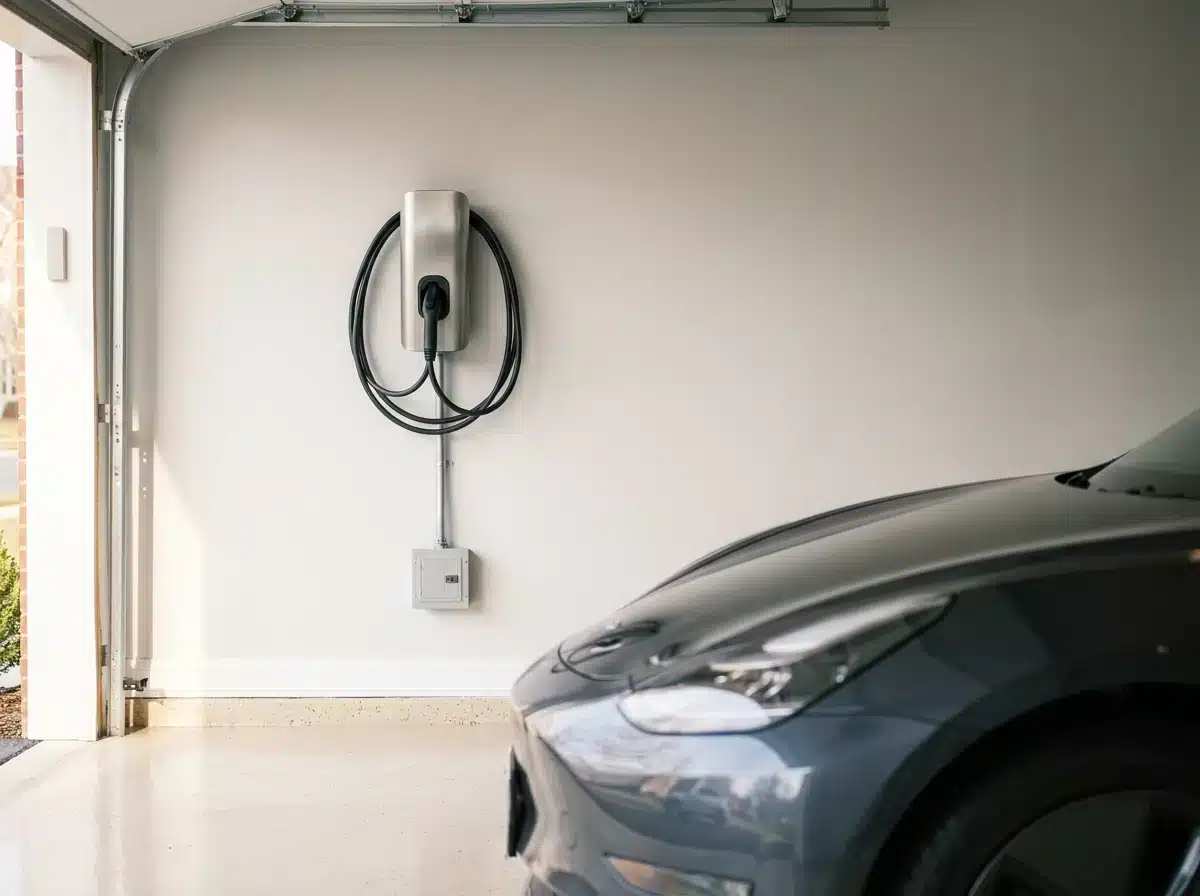
Looking for a public charging station?
Try bethesdatransit.org or ChargeHub for public EV stations in Bethesda.
We install home and business EV chargers in Bethesda — Level 2 hardwired or NEMA 14-50, with the Montgomery County permit handled. If you need a charger installed at your house or commercial property, you are in the right place.
Schedule Your Install →Why Bethesda Homeowners Need a Dedicated EV Circuit
Bethesda has one of the highest EV ownership rates in the D.C. metro area — but most homes here were wired decades before Teslas, Rivians, and BMW iX models filled the driveways. Whether your Edgemoor colonial has a 60-amp panel from 1948 or your Bradley Hills split-level runs on 150 amps, the first step is always the same: a load calculation.
A Level 2 EV charger draws 40 to 50 amps of continuous load. That is a significant addition to any home’s electrical capacity — especially in Bethesda, where central air, kitchen renovations, and home offices have already consumed most of the available amperage. If the load calc shows your panel cannot handle a charger, a Bethesda panel upgrade comes first.
The good news: once the electrical capacity is confirmed (or upgraded), the charger installation itself is straightforward. Ahmad handles the Montgomery County electrical permit, runs the dedicated circuit, and installs the charger — typically in a single visit.
Does Your Bethesda Home Have Capacity for an EV Charger?
The load calculation — per NEC 220.82 — determines whether your existing panel can support a new 40- to 50-amp EV circuit. Here is what Ahmad checks during the on-site visit.
Bethesda Load-Calc Decision Tree
Step 1: Identify your panel size. Most Bethesda homes fall into one of four ranges — 60A, 100A, 150A, or 200A. The panel door label or the main breaker rating tells you.
Step 2: Add up your existing loads. Central air (30–60A), electric range (40–50A), dryer (30A), water heater (30A if electric), and any sub-panels. Ahmad measures actual draw, not just breaker ratings.
Step 3: Apply the NEC 220.82 demand factor calculation. This determines remaining capacity after existing loads.
60A–100A panels (common in Edgemoor, Kenwood, Battery Park): Almost always require a full service upgrade to 200A before a Level 2 charger can be installed. The panel and the service entrance both need replacement.
100A–150A panels (common in Wyngate, Westbard, Alta Vista): May or may not have capacity — the load calc decides. If your home has gas heat and a gas dryer, a 150A panel often has room. If everything is electric, an upgrade is likely.
200A panels (common in Bradley Hills, Burning Tree, newer construction): Usually have capacity for a 50A EV circuit. The load calc confirms it.
If the load calc shows your panel cannot support the charger, a panel upgrade is the first step — Ahmad handles both as a bundled project when needed.
What Drives the Cost of an EV Charger Installation in Bethesda?
Every EV charger installation is different. The cost depends on your home’s existing electrical infrastructure, the distance from the panel to the charging location, and the type of charger you choose.
Cost Factors for Bethesda EV Charger Installs
- Panel capacity: If your panel needs an upgrade (common in pre-1970s Bethesda homes), that is a separate project that precedes the charger installation.
- Circuit run distance: A charger in an attached garage with the panel on the same wall is a shorter run than a detached garage across a large Edgemoor lot — which may require underground conduit.
- Charger type: Hardwired units (Tesla Wall Connector, Grizzl-E, JuiceBox) require a dedicated 60A circuit. NEMA 14-50 outlet installs use a 50A circuit.
- Permitting: Montgomery County DPS requires an electrical permit for EV charger installations. Ahmad handles the permit — the cost is included in your estimate.
- Existing wiring condition: Older Bethesda homes may have aluminum wiring, undersized feeders, or outdated grounding that needs to be addressed before the charger circuit is installed.
Ahmad provides a written estimate after the on-site load check — no surprises. The estimate covers the charger circuit, materials, Montgomery County permit, and installation labor. Call 571-500-6637 to schedule your free estimate.
EV Charger Types: Level 1, Level 2 NEMA, and Level 2 Hardwired
Which charger type is right for your Bethesda home depends on your vehicle, your daily driving distance, and your electrical capacity.
Level 1 (120V Outlet)
Uses your existing 120V outlet — the cord that came with your car. Adds roughly 3–5 miles of range per hour. Fine if you drive under 30 miles a day and can charge overnight. No electrical work needed, but painfully slow for most EV owners.
Level 2 — NEMA 14-50 Outlet
A dedicated 240V, 50-amp outlet installed near your parking spot. You plug in a portable Level 2 charger (like the Tesla Mobile Connector). Adds 25–30 miles of range per hour. Good flexibility — you can unplug the charger and take it with you.
Level 2 — Hardwired
A permanently mounted charger (Tesla Wall Connector, ChargePoint Home Flex, Grizzl-E) wired directly to a dedicated 60-amp circuit. Adds 30–44 miles of range per hour. The fastest home charging option and the cleanest installation. Most Bethesda homeowners choose this.
Bethesda EV Charger Installation Scenarios
Every Bethesda neighborhood has different housing stock, different panel ages, and different installation challenges. Here are the most common scenarios Ahmad handles.
60A–100A Panel + Level 2 Request
Edgemoor, Kenwood, Battery Park (pre-1950s)
These homes need a full service upgrade to 200A before the charger circuit can be installed. Detached garages on large lots require underground conduit runs. Ahmad handles the panel upgrade and charger install as a bundled project.
100A–150A Panel, Attached Garage
Wyngate, Westbard, Alta Vista (1950s–70s)
The load calc determines whether an upgrade is needed. Attached garages mean shorter circuit runs and lower install complexity. If your 150A panel has room, the charger install is straightforward.
200A Panel, Townhome Parking
Bradley Hills, Burning Tree, Sumner (1980s+)
Most 200A panels have capacity for a 50A EV circuit. Townhome installs may require exterior conduit routing and HOA coordination — Ahmad handles the Montgomery County permit either way.
Detached Garage on Large Lot
Edgemoor, Kenwood estates
Long circuit runs from the main panel to a detached garage — often 80 to 150 feet. May require underground conduit and a sub-panel in the garage. Ahmad surveys the route during the load check visit.
Condo / Underground Parking
Downtown Bethesda, Woodmont Triangle
Condo EV installs may require dedicated metering and building-management coordination. Ahmad consults with the condo board on electrical access and permitting before starting work.
Tesla Wall Connector (Hardwired)
Any Bethesda neighborhood
Tesla’s Wall Connector requires a dedicated 60A circuit and hardwired connection per Tesla’s installation specifications. Ahmad installs Tesla Wall Connectors to manufacturer spec — no adapters, no shortcuts.
NEMA 14-50 Outlet (Portable Charger)
Any Bethesda neighborhood
A dedicated 50A, 240V outlet near your parking spot. You plug in your own portable Level 2 charger. Good option if you want the flexibility to take the charger with you or if you are renting.
Multi-EV Household
Estate properties, 2-car homes
Two EVs mean two charging circuits — and a load calc that accounts for combined draw. May require a sub-panel or panel upgrade even on a 200A service. Ahmad calculates total demand before committing to a plan.
Bethesda Housing Eras and EV Charger Readiness
The decade your Bethesda home was built tells Ahmad most of what he needs to know before the on-site visit.
1920s–1950s Colonial & Tudor Estates
Edgemoor, Kenwood, Battery ParkOriginal 60A–100A service. Fuse panels or early breaker panels. Almost always need a full service upgrade to 200A. Detached garages on large lots mean long conduit runs — underground routing is common. These are the most complex EV charger installs in Bethesda, but they are also the most common request.
1950s–1970s Split-Levels & Ramblers
Wyngate, Westbard, Alta Vista100A–150A panels. May or may not need an upgrade — the load calc decides. Attached garages simplify the circuit run. If your home has gas heating and a gas dryer, a 150A panel often has enough room for a dedicated 50A EV circuit without an upgrade.
1980s–2000s Colonials & Townhomes
Bradley Hills, Burning Tree, Sumner200A service — likely has capacity for a 50A EV circuit. Townhome installations may involve exterior conduit routing and HOA review. Newer breaker panels are well-documented and straightforward to work with.
2000s+ Luxury Infill & Condos
Downtown Bethesda, Woodmont Triangle, West Elm200A panels, modern wiring. Underground parking garages add complexity — condo boards may require dedicated metering for EV circuits. These are a different install category that Ahmad evaluates case-by-case with building management.
Montgomery County Permits & Maryland Electrical Code
EV charger installations in Bethesda require an electrical permit from Montgomery County. Ahmad handles the permitting process — you do not need to navigate DPS yourself.
Montgomery County Department of Permitting Services (DPS)
All residential electrical work in Bethesda — including EV charger installation — requires a Montgomery County electrical permit from the Department of Permitting Services.
- Office: 2425 Reedie Drive, Wheaton, MD 20902
- Phone: 311 (within Montgomery County) or 240-777-0311
- Online: MC311 portal or ePlan/ePermit system
A licensed Maryland Master Electrician must pull the permit. Ahmad is MD-licensed and pulls the Montgomery County permit as part of every EV charger installation in Bethesda.
Maryland Electrical Code (NEC Adoption)
Maryland adopts the National Electrical Code (NEC) on its own cycle — currently the 2020 NEC via COMAR 09.12.01. This is different from Virginia’s code adoption. Key provisions for EV charger installations:
- NEC 625 (EVSE Installation): Governs circuit sizing, conductor requirements, and overcurrent protection for electric vehicle supply equipment.
- NEC 220.82 (Dwelling Load Calculation): The method Ahmad uses to determine whether your panel can support a new EV circuit without an upgrade.
- Dedicated circuit required: A Level 2 EV charger must be on its own dedicated circuit — no shared circuits, no extension cords.
Ahmad handles the permit and inspection scheduling. After installation, Montgomery County DPS inspects the work. Ahmad coordinates the inspection — you do not need to be involved in the permitting process beyond approving the work scope.
EV Charger Tax Credits & Incentives (Bethesda, MD)
A note on federal and state incentives for EV charger installation — some have expired, others require independent verification.
Current Status of EV Charger Incentives
Federal EV Charger Tax Credit (Form 8911)
The federal Alternative Fuel Vehicle Refueling Property Credit (IRS Form 8911) expired on June 30, 2026. This credit previously covered up to 30% of the cost of qualified EV charging equipment and installation. It is no longer available for new installations. If you installed a charger before the expiration date, consult your tax advisor about eligibility for the credit on your 2026 return.
Maryland State EV Incentives
Maryland has offered EV-related incentive programs through the Maryland Energy Administration (MEA). Montgomery County may also have county-level EV programs. Verify current availability directly with energy.maryland.gov or montgomerycountymd.gov before claiming any state or county incentive — program availability and funding change frequently.
PEPCO Utility Programs
PEPCO (Potomac Electric Power Company) is the electric utility serving Bethesda. PEPCO has historically offered EV-related programs and time-of-use rates for EV charging. Check pepco.com for current offerings. Ahmad can advise on circuit configuration that works with time-of-use rate structures if available.
EV Charger Installation in Bethesda — What Homeowners Ask
These are the questions Bethesda homeowners ask most often when scheduling an EV charger installation. If your question is not listed here, call Ahmad directly at 571-500-6637.
Bethesda EV Charger Q&A
6 common questions from Bethesda homeowners
Do I need a permit for an EV charger in Bethesda?
Yes. Montgomery County DPS requires an electrical permit for EV charger installations. Ahmad pulls the permit and coordinates the inspection — you do not need to visit DPS yourself.
Can my 100-amp panel handle a Level 2 charger?
It depends on your existing electrical loads. Ahmad runs a load calculation per NEC 220.82 during the on-site visit. If the panel is at capacity, a panel upgrade is the first step.
How long does a Bethesda EV charger installation take?
Most installations (panel has capacity, attached garage, reasonable circuit run) are completed in one visit — typically 3 to 5 hours. Installs requiring a panel upgrade or underground conduit to a detached garage take longer and may require two visits.
Can you install a Tesla Wall Connector in Bethesda?
Yes. Ahmad installs Tesla Wall Connectors to Tesla’s manufacturer specifications — hardwired to a dedicated 60A circuit. He also installs ChargePoint, Grizzl-E, JuiceBox, and other Level 2 chargers.
Is PEPCO involved in my EV charger installation?
Only if a service upgrade is needed. If your panel upgrade requires a new meter base or increased service entrance capacity, PEPCO coordinates the service connection. For a standard charger install on an existing panel with capacity, PEPCO is not involved.
Do you handle HOA approval for townhome installs?
Ahmad provides the technical documentation (circuit plan, conduit routing, equipment specs) that HOAs typically require. You submit to your HOA; Ahmad handles the Montgomery County permit and the installation.
How a Bethesda EV Charger Installation Works
From first call to charging — here is what to expect when you hire EV Electric Services for your Bethesda EV charger installation.
Call & Schedule
Call 571-500-6637. Ahmad will ask about your vehicle, your home’s panel size (if you know it), and where you want the charger. He schedules the on-site visit — same-day availability for Bethesda.
On-Site Load Check & Estimate
Ahmad drives to your Bethesda home, inspects your panel, runs the NEC 220.82 load calculation, surveys the circuit route, and gives you a written estimate on the spot. If a panel upgrade is needed, he includes that in the scope.
Permit, Install, Inspect
Ahmad pulls the Montgomery County electrical permit, installs the dedicated circuit and charger, and coordinates the DPS inspection. You start charging.
Serving Bethesda from Fairfax — Same-Day Scheduling
EV Electric Services is based in Fairfax, VA. Ahmad is MD-licensed and drives to Bethesda same-day for the on-site load check and installation.
Drive Times to Bethesda
- Fairfax to Bethesda (I-495) ~25 min
- Fairfax to Bethesda (Georgetown Pike) ~30 min
- Fairfax to Kenwood / Edgemoor ~25 min
- Fairfax to Downtown Bethesda ~25 min
Fairfax-based, MD-licensed, drives to Bethesda same-day.
Ahmad does the load check himself — no subcontractors, no franchise dispatch. He is an MD-licensed Master Electrician who pulls the Montgomery County permit directly.
Most Bethesda “local” electricians are franchise operations that subcontract the work. Ahmad is the owner, the estimator, and the electrician who does the installation.
About Ahmad Shaban — Your Bethesda EV Charger Installer
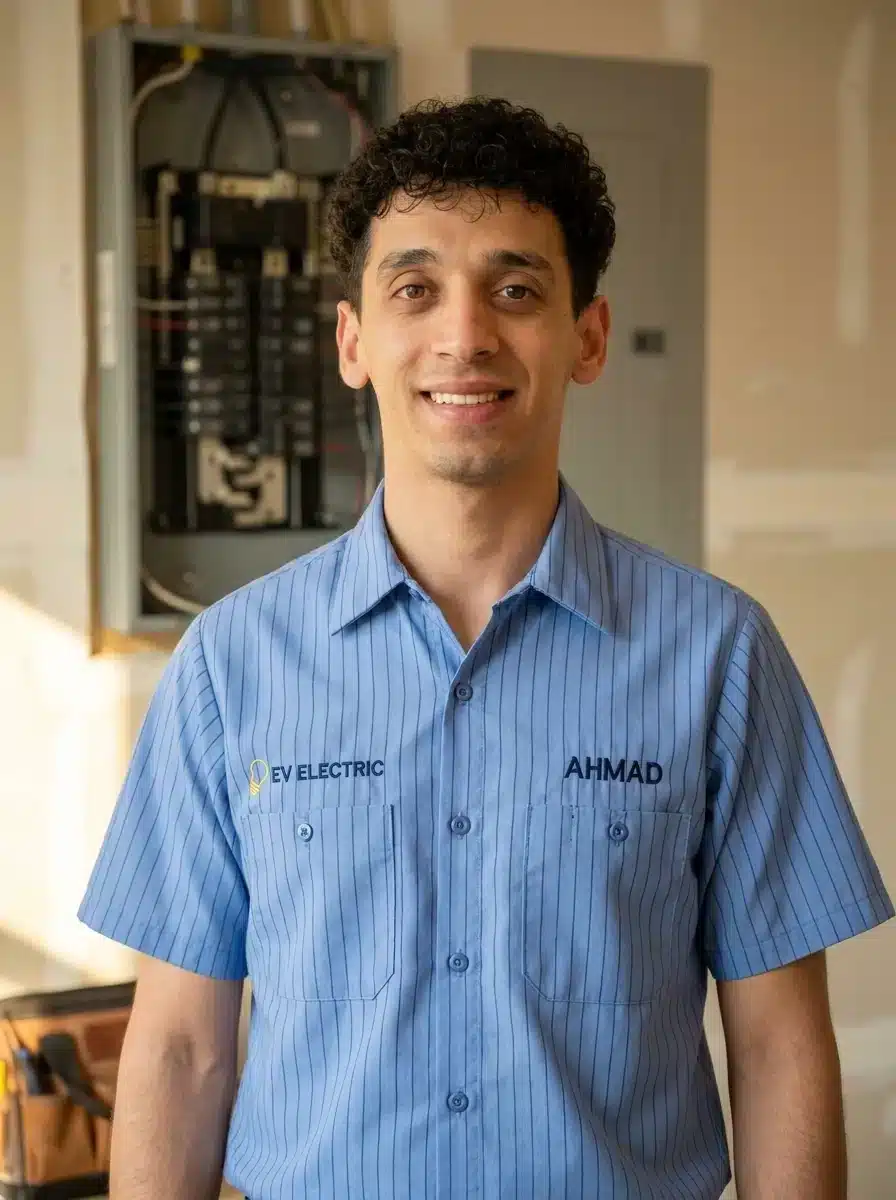
Ahmad Shaban is the owner and sole operator of EV Electric Services. He is a Maryland-licensed Master Electrician (verified through the Maryland State Board of Master Electricians) who handles every EV charger installation personally — from the load calculation to the Montgomery County permit to the final inspection.
EV Electric Services is rated 5.0 stars across 122 reviews. Ahmad works directly with Bethesda homeowners — no call centers, no dispatched technicians, no franchise overhead.
Whether your Bethesda home needs a straightforward charger install on an existing 200A panel or a full service upgrade before the charger circuit can be run, Ahmad scopes the work honestly and completes it himself.
Bethesda Neighborhoods We Serve
Ahmad installs EV chargers across Bethesda and surrounding Montgomery County neighborhoods. Each area has its own housing stock and electrical characteristics.
- Edgemoor — 1920s–40s colonials, 60A–100A panels, detached garages on large lots. Panel upgrade typically required.
- Kenwood — Estate-scale homes from the 1930s–50s. Large lots, long conduit runs, historic-neighborhood considerations.
- Battery Park — Pre-war homes, similar electrical profile to Edgemoor. Older panels, high EV ownership.
- Wyngate — 1950s–60s split-levels with 100A–150A panels. Attached garages, moderate install complexity.
- Westbard — Mix of 1960s ramblers and newer infill. Panel capacity varies — load calc decides.
- Alta Vista — 1950s–70s homes with 100A–150A panels. Attached garages, gas heat common (helps with panel capacity).
- Bradley Hills — 1980s–2000s colonials with 200A service. Most have capacity for a 50A EV circuit.
- Burning Tree — Larger lots, 1960s–80s construction. Mixed panel sizes. Load calc required.
- Sumner — Townhomes and single-family homes. HOA coordination may be needed for townhome parking installs.
- Woodmont Triangle — Downtown Bethesda condos and mixed-use. Underground parking, dedicated metering considerations.
Related Services
EV Electric Services provides residential electrical work across Bethesda, MD and Fairfax, VA.
Frequently Asked Questions — EV Charger Installation in Bethesda
How much does it cost to install an EV charger at home in Bethesda?
The cost depends on your panel capacity, the distance from the panel to the charging location, and whether a panel upgrade is needed. Older Bethesda homes (Edgemoor, Kenwood) with 60A–100A panels will cost more because they require a service upgrade before the charger circuit can be installed. Ahmad provides a written estimate after the on-site load check — call 571-500-6637 to schedule.
Do I need a panel upgrade for an EV charger in Bethesda?
It depends on your existing panel size and electrical loads. Homes with 60A–100A panels (common in pre-1950s Bethesda neighborhoods) almost always need an upgrade. Homes with 200A panels usually have room. Ahmad runs the NEC 220.82 load calculation during the on-site visit to determine whether your panel can support the new circuit. If an upgrade is needed, see Bethesda panel upgrade.
Do I need a permit to install an EV charger in Maryland?
Yes. Montgomery County requires an electrical permit from the Department of Permitting Services (DPS) for all EV charger installations. A licensed Maryland Master Electrician must pull the permit. Ahmad handles the permit application, the installation, and the inspection coordination.
Is there still a federal tax credit for EV chargers?
The federal EV charger tax credit (IRS Form 8911) expired on June 30, 2026. It is no longer available for new installations. Maryland may have state-level incentive programs — verify current availability with the Maryland Energy Administration at energy.maryland.gov.
Can you install an EV charger in a Bethesda condo?
Yes, but condo installations are more complex. They often require coordination with building management, dedicated metering, and longer circuit runs through underground parking structures. Ahmad evaluates condo installs on a case-by-case basis — call to discuss your specific building.
What is the difference between a NEMA 14-50 outlet and a hardwired charger?
A NEMA 14-50 is a 240V outlet — you plug in a portable Level 2 charger. A hardwired charger (like a Tesla Wall Connector) is permanently mounted and wired directly to the circuit. Hardwired chargers are faster (up to 48A vs 40A for plug-in) and have a cleaner installation. Most Bethesda homeowners choose hardwired.
Can my electrician install a Tesla Wall Connector?
Any MD-licensed electrician can install a Tesla Wall Connector. Ahmad installs them to Tesla’s manufacturer specifications — hardwired to a dedicated 60A circuit with the correct wire gauge and overcurrent protection per NEC 625. He also configures the charger’s amperage settings to match your circuit capacity.
If my charger trips a breaker, what should I do?
A tripping breaker on an EV charger circuit usually indicates an overloaded panel, a wiring issue, or a faulty breaker. Do not keep resetting it — repeated tripping causes breaker fatigue and can create a fire hazard. Call Ahmad at 571-500-6637 or see Bethesda electrical troubleshooting for diagnostic help.
Ready to Charge at Home in Bethesda?
MD-licensed Master Electrician. Same-day scheduling. Montgomery County permit handled. Call Ahmad directly — no call centers, no franchise dispatch.
571-500-6637