
EV Charger Installation in Fairfax, VA
Home EV charger installation in Fairfax, VA — load check, permit, and install by a Master Electrician
EV Electric Services • 9488 Fairfax Blvd, Fairfax, VA 22031 • Serving City of Fairfax, Mantua, Kings Park, Penderbrook, Fair Oaks & surrounding neighborhoods
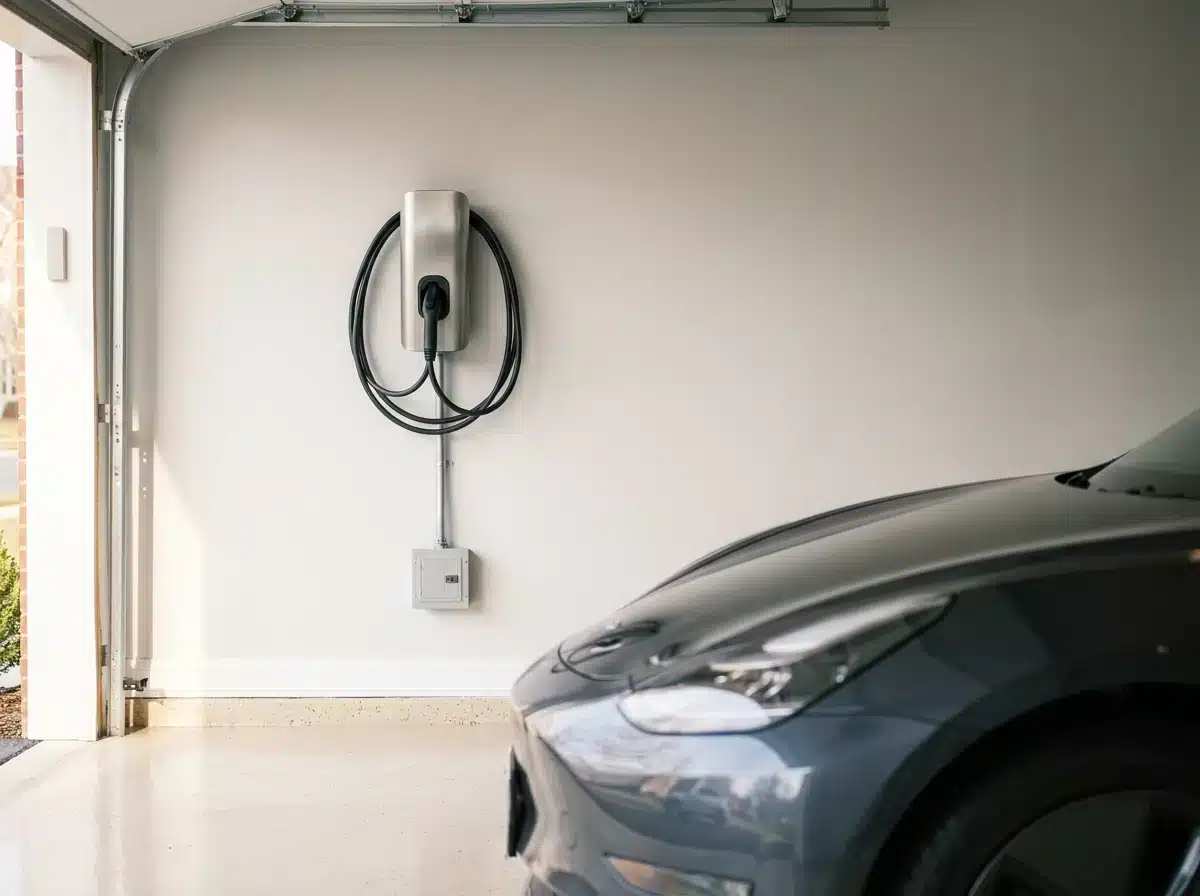
Not a charging station directory — we install EV chargers at your home or business
Looking for a public charging station? We install home and business EV chargers — Level 2 hardwired or NEMA 14-50, Tesla Wall Connector certified, with the permit and inspection handled. Ahmad pulls the electrical permit, runs the load calculation, installs the dedicated circuit, and schedules the inspection — one contractor, start to finish.
Call 571-500-6637 for a Free Load CheckWill Your Panel Handle an EV Charger?
This is the first question every Fairfax homeowner needs answered before buying a charger. A Level 2 home charger draws 40 to 50 amps continuously — your panel must have the capacity to support that load safely. We use the NEC 220.82 dwelling-unit load calculation to find out.
NEC 220.82 Load Calculation — How It Works
The load calculation starts with your panel’s total rated capacity — typically 100, 150, or 200 amps in Fairfax homes — then subtracts the demand from your existing circuits: HVAC, water heater, range, dryer, and general lighting loads. The remainder is your available capacity for an EV charger circuit.
Key math (NEC 625): A 48-amp EV charger requires a 60-amp breaker (48A × 1.25 continuous-load factor = 60A). The circuit needs #6 copper conductors per NEC 625 and Table 310.16. That 60-amp demand must fit within your panel’s available capacity after existing loads.
If the math works: We install a dedicated EV circuit — breaker, wire, and outlet or hardwired connection — without touching your panel.
If the math doesn’t work: Your panel needs a service upgrade before the charger goes in. Many 1960s–1970s Fairfax homes with original 100-amp panels fall into this category. We handle the panel upgrade and EV circuit together — one permit, one visit, one inspection.
We run this calculation on-site at your panel, for free, before you commit to anything. No guesswork — you see the numbers before we quote.
What Drives EV Charger Installation Cost
Every EV charger install in Fairfax is different. The cost depends on your home’s electrical setup, not just the charger itself. Here is what determines your price.
- Panel capacity & condition — A 200-amp panel with available slots keeps cost lower. A 100-amp panel that needs a service upgrade adds to the scope. An FPE Stab-Lok panel needs replacement regardless.
- Circuit length (panel to charger) — A charger on the same wall as the panel costs less than a 50-foot conduit run to a detached garage in Mantua. Longer runs mean more wire and conduit.
- Charger type — A NEMA 14-50 outlet (plug-in charger) is simpler than a hardwired Tesla Wall Connector or a 60-amp dedicated circuit. Hardwired installs require more labor and materials.
- Permit & inspection fees — The City of Fairfax and Fairfax County each charge separately for electrical permits. We pull the permit and schedule the inspection — the fee is part of the project cost.
- Existing wiring condition — Older homes may need conduit runs, junction box upgrades, or grounding corrections before the EV circuit can be added safely.
EV Charger Types — Which One Fits Your Setup
Not every EV owner needs the same charger. The right choice depends on your vehicle, driving habits, and electrical panel.
Level 1 — Standard 120V Outlet
Uses your existing 15A or 20A household outlet. Charges at roughly 4 miles of range per hour — over 40 hours for a full battery. Best for plug-in hybrids with small batteries (under 40 miles of range) or renters who cannot modify wiring. No installation needed, but very slow for a full EV.
Level 2 — NEMA 14-50 Outlet
A dedicated 50A/240V outlet on its own circuit. Charges at roughly 25 miles of range per hour — a full battery overnight. The charger plugs into the outlet, so you can swap or upgrade chargers later without rewiring. Lower install cost, and portable if you move. The most popular choice for Fairfax homeowners.
Level 2 — Hardwired
A dedicated 40A to 60A/240V circuit wired directly to the charger. Charges at 25 to 30 miles of range per hour. Required for some chargers, including the Tesla Wall Connector Gen 3. Permanent installation — cleaner look, no exposed outlet. Code-required in some jurisdictions for outdoor installs.
Common EV Charger Install Scenarios in Fairfax
Every home is different. Here are the installations we see most often across Fairfax neighborhoods, and what each one involves.
100A Panel + Level 2 Charger
Mantua, Old Town Fairfax, Kings Park (1960s–70s homes)
The load calc almost always shows insufficient capacity. We bundle a panel upgrade with the EV circuit — one permit, one inspection, one visit.
FPE Stab-Lok Panel + EV Charger
Mantua, Country Club Hills (1960s FPE-heavy neighborhoods)
FPE panels are a known fire hazard and most insurers flag them. We replace the panel (insurance plus capacity) and install the EV circuit in the same visit.
200A Panel, Attached Garage
Penderbrook, Greenbriar (1980s–90s colonials)
Load calc usually confirms capacity. Roughly 15 feet of conduit from panel to charger location. Dedicated 50A circuit — straightforward install, typically done in one visit.
200A Panel, Detached Garage
Mantua estates, Mosby Woods
Requires an underground or overhead conduit run from the main panel to the garage, plus a sub-panel in the garage. Longer circuit run means more materials and labor — the on-site estimate accounts for the exact distance.
Townhome / Shared Parking
Fair Oaks, Fair Lakes, Fairfax Corner (2000s+ communities)
200-amp panels with capacity, but parking may require exterior-rated conduit runs. HOA approval is usually needed — Fairfax County’s Charge Up Fairfax program can help with the HOA process.
Tesla Wall Connector (Gen 3, Hardwired)
Any Fairfax neighborhood
60A dedicated circuit, #6 copper conductors, hardwired per Tesla specifications. We are Tesla Wall Connector certified — the install meets Tesla’s warranty requirements.
NEMA 14-50 Outlet (Portable Charger)
Any Fairfax neighborhood
50A dedicated circuit with a NEMA 14-50 outlet. Your charger plugs in — portable, swappable, and easy to upgrade later. The most flexible option for homeowners who may change vehicles.
Multi-EV Household (2 Vehicles)
Newer Fair Lakes, McLean-adjacent estates
Two chargers on one panel requires careful load calculation for combined draw. May need a sub-panel or load-management device. We assess capacity for both circuits and, if needed, bundle a panel upgrade into the scope.
Fairfax Homes by Era — What Your Panel Means for EV Charging
The age of your Fairfax home tells us a lot about what the EV charger install will involve. Here is what we typically find.
1950s–1970s Split-Levels & Ranches
Old Town Fairfax, Mantua, Kings Park, Mosby Woods, Country Club HillsOriginal 100-amp panels that cannot support a 50A EV circuit without a service upgrade. Detached garages are common in Mantua, requiring longer circuit runs. FPE Stab-Lok panels appear frequently in this era — a double reason to upgrade (insurance concern plus insufficient capacity). These homes almost always need a panel upgrade before a Level 2 charger.
1970s–1990s Colonials & Traditionals
Penderbrook, Greenbriar, south Mantua200-amp service, but mid-1970s circuits may be heavily loaded. Usually can add a 40A or 50A EV circuit without a panel upgrade, but the NEC 220.82 load calc confirms whether the headroom is there. Attached garages mean shorter circuit runs — typically the most straightforward EV charger installs in Fairfax.
2000s–2020s Townhomes & Newer Detached
Fair Oaks, Fair Lakes, Fairfax Corner200-amp panels with available capacity, but townhome parking configurations may require exterior-rated conduit runs to reach the charging location. HOA approval is often required — the Charge Up Fairfax program provides a framework for HOA coordination on EV charger installations. These homes typically have the electrical capacity; the complexity is in the physical route.
EV Charger Permits & Electrical Code in Fairfax
Every Level 2 EV charger installation in Fairfax requires an electrical permit and inspection. The permitting authority depends on whether your home is in the City of Fairfax (independent city) or Fairfax County (unincorporated area) — determined by your property’s corporate limits and tax bill, not by ZIP code.
City of Fairfax (Independent City)
EVCS installations permit through the City of Fairfax Code Administration.
- Phone: 703-385-7830
- Email: CodeAdministration@fairfaxva.gov
- Online portal: Accela Citizen Access (aca-prod.accela.com/FAIRFAX) — file under Electrical / Trade Permit
The City reviews and inspects residential EVSE installations as standard electrical trade permits. We pull the permit, schedule the inspection, and handle the paperwork.
Fairfax County (Unincorporated Areas)
EVCS installations permit through Land Development Services (LDS).
- Phone: 703-222-0801
- Office: 12055 Government Center Pkwy, Fairfax, VA 22035
- Online portal: PLUS (plus.fairfaxcounty.gov) — file under ELER trade permit
Fairfax County has a dedicated EVCS Permits page with requirements specific to electric vehicle charging stations. We navigate the County process and ensure the install meets all LDS requirements.
Code references: Virginia follows the 2021 Uniform Statewide Building Code (USBC) incorporating the 2020 National Electrical Code. EV charger installations must comply with NEC 625 (Electric Vehicle Charging Equipment — dedicated circuit, conductor sizing, overcurrent protection) and NEC 220.82 (dwelling-unit load calculation). If the EV install triggers a panel upgrade, NEC 230.85 (outdoor emergency disconnect) and NEC 230.67 (whole-home surge protection) also apply. Ahmad pulls the permit so the inspection passes on the first visit.
EV Charger Incentives & Tax Credits — Current Status
Federal and utility incentives for home EV charger installations change frequently. Here is the current status as of July 2026.
Incentive Status for Fairfax Homeowners
Federal Form 8911 — Alternative Fuel Vehicle Refueling Property Credit
The federal Form 8911 credit (up to 30% of installation cost for residential EVSE) expired June 30, 2026. As of this writing, no federal EV charger tax credit is active for residential installations. If Congress reinstates or replaces the credit, we will update this page.
Dominion Energy — Residential EV Charger Program
Dominion Energy may offer programs related to residential EV charger installations. We have not independently verified current availability, eligibility, or terms. Verify directly at dominionenergy.com before relying on any incentive for your project budget.
EV Charger Installation in Fairfax — What You Need to Know
Most Fairfax homeowners have the same questions before scheduling an EV charger install. The load calculation and panel capacity are the biggest variables — everything else follows from those answers.
A Level 2 charger on a dedicated 240V circuit is the standard for home charging. It charges your vehicle overnight, every night, so you start each morning with a full battery. The installation itself typically takes half a day once the permit is in hand.
If the load calc shows your panel cannot handle a charger, a panel upgrade comes first. We handle both in the same project — one permit application, one inspection, one point of contact.
If your charger trips a breaker or throttles after installation, that is a diagnostic issue, not a charger defect. A dedicated EV breaker replaces an existing slot — see circuit breaker replacement if you are running out of panel space.
Fairfax EV Charger Q&A
Common questions from Fairfax homeowners about EV charger installation.
How long does an EV charger installation take?
Most installations take 3 to 5 hours once the permit is approved. If a panel upgrade is needed, add a half day. Permit turnaround varies — City of Fairfax is typically faster than County LDS.
Do I need a permit to install an EV charger in Fairfax?
Yes. Every Level 2 EV charger installation requires an electrical permit — from the City of Fairfax Code Administration or Fairfax County LDS, depending on your property’s jurisdiction. We pull the permit and schedule the inspection.
Can my 100-amp panel support an EV charger?
In most cases, no. A 48-amp Level 2 charger requires a 60-amp breaker (NEC continuous-load rule). On a 100-amp panel with existing loads, there is usually not enough headroom. The on-site load calc confirms — and if an upgrade is needed, we handle both together.
What is the difference between NEMA 14-50 and hardwired?
A NEMA 14-50 is a 240V outlet — your charger plugs in and can be unplugged. Hardwired means the charger is permanently connected to the circuit. Some chargers (like Tesla Wall Connector Gen 3) require hardwiring. NEMA 14-50 gives you more flexibility.
Will my HOA allow an EV charger?
Most Fairfax County HOAs are required to allow EV charger installations under Virginia law (SB 1266). The Charge Up Fairfax program helps navigate HOA processes. We handle the electrical side — you handle the HOA approval.
Can you install a charger in my detached garage?
Yes. It requires a conduit run (underground or overhead) from your main panel to the garage, plus a sub-panel in the garage. It costs more than an attached-garage install because of the additional wire and conduit, but it is a common setup in Mantua and Mosby Woods.
How an EV Charger Install Works
Every EV charger installation with EV Electric follows the same five-step process: 1. On-site load check (we inspect your panel and measure the circuit run) → 2. Written estimate (you see the full scope and cost before you approve) → 3. Permit (we pull the electrical permit from City of Fairfax or Fairfax County) → 4. Install (dedicated circuit, breaker, wiring, and charger connection in one visit) → 5. Inspection (we schedule and pass the county or city electrical inspection).
Start to finish, most EV charger installs are complete within a week of the initial load check. If a panel upgrade is needed, we bundle it into the same project so you are not coordinating two contractors. Learn more about how we work.
Your Local EV Charger Installer — Around the Corner from Fairfax Circle
EV Electric Services operates from 9488 Fairfax Blvd, right near Fairfax Circle. When you call for an EV charger install, Ahmad comes to your garage, inspects the panel, measures the circuit run, and gives you a written estimate on the spot. Same-day load checks are available for City of Fairfax and surrounding neighborhoods.
Drive Times from Our Shop
- City of Fairfax (downtown) ~5 min
- Mantua ~7 min
- Kings Park ~8 min
- Mosby Woods ~7 min
- Penderbrook ~10 min
- Fair Oaks / Fair Lakes ~12 min
- Greenbriar ~10 min
- Country Club Hills ~6 min
Local, not a franchise. EV Electric is not a national brand dispatching from a call center. Ahmad is a Virginia-licensed Master Electrician who lives and works in Fairfax. He is the person who inspects your panel, writes your estimate, pulls the permit, and installs your charger. One point of contact from load check to inspection.
Mr. Electric of Fairfax dispatches from Lorton — roughly 20 miles south. We are around the corner.
About EV Electric Services
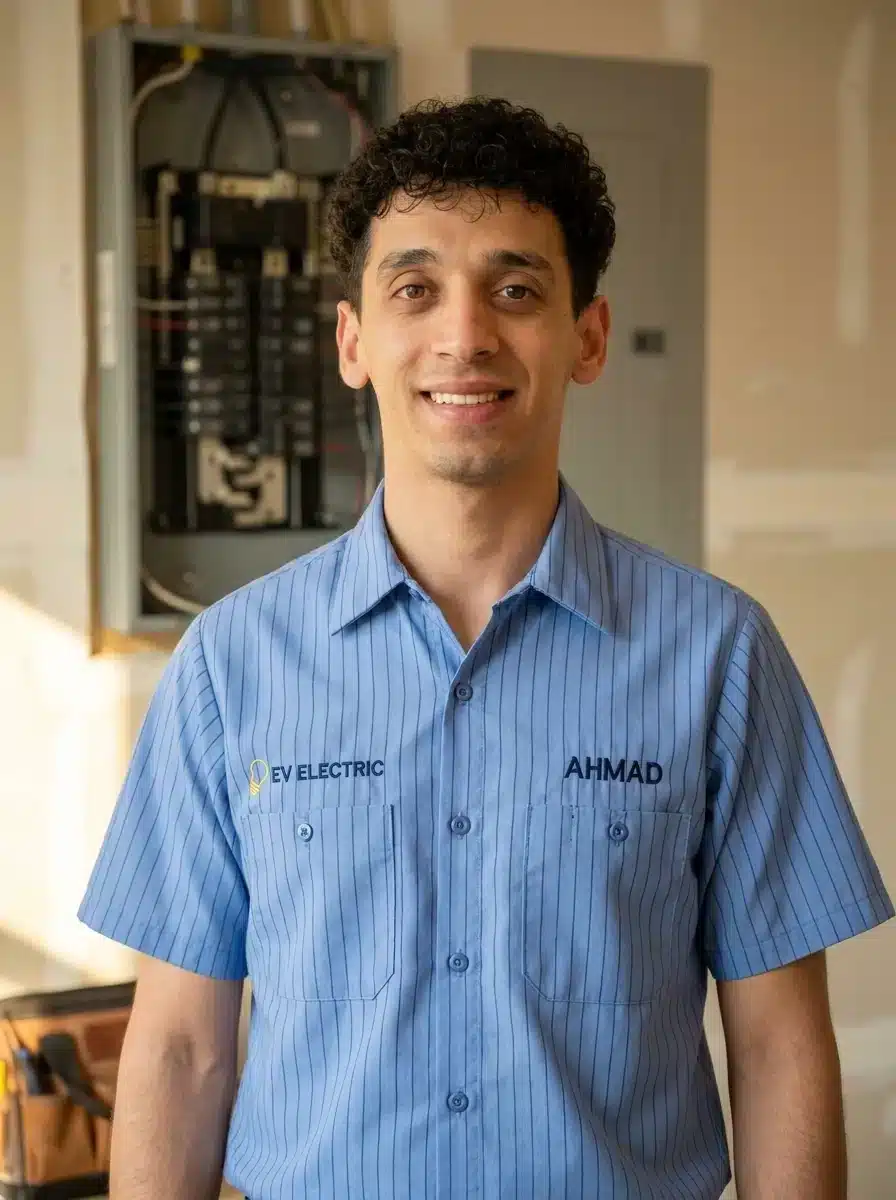
Ahmad Shaban — Master Electrician, Fairfax VA
EV Electric Services holds a 5.0-star average across 122 Google reviews. Ahmad is a Virginia-licensed Master Electrician who handles every EV charger installation personally — from the initial load check through the final inspection.
Every job is permitted, inspected, and done to the 2020 National Electrical Code. Ahmad pulls the electrical permit from the City of Fairfax Code Administration or Fairfax County LDS, installs the dedicated circuit per NEC 625, and schedules the inspection. No subcontractors, no handoffs.
EV Electric operates from 9488 Fairfax Blvd — near Fairfax Circle — and serves the City of Fairfax, Mantua, Kings Park, Penderbrook, Fair Oaks, Fair Lakes, and surrounding neighborhoods. Whether you need a NEMA 14-50 outlet, a hardwired Tesla Wall Connector, or a panel upgrade before the charger goes in, Ahmad handles it.
Fairfax Neighborhoods We Serve for EV Charger Installation
- Old Town Fairfax — 1950s–60s ranches and split-levels; most have 100A panels that need an upgrade before a Level 2 charger
- Mantua — 1960s split-levels with detached garages common; FPE Stab-Lok panels frequent; plan for a panel upgrade and longer circuit runs
- Kings Park — 1960s–70s colonials and split-levels; 100A panels typical; attached garages make the circuit run shorter once the panel is upgraded
- Country Club Hills — 1960s homes with original panels; FPE panels appear here; upgrade usually required for EV charging
- Mosby Woods — 1960s ranches; some detached garages require sub-panel and conduit runs; 100A panels standard
- Penderbrook — 1980s–90s townhomes and condos; 200A panels with capacity; HOA coordination may be needed
- Greenbriar — 1980s colonials and traditionals; 200A service with attached garages; straightforward EV charger installs in most homes
- Fair Oaks / Fair Lakes — 2000s+ townhomes and newer detached; 200A panels with capacity; exterior conduit runs for some parking configurations
- Fairfax Corner — Newer townhome communities; 200A panels; HOA approval per Charge Up Fairfax program recommended
- McLean-adjacent areas — Larger estate homes may need multi-EV capacity planning; load calc critical for combined 2-vehicle draw
We also serve Montgomery County, MD. Bethesda homeowners — see our Bethesda panel upgrade page or our Bethesda EV charger installation page.
Related Electrical Services
EV Charger Installation FAQ — Fairfax, VA
Answers to the most common questions Fairfax homeowners ask about EV charger installation.
How much does it cost to install an EV charger in Fairfax, VA?
The cost depends on your panel capacity, the length of the circuit run from panel to charger, the charger type (NEMA 14-50 outlet vs. hardwired), and whether a panel upgrade is needed. We provide a free on-site load check and written estimate so you see the full scope before you commit. Call 571-500-6637 to schedule.
Can I charge my EV for free anywhere in Fairfax?
Some public locations offer free or low-cost EV charging — check station finders like ChargeHub or PlugShare for current availability. For daily driving, home charging on a dedicated Level 2 circuit is the most convenient and cost-effective option. You charge overnight at home electricity rates rather than paying per-session at a public station.
What is the EV strategy in Fairfax County?
Fairfax County supports EV adoption through its Charge Up Fairfax program, which helps HOAs and multi-family communities plan EV charger installations. The County also has a dedicated EVCS Permits page through Land Development Services. For residential installations, we handle the permitting and code compliance so you benefit from the County’s EV-friendly framework without navigating it yourself.
Do I need a panel upgrade to install an EV charger?
It depends on your panel’s rated capacity and existing loads. Homes with 100-amp panels (common in 1960s–70s Fairfax neighborhoods) almost always need an upgrade. Homes with 200-amp panels usually have enough headroom, but the NEC 220.82 load calculation confirms. We run this check on-site before quoting.
Is there a federal tax credit for EV charger installation?
The federal Form 8911 credit (Alternative Fuel Vehicle Refueling Property Credit) expired June 30, 2026. As of July 2026, no federal residential EV charger tax credit is active. If Congress reinstates or replaces the credit, we will update this page. Dominion Energy may offer utility programs — verify current availability directly at dominionenergy.com.
How long does it take to install a home EV charger?
Most installations take 3 to 5 hours once the permit is approved. If a panel upgrade is needed, add a half day. The entire process — from initial load check to passed inspection — typically takes about a week, with most of that time being permit processing.
Can you install a Tesla Wall Connector in Fairfax?
Yes. We are Tesla Wall Connector certified. The Gen 3 Wall Connector requires a 60A hardwired circuit with #6 copper conductors. We install it per Tesla’s specifications so the charger warranty remains valid. The same permit and inspection process applies.
Are EV chargers at Walmart free?
Some Walmart locations have partnered with charging networks to offer EV charging, but availability and pricing vary by location and network. For reliable daily charging, a home Level 2 charger on a dedicated circuit gives you a full charge overnight without depending on public station availability or pricing changes.
Ready to Charge at Home?
Free on-site load check, written estimate, and a Master Electrician who handles the permit, install, and inspection — from 9488 Fairfax Blvd, around the corner from Fairfax Circle.
571-500-6637