
EV Charger Installation in McLean, VA
Home EV Charger Installation in McLean — Level 2 Circuit, Load Assessment, Permitted
We install the circuit. We don’t run a charging network. Ahmad Shaban — Virginia Master Electrician — handles the electrical side: load assessment, permitting through Fairfax County, and installation.
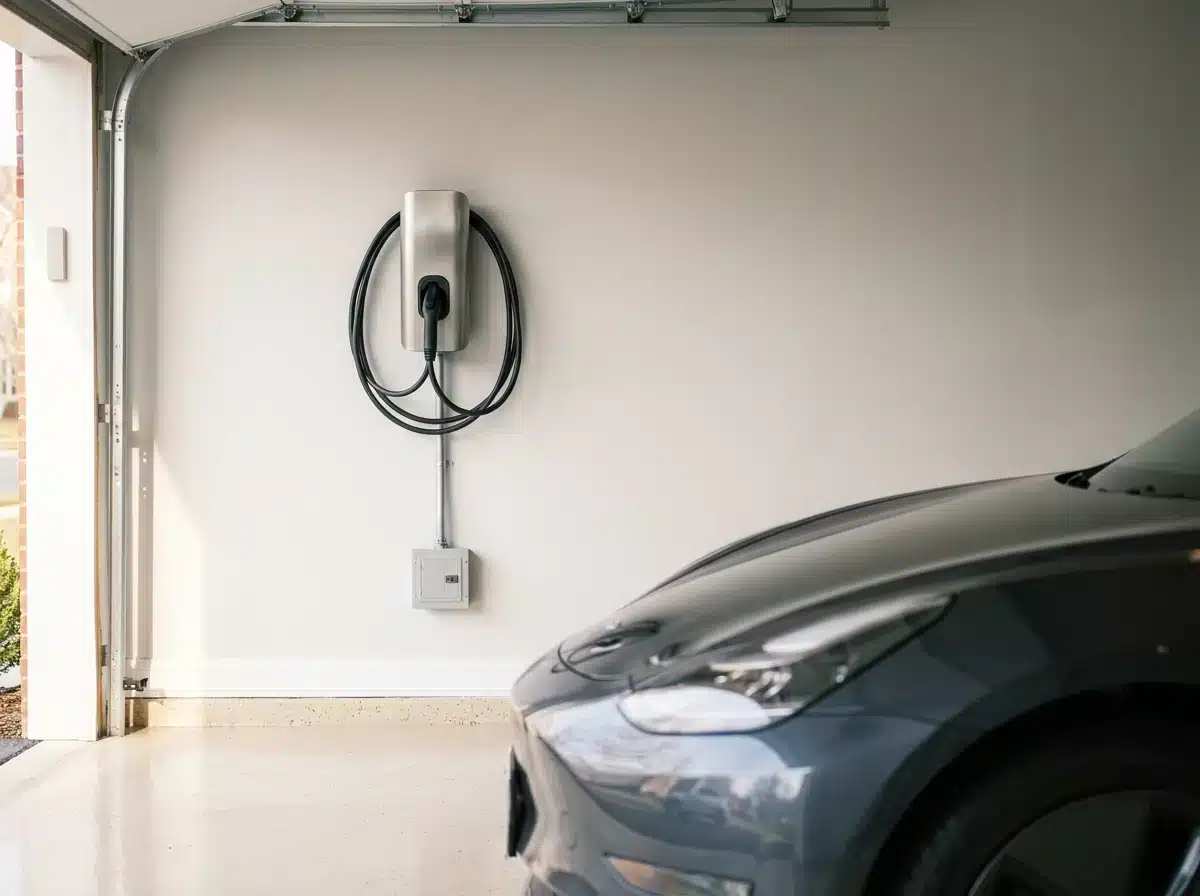
Looking to install a home or business EV charger in McLean?
We handle the electrical circuit — permitting through Fairfax County LDS, on-site load assessment, and installation. If you are searching for a public charging station, try ChargeHub or PlugShare.
What drives the cost of a home EV charger installation
A home Level 2 EV charger requires a dedicated 240V circuit — typically 40A or 50A, depending on the charger’s rated draw. The circuit runs from the electrical panel to the charger location (garage, carport, or exterior wall).
If your panel is near capacity, a load calculation per NEC 220.82 determines whether the existing panel can support the new circuit or whether a sub-panel or full panel upgrade is needed first. Estate-era McLean homes on 100A service almost always require a panel upgrade before adding an EV circuit.
We provide a written estimate after an on-site assessment — not a blind quote over the phone. The assessment identifies the panel condition, available capacity, circuit run distance, and any code-required additions before pricing.
EV charger types — what homeowners need to know
There are three levels of EV charging. Only Level 2 requires an electrician for residential installation.
Level 1 (120V)
~4 miles of range per hourUses your existing standard 120V household outlet. No installation needed — the charging cable that came with your vehicle plugs in directly. Sufficient for plug-in hybrids or very low daily mileage. Not practical as a primary charger for a full battery-electric vehicle.
Level 2 (240V)
~20–30 miles of range per hourThe primary residential EV charging solution. Requires a dedicated 240V circuit (40A or 50A) from your electrical panel. This is the installation we perform — the circuit, the load assessment, the Fairfax County permit, and the EVSE mounting. A full charge overnight is typical for most battery-electric vehicles.
DC Fast Charging (DCFC)
Commercial — not residentialDC fast chargers require 480V three-phase power and commercial-grade electrical infrastructure. These are the chargers at public stations (Electrify America, Tesla Supercharger). Not applicable to residential installation — included here only to clarify the distinction.
McLean housing and EV charger readiness — by era
Your home’s construction era determines what an EV charger installation involves. Three distinct McLean housing profiles create three different starting points.
1950s–1970s estate-era homes
Langley, Salona, McLean HamletOriginal 100A panels sized for mid-century loads. A Level 2 EV charger draws 40–50A continuously — on a 100A service already supporting HVAC, pool pump, and kitchen appliances, the panel has no headroom. A panel upgrade to 200A is typically required before the EV circuit can be added.
1980s–2000s colonials
Franklin Park, Chesterbrook200A service was standard by this era, but available capacity depends on existing load. A home with central AC, electric dryer, electric range, and a finished basement on the same panel may have less headroom than expected. A load calculation (NEC 220.82) confirms whether the EV circuit fits or a sub-panel is needed.
2000s+ luxury builds
McLean proper, Lewinsville areaModern 200A or 400A service — usually sufficient headroom for a Level 2 EV charger circuit. The load calculation still confirms it, because some luxury builds run multiple HVAC zones, heated floors, and pool equipment that consume more capacity than the panel size suggests. Installation is often straightforward once the load calc clears.
| Diagnostic question | What it tells you | Likely next step |
|---|---|---|
| What amperage is your panel? | 100A panels rarely have headroom for a 40–50A EV circuit | If 100A: panel upgrade likely required first |
| How many open breaker slots? | A dedicated EV circuit needs its own double-pole breaker | If no open slots: sub-panel or panel upgrade |
| Where is the panel relative to the charger location? | Longer circuit runs increase wire gauge and cost | On-site measurement determines wire run and conduit |
| Is there existing 240V in the garage? | An existing 240V outlet (dryer, welder) may or may not be on a suitable circuit | Verify circuit amperage and wire gauge — repurposing is sometimes possible |
| Do you have a detached or attached garage? | Detached garages may require a sub-panel or longer conduit run | Detached: sub-panel + dedicated feeder from main panel |
| Is your home on 100A with a pool pump or multiple HVAC zones? | Combined existing load plus EV exceeds 100A service capacity | Load calc (NEC 220.82) → panel upgrade before EV circuit |
Permits and code for EV charger installation in McLean
McLean is unincorporated Fairfax County — not a city and not a town. All permits go through one authority.
Fairfax County Land Development Services (LDS)
The single permit authority for all McLean residential electrical work, including EV charger circuits.
- Permit type: ELER trade permit (electrical) — filed via the PLUS portal (plus.fairfaxcounty.gov)
- NEC 625 — governs EVSE (Electric Vehicle Supply Equipment) installation requirements
- NEC 220.82 — governs the load calculation that determines whether the existing panel can support the new circuit
- Virginia 2021 USBC incorporating the 2020 NEC — the code in effect across Fairfax County
- Ahmad Shaban holds a Master Electrician license issued by the Commonwealth of Virginia
EV pulls the permit for you. We file the ELER permit through the PLUS portal, schedule the County inspection, and coordinate with Dominion Energy if a service upgrade is part of the scope. You do not navigate the permitting system yourself.
McLean ZIPs 22101, 22102, and 22106 are geographic references only — they do not determine your permit authority. All McLean parcels permit through Fairfax County LDS.
EV charger incentives and tax credits — current status
Incentive programs change frequently. Here is the verified status as of this writing — we update this section when programs change, but always confirm independently before making financial decisions.
Federal tax credit (Form 8911) — EXPIRED June 30, 2026. The Alternative Fuel Vehicle Refueling Property Credit (IRC 30C / Form 8911) expired on June 30, 2026. It is no longer available for new installations. Any source still advertising this credit is out of date. Confirm current federal incentive status at IRS.gov Form 8911.
Dominion Energy EV charger program — UNVERIFIED. Dominion Energy has offered EV-related programs in the past. We have not independently verified the current program status, eligibility criteria, or dollar amounts. Check directly with Dominion Energy for the latest program details before relying on any incentive in your decision.
Virginia state incentives — verify independently. Virginia state incentive programs for EV charging equipment change with legislative sessions. We do not cite specific dollar amounts or programs we have not independently confirmed. Check the DOE Alternative Fuels Data Center for current Virginia programs.
We install the electrical circuit regardless of incentive status. If a program is active and you qualify, we provide the documentation you need for your claim — but we do not promise incentive amounts we have not verified.
Our process — site assessment to operational charger
You call → we schedule an on-site visit at your McLean home → Ahmad inspects the panel, measures the load (NEC 220.82), and assesses the circuit run → you receive a written estimate → you approve → we pull the Fairfax County ELER permit → circuit installation and EVSE mounting → charger test and commissioning → Dominion coordination if a service upgrade was part of the scope → County inspection.
Written estimate before any work starts — no surprises. The on-site assessment trip is free.
For the full process breakdown, see our EV charger installation services page.
Frequently asked questions — EV charger installation in McLean
What kind of EV charger can I install at home in McLean?
A Level 2 charger is the standard residential installation. It operates on a dedicated 240V circuit (typically 40A or 50A) and delivers approximately 20–30 miles of range per hour of charging. Level 1 (120V) uses an existing household outlet and requires no installation but is too slow for most battery-electric vehicles. DC fast chargers require commercial-grade 480V power and are not suitable for residential properties.
Do I need a permit for a home EV charger in Fairfax County?
Yes. McLean is unincorporated Fairfax County, and all new electrical circuits — including EV charger circuits — require an ELER trade permit through Fairfax County Land Development Services. EV Electric pulls the permit through the PLUS portal and coordinates the County inspection. You do not navigate the permit system yourself.
What is the difference between Level 1 and Level 2 charging?
Level 1 uses a standard 120V outlet and adds approximately 4 miles of range per hour — adequate for plug-in hybrids with small batteries but impractical for battery-electric vehicles. Level 2 uses a dedicated 240V circuit and delivers approximately 20–30 miles of range per hour, fully charging most EVs overnight. Level 2 requires a licensed electrician to install the dedicated circuit.
How much does EV charging cost in Virginia?
Home EV charging cost depends on your electricity rate. Dominion Energy residential rates in Northern Virginia are typically structured with tiered pricing. Charging at home overnight is significantly cheaper than DC fast charging at public stations. For a rough estimate: charging a 60 kWh battery from empty on a Level 2 charger at Dominion’s residential rate costs a fraction of what a comparable gasoline fill-up would. Your actual cost depends on your rate schedule, time-of-use plan (if available), and vehicle efficiency.
What if my panel doesn’t have room for an EV charger circuit?
If your panel is full or near capacity, a load calculation per NEC 220.82 determines the next step. Options include: adding a sub-panel to create additional circuit capacity, upgrading from 100A to 200A service (common in McLean’s 1950s–70s estate homes), or in some cases, circuit consolidation to free breaker slots. Ahmad assesses this on-site and includes the recommendation in the written estimate. See panel upgrade details for McLean.
Is the federal EV charger tax credit still available?
No. The federal Alternative Fuel Vehicle Refueling Property Credit (IRC 30C / Form 8911) expired on June 30, 2026. It is no longer available for new EV charger installations. Any website or contractor still advertising this credit is out of date. Check IRS.gov for current status. Virginia state and Dominion Energy programs may exist but should be verified independently before relying on them.
Is Costco EV charger free?
Some Costco locations have public EV chargers in their parking lots — those are part of a public charging network (typically ChargePoint or Electrify America), not a Costco-operated service. Whether they are free depends on the network and membership. This is unrelated to home charger installation. If you are looking to install a charger at your McLean home so you can charge overnight on your own electricity, that is what EV Electric does — we install the dedicated 240V circuit, not a public station.
Do I need a panel upgrade before installing a Level 2 charger?
It depends on your panel’s existing capacity and load. A Level 2 EV charger draws 40–50A continuously. On a 100A panel already supporting central AC, a pool pump, and kitchen appliances, there is likely no headroom — a panel upgrade to 200A is required first. On a 200A panel, a load calculation (NEC 220.82) confirms whether the circuit fits. Ahmad performs this assessment on-site and includes the finding in the written estimate.
Your electrician: Ahmad Shaban
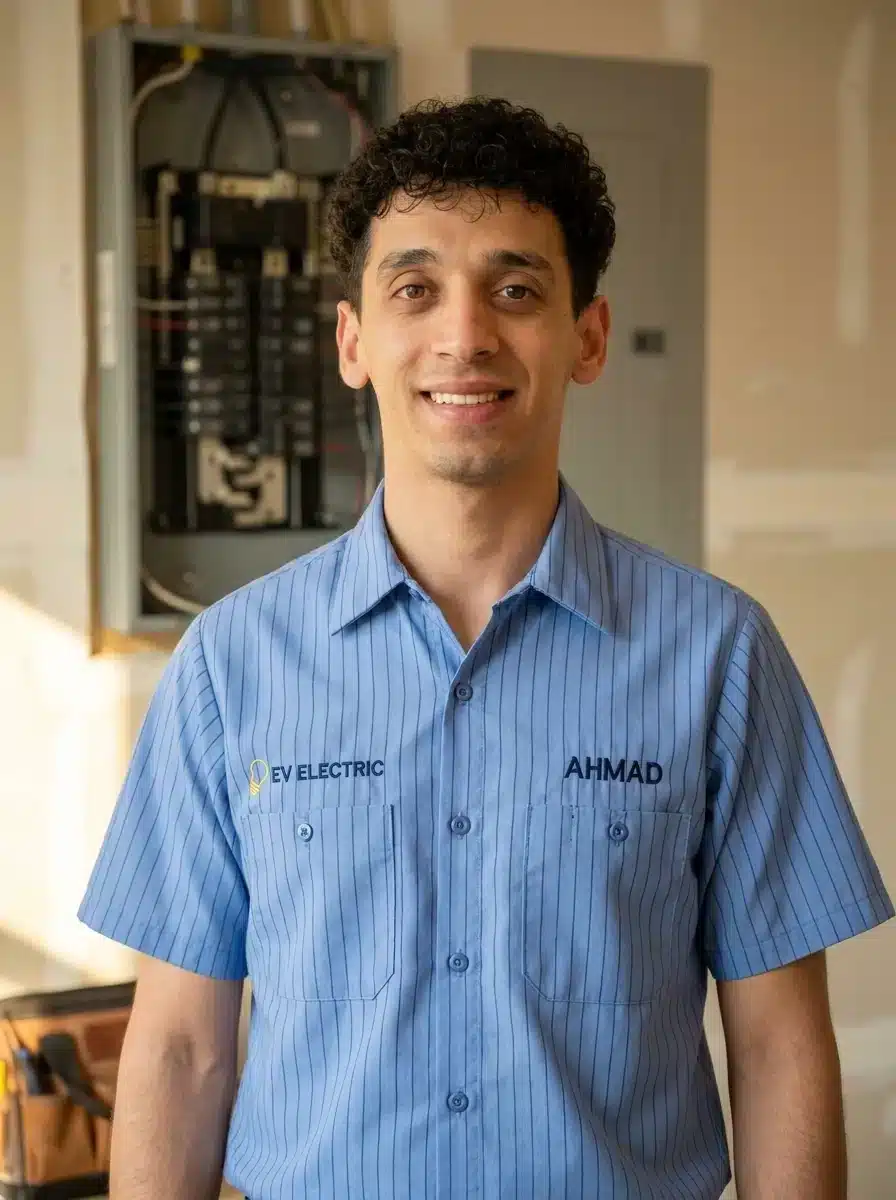
Ahmad Shaban holds a Master Electrician license issued by the Commonwealth of Virginia — the state’s highest electrician credential. He personally handles McLean EV charger assessments: inspecting the panel, running the load calculation, determining the circuit route, and overseeing the installation. Fully insured, with a maintenance team so your timeline does not depend on one person’s calendar.
EV Electric Services holds a 5.0-star average across 122 Google reviews. Residential-only — we do not split focus between commercial and residential work.
McLean neighborhoods we serve for EV charger installation
McLean is unincorporated Fairfax County — all neighborhoods permit through Fairfax County LDS. We install EV charger circuits throughout McLean, including:
- McLean proper — mixed eras near the Dolley Madison corridor; modern builds usually have panel headroom
- Langley — 1950s–70s estate homes; 100A panels common; panel upgrade often required before EV circuit
- Pimmit Hills — established 1950s–60s neighborhood near the Tysons border
- Lewinsville — 2000s+ luxury builds; typically adequate capacity for Level 2
- Chain Bridge area — mixed housing near the Potomac; era-dependent panel status
- Chesterbrook — era-mixed housing; load calc determines scope
- El Nido — 1970s–90s colonials; usually 200A but load calc confirms
- Salona — estate-era homes similar to Langley; 100A panels and FPE/Zinsco common
ZIPs 22101, 22102, and 22106 are geographic references — not jurisdiction determinants. We also serve Vienna, Fairfax, and the rest of Fairfax County.
Local to McLean — site assessment before quoting
Our shop is at 9488 Fairfax Blvd, near Fairfax Circle. McLean is approximately 12 minutes north via Route 123 (Chain Bridge Road). We assess the panel, measure the load, and inspect the circuit route on-site before providing a written estimate — no blind quotes over the phone.
Drive time from our shop
- McLean proper ~12 min
- Langley ~12 min
- Salona ~12 min
- Chesterbrook ~14 min
- Pimmit Hills ~15 min
Local, not a franchise dispatched from 25 miles away. Mr. Electric of Fairfax dispatches from Lorton — roughly 25 miles south of McLean. Ahmad’s shop is on the Route 123 corridor that runs straight through McLean. When you call for an EV charger site assessment, we can usually be on-site the same day.
On-site assessment + written estimate — we drive to McLean, inspect the panel, run the load calculation, assess the circuit route, and provide a written estimate before any work begins. The assessment trip is free.
Related electrical services in McLean
An EV charger installation often involves related electrical work. These are the services McLean homeowners commonly pair with or discover during the assessment:
Schedule a site assessment for your McLean EV charger installation
On-site load assessment, code-complete circuit installation, written estimate before any work starts. Serving McLean proper, Langley, Pimmit Hills, Lewinsville, Chain Bridge, Chesterbrook, El Nido, Salona, and all McLean neighborhoods.
571-500-6637