
Panel & Service Upgrades · Northern Virginia & Maryland
Electrical Panel Upgrades — More Capacity, Safer Wiring, One Visit
If your panel can’t keep up with modern loads — EV chargers, heat pumps, kitchen renovations — Ahmad sizes the upgrade, pulls the permit, and does the work. Written estimate before anything starts.

Key Takeaways
- Licensed: Master Electrician, Commonwealth of Virginia #2710086216
- Insured: $1 million per-occurrence, $2 million aggregate general liability
- Same-amperage panel replacement: $5,000–$7,500 — service upgrades quoted per job
- No trip fee, free estimates — itemised written estimate before work starts
- Fairfax County permit pulled and inspection scheduled on every panel job
Replacement or upgrade? Start here.
Almost every cost figure you will find for this work is unreliable for the same reason: it quotes two different jobs as though they were one. Swapping a panel while the service size stays where it is costs one thing. Raising the size of the service coming into the house costs another, and the difference is not a trim level. It is a different scope of work involving your power company. Before anything else, work out which of these two you are actually asking about.
Panel replacement, amperage unchanged
The old panel comes out, a new one goes in, and the service stays the size it already is. A 200-amp service stays a 200-amp service. This is the job when the enclosure is obsolete, rusted, full, or a make an inspector has flagged, but the capacity feeding the house is adequate.
- New enclosure, new bus, new breakers sized to the circuits that are actually there
- Every existing circuit re-landed and labeled
- Grounding and bonding brought up to current code
- Fairfax County permit and inspection
- Nothing changes outside: same meter base, same service cable, same size main
That is the range for a straight replacement where the amperage stays as it is. It is one number for one defined job, which is why we can print it.
Service upgrade, 150 to 200 or 200 to 400
Here the size of the service itself goes up, so the work reaches past the panel and out to the street. That is a genuine electrical service upgrade, and it is the job people usually mean when they search for a 100 amp to 200 amp change or a 200 amp panel upgrade.
- Coordination with the power company for the disconnect, the reconnect and the new service size
- Service entrance cable, usually replaced because the existing one is sized for the old service
- Meter base, commonly replaced at the same time
- Grounding electrode system, often needing to be brought up to the current requirement
- Mast and weatherhead work where the service comes in overhead, which depends entirely on what is up there
Here is how to tell which one is in front of you. Find the main breaker at the top of the panel and read the number stamped on its handle, or read the label inside the door. That number is the size of your service. If it already says 200 and the trouble is a panel that is full, corroded, discontinued or written up on an inspection report, you are looking at a replacement, and the range above applies. If it says 100 or 150 and you are adding load the house was never built for, you are looking at an upgrade, and the honest answer on price is that it depends on what the power company requires at your address and what condition the service equipment is in.
Load is the deciding question far more often than age. A 1970s panel running a gas furnace, a gas range and one air conditioner may be sitting at half its capacity and have years left in it. The same panel in a house that has since gained a heat pump, an induction range, a finished basement and a car charger is a different situation, and adding a charger in particular is a capacity calculation before it is anything else. If that is what brought you here, our EV charger installation page covers how the load calculation is done and when the panel actually has to change.
One more distinction worth having early. Replacing a panel does not rewire the house. The wiring in your walls stays exactly as it is; a panel job changes where those wires terminate and what protects them, not the wires themselves. A house that needs rewiring needs rewiring whether or not the panel is new, and that is a separate conversation with a separate price.
Estimates are free. If the problem needs diagnosing first, we tell you what that costs before we begin.
Cities we serve
Each town below has its own page with local details and service-area specifics.
Vienna, VA
10 minutes from our Fairfax Blvd shop — same-day assessments available.
Fairfax, VA
Our home base in the City of Fairfax.
McLean, VA
McLean homes often need the upgrade to support renovation loads.
Oakton, VA
Oakton’s 1970s–1990s housing stock is a sweet spot for 100→200A upgrades.
Tysons, VA
Tysons townhomes and condos — we work with HOA and building management.
Rockville, MD
Montgomery County coverage for panel upgrades.
Annandale, VA
Split-levels and ramblers from the 1950s and 60s, where the original service is often still in place.
Bethesda, MD
Montgomery County permitting, and older homes carrying modern loads.
Falls Church, VA
The City of Falls Church issues its own permits, which we handle.
Gaithersburg, MD
Upper Montgomery County, including service upgrades ahead of a car charger.
Federal Pacific and Zinsco panels — why an inspector flags them
If a home inspector has written “Federal Pacific Stab-Lok” or “Zinsco” on your report, that is not a note about age or appearance. Both makes have a measured problem with the breakers themselves: they can fail to do the one job they exist to do.
A circuit breaker is a safety device. When a circuit draws more current than the wire behind the wall can carry, the breaker is supposed to open and cut the power before the wire heats up. What the defect actually is: the breaker can fail to open when the circuit is overloaded. CPSC testing in the early 1980s ran 122 Stab-Lok breakers at 135 percent of their rated current and recorded two-pole failure-to-trip rates between 25 and 51 percent. A later field sample, published by Dr Jess Aronstein in 2004, tested units pulled from 17 occupied homes and found 14 percent of 215 single-pole breakers and 48 percent of 31 two-pole breakers failing the same test. The CPSC closed its investigation in 1983 without a recall, saying it was “unable at this time to link these failures to the development of a hazardous situation”, and citing the cost of continuing. So: measured failure rates, no federal recall, and a defect that is internal and gives no warning. Zinsco panels carry a related failure, plus a second one: the breakers connect to an aluminum bus bar that corrodes and can weld the breaker to the bus, so it cannot trip and, in some cases, cannot be switched off by hand either.
The honest position is this. A great many of these panels have run for decades without incident, and nobody can tell you that yours will fail tomorrow. What nobody can tell you either is that yours will trip when it needs to, because the failure is internal and there is no test you can run on a live panel in your house that proves the breakers are sound. That is why inspectors flag them and why insurers increasingly ask. Replacing the panel is the only fix that resolves it — we do not consider individual replacement breakers for these makes a remedy we would stand behind, and a panel that old is usually undersized for a modern house anyway.
Burning smell, scorch marks or a breaker that will not reset
Discolored plastic around a breaker, a smell of hot bakelite, or a breaker that trips and refuses to stay in means something is arcing or overheating inside the enclosure right now. Switch off the affected circuit if you can do so safely, stop using it, and get someone out the same day. This is what an emergency electrician in Fairfax VA is for.
An FPE or Zinsco panel with no symptoms at all
Most flagged panels look and behave perfectly normally, because the defect only shows itself at the moment of an overload. Nothing here needs a van tonight, but it does need a plan rather than a shrug — particularly if you are selling, refinancing, renewing insurance, or adding load such as a car charger or a heat pump.
You are not sure what make you have
The brand is usually printed on the inside of the door or on the label behind it. Photograph the label and the breaker faces and we can tell you what you are looking at before anyone comes out. Plenty of panels people worry about turn out to be perfectly ordinary and need nothing done.
Fuse boxes and pre-1960s service equipment
A fuse box does the same job as a breaker panel by a cruder method. Each circuit runs through a fuse holding a thin metal strip; draw too much current and the strip melts, breaking the circuit. It works. The weakness is that a fuse is consumable and a breaker is not, so when a fuse blows at an inconvenient hour somebody eventually screws in a larger one to make the problem go away. A thirty-amp fuse fitted to a circuit wired for fifteen removes the protection entirely and leaves no visible sign that anything is wrong.
That is why a call that begins as a fuse box replacement usually becomes a wider conversation. The fuse holders themselves are rarely the expensive part of the job. What matters is what sits behind them: the size of the service coming in from the street, the condition of the meter base and service entrance cable, whether there is a proper grounding electrode, and how many circuits the house actually needs now compared with when the equipment was installed. A house built with six or eight circuits for lighting, a cooker and a couple of sockets is now being asked to run a kitchen full of appliances, a laundry, air conditioning, home office equipment and possibly a car charger.
So the real job is almost always a service upgrade rather than a like-for-like swap — commonly moving a hundred-amp service up to two hundred amps, with a new panel, new grounding and bonding, and the existing circuits transferred across and labeled properly. Fairfax County requires a permit and an inspection for this work, and the power company has to be scheduled to disconnect and reconnect the service. None of that is difficult, but it is worth knowing at the start that it is a planned day of work with a short power outage in it, not a ten-minute repair.
When the breaker keeps tripping, is it the panel?
Usually, no. When a breaker keeps tripping the panel is the least likely culprit on the list, and replacing it is an expensive way to find that out. A breaker that trips is a breaker that is working. It has interrupted a circuit because something on that circuit asked for more current than the wire behind the wall is rated to carry, or because the breaker itself can no longer tell the difference. The job is to establish which, and the panel only enters the picture at the end of that process, not the start.
Too much on one circuit
The commonest cause by a distance, and the least dramatic. A space heater and a vacuum on the same 15-amp bedroom circuit will trip it most times you run both, and no fault exists anywhere. The test is simple: note what was running at the moment it went, unplug one of them, and see whether the circuit holds. If it does, the answer is load distribution, not equipment.
A damaged cable or a shared neutral
A staple driven through a cable during a past renovation, a nail from a picture hook, a rodent in a crawlspace, or two circuits sharing a neutral. If both hot legs land on the same bus leg, the shared neutral carries the sum of the two currents instead of the difference, and it can overheat without any ordinary breaker tripping — the silence is what makes it dangerous rather than merely annoying. Where an AFCI or GFCI breaker is fitted, a mis-shared neutral usually trips that instead without any appliance being at fault. These trip at odd times and often with nothing obvious running, which is the pattern that tells you to stop guessing. Tracing it is electrical troubleshooting work.
Trips with nothing plugged in means a fault in the fixed wiringAn appliance on its way out
Motors draw more current as their bearings wear and their windings degrade. A well pump, a compressor, a dryer or a garbage disposal can pull well past its normal draw for a second or two on start-up long before it fails outright. If one appliance is always running when the breaker goes, and the circuit holds fine without it, the appliance is telling you something.
A weakened breaker
Breakers are mechanical and they age. One that has tripped hundreds of times, or has sat for decades in a damp basement, can start opening below its rated current. The giveaway is a circuit whose load has not changed in years suddenly becoming unreliable. That is a circuit breaker replacement, a small job, and not a reason to touch the rest of the panel.
Now the panel
The panel becomes the answer when several circuits misbehave at once, when the enclosure is warm or humming, when there is no space left to separate an overloaded circuit onto its own breaker, or when the make is one nobody can source a sound breaker for any more. That last case is the one where a small repair stops being possible and a replacement becomes the sensible course.
Heat, buzzing or scorching is a live fault, not a maintenance itemThe one response to avoid, always, is a bigger breaker. Fitting a 20-amp breaker to stop a 15-amp circuit tripping does not give the circuit more capacity. It raises the point at which the wire in the wall is disconnected from the supply, and that wire did not get any thicker. The breaker protects the cable, not the appliance, and over-fusing removes that protection while leaving everything looking perfectly normal from the front.
We check the panel before quoting the panel
Not every warm breaker means a new service. A thermal scan of the panel under load shows which connections are running hot, and whether the problem is the panel itself or one circuit inside it.
Sometimes that means a torque correction and a tightened lug rather than an upgrade. When it does mean an upgrade, you have seen the reason on the screen first — not just been told.
Does a 200-amp service add value?
It helps, and we are not going to pretend anyone can put a figure on it. No electrician can promise you a dollar-for-dollar return on this work, and treat any who does with suspicion. What we can describe is where it actually shows up, because the effect is real but it is mostly defensive rather than additive.
At resale, it removes an objection rather than creating a premium. A 100-amp service in a house otherwise presented as move-in ready is a line item a buyer’s agent will use, and the number that gets negotiated off the price is rarely the true cost of the work. It tends to be whatever the buyer fears the work might cost. A finished, permitted, inspected 200-amp service takes that whole conversation off the table before it starts.
At the buyer’s inspection, it is one of the first things written up. Home inspectors photograph the panel on every job. An obsolete make, a full panel with double-tapped breakers, or a service that plainly cannot support what the listing advertises will appear in the report, and once it is in writing it has to be answered. Answering it under a contract deadline is the most expensive moment to do this work, because the timeline is somebody else’s.
Insurance and refinancing are where it turns into a hard stop. Carriers increasingly ask what make and what size the service is before they will write or renew a policy on an older house, and some will decline outright over the answer. Lenders order an appraisal, and an appraiser noting deficient or obsolete service equipment can put a condition on the file that has to be cleared before closing. In both cases the panel stops being a preference and becomes a gate.
On appraisal, be realistic. An appraiser will not usually add a line for a modern panel the way they add one for a bathroom. Where it matters is in the condition rating and in the absence of an adjustment against you. That is a quieter benefit than a renovation, but it is the honest description of what the work does.
The clearest case is the practical one. If you intend to add a heat pump, an induction range, a car charger, a hot tub or a finished basement, the capacity has to exist first, and doing that work once as a planned electrical panel upgrade costs less than doing it in pieces under pressure.
What panel customers say
We would rather show you a review with its Google service tags intact than one edited to look like it fits the page. Katherine’s tagged work with us was wiring, fixtures and outlets rather than a panel job, and her tags below say exactly that. What her review speaks to is how the work is run, which is the part that carries over to a day with the power off and a county inspector due.
Consistently excellent results, unmatched professionalism and attention to detail, clear communication, competitive rates. EV-Electric Services is in its own league.
How a panel day runs
The look at the job. Ahmad reads the main breaker and the label, opens the cover, and checks what is actually in the panel against what the house is being asked to run. He looks at the meter base, the service cable and the grounding, because on this kind of work those decide the scope more often than the panel does. You get a written estimate itemized by panel, breakers, labor and permit fee, and you get it with no obligation. No trip fee, free estimates. If what you have is a fault to be traced rather than equipment to be replaced, that is diagnostic work, and the cost of it is agreed with you before any of it starts.
The permit. Service work in Fairfax County requires a permit and an inspection. We pull it in our name as the licensed contractor and we meet the inspector at the property. You are not filing anything, and you are not waiting at home for an inspector nobody has briefed.
The utility disconnect. The panel cannot be worked on live, and the conductors feeding it belong to the power company up to the meter. So the disconnect and reconnect are scheduled with them, and that scheduling, rather than the electrical work, is usually what sets the date. On an upgrade it is also where the power company tells us whether anything on their side has to change.
The outage. Plan for a day with the power off in it. A straight replacement is typically most of one working day, with the supply down for the middle of it. Move anything in the freezer that matters, charge what you need charged, and expect to be without heating, cooling and internet while the panel is out. Homes on a well have no water during the outage, which catches people out more than anything else on this list.
The sign-off. The circuits go back with proper labels, not pencil marks from 1978. The inspector signs the work off and the permit closes, which is the piece of paper that matters later when you sell, refinance or renew insurance.
Panel upgrade questions we get asked
How much does it cost to upgrade a house electrical panel?
It depends on whether the amperage changes. If it does not, meaning the panel is replaced and the service stays the size it already is, our range is $5,000 to $7,500 in 2026. If the service size itself goes up, from 150 to 200 or from 200 to 400, that is a different job. It brings in the power company, usually the service entrance cable and meter base, and often the grounding electrode, so we quote it per job rather than publish a band we would have to caveat into meaninglessness.
How much should a 200amp panel upgrade cost?
Read the question carefully first, because two jobs hide inside it. Replacing an existing 200-amp panel with a new 200-amp panel is $5,000 to $7,500 in 2026. Going up to 200 amps from a smaller service is not the same work and we quote it per job. Where you see a single figure covering both, that is usually why competing pages disagree with each other, and sometimes why one site carries several different ranges on different pages.
How much does it cost to upgrade your electrical panel from 100 to 200?
That one is a genuine service upgrade, so we quote it per job and we do not publish a range for it. The reason is that the cost sits in things nobody can see from the driveway: what the power company requires at your address, whether the service entrance cable and meter base have to be replaced, what the grounding electrode system needs, and whether there is mast and weatherhead work on an overhead service. We look at all of that before quoting, and the estimate is free.
Can you upgrade an electrical panel without rewiring the house?
Yes, and that is the normal case. The panel is where the circuits terminate; it is not the circuits. Replacing it means every existing cable is re-landed on a new bus with correctly sized breakers, and the wiring in your walls is untouched. Two things can change that. If a cable is damaged where it enters the panel it gets repaired or extended, and if the house has old wiring with no ground, some circuits may need different protection. Neither of those is a rewire.
Is it worth it to upgrade an electrical panel?
It is worth it when there is a reason, and it is not worth it as a precaution against age alone. Good reasons: the panel is full and you need capacity, the make is one insurers and inspectors flag, there is heat or buzzing at the enclosure, or you are adding a heat pump or a car charger the service cannot carry. A working panel of adequate size with no symptoms does not need replacing because it is old. We will tell you which of those you have.
Does upgrading to 200-amp service increase home value?
It helps, though nobody can honestly promise a dollar-for-dollar return, and be wary of anyone who does. The effect is mostly defensive. It removes an inspection write-up a buyer would otherwise negotiate against, and buyers usually deduct what they fear the fix costs rather than what it actually costs. It also clears obstacles in places where an old service becomes a hard stop, particularly insurance renewals and lender-ordered appraisals. Appraisers rarely add a line for it, but they do note deficient service equipment.
How much do electricians charge to change a panel?
Ours is $5,000 to $7,500 in 2026 for a same-size panel replacement — 200 amp in, 200 amp out. The written estimate itemizes the panel, the breakers, the labor and the permit fee separately, so you can see exactly what is in the number before any work starts. Changing the size of the service costs more and is quoted per job. Published figures elsewhere vary wildly mostly because they mix those two jobs together, not because the work varies that much.
Can I add a 100 amp subpanel to a 200 amp main panel?
Often yes, and it is a common way to feed a garage, an addition or a workshop without touching the main service. The limit is not the label on the subpanel but the load calculation. A 100-amp subpanel does not consume 100 amps of your service; it consumes what is actually connected to it. The main panel needs a spare two-pole space, a correctly sized feeder, and separated neutrals and grounds at the subpanel. If the calculated load has no room left, the service has to grow first.
Why choose EV Electric for panel upgrades
- Master Electrician handles the full job — assessment, permit, install, inspection coordination.
- Written estimate with itemized line items. Panel, breakers, labor, permit fee — each piece visible.
- Federal Pacific and Zinsco panel replacements are a specialty. Ahmad knows the failure modes.
- Utility coordination handled for you. We schedule the disconnect and reconnect with your power company — Dominion for most Northern Virginia addresses, NOVEC in parts of Centreville and Clifton, Pepco in DC and Montgomery County.
- 5.0-star average across 113 Google reviews.
Ahmad Shaban, Virginia Master Electrician
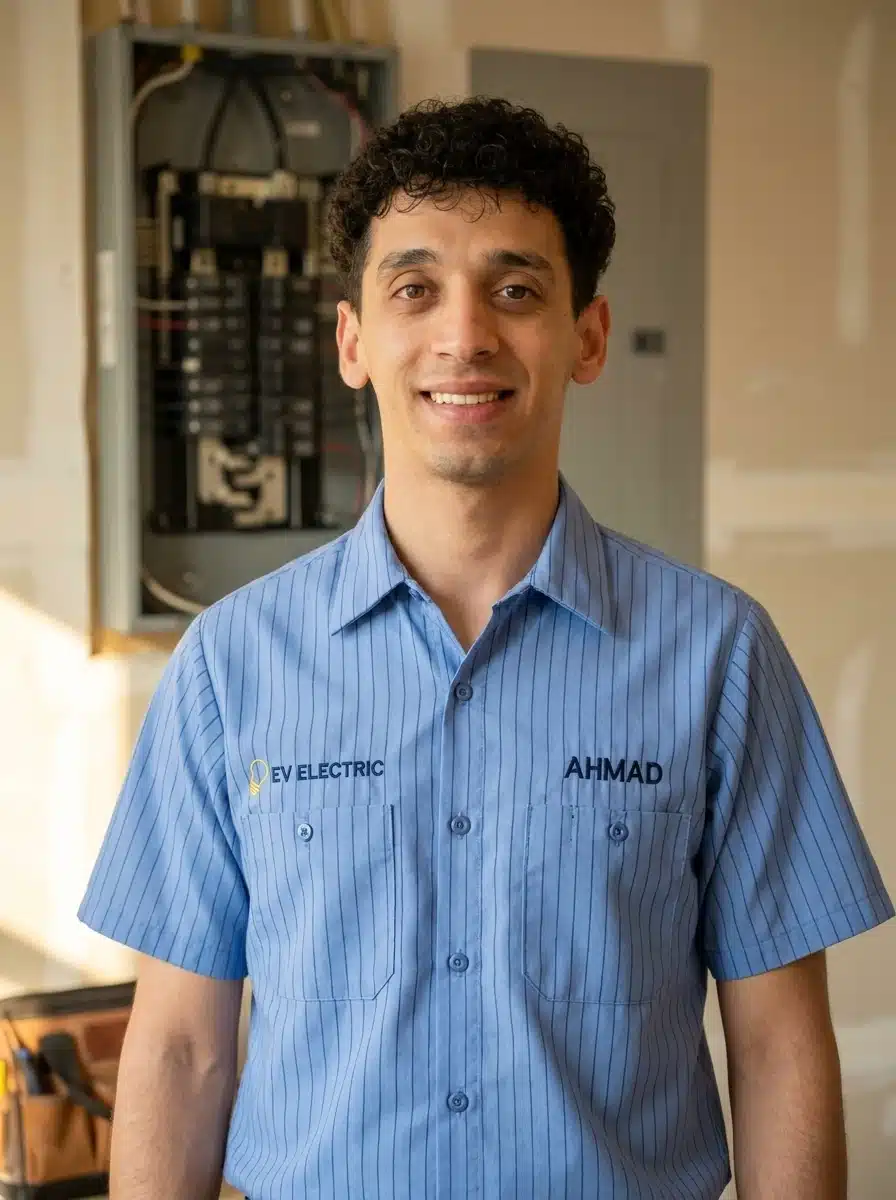
Ahmad holds a Master Electrician license issued by the Commonwealth of Virginia — the highest electrician credential the state issues. He earned it after several years of journeyman work and a passed state exam. EV Electric Services is fully insured, and Ahmad runs a maintenance team so scheduling doesn’t bottleneck on one person.
Ahmad is on the job site for most residential calls. He does the assessment, explains what he finds, and handles the work himself. You’re not getting a subcontractor you’ve never met — you’re getting the Master Electrician whose name is on the license. Our shop is at 9488 Fairfax Blvd, physically inside the City of Fairfax.
EV Electric Services holds a 5.0-star average across 113 Google reviews. Our review base is real, recent, and from Northern Virginia homeowners.
Where we do panel work
EV Electric Services is based at 9488 Fairfax Blvd in the City of Fairfax. We serve Vienna, VA, Fairfax, VA, McLean, VA, Oakton, VA, Tysons, VA, and Rockville, MD, and the rest of Fairfax County. We also cover DC and Montgomery County, MD (Rockville, Bethesda, Chevy Chase, Potomac).
No trip fee and free estimates across our service area. For DC and Maryland, call to check availability first.
Other electrical services
Ready to upgrade your panel?
Electrical panel upgrades across Northern Virginia and Maryland — Master Electrician, permit included, written estimate before work starts.
We respond within one business day.