
Panel Upgrade in Falls Church, VA
Your Falls Church Home’s Panel Is Talking — Here’s What It’s Saying
Breakers tripping when you run the AC and the dryer? Lights dimming when the heat pump kicks on? If your Falls Church home was built before 1970, these aren’t quirks — they’re your panel telling you it’s overloaded. Ahmad Shaban, Virginia-licensed Master Electrician, assesses your panel on-site, gives you a written estimate, and pulls the correct permit — City of Falls Church DCA or Fairfax County LDS.
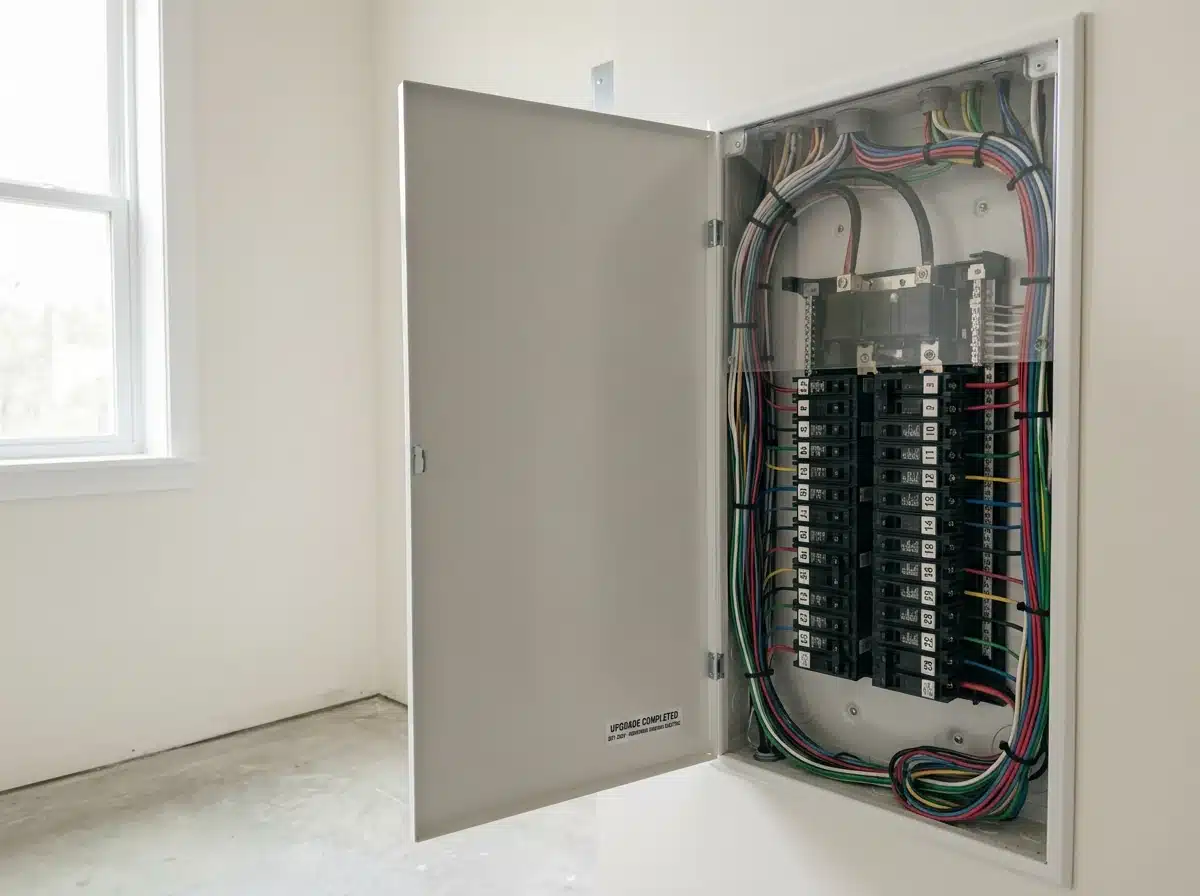
Signs your Falls Church home needs a panel upgrade
Breakers tripping when you run the AC and the dryer? Lights dimming when the heat pump kicks on? A warm or buzzing panel? If your Falls Church home was built before 1970 — and most in Broadmont, Cherry Hill, and Jefferson Village were — these aren’t quirks. They’re your 60-year-old panel telling you it’s overloaded.
Falls Church City has some of the oldest housing stock in Northern Virginia — 1930s bungalows in Cherry Hill, 1940s Cape Cods in Broadmont, postwar ranches in Jefferson Village. Many still have original fuse boxes or early 60-100 amp breaker panels. The electrical service was designed for a few lights, a radio, and a window fan. Today you’re running central AC, a heat pump, a home office, and asking about an EV charger. The panel is the bottleneck — and it tells you before it fails. Here’s what to look for, what it costs, and how the City of Falls Church permits the work.
Reading the warning signs — what each symptom reveals about your panel
A failing panel rarely announces itself dramatically. Instead, it sends a pattern of everyday frustrations that Falls Church homeowners learn to tolerate. The table below decodes each one into a diagnosis and an action plan — including what each scenario typically means for your budget.
| What you notice | Root cause inside the panel | How we resolve it | Budget signal |
|---|---|---|---|
| AC + dryer trips breaker | Your 100-amp service is splitting its full capacity between two high-draw appliances. In Jefferson Village and Hillwood homes with original wiring, the combined startup current exceeds the main breaker rating within seconds. | We measure actual household demand with a load calculation, then upgrade to 200-amp service — new panel, new meter base if required, plus the two code-mandated additions Virginia now requires on every service change. | Full service upgrade scope — the largest of the common scenarios. The on-site assessment determines whether the meter base and mast also need replacing, which affects the total. |
| Lights sag when heat pump starts | The momentary inrush current from the compressor motor creates voltage sag across undersized service entrance conductors. The wires feeding the panel physically cannot deliver enough amperage without a voltage drop. | We test the voltage under load at the service entrance. Confirmed sag means the feeder conductors get replaced alongside the panel — not just the panel box itself. | Similar scope to the AC/dryer scenario. Conductor replacement is built into the estimate when voltage testing confirms the issue. |
| Panel is warm to the touch or buzzes | Loose connections on the bus bar generate resistance; resistance converts to heat. A buzzing sound indicates arcing — intermittent electrical discharge at a connection point. Both are precursors to fire. | This is our highest-priority residential call. We assess same-day when possible. If connections can be re-torqued and the bus is sound, we tighten and re-verify. If the panel or bus is compromised, full replacement. | Ranges from a targeted repair (tighten and verify) to a full panel swap depending on bus-bar condition. The on-site inspection separates the two within minutes. |
| Fuses blow repeatedly | Your home still has a fused service — typically 60-amp capacity from Broadmont and Cherry Hill construction in the 1930s-1950s. The fuse is doing its job (disconnecting an overloaded circuit), but the real problem is that the entire service is undersized for anything beyond a few lights and a window fan. | Fuse-box-to-breaker conversion: we remove the fused panel, install a modern breaker panel with arc-fault and ground-fault protection capability, and upgrade the service to 200 amps. | Conversion scope. Includes a new breaker panel, meter base, conductors, and the two Virginia code additions. Typically the same price range as a 100-to-200 upgrade since the physical work overlaps heavily. |
| Insurer flagged the panel | Your panel carries a brand name — Federal Pacific Stab-Lok or Zinsco — that insurers classify as a known hazard. Independent testing documented that these breakers can fail to disconnect an overloaded circuit, leaving wiring energized past its safe capacity. Most carriers now refuse to issue or renew coverage until the panel is swapped. | Complete panel and bus-bar removal (not a breaker swap — replacement parts do not exist for these brands). New 200-amp panel, current-code breakers, and the two mandatory code additions. We treat insurance-deadline jobs as priority scheduling. | Full panel replacement scope. The insurance letter usually carries a deadline — schedule the assessment early so the work and inspection can close before the deadline hits. |
| EV charger trips the main | A Level 2 charger pulls 40-50 amps continuously. Stacked on top of AC, cooking, and hot-water loads, the total demand exceeds what a 100-amp panel (or a near-capacity 200-amp panel) can sustain. | Load calculation first — sometimes there is headroom and we simply add the dedicated circuit. When headroom is absent, the panel gets upgraded (or a sub-panel added) before the charger circuit goes in. We handle both scopes in a single project when possible. | May be a circuit addition (smaller scope) or a panel upgrade (larger scope). The load calculation determines which, and we present both options with pricing before you decide. |
Not sure which row matches your situation? Call 571-500-6637 — describe what’s happening and we’ll narrow it down before scheduling the on-site visit.
6 signs your Falls Church home needs a panel upgrade
Most panel issues show up as recurring nuisances that homeowners learn to work around. These are the real signals that the panel is the bottleneck — not the appliance or the circuit. Each one is tagged to the Falls Church neighborhoods where we see it most often.
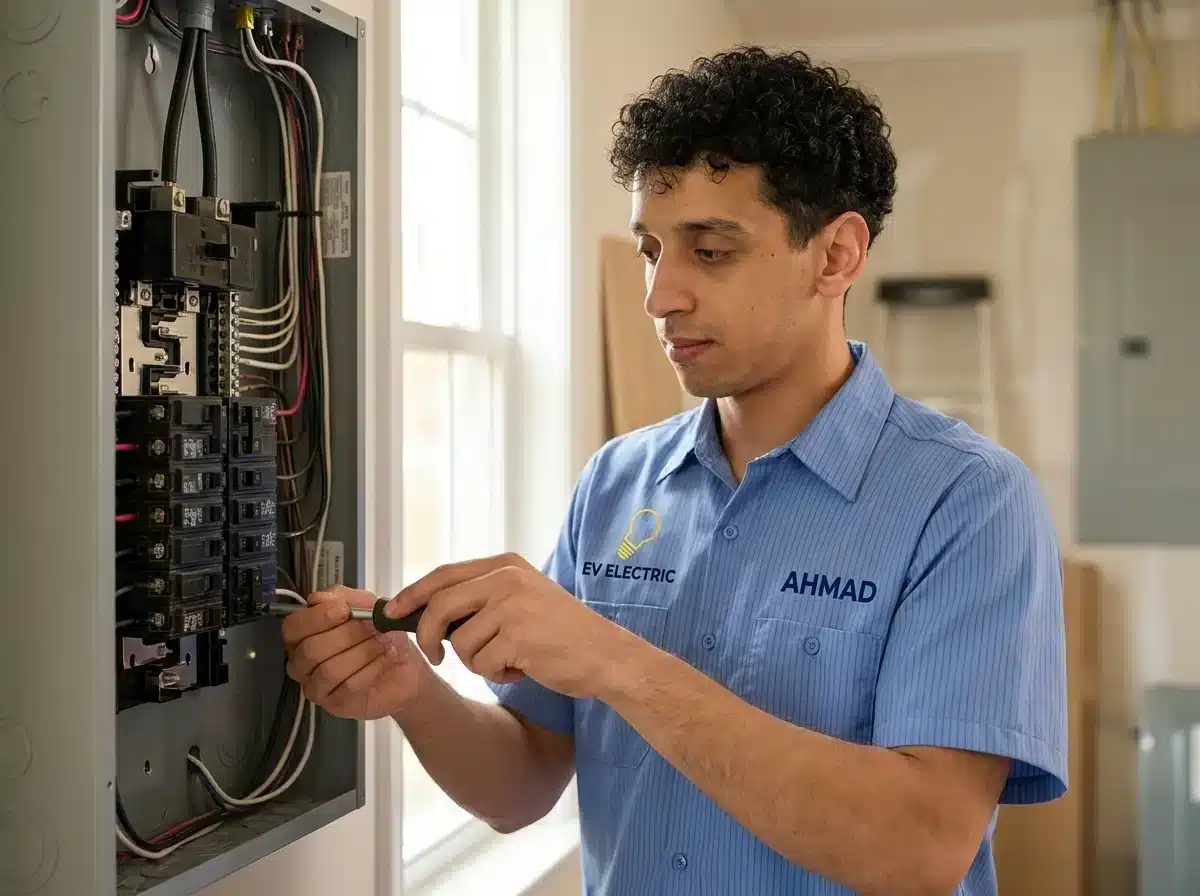
Signs you need a panel upgrade
Expand each sign for what it means and what to do.
You still have a fuse box (Broadmont, Cherry Hill)
Falls Church City’s pre-war and early postwar neighborhoods — Broadmont bungalows from the 1940s, Cherry Hill homes dating to the 1930s — were wired with fused service panels rated at 60 amps or less. These cannot safely distribute modern electrical loads, lack the ability to accept arc-fault or ground-fault protection breakers, and are flagged by virtually every insurance carrier during policy reviews. The proper remedy is a full fuse-box-to-breaker conversion with a 200-amp service upgrade — not simply installing higher-rated fuses, which bypasses the circuit protection and creates a fire path.
You have a Federal Pacific (FPE) or Zinsco panel (Winter Hill, Virginia Village)
Mid-century construction in Winter Hill and Virginia Village — the 1960s-70s building boom — installed FPE Stab-Lok and Zinsco panels extensively. Both brands share a documented failure pattern: the breaker physically does not open the circuit under overload conditions, allowing the conductor to carry current past its rated limit. There is no repair, retrofit, or compatible replacement breaker for either product line. The only safe path is removing the entire panel assembly and installing a new bus with modern breakers. Open the panel door to check: FPE breakers are labeled “Stab-Lok”; Zinsco units have distinctive teal or gray handles. If you are unsure, we verify the brand during the on-site visit and provide a written scope for replacement.
Your breakers trip regularly under normal load (Jefferson Village, Hillwood)
When the dishwasher and microwave running at the same time trips a breaker in your Jefferson Village ranch or Hillwood Cape Cod, the issue is almost never a defective breaker. It is a 100-amp panel distributing 1960s-era capacity across 2026 appliance loads. The total service bandwidth — not any single circuit — is the constraint. A diagnostic visit identifies whether a dedicated circuit solves the specific trip or whether the underlying 100-amp service needs upgrading to 200.
Your insurer has flagged the panel or required replacement
An insurance letter demanding panel replacement within 30 or 60 days carries real consequences — the carrier will lapse your coverage at the deadline, leaving the home uninsured. These letters are almost always triggered by an FPE, Zinsco, or fuse-box identification during a policy review or a real-estate transaction inspection. Treat the letter as a scheduling constraint, not a suggestion. We routinely complete insurance-deadline replacements and can confirm timeline feasibility during the initial call — have the letter handy when you phone.
You’re adding an EV charger or major appliance (West Falls Church)
A Level 2 EV charger draws 40-50 amps on a dedicated 240V circuit — continuously, not in bursts. Stack that on top of central AC, an induction cooktop, a tankless water heater, and a heat pump, and even a 200-amp panel in a newer West Falls Church home near Metro may be running at capacity. We perform a load calculation before specifying any panel work; sometimes a sub-panel addition is sufficient. See also: EV charger installation.
You’re selling your home and the inspector flagged the panel
Home inspectors routinely flag FPE panels, Zinsco panels, fuse boxes, and double-tapped breakers as material defects. In Falls Church’s competitive housing market, buyers’ agents use these findings as contract leverage — often demanding replacement before closing. We turn around written estimates quickly for disclosure timelines and schedule the permitted work to close before contract deadlines. The resulting permit card and inspection certificate become part of the property record, converting a defect into a documented capital improvement.
What these symptoms mean for your budget
Falls Church homeowners want to know: “What will this cost?” The honest answer starts with which symptom brought you here, because the symptom determines the scope — and scope determines price. We present a written, itemized estimate after the on-site assessment, but here is how the symptoms above map to budget ranges so you know what to expect before we arrive.
Scope tiers — from the symptom table to the estimate
Every panel project in Falls Church falls into one of three scope tiers. The symptom you are experiencing points to the tier, and the tier frames the budget conversation:
Tier 1 — Targeted fix
Triggered by: a single circuit tripping, a warm connection point that can be re-torqued, or EV-charger prep on a panel with confirmed spare capacity.
Scope is narrow: diagnose, repair or add a circuit, verify. No new panel, no utility involvement. The smallest budget tier.
Tier 2 — Panel replacement only
Triggered by: FPE or Zinsco brand identification, insurance mandate, or a compromised bus bar — where the home already has 200-amp service and the service entrance is sound.
The panel and breakers get replaced. The meter base, mast, and conductors stay. Virginia’s adopted code adds two items to every panel replacement: an outdoor emergency disconnect and a whole-home surge protector. Both are part of every EV Electric estimate — never billed as add-ons.
Tier 3 — Full service upgrade
Triggered by: 100-amp-to-200-amp upgrade, fuse-box conversion, voltage-sag diagnosis, or a deteriorated service mast.
Everything changes: panel, meter base, service entrance conductors, mast (if needed), plus the two code-mandated additions. Utility coordination with Dominion is required for the meter disconnect and reconnect. This is the broadest scope and the highest budget tier.
What every EV Electric estimate covers — regardless of tier
- On-site load measurement. We record the actual amperage your household draws before selecting a panel size. A 200-amp panel that is already near capacity the day it is installed is a wasted upgrade — we measure first to prevent that.
- Virginia’s two code-mandated additions. The 2021 Virginia USBC (incorporating the 2020 NEC) requires an outdoor emergency disconnect and a whole-home surge protector on every panel replacement or service change. Both appear as line items in our estimate. Any bid that omits them is incomplete — the permit inspector will flag the gap, and the homeowner pays twice.
- Correct-jurisdiction permit filed on your behalf. City of Falls Church DCA for homes inside the independent city’s 2.2-square-mile boundary; Fairfax County LDS for homes with a “Falls Church” mailing address that sit in the County. We determine which applies to your parcel and file accordingly.
- Inspector coordination. We book the electrical inspection with the relevant authority and remain on-site throughout.
- Utility scheduling with Dominion. When the scope requires a meter pull, we arrange the disconnect/reconnect window with Dominion and sequence our work to fit their slot. No separate coordination charge.
- Fixed-price commitment. The number on the estimate is the number you pay. Panel work is quoted as a fixed project price — never billed hourly or on a time-and-materials basis. If something unexpected surfaces during the job, we pause, explain, and issue a written change order before proceeding. Call 571-500-6637 to book the assessment.
Eight panel projects we handle in Falls Church — and what each one involves
No two panel jobs follow the same playbook. Below are the eight scenarios we encounter most often across Falls Church’s neighborhoods, from the oldest Cherry Hill bungalows to the newest West Falls Church infill.
Doubling capacity: 100A to 200A
The bread-and-butter upgrade for Jefferson Village, Hillwood, and Virginia Village homes built in the 1950s-70s. We swap the panel, replace the meter base when its rating does not match, run new service entrance conductors sized for 200 amps, and mount the exterior emergency disconnect. Dominion pulls and resets the meter; a permit through City DCA or County LDS covers the inspection.
Fuse panel retirement
Falls Church City packs more fuse boxes per block than almost any area we serve — a consequence of Broadmont and Cherry Hill being built decades before breaker panels became standard. We strip out the entire fused assembly, install a breaker panel with arc-fault and ground-fault slots, and bring the service entrance up to 200-amp capacity. A frequent transaction-driven upgrade in the City’s active resale market.
FPE Stab-Lok removal
The panel and its proprietary bus come out together — breaker swaps are not viable because FPE discontinued all replacement components. A fresh 200-amp panel with listed breakers goes in, along with the two Virginia code additions. Insurance-deadline scheduling is standard for these calls; we prioritize them accordingly.
Zinsco bus-bar replacement
Identical scope to the FPE job: the Zinsco bus is removed, a new panel installed, and the full code-adder package applied. Found primarily in South Falls Church and Winter Hill homes from the early 1970s. The distinctive teal or gray breaker handles are the quickest visual identifier.
Charger-ready panel preparation
A Level 2 EV charger is a continuous 40-50 amp draw — the NEC sizes continuous-load circuits at 125% of the appliance rating. If the existing panel lacks a spare 50-amp slot or the load calculation shows the service is near its ceiling, we upgrade the panel (or add a sub-panel) before running the charger circuit. Both tasks happen in the same project visit when practical. Related: EV charger installation.
Sub-panel for a detached structure or addition
Finished basements, detached garages, and ADU circuits in newer West Falls Church properties frequently need their own distribution panel fed from the main. We calculate the sub-panel load, size the feeder, run the conduit, and install the sub-panel with its own breaker slots. Permitted through the same jurisdiction that covers the main panel.
Listing-prep panel swap
Sellers clearing a known inspection defect before putting the home on the market. Falls Church’s tight inventory and high buyer expectations make this a common pre-listing move. We deliver a written estimate on a fast turnaround, complete the work under permit, and hand over the permit card and inspection certificate as documentation that transfers with the sale.
Weatherhead and mast renewal
The overhead conduit carrying conductors from Dominion’s drop to the meter base corrodes over decades of weather exposure. On 1940s-1960s Falls Church homes, the original mast may be 70+ years old. A rusted or sagging mast is both a code violation and a disconnection risk — Dominion can red-tag it. Often bundled with a panel upgrade to consolidate the permit and utility coordination into a single project.
Why Falls Church homes need panel upgrades — by era
The City of Falls Church packs nearly a century of residential construction into just 2.2 square miles. The era your home was built tells you what panel risk profile to expect before we even open the door.
Pre-war & early postwar (1930s–1950s)
Broadmont, Cherry Hill, Jefferson Village, HillwoodThe oldest homes in Falls Church City — bungalows, Cape Cods, and small ranches built before the City’s 1948 incorporation from Arlington County. Original 60-100 amp panels or fuse boxes. Some 1930s homes in Cherry Hill still have remnants of knob-and-tube wiring in attic spaces. These homes are prime fuse-box-to-breaker + full service upgrade territory. Many have never had their electrical service touched since construction.
Panel risk: Fuse box replacement, 60-100A to 200A upgrade, service mast replacement on original utility drops, possible knob-and-tube remediation in oldest homes.
Mid-century (1950s–1970s)
South Falls Church, Winter Hill, Virginia VillageClassic 100-amp panels sized for mid-century electrical loads. Federal Pacific (FPE) Stab-Lok panels appear in this era — Winter Hill and Virginia Village are the most common locations. Mid-1970s homes in this range also introduced aluminum branch wiring, which requires attention at panel terminations. A 100-amp panel that “worked fine in 1968” can’t handle a heat pump, central AC, and an EV charger simultaneously.
Panel risk: FPE/Zinsco replacement, 100-to-200A upgrade for modern loads, aluminum branch wiring termination remediation.
Infill & modern (2000s–2020s)
West Falls Church (near Metro), teardown-rebuilds citywideNewer homes start with 200-amp service and modern panels — but their panels weren’t installed with the 2020 NEC in mind. They lack the outdoor emergency disconnect and whole-home surge protection now required on any service upgrade. EV charging loads are the most common trigger: adding a 50-amp charger circuit to a 200-amp panel that’s already near capacity requires a load assessment first.
Panel risk: EV-charger capacity assessment, sub-panel addition for ADU or garage circuits, and code-adder retrofits when the service is upgraded for any reason.
If your home falls in any of these eras, the on-site assessment tells you whether your panel is current, approaching end-of-life, or an active insurance risk. The assessment is free — call 571-500-6637 to schedule it.
Permits & code in Falls Church — the detail no competitor explains
“Falls Church, VA” is actually two separate permitting jurisdictions. The City of Falls Church is an independent city — legally separate from Fairfax County — with its own permit office. But ZIP code 22046 extends beyond the City limits into Fairfax County, so a “Falls Church” mailing address doesn’t tell you which jurisdiction you’re in. Getting this wrong delays the project.
City of Falls Church (independent city)
If your home is inside the City of Falls Church corporate limits — Broadmont, Cherry Hill, Jefferson Village, Hillwood, Virginia Village, Winter Hill — your electrical permit goes through the City of Falls Church Department of Code Administration (DCA). This is an independent city office, entirely separate from Fairfax County.
- Office: City Hall, 300 Park Ave., Falls Church, VA 22046
- Phone: 703-248-5080 (TTY 711)
- Email: permits@fallschurchva.gov
- Applications: PDF via email (no dedicated online portal)
- Counter hours: Mon-Fri, 8 AM – 5 PM
- Panel upgrades = electrical trade permit
Falls Church DCA enforces the 2021 Virginia USBC (2020 NEC) — the same code as the rest of Virginia. Ahmad holds a Virginia Master Electrician license, which qualifies him to sign the required riser diagram for service upgrades.
Fairfax County (surrounding areas)
Homes with a “Falls Church” mailing address that sit outside the City boundary — Madison Manor, portions of South Falls Church, neighborhoods near Seven Corners and Bailey’s Crossroads — file permits through Fairfax County Land Development Services (LDS).
- Office: 12055 Government Center Pkwy, Fairfax, VA 22035
- Phone: 703-222-0801
- Online submissions: PLUS portal (plus.fairfaxcounty.gov)
- Residential panel work = trades permit (ELER), filed electronically, no drawings needed for standard upgrades
Madison Manor is the textbook case: every home there carries a “Falls Church” mailing address yet falls under Fairfax County jurisdiction. Their permits route through County LDS, not City DCA. We have filed with both offices and can confirm the correct path for any address in the area.
How do you know which jurisdiction you’re in? Not by ZIP code — ZIP 22046 extends well beyond the City of Falls Church’s 2.2-square-mile corporate limits into Fairfax County. The accurate test: check your real-estate tax bill — City of Falls Church vs. Fairfax County. If you’re not certain, ask us when we come out for the estimate — we know which office handles your address, and we’ve filed with both.
Virginia’s adopted code adds two items to every panel upgrade
The 2021 Virginia Uniform Statewide Building Code incorporates the 2020 National Electrical Code. Under the current code, any residential panel replacement or service change in Falls Church triggers two additions that were not required under prior code cycles:
- Exterior service disconnect. An accessible disconnect switch mounted outside the home so that emergency responders — or the homeowner — can de-energize the entire service without entering the structure. This is the NEC 230.85 requirement. It applies to every panel upgrade and every new service installation. A bid that omits it is a bid that will fail the permit inspection.
- Surge protection at the service entrance. A Type 1 or Type 2 surge protective device installed at the panel to absorb voltage transients — the spikes that follow storm outages, utility switching events, and power restorations. This is the NEC 230.67 requirement. It protects HVAC compressors, electronics, and appliance control boards from the transient damage that accumulates over years of exposure. We include it in every panel estimate as a standard line item.
Together, these two additions explain the gap between a low-ball bid that skips them and a code-complete estimate that passes inspection on the first visit. The permit inspector — whether City DCA or County LDS — verifies both items before signing off.
The two panel types behind most Falls Church upgrade calls
While we handle every panel brand, two equipment categories generate the majority of panel work across Falls Church’s neighborhoods. Here is what each one is, where it appears, and what the replacement involves.
Federal Pacific Electric (FPE) Stab-Lok
Insurance Risk · Fire HazardStab-Lok breakers went into millions of American homes between the 1950s and 1980s. A CPSC-funded testing program established that these breakers trip at significantly lower rates than listed breakers under overload conditions — leaving circuits energized past their rated capacity and creating ignition risk at wire terminations and insulation contact points.
In Falls Church, Winter Hill and Virginia Village carry the heaviest concentration of FPE panels — a product of the 1960s-70s building wave that coincided with FPE’s peak market share. Remediation is a complete panel and bus-bar removal; the replacement parts were discontinued decades ago, and no aftermarket breaker is listed for the Stab-Lok bus. A new 200-amp panel with current-code breakers, the exterior disconnect, and surge protection replaces the assembly.
Fuse boxes (pre-war & early postwar homes)
Undersized · UninsurableFalls Church’s housing stock predates breaker technology in many blocks — Broadmont and Cherry Hill homes from the 1930s-1950s shipped with 60-amp fused service designed to power a handful of ceiling fixtures, a radio, and perhaps a window fan. That capacity is roughly one-third of what a modern household with central AC, a heat pump, and a home office requires.
Beyond raw capacity, fuse panels lack the ability to host arc-fault or ground-fault breakers mandated by current code for new circuits. Most insurers treat them as uninsurable. The appropriate resolution is a complete conversion — removing the fused panel, installing a modern breaker panel with AFCI/GFCI capability, upgrading the service entrance to 200 amps, and adding the exterior disconnect and surge protector that Virginia’s code now requires.
From your call to a passed inspection — how the project flows
You phone us with the symptom. We schedule a free on-site assessment — typically within a few days. At your home, we open the panel, examine the service entrance, measure the load, and present a written estimate covering every line item the inspector will verify. You approve the scope. We file the permit with the correct Falls Church jurisdiction, coordinate the Dominion meter window if the scope requires it, complete the installation, and remain on-site while the inspector signs off. The job is not done until the inspection passes.
For a detailed walkthrough of each phase — from assessment through final sign-off — see our electrical services overview.
On-site in Falls Church for the estimate — not dispatched from 20 miles away
Our shop is at 9488 Fairfax Blvd, Fairfax — right at Fairfax Circle. Falls Church City is a 15-minute drive via Rt 29 (Lee Highway) or I-66. When you call to schedule a panel assessment, we’re not dispatching from Lorton or Manassas. We’re around the corner. Falls Church is only ~2.2 square miles — we can serve multiple homes in a single visit.
Drive times from our shop to your panel
- Broadmont / Cherry Hill ~15 min
- Jefferson Village / Hillwood ~15 min
- Winter Hill / Virginia Village ~15 min
- West Falls Church (near Metro) ~12 min
- South Falls Church ~12 min
- Madison Manor ~15 min
- Seven Corners ~12 min
- Bailey’s Crossroads ~10 min
Owner-operated, not franchised. Ahmad owns EV Electric and personally conducts the assessments. 9488 Fairfax Blvd is a physical shop — not a virtual office or a franchise territory marker. When you dial 571-500-6637, a real person picks up, collects the details, and books the next available on-site slot.
Why proximity matters for panel work: an accurate estimate requires physically examining your panel, meter base, service entrance, and mast. A contractor 15 minutes away can schedule tighter, coordinate with the City’s permit office more efficiently, and show up for the inspection without a half-day travel buffer. Local accountability is built into the geography.
Your electrician: Ahmad Shaban
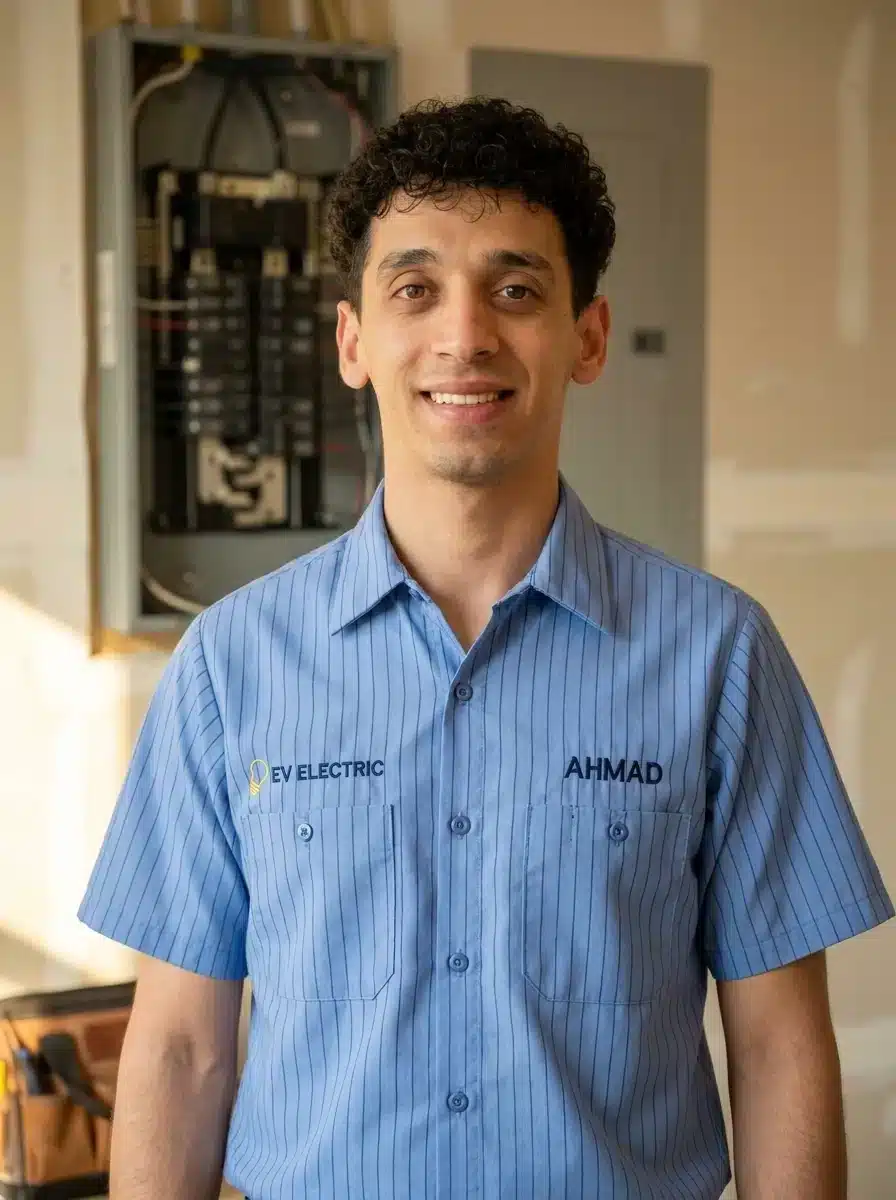
Ahmad Shaban holds a Master Electrician license issued by the Commonwealth of Virginia — the state’s highest electrician credential and the license level required to sign service riser diagrams for large service upgrades. Panel upgrades are his highest-volume residential service. He runs the on-site assessments, pulls the permits — whether through the City of Falls Church DCA or Fairfax County LDS — and is present for the final inspection.
EV Electric Services has a 5.0-star average across 113 Google reviews, all from Northern Virginia homeowners. The reviews are real and recent — no incentivized review programs.
Falls Church neighborhoods we serve for panel upgrades
Panel upgrades are one of our most-requested services across the City of Falls Church and the surrounding areas with “Falls Church” mailing addresses. Fuse boxes and FPE panels are heavily concentrated in the City’s oldest neighborhoods:
- Broadmont — 1940s-50s bungalows north of Broad St; fuse boxes, original 60-100A service; City of Falls Church DCA permits
- Cherry Hill — 1930s-40s homes near Cherry Hill Park; oldest housing stock in the City; fuse boxes, some knob-and-tube; City DCA permits
- Jefferson Village — 1950s ranches south of Rt 29; 100A panels, some FPE-era; City DCA permits
- Hillwood — 1940s-50s Cape Cods and ranches; fuse-box-to-breaker conversions common; City DCA permits
- Winter Hill — 1960s near Seven Corners; FPE Stab-Lok panels appear; City DCA permits
- Virginia Village — 1950s-60s; mix of FPE and original 100A panels; City DCA permits
- West Falls Church — near Metro, newer development; sub-panel adds and EV-charger prep; City DCA permits
- South Falls Church — mixed era near Bailey’s Crossroads; check jurisdiction — some parcels are City, some are County
- Madison Manor — “Falls Church” mailing address but Fairfax County permits (County LDS, not City DCA); a common jurisdiction-clarification case
We also serve Fairfax, Annandale, Vienna, McLean, and the broader Northern Virginia area. If you’re unsure whether we cover your neighborhood, call 571-500-6637 and we’ll confirm.
Related electrical services in Falls Church
A panel upgrade is often the starting point for other electrical work. If your assessment reveals issues beyond the panel itself, these are the next steps we handle:
Frequently asked questions — panel upgrades in Falls Church
What’s the average cost to upgrade an electrical panel in Falls Church?
There is no single number because the scope varies by symptom. A panel replacement on a home that already has 200-amp service (e.g., swapping an FPE panel) is a narrower job than a full 100-to-200 service upgrade with a new mast, meter base, and conductors. Every EV Electric estimate includes the two additions Virginia’s adopted code now mandates — the exterior emergency disconnect and the surge protector at the service entrance — plus the permit fee for whichever jurisdiction covers your address. The on-site assessment is free, and the written estimate locks in a fixed project price. Call 571-500-6637 to schedule.
My home has a Falls Church address — is my permit through the City or the County?
It depends on whether your home is inside the City of Falls Church corporate limits or in Fairfax County with a “Falls Church” mailing address. ZIP code 22046 extends well beyond the City’s 2.2-square-mile boundary into Fairfax County — a “Falls Church” mailing address does NOT mean you’re in the independent city. Check your real-estate tax bill: if it comes from the City of Falls Church, your permit goes through the City’s Department of Code Administration (703-248-5080). If it comes from Fairfax County, your permit goes through Fairfax County LDS. Madison Manor is a common example — “Falls Church” address, Fairfax County permits. Not sure? Ask us when we come out for the estimate.
Who can upgrade my electrical panel?
Virginia law requires a licensed electrician and a permit for every panel upgrade. Ahmad Shaban carries the Master Electrician credential issued by the Commonwealth — the highest license class the state offers. That credential authorizes him to sign the service riser diagrams that larger service upgrades require, a qualification most residential contractors lack. He performs the on-site assessment, files the permit with City DCA or County LDS, and stays on-site through the final inspection.
Can I upgrade my electrical panel without rewiring my house?
Yes — a panel upgrade replaces the panel (and service, if you’re upgrading from 100 to 200 amps) without touching the branch wiring running to your outlets, switches, and fixtures. The existing branch wiring stays in the walls. The exception: if the diagnostic reveals a wiring problem — aluminum branch wiring with deteriorated terminations, damaged circuits, or unsafe splices — we’d recommend addressing those separately. Panel upgrade and whole-house rewire are distinct scopes of work.
Do I need a permit to upgrade my electrical panel in Falls Church?
Yes — no exceptions. A permit is mandatory whether your property sits inside the independent City of Falls Church or in Fairfax County with a “Falls Church” postal address. City permits route through the Department of Code Administration at City Hall (703-248-5080, permits@fallschurchva.gov, PDF applications via email). County permits route through Land Development Services via the PLUS online portal. We handle the filing for you and submit to the correct office.
My insurance company is requiring me to replace my FPE panel — how soon can you do it?
Insurance-deadline replacements go to the front of our scheduling queue. Phone 571-500-6637 with the insurer’s letter — we will confirm assessment availability, turn around the written estimate, and give you a realistic completion date relative to your deadline. Most FPE and Zinsco panel swaps finish within one to two weeks of estimate approval. The variable we cannot fully control is Dominion’s meter-pull scheduling window, which is why calling early — well before the policy expiration — gives us the most room to hit the date.
Will my power be off all day during a panel upgrade?
The main service is de-energized only during the portion of the work that involves live connections at the panel and service entrance — typically several hours, not the full day. We coordinate the Dominion meter pull to minimize that window and target same-day restoration for every residential panel job. When we schedule the install, we give you the expected outage duration so you can plan around it.
What’s the difference between a panel upgrade and a service upgrade?
A panel upgrade swaps the breaker enclosure and bus bar inside your home. A service upgrade replaces the conductors, meter base, and (sometimes) the mast that connect Dominion’s power line to your panel — the entire service entrance. Upgrading from 100 to 200 amps usually requires both, because the existing conductors and meter base are rated for the lower amperage. Replacing an FPE or Zinsco panel on a home that already has 200-amp service may only require the panel itself. The on-site assessment determines which scope applies.
Get a Written Estimate for Your Falls Church Panel Upgrade
Free on-site assessment. Written, itemized estimate before any work starts. Code-complete — emergency disconnect, surge protection, and permit included. City of Falls Church DCA or Fairfax County LDS, we know which office to file with.
571-500-6637