
Electrical Safety Guide
Space Heater Safety: Plugs, Circuits and Tripped Breakers
A heater that trips the breaker, a plug that feels hot, or no outlet where you need one. Here is what each one usually means, what to do, and when to call an electrician. Every safety step names its source.
Sources checked October 30, 2026 (NFPA on September 29, 2026).
Get out. Stay out. Call 911 from outside.
Source: US Fire Administration, Fire Safety for Older Adults (FA-221).
What to Do Right Now
Stop using the heater and call an electrician if
- The heater plug, the wall outlet or the faceplate feels hot, or feels warm and keeps getting warmer.
- The breaker trips whenever one particular outlet is used, no matter what is plugged in.
- The breaker keeps tripping, or breakers in your home need resetting often.
- You hear sizzling or buzzing, or smell hot insulation.
Stop using the heater and fix or replace it if
- The heater cord feels hot. CPSC says to unplug it and have it checked by an authorized repair person. We recommend calling an electrician instead of doing this yourself.
- The heater keeps tripping breakers in more than one room, even with nothing else on. CPSC says one appliance that keeps tripping breakers points to a defect that could cause a fire or shock.
- The heater is damaged or recalled. Check at cpsc.gov or SaferProducts.gov.
If a plug or outlet is hot, our advice is to leave it alone and call an electrician. If the plug is too hot to hold, do not touch it, and keep people away from that outlet until an electrician checks it. Smell burning and not sure where it is from? Use the red box above.
Sources: CPSC Pub. 098 and Pub. 518. The “keeps getting warmer” line and the advice in the paragraph above are ours.
For an emergency, we dispatch an electrician within about 45 minutes, 24 hours a day, 7 days a week.
Most heater problems come down to the circuit, the plug or where it sits
- Plug it straight into a wall outlet. No extension cord, no power strip. Why.
- If it trips the breaker, call an electrician to check what is on that circuit. What CPSC says.
- If the plug or outlet gets hot, stop using it and call an electrician.
- Keep it 3 feet from anything that can burn, and turn it off when you leave the room or go to bed. Where to put it.
What You See, What It Usually Means, What to Do
| What you see | What it usually means | What to do now |
|---|---|---|
| Breaker trips when the heater and other things are on at the same time | Too many watts on one circuit (CPSC) | Call an electrician to check what is on that circuit. |
| The heater keeps tripping breakers, even in other rooms with nothing else on | CPSC says one appliance that keeps tripping breakers points to a defect that could cause a fire or shock | Stop using the heater. Have it repaired or replace it. |
| The breaker trips whenever one outlet is used, no matter what is plugged in | A problem at that outlet or circuit (CPSC) | Stop using that outlet. Call a qualified electrician. Do not put in a bigger breaker. |
| The plug, outlet or faceplate feels hot | A faulty outlet or plug, or a wiring problem (CPSC). CPSC says plugs and outlets may be warm, never hot. | Stop using the heater. Call an electrician to check the plug and outlet. See our hot outlet guide. |
| The heater cord feels hot | A problem with the heater or its cord (CPSC) | CPSC says to unplug it and have it checked by an authorized repair person. We recommend calling an electrician instead of doing this yourself. |
| The plug is loose in the outlet | CPSC says a loose connection can overheat. CPSC describes trying plugs from two or three other cords: if most fit loosely, the outlet probably needs to be replaced by a qualified electrician. | Do not use that outlet for the heater. Call an electrician. |
Sources: CPSC Pub. 098 and CPSC Pub. 518.
When a Space Heater Trips the Breaker
A breaker trips to protect the wires in your walls. CPSC calls portable electric heaters high-wattage appliances, and the US Fire Administration says tripping breakers usually means the circuit is overloaded. So a trip does not always mean something is broken, but finding the cause is a job for an electrician.
What CPSC says about the load on a circuit: the total on a circuit at one time should be less than 1,500 watts on a 15-amp circuit, or 2,000 watts on a 20-amp circuit. The number on the breaker handle, usually 15 or 20, is its amps.
Our advice: leave the heater off and the breaker alone, and call an electrician at 571-500-6637. We check what is on the circuit and make sure the wiring is not damaged. CPSC lists breakers that need resetting often as a warning sign.
Source: CPSC, Guide to Home Wiring Hazards (Pub. 518), Appliance Power Budget.
When it is not just an overload
CPSC names two cases that point past a simple overload. If one appliance keeps tripping breakers, that points to a defect in the appliance that could cause a fire or shock, so repair or replace it. If the breaker trips whenever a certain switch or outlet is used, get a qualified electrician, and do not put in a higher-rated breaker.
If the heater is plugged into a GFCI outlet (the kind with TEST and RESET buttons) and that trips, Safe Electricity, an electrical safety education program, says to stop using the heater until a professional checks it, and not to assume the GFCI is the problem.
We did not find an official source that says how many times it is fine to reset a breaker. CPSC lists breakers that need resetting often as a warning sign. For every kind of trip, not just heaters, see our breaker keeps tripping guide.
It may only be an overload if
- It trips only when the heater and other things run at the same time.
- The plug and outlet stay cool.
Call us if
- The plug or outlet is hot, or the plug is loose.
- One outlet trips no matter what is plugged in.
- It trips again.
- You cannot tell which breaker goes with which room.
Based on CPSC Pub. 518: do not use a higher-rated breaker, and get a qualified electrician. The split into two lists is ours.
Plug It Into the Wall, Not a Cord or Strip
- Wall outlet only. CPSC says never power a heater with an extension cord or a power strip. Fairfax County Fire and Rescue says never use an extension cord with a portable heater.
- The plug should fit tightly. If it does not, CPSC says do not use that outlet for the heater.
- Keep the cord out from under rugs. CPSC says a cord under a rug or carpet can get damaged and burn.
- Check the heater, cord and plug for damage before you use it, and look it up for recalls at cpsc.gov or SaferProducts.gov (CPSC).
- Check the plug and outlet often while it runs. CPSC says to check frequently whether they are hot.
- One heater per outlet. The US Fire Administration says to plug only one high-wattage appliance, such as a heater, into an outlet at a time, even if the outlet has space for more.
Where to Put It and When to Turn It Off
Where
- At least 3 feet from beds, sofas, curtains, paper and clothes, on all sides (CPSC, USFA, Fairfax County).
- On a flat, steady surface where it will not get knocked over (CPSC).
- Away from water. Never touch an electric heater if you are wet (CPSC).
- Away from children and pets (Fairfax County).
When
- Never leave it running unattended or while you sleep (CPSC).
- Turn it off when you leave the room or go to bed (USFA). Fairfax County says when you leave home or go to bed.
- Never use an oven to heat your home (USFA).
- Pick a heater that shuts off if tipped over (Fairfax County).
- Pick one with a safety certification mark (CPSC). Fairfax County names UL or Factory Mutual.
This guide covers plug-in electric heaters. Fuel-burning heaters, such as kerosene heaters, have their own rules. See Fairfax County Fire and Rescue’s heater page in the sources below. The US Fire Administration says to make sure all fuel-burning equipment is safely vented to the outside to avoid carbon monoxide poisoning, and to install carbon monoxide alarms, especially if your home is heated by any source other than electricity. A working smoke alarm on every level helps with any heater; see our smoke alarm page.
Need a Person, Not a Guide?
If an outlet got hot, a breaker will not stay on, or you just want someone to look, call us. A real person answers, day or night. For an emergency, we dispatch an electrician within about 45 minutes, 24 hours a day, 7 days a week.
Virginia-licensed master electrician. Fully insured. 127 Google reviews, 5.0 stars.
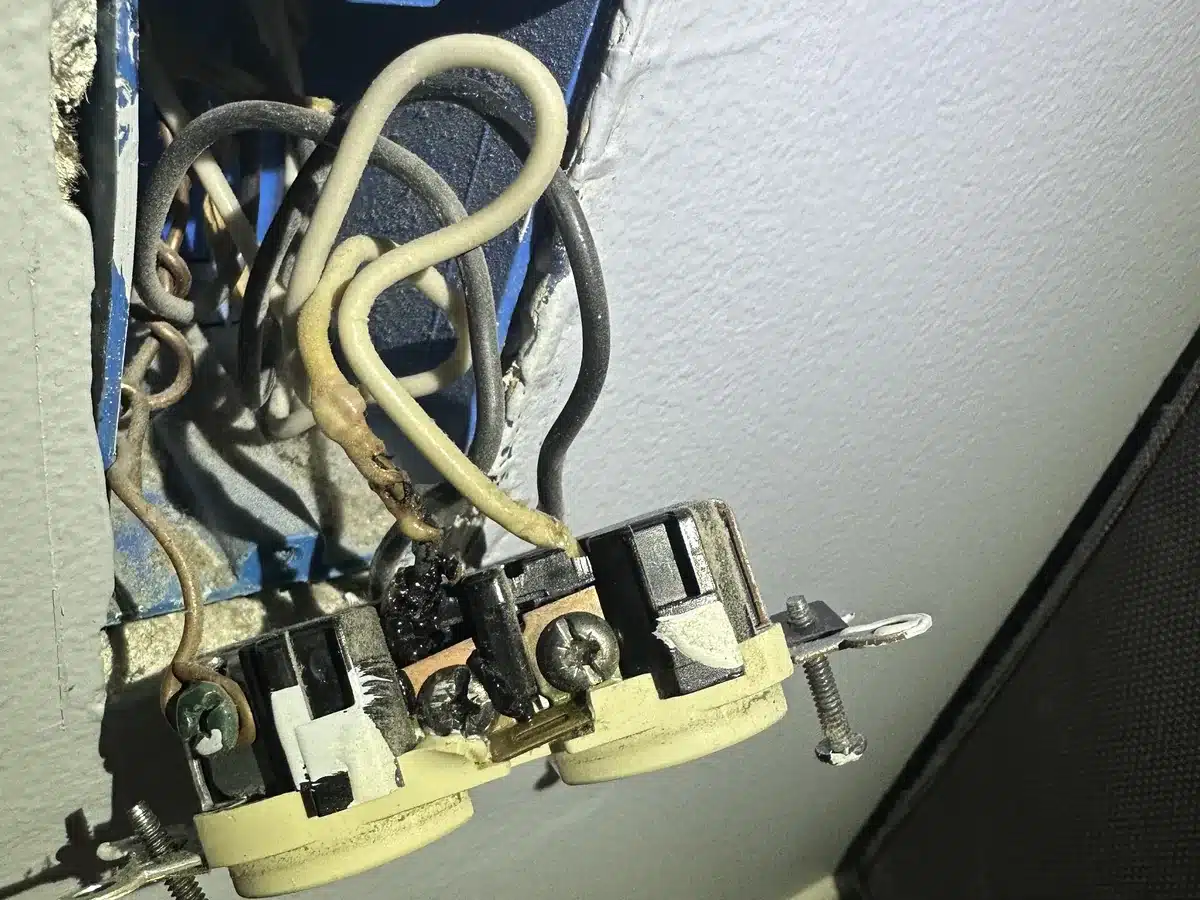
“The last time someone called about a space heater tripping the breaker, I found a melted wire and outlet. In winter it is usually too much on one circuit and a bad connection. When I come out, I check the wiring and make sure nothing is damaged.”
Ahmad Shaban, master electrician and owner, November 2026. The photo at the top of this page is from one of his heater calls.
Use a heater in the same spot every winter? We can add a new outlet or a separate circuit for it, so it is not sharing a circuit with everything else in the room.
What happens when Ahmad comes out
- Ahmad picks up the phone himself, day or night. Describe the heater, the outlet and what tripped, and he will say what not to touch before he arrives.
- He checks the outlet, the plug and the wiring behind it for heat damage, and looks at what else shares that circuit. In winter he most often finds too much on one circuit, or a bad connection.
- Before any paid work starts, he shows you what he found and gives you the price.
Have this ready when you call
- What happened: a trip, a hot plug or outlet, or a smell.
- The watts on the heater’s label.
- What else was running in that room.
- Whether the breaker keeps tripping.
We work across Northern Virginia, including Fairfax, McLean, Vienna, Arlington and Falls Church.
Space Heater Questions
Short answers, with the source named.
Why does my space heater keep tripping the breaker?
Most often the circuit is carrying more than it can. The Consumer Product Safety Commission (CPSC) says a 15-amp circuit can carry 1,500 watts and a 20-amp circuit 2,000 watts. CPSC also says one appliance that keeps tripping breakers points to a defect in the appliance that could cause a fire or shock, and that a breaker that trips whenever one particular outlet is used, no matter what is plugged in, needs a qualified electrician. If the heater trips in more than one room with nothing else on, suspect the heater. If any appliance trips one outlet, suspect the outlet. We recommend calling an electrician to check what is on that circuit.
How many space heaters can I run on a 20-amp breaker?
Usually one, with nothing else big on that circuit. The US Fire Administration says to plug only one high-wattage appliance, such as a heater, into an outlet at a time. Read the watts on each heater’s label and add them up, along with anything else on that circuit. CPSC says the total on a 20-amp circuit at one time should be less than 2,000 watts. Call an electrician to check what is on that circuit.
Can I plug a space heater into a 15-amp outlet?
CPSC says the total on a 15-amp circuit at one time should be less than 1,500 watts. If your heater’s label says 1,500 watts, it sits right at that amount by itself. So on a 15-amp circuit, it should be the only thing running. Plug it straight into the wall, check often that the plug and outlet do not get hot, and if the breaker still trips, call an electrician.
Can I plug a space heater into a power strip or a heavy-duty extension cord?
CPSC says never power a heater with an extension cord or a power strip, and Fairfax County Fire and Rescue says never use an extension cord with a portable heater. One state fire office allows a short heavy-duty cord if one is needed, so you will see softer advice online. The safest choice is the wall outlet. If no outlet is close enough, call an electrician about your options.
Is it safe to leave a space heater on overnight?
No. CPSC says never leave a heater running unattended or while you are sleeping. The US Fire Administration says to turn it off when you leave the room or go to bed, and Fairfax County Fire and Rescue says when you leave home or go to bed. Some websites say certain heater types are fine overnight. We did not find an official source that says so.
Can I use a space heater in a bedroom or a bathroom?
In a bedroom, keep it at least 3 feet from the bed, curtains and anything else that can burn, and turn it off when you go to bed (CPSC, USFA). In a bathroom, CPSC says to keep electric heaters away from water and never touch one if you are wet. Unless the heater maker says it is made for bathrooms, we suggest using it somewhere else.
How long can a space heater safely run?
We did not find an official time limit. CPSC says never leave a heater running unattended or while you are sleeping, and to check often during use that the plug, cord and outlet are not hot.
How many times can a breaker trip before something is wrong?
We did not find an official source that gives a number. CPSC lists breakers that need resetting often as a warning sign of a wiring hazard, and says not to put in a bigger breaker. If it keeps happening, have a qualified electrician check it.
How likely is a space heater to start a fire?
The US Fire Administration says portable heater fires were only 3 percent of home heating fires in 2017 to 2019, but 41 percent of the deadly ones. That covers portable heaters of all kinds, not just electric ones. You may see much bigger numbers on other websites. We use the federal figure.
Where These Facts Come From
We checked each source on October 30, 2026, except the NFPA page, which would not load that day; we last read it on September 29, 2026. This is general safety information. It does not replace 911, the heater maker’s instructions, or an electrician who can see your wiring.
- CPSC, Reducing Fire Hazards for Portable Electric Heaters (Pub. 098, an older CPSC leaflet with footer dates 2011 and 2013): hot plugs and outlets, no extension cords or power strips, 3 feet, sleeping, water, recalls. Open the source
- CPSC, Guide to Home Wiring Hazards (Pub. 518): the appliance power budget, what to do when a breaker trips, and warning signs. Open the source
- US Fire Administration, Heating Fire Safety (last reviewed May 4, 2023): heating fire numbers, 3 feet, turning heaters off. Open the source
- Fairfax County Fire and Rescue, Portable Heater Safety: tip-over shutoff, testing lab label, 3 feet, no extension cords, children and pets. Open the source
- US Fire Administration, Fire Safety for Older Adults (FA-221): get out, stay out, call 911; tripping breakers and overloaded circuits; one high-wattage appliance per outlet; carbon monoxide alarms. Open the source
- NFPA, Electrical Home Fire Safety: warm outlets as a reason to call a qualified electrician. Open the source
- Missouri Division of Fire Safety, Space Heater Safety: the short heavy-duty cord exception. Open the source
- Safe Electricity (an electrical safety education program), Space Heaters: a heater that trips a GFCI outlet. Open the source
Related guides: Electrical emergencies (smoke, sparks, power lines) · Hot outlet or switch (plug or plate feels hot) · Breaker keeps tripping (what the sources say) · Electric shock (when to go to the ER) · Water and electricity (leaks, wet outlets, floods)
Hot Outlet or a Breaker That Will Not Stay On?
Stop using the heater on that outlet and call. Smoke or flames: get out and call 911 first.
