
Ceiling Fan Installation — Fairfax, VA
Ceiling Fan Installation & Replacement in Fairfax, VA
Fan-rated box, correct circuit, proper mounting — installed right the first time. Same-day scheduling from Fairfax Circle.
5.0 stars from 113 reviews

Who should you call to install a ceiling fan — and what does it cost?
A ceiling fan installation in Fairfax is an electrician’s job — not a handyman’s. The fan hangs from a fan-rated electrical box (not a standard light-fixture box), and if you’re adding a fan where none existed, you need a new circuit or extension. A licensed electrician handles the wiring, the box, and the permit if one is needed.
Why does that matter? A standard light-fixture box is rated for about 50 pounds. A ceiling fan in motion creates dynamic load — pulling, wobbling, vibrating — that can rip a non-rated box out of the ceiling joist. The fan-rated box is lag-screwed into framing and tested for the weight plus motion. Getting this wrong is not a cosmetic problem; it is a safety failure.
Cost depends on the starting point. Swapping an existing fan for a new one on the same wiring is the simplest job — typically under an hour. Replacing a light fixture with a ceiling fan adds box-upgrade work and possibly attic access. Installing a fan where no fixture existed means running a new circuit, cutting the ceiling, and mounting from scratch. Each step adds complexity, which is why a flat-rate quote from a licensed electrician is the only honest answer to “how much does it cost?”
EV Electric gives free estimates for every ceiling fan job in Fairfax, Merrifield, Dunn Loring, and Oakton. Ahmad Shaban — Virginia-licensed Master Electrician — or his crew does the work. No subcontractors.
What drives the cost of ceiling fan installation?
Every PAA for this service is a cost question — and the honest answer is that it depends on your home’s starting point. Here is what moves the price up or down:
- Simple swap (existing fan, same wiring) — Lowest cost. Disconnect the old fan, mount the new one, same circuit and box. Typically 30 to 60 minutes.
- Light fixture to ceiling fan (box upgrade) — The existing light-fixture box is almost never fan-rated. Upgrading the box may require attic access. Adds time and materials beyond a simple swap.
- New fan where nothing existed — Highest complexity. New circuit or extension from an existing circuit, ceiling cutout, fan-rated box installation. May require a permit.
- Smart fan / app-controlled — If your home was built before 2011, the switch box may lack a neutral wire. Pulling a neutral adds wiring work.
- Vaulted or two-story ceiling — Extended downrod, angled mounting hardware, and scaffold or lift access. The access drives the complexity.
- Outdoor / covered patio fan — Wet- or damp-rated fan, GFCI-protected circuit, weather-rated box. More materials, more code requirements.
Ceiling Fan Job Types We Handle
Every ceiling fan project is different. Here are the eight most common jobs EV Electric performs in the Fairfax area.
Simple Fan Swap
Existing fan replaced with a new one on the same wiring and box. The fastest job — disconnect, mount, test. 30 to 60 minutes.
Light Fixture to Ceiling Fan
Remove the existing light fixture, install a fan-rated box (if the current box is not rated), and hang the new fan. May require attic access to secure the box to framing.
New Fan Where Nothing Existed
Run a new circuit or extend an existing one, cut the ceiling opening, install a fan-rated box, and mount the fan. The most involved installation — may require a new breaker if your panel is full.
Outdoor / Covered Patio Fan
Wet- or damp-rated fan installed on a covered porch or patio. Requires a weather-rated box and GFCI-protected circuit per code.
Smart Fan / App-Controlled
Wi-Fi-enabled fans that require a neutral wire at the switch location. Many Fairfax homes built before 2011 lack the neutral — we verify and pull one if needed.
Fan + Light on Separate Controls
Requires 3-wire cable (14/3) between the switch and the fan location so the fan motor and light kit operate independently. May need a new switch leg pulled through the wall.
Vaulted / Sloped / Two-Story Ceiling
Extended downrod, angled mounting bracket, and scaffold or ladder access. Common in 1980s–1990s Fairfax colonials with two-story foyers and vaulted great rooms.
Bathroom Exhaust Fan
Ventilation, not air circulation — a separate job, with its own circuit and a duct run to the exterior. See bathroom exhaust fan installation.
Fairfax Housing Eras and What They Mean for Ceiling Fan Wiring
The era your Fairfax home was built determines what wiring work a ceiling fan installation requires.
1950s–1970s Split-Levels & Ranches
Old Town Fairfax, Mantua, Kings Park, Mosby WoodsOriginal wiring almost never includes a fan-rated ceiling box. Most rooms have a single light fixture on a switch — adding a fan means verifying or upgrading the box and possibly the circuit capacity. Ranches typically have accessible attics, which makes new wiring runs easier. Split-levels may have limited attic access between levels, adding complexity.
1970s–1990s Colonials & Traditionals
Penderbrook, Greenbriar, Country Club HillsHigher ceilings mean longer downrods and more mounting complexity. Two-story foyers and vaulted great rooms are common in this era. Fan-rated boxes are more likely but should be verified before installation. Neutral wire at the switch is often absent in pre-2011 homes — this affects smart-fan and app-controlled fan compatibility.
2000s–2020s Townhomes & Newer Detached
Fair Oaks, Fair Lakes, Fairfax CornerModern wiring with fan-rated boxes at most fixture locations. Neutral wire at the switch is standard in homes built after 2011 (NEC requirement). Simple fan swaps dominate this era. Smart-fan and app-controlled installations are straightforward — the wiring infrastructure is already there.
Ceiling Fan Installation in Merrifield
Merrifield is an unincorporated Fairfax County community centered around the Mosaic District and the Merrifield/Dunn Loring Metro area. It is approximately 5 minutes from EV Electric’s Fairfax Circle shop via Gallows Road or Lee Highway — same-morning scheduling is standard for ceiling fan jobs here.
The housing stock in Merrifield splits into two distinct eras, and each one presents a different ceiling fan installation scenario:
1950s–1960s Post-War Ranches & Cape Cods
Found along the Gallows Road and Lee Highway corridors. Original wiring — likely no fan-rated boxes, may lack attic access for wiring runs. These homes benefit most from ceiling fan installation: many have no central AC ductwork, relying on window units or mini-splits. A ceiling fan supplements cooling without the cost of a full HVAC retrofit.
2000s–2010s Mosaic District Condos & Townhomes
Modern wiring, fan-rated boxes at fixture locations, neutral wire at the switch. Simple swaps and smart-fan upgrades are straightforward in these units. The most common Merrifield request from this housing stock is upgrading a builder-grade flush-mount to a larger fan on a downrod.
Merrifield is in unincorporated Fairfax County — permitting goes through the County’s Land Development Services (LDS), not the City of Fairfax. EV handles the jurisdiction lookup for every job.
Ceiling Fan Installation in Dunn Loring
Dunn Loring is an unincorporated Fairfax County community adjacent to Merrifield, centered around the Dunn Loring–Merrifield Metro station. EV Electric’s Fairfax Circle shop is approximately 8 minutes away via I-66 or Gallows Road.
Dunn Loring’s housing stock creates two common ceiling fan scenarios:
1940s–1960s Post-War Colonials & Ranches
The original Dunn Loring village housing — small-footprint homes with older wiring. Fan installation often involves attic wiring runs through older framing. Fan-rated box upgrades are nearly always required. These homes were built before ceiling fans were standard, so most rooms have only a single overhead light on a pull chain or switch.
1990s–2000s Townhome Developments
Located along Gallows Road — more modern wiring, easier fan installation. Many of these townhomes already have fan-rated boxes at ceiling fixture locations. The typical job is a swap or adding a fan to a room that currently has a flush-mount light.
Like Merrifield, Dunn Loring is in unincorporated Fairfax County — permitting through County LDS. Same-day ceiling fan scheduling from Fairfax Circle is standard.
Ceiling Fan Installation in Oakton
If you searched for “ceiling fan installation Oakton” and landed here, that is by design — EV Electric serves Oakton from our Fairfax Circle shop, approximately 12 minutes away via Route 123. This page covers everything an Oakton homeowner needs to know about ceiling fan installation.
Oakton housing is predominantly 1960s–1980s colonials and ranches on larger lots — neighborhoods like Fox Mill Estates and Waples Mill Manor. The 1980s builds tend to have higher ceilings (vaulted great rooms, two-story foyers), which means longer downrods and angled mounting brackets. Older Oakton homes from the 1960s and 1970s almost certainly lack fan-rated boxes at ceiling fixture locations.
Because Oakton lots are larger and homes are set back from the street, covered-porch and patio ceiling fan installations are more common here than in the townhome-heavy neighborhoods closer to Fairfax Circle. Outdoor fans require wet- or damp-rated hardware and GFCI-protected circuits.
Oakton is in unincorporated Fairfax County — permitting through County LDS, same as Merrifield and Dunn Loring. For all other Oakton electrical services, see our Oakton electrician hub.
Ceiling Fan Installation Scenarios by Neighborhood
The job your home needs depends on the house, the era, and the neighborhood. Here are the eight most common scenarios we see across Fairfax.
Simple Swap — Modern Homes
Fair Lakes, Fairfax Corner, newer Mosaic units — Existing fan replaced on the same wiring and fan-rated box. Disconnect, mount, test. Under an hour.
Light Fixture to Fan — Box Upgrade
Mantua, Old Town Fairfax (1960s homes) — No fan-rated box in the ceiling. Attic access required to lag-screw a fan-rated box to the joist before mounting.
New Fan Where Nothing Existed
Kings Park, Mosby Woods (1970s split-levels) — Run a new circuit or extend an existing one, cut the ceiling, install box and fan. May need a new breaker.
Vaulted / Two-Story Ceiling Fan
Penderbrook, Greenbriar (1980s–90s colonials) — Extended downrod, angled mount, scaffold access. Two-story foyers and vaulted great rooms are the norm in this era.
Outdoor / Patio Fan
Country Club Hills, Fair Oaks (homes with covered patios) — Wet- or damp-rated fan, GFCI-protected circuit, weather-rated box. Code-compliant outdoor installation.
Smart Fan — Neutral Wire Needed
Fairfax Corner, Fair Lakes (2010s+ builds) — Verify neutral at the switch, install the smart fan, configure the app. Older homes may need a neutral wire pulled first.
Merrifield Post-War Ranch
Merrifield (1950s–60s ranches along Gallows Rd) — Upgrade the box, verify circuit capacity, install fan as primary cooling supplement. Many of these homes lack central AC — the ceiling fan is not decorative, it is functional.
Dunn Loring Colonial — Attic Wiring Run
Dunn Loring (1940s–60s village homes) — Attic wiring through older framing, fan-rated box installation, new switch if needed. Small footprint homes with tight attic spaces.
Permits and Code for Ceiling Fan Installation in Fairfax
Whether you need a permit depends on the scope of the job — and whether your address is in the City of Fairfax or unincorporated Fairfax County.
City of Fairfax
Permitting authority: City of Fairfax Code Administration
- Fan swap (same wiring): We confirm the permit position with this office for your address before any work starts.
- Box upgrade only: Confirmed with the same office before we start.
- New circuit added: Electrical permit required through Code Administration.
- Fan-rated box required for all ceiling fan installations per NEC.
Fairfax County (Merrifield, Dunn Loring, Oakton)
Permitting authority: Fairfax County Land Development Services (LDS) — ELER division
- Fan swap (same wiring): We confirm the permit position with this office for your address before any work starts.
- Box upgrade only: Confirmed with the same office before we start.
- New circuit added: Electrical permit required through LDS ELER.
- Fan-rated box required for all ceiling fan installations per NEC.
The non-negotiable rule: Every ceiling fan must hang from a fan-rated electrical box — not a standard light-fixture box. This is an NEC requirement, not a suggestion. A standard box is rated for static load only; a ceiling fan creates dynamic load (vibration, wobble, torque) that can pull a non-rated box out of the ceiling. EV Electric verifies the box on every job, regardless of permit requirements.
Spring and Summer Are Peak Ceiling Fan Season
April through August is when Fairfax homeowners schedule the most ceiling fan installations — before and during the heat. If you are planning a fan install, booking in March or April avoids the June–August scheduling crunch.
EV Electric offers same-day scheduling for ceiling fan jobs year-round, but spring and summer slots fill faster. Call 571-500-6637 to get on the calendar.
Ceiling Fan Installation — What to Know Before You Call
Most ceiling fan jobs in Fairfax take between 1 and 3 hours, depending on the scope. A simple swap is the fastest; a new-circuit installation is the longest. Here is what affects timing and complexity:
- Fan-rated box: Every ceiling fan must hang from one. If your home does not have one at the fixture location, we install it — this is non-negotiable.
- Attic access: Homes with accessible attics (most ranches, Cape Cods) make wiring runs and box upgrades faster. Finished ceilings without attic access above require more careful routing.
- Switch wiring: If you want the fan and light on separate switches, the cable between the switch and fan location must be 3-wire (14/3). Many older homes have only 2-wire, which means pulling a new switch leg.
- Smart-fan compatibility: App-controlled fans often require a neutral wire at the switch. Homes built before 2011 may not have one — we check and resolve this before installing.
- Ceiling height and slope: Vaulted, cathedral, and two-story ceilings require extended downrods and angled brackets. Access (scaffold vs. ladder) affects how long the job takes.
If your ceiling fan wobbles, hums, or trips a breaker after installation, that is a wiring or mounting issue — not a fan defect. Start with a diagnostic visit before buying a replacement fan.
Ceiling Fan Installation FAQs
Fast answers for Fairfax homeowners.
How long does a ceiling fan installation take?
A simple swap takes 30 to 60 minutes. A light-fixture-to-fan conversion with box upgrade takes 1 to 2 hours. A new installation where no fixture existed takes 2 to 3 hours depending on wiring access.
Can I use my existing light fixture box for a ceiling fan?
Only if the box is specifically rated for ceiling fans. Standard light-fixture boxes are not designed for the dynamic load of a spinning fan. EV verifies the box on every job and upgrades it if needed.
Do I need a permit for a ceiling fan in Fairfax?
We do not assume a simple fan swap on existing wiring is exempt: we confirm the permit position for your address before starting. If the job involves a new circuit, an electrical permit is required through the City of Fairfax Code Administration or Fairfax County LDS.
Can I install a smart ceiling fan in an older home?
Yes, but the switch box may need a neutral wire added. Homes built before 2011 often lack the neutral at the switch location. EV verifies this during the estimate and includes the neutral-wire work in the quote if needed.
What is a fan-rated box?
A fan-rated electrical box is lag-screwed into ceiling framing and tested for the weight plus dynamic motion of a spinning fan. It is an NEC requirement for every ceiling fan installation — no exceptions.
Does EV Electric serve Merrifield and Dunn Loring?
Yes. Merrifield is approximately 5 minutes from EV’s Fairfax Circle shop and Dunn Loring is approximately 8 minutes away. Same-day scheduling is standard for both neighborhoods.
How a Ceiling Fan Installation Works
From call to spinning fan — here is what to expect when you hire EV Electric.
Call or Request an Estimate
Tell us the job — swap, new install, smart fan, outdoor — and the neighborhood. We schedule a visit, usually same-day or next-day.
On-Site Assessment
Ahmad or his crew inspects the ceiling box, wiring, switch setup, and attic access. You get a flat-rate quote before any work starts.
Installation
Fan-rated box verified or installed, wiring connected, fan mounted and balanced, controls tested. We clean up and walk you through the operation.
How Close We Are — Drive Times from Fairfax Circle
EV Electric’s shop is at 9488 Fairfax Blvd, near Fairfax Circle. Ceiling fan jobs are typically 1 to 3 hours — we get to you fast and finish the same visit.
Drive Times to Your Neighborhood
- Merrifield (Gallows Rd) ~5 min
- Dunn Loring (I-66 / Gallows) ~8 min
- Central Fairfax (Old Town, Mantua) ~10 min
- Kings Park / Mosby Woods ~10 min
- Penderbrook / Greenbriar ~10 min
- Oakton (Rt 123) ~12 min
- Fair Oaks / Fair Lakes ~12 min
Same-day scheduling available. Ceiling fan installations are typically 1- to 3-hour jobs — we arrive, install, and you have a working fan the same day you called.
No subcontractors. Ahmad Shaban or his crew does the work. You know who is coming to your home before they arrive.
Call 571-500-6637 to schedule.
Fairfax Neighborhoods We Serve for Ceiling Fan Installation
Licensed, insured, and based at Fairfax Circle. We install ceiling fans across every Fairfax neighborhood.
- Old Town Fairfax — 1950s–1970s homes, box upgrades common
- Mantua — split-levels and ranches, attic-access installs
- Kings Park — 1970s colonials, vaulted ceilings in many units
- Mosby Woods — split-level community, limited mid-level attic access
- Country Club Hills — 1980s traditionals, outdoor patio fans
- Penderbrook — townhomes and condos, two-story foyers
- Greenbriar — 1980s–90s colonials, vaulted great rooms
- Fair Oaks / Fair Lakes — 2000s+ builds, simple swaps dominate
- Merrifield — post-war ranches + Mosaic condos, ~5 min from shop
- Dunn Loring — post-war colonials + 1990s townhomes, ~8 min from shop
Ceiling Fan Installation FAQ — Fairfax, VA
Answers to the most common questions Fairfax homeowners ask about ceiling fan installation.
How much should I pay someone to install a ceiling fan?
It depends on the starting point. A simple swap on existing wiring is the least expensive job. Replacing a light fixture with a fan (box upgrade required) costs more. Installing a fan where no fixture existed — new circuit, ceiling cut, box — is the most involved. EV Electric provides a free on-site estimate before any work begins. Request yours here.
How much does an electrician charge to install a ceiling fan?
An electrician’s price reflects the scope: wiring complexity, box upgrade needs, ceiling height, and access. A flat-rate quote from a licensed electrician is the only honest answer — ranges published online cannot account for what your specific ceiling looks like. EV Electric quotes every job on-site, free of charge.
How much does Lowe’s charge to install a ceiling fan?
Big-box stores subcontract ceiling fan installation to third-party companies. You do not choose the installer, and you do not know their qualifications until they show up. With EV Electric, Ahmad Shaban — Virginia-licensed Master Electrician — or his crew does the work. You know who is in your home before they arrive. Get a free estimate and compare.
Who should I call to install a ceiling fan — an electrician or a handyman?
An electrician. A ceiling fan hangs from a fan-rated electrical box that must be lag-screwed into ceiling framing. If you are adding a fan where none existed, the job involves new wiring and possibly a permit. A handyman is not licensed to pull permits or perform electrical work in Virginia. A licensed electrician handles the wiring, the box, the mounting, and the code compliance.
Do I need a fan-rated box for a ceiling fan?
Yes — no exceptions. A fan-rated box is tested for the dynamic load of a spinning fan (weight plus vibration, wobble, and torque). A standard light-fixture box is rated for static load only. Using the wrong box is a safety hazard. EV Electric verifies the box on every ceiling fan job and upgrades it if needed.
Can I replace a light fixture with a ceiling fan?
Yes, but the existing light-fixture box is almost certainly not fan-rated. The box must be upgraded to a fan-rated box before the fan can be mounted. This usually requires attic access to secure the new box to the ceiling joist. The wiring itself is often compatible — the box is the issue.
Do I need a permit for ceiling fan installation in Fairfax?
We do not assume a simple fan swap on existing wiring is exempt: we confirm the permit position for your address before starting. If the installation involves a new circuit — running new wire from the panel to the fan location — an electrical permit is required. In the City of Fairfax, this goes through Code Administration. In Fairfax County (Merrifield, Dunn Loring, Oakton), it goes through Land Development Services. EV handles the permit process when one is needed.
Can I install a smart ceiling fan in an older Fairfax home?
Yes, but the switch box may need a neutral wire. App-controlled and Wi-Fi-enabled ceiling fans typically require a neutral wire at the switch location for the smart controller to work. Homes built before 2011 often lack this wire. EV verifies neutral-wire presence during the estimate and includes the wiring work in the quote if the neutral needs to be pulled.
About EV Electric Services
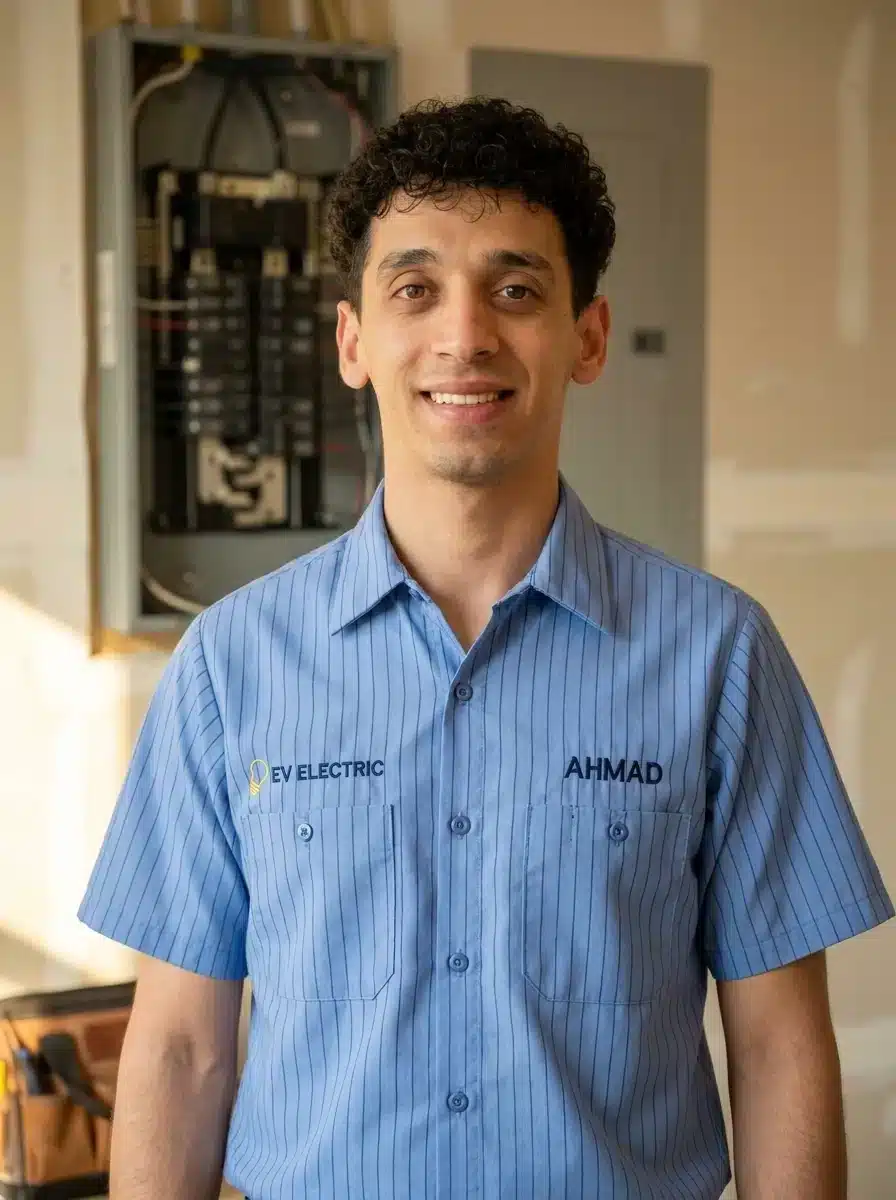
Ahmad Shaban — Virginia-Licensed Master Electrician
5.0 stars from 113 reviews. EV Electric Services is a residential electrical company based at 9488 Fairfax Blvd, Fairfax, VA 22031 — near Fairfax Circle.
Ahmad Shaban holds a Virginia Master Electrician license. He and his crew handle every job personally — no subcontractors, no third-party installers. When you call EV Electric for a ceiling fan installation, you know who is doing the work before they arrive.
Ceiling fan installation is one of the most common residential electrical jobs we perform. Whether it is a simple swap, a light-fixture conversion, or a new installation from scratch, the process is the same: verify the box, verify the wiring, install correctly, and test.
Related Electrical Services in Fairfax
Ceiling fan installation connects to several other residential electrical services. Here are the most relevant.
Looking for attic ventilation fans? That is a different service — see attic fan installation. Ceiling fans circulate air within a room; attic fans exhaust hot air from the attic space.
Schedule Your Ceiling Fan Installation in Fairfax
Fan-rated box, correct circuit, proper mounting — installed by a Master Electrician. Free estimates for Fairfax, Merrifield, Dunn Loring, and Oakton.
571-500-6637