
Light Fixture & Chandelier Installation in Fairfax, VA
Permitted, Code-Compliant Fixture Installation
Ahmad Shaban is a Virginia-licensed Master Electrician who installs light fixtures and chandeliers across the City of Fairfax every week. Simple swaps, heavy chandeliers, and full recessed layouts — filed correctly with the City of Fairfax when new wiring is involved, wired to code every time.
Key Takeaways
- Licensed: Master Electrician, Commonwealth of Virginia #2710086216
- Insured: Fully insured for residential electrical work in the City of Fairfax and surrounding area
- Code-compliant wiring: GFCI (ground-fault circuit interrupter — shuts off power when it senses current leaking somewhere it shouldn’t) protection near water, and AFCI (arc-fault circuit interrupter — shuts off power at the first sign of a dangerous arc) compatibility checked on every dimmer install
- No trip fee, free estimates — an on-site look costs nothing, and the written estimate is firm
- Pricing: standard fixture and recessed-can installation is $100-$250 per fixture (2026); chandeliers and new circuit locations are quoted after a free on-site look
- Service area: Fairfax, Vienna, McLean, Oakton, and Tysons
What light fixture installation involves
Light fixture installation covers a one-for-one swap of a builder-grade flush mount, a heavy chandelier mounted in a two-story foyer, a full recessed lighting layout added during a kitchen remodel, and everything between: outdoor sconces, bathroom vanity lights, under-cabinet lighting, ceiling fan swaps. Anything that connects to a junction box is fixture work.
The dividing line that actually matters in the City of Fairfax is whether the job touches new wiring. A straightforward swap on an existing junction box is usually a same-day job with no permit. A new fixture location, a new circuit, or cutting into a finished ceiling crosses into permitted electrical work — and Fairfax City runs its own single-filing permit system, separate from the county process Vienna and unincorporated Fairfax County homeowners deal with.
Ahmad Shaban is a Virginia-licensed Master Electrician and the owner of EV Electric Services, headquartered at 9488 Fairfax Blvd in the City of Fairfax. He is the person who assesses the ceiling, pulls the permit when one is required, and does the wiring himself — there is no dispatcher and no separate crew.
What actually needs a permit — and why Fairfax makes it simple
The City of Fairfax runs its own Accela-based Permit Portal, separate from Fairfax County’s PLUS system that covers Vienna, McLean, Oakton, and the rest of the county. That matters for fixture work because it’s a single filing with one inspection — no county overlay, no second approval to track down.
Usually no permit
Swapping an existing fixture for a new one on the same junction box and the same wiring — a flush mount for a pendant, a dated chandelier for a new one — typically doesn’t require a City of Fairfax permit.
Permit typically required
Adding a new fixture location, running a new circuit, or cutting into a finished ceiling or wall crosses into permitted work. We file it, schedule the inspection, and factor the timeline into your quote.
Older panels get a second look
Fairfax’s 1950s-1970s stock (Mosby Woods, Country Club Hills, Mantua) commonly carries 100-amp original panels, some in recognized fire-hazard brands like Federal Pacific or Zinsco. If new fixture wiring means opening that panel, we flag what we find before proceeding.
HOA layer on newer construction
Penderbrook and Fairfax Corner are HOA-governed communities; exterior-visible fixture work there — porch sconces, soffit lights — may need architectural review on top of any City permit. We tell you upfront if your neighborhood adds that step.
The rule of thumb: if we’re adding new wiring, it gets permitted. If we’re not, it usually doesn’t. Either way, we tell you which one your job is before we start.
Fairfax’s housing stock, and what it means for fixture work
Fairfax’s median home was built in 1967 — older, on average, than neighboring Vienna. More than half the city’s housing predates modern 200-amp panels and the GFCI and AFCI code requirements that came later.
1950s-1970s split-levels & ranches
Mosby Woods, Country Club Hills, neighborhoods bordering Old TownBuilt with 100-amp panels sized for a toaster, a fridge, a window unit — not the induction range, central AC, and EV charger a 2026 household runs. Mosby Woods, the largest community inside the City of Fairfax at roughly 600 properties, is the textbook example: first homeowners moved in during the early 1960s, and many homes still carry original electrical infrastructure.
What that means for fixture work: a new fixture circuit here often means confirming the existing panel has room, and checking whether the junction box at the fixture location predates modern support standards
1960s-1980s colonials & traditionals
Mantua, Kings Park, older Greenbriar blocks200-amp service became standard in the late 1970s, but a meaningful share of this stock still runs 150-amp or even 100-amp panels. A subset of mid-1970s homes carry the now-deprecated aluminum branch wiring, and GFCI gaps are common in kitchens and bathrooms built before the 1996 code requirement.
What that means for fixture work: aluminum wiring at a fixture junction calls for a pigtail connection rather than a direct splice — we check for it before connecting a new fixture
1990s-2020s townhomes & newer detached
Fair Oaks, Fair Lakes, Fairfax Corner, PenderbrookNewer construction isn’t exempt. AFCI breakers are sensitive by design and can trip on a noisy dimmer or LED driver. Penderbrook and Fairfax Corner townhomes add a second wrinkle: shared walls, limited panel access, and HOA rules on anything visible from outside.
What that means for fixture work: an AFCI nuisance trip after a fixture install usually means a dimmer-compatibility check, not a wiring fault
Whichever era your home falls into, we check the panel and the junction box before we touch the fixture — not after something trips.
Light fixture situations we handle every week in Fairfax
Here’s what Ahmad gets called for most often across the City of Fairfax. If your situation matches one of these, you’re in the right place.
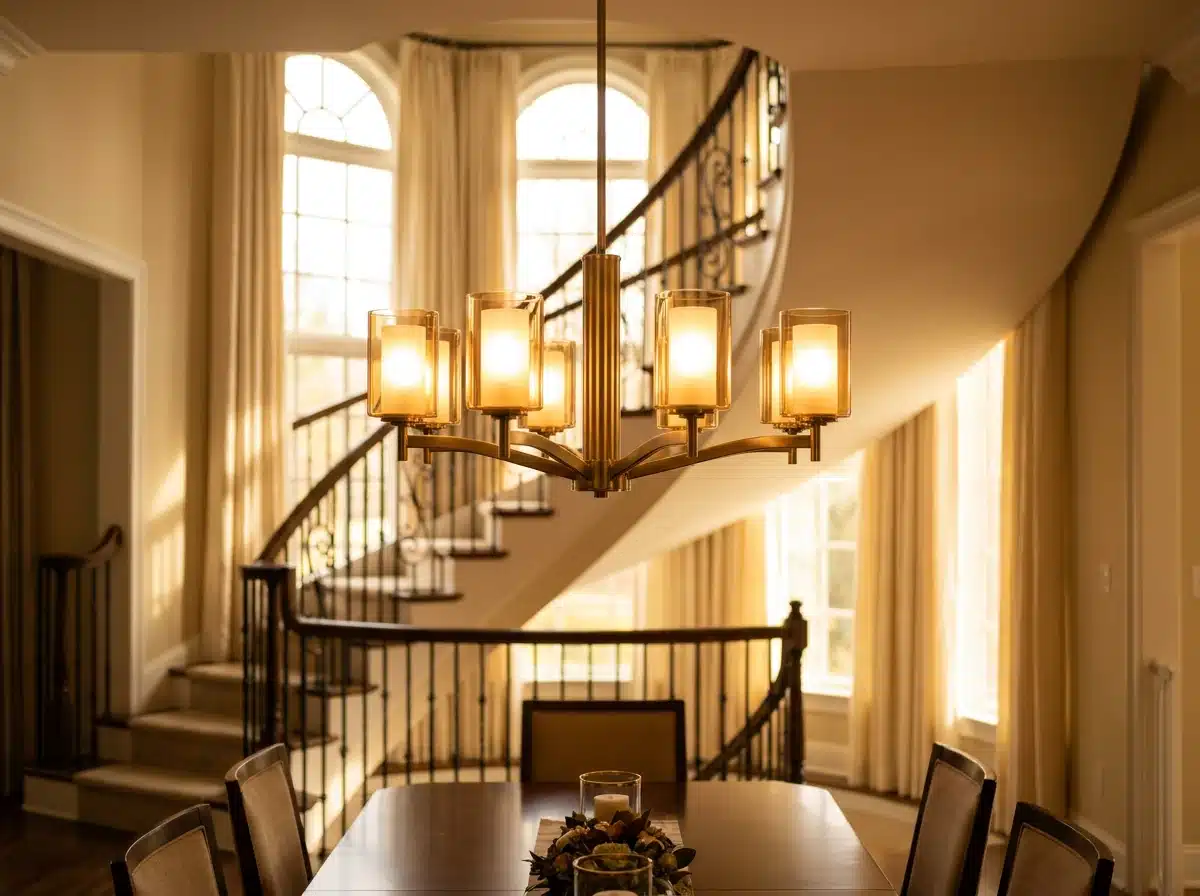
Chandelier installation in a two-story foyer
Heavy chandeliers (50-200+ lbs) need structural support rated for the fixture weight, a reinforced junction box, and safe access at height. We assess the ceiling, install the right bracket, and wire to code. Not a solo YouTube-and-a-ladder job.
Swapping a builder-grade fixture in a 1960s Fairfax home
Most of Mosby Woods and Country Club Hills still has the original flush mounts the builder put in. The fixture itself swaps out in under an hour, but the junction box behind it is often undersized or loose after 60 years — Ahmad checks the box and the wire condition before hanging anything new on it.
Adding a fixture where there’s no wiring yet
A new fixture location means running a circuit to that spot, cutting the ceiling, and mounting a junction box. In a Fairfax colonial with attic access, the wire runs from above. In a split-level — and there are a lot of them inside City limits — the wire gets fished through a closed joist bay, which takes longer and requires a City of Fairfax electrical permit.
Recessed lighting layout for a kitchen or living room
Ahmad spaces the cans to light the room evenly — not the centered cluster that builders default to. Each housing is IC-rated for insulation contact, wired in series to a dimmer that’s compatible with your LED bulbs. In older Fairfax homes, the panel check comes first: six new cans on a dedicated circuit means confirming there’s a free breaker slot.
Outdoor lighting installation
Wall sconces, soffit lights, pathway fixtures need weatherproof junction boxes, GFCI protection, and outdoor-rated wiring. In Penderbrook or Fairfax Corner, this is also where HOA architectural review can come into play.
Replacing a ceiling fan with a light fixture (or the other way)
Going from fan to fixture is electrically simple — fewer wires — but the box question matters. A fan-rated box handles vibration and dynamic weight that a standard fixture box doesn’t. If you’re swapping a light for a fan, the box almost certainly needs upgrading. If you’re removing a fan for a fixture, the existing fan-rated box works fine, but the dual switch (fan speed plus light) gets simplified to a single dimmer.
Customer-supplied fixture — you bought it, we install it
Any brand, any style, any weight, as long as it arrives with mounting hardware. If parts are missing, we say so before we start rather than mid-install.
Why fixture work in Fairfax’s split-levels isn’t the same as in a colonial
More than half the City of Fairfax’s housing stock is split-level or raised-ranch — Mosby Woods alone has roughly 600 of them, most built between 1958 and 1965. That floor plan creates fixture challenges you don’t hit in a standard two-story colonial.
No attic access above the lower-level ceiling
In a colonial, you can usually walk the attic to run wire and position a new junction box from above. In a split-level, the upper floor sits directly on top of the lower-level ceiling joists — there’s no crawlable attic space. Adding a new fixture location on the lower level means fishing wire through a closed ceiling cavity, which takes longer and limits where the junction box can go. Ahmad maps the joist layout before cutting anything so the fixture lands where you actually want it, not just where the nearest joist happens to be.
Original 100-amp panels with no spare breaker slots
A 1962 Mosby Woods home was wired for a refrigerator, a few ceiling lights, and maybe a window AC unit. The panel is sized for that load. Adding a dedicated circuit for a recessed lighting layout means confirming the panel has a free slot — and if it doesn’t, the conversation shifts to a panel upgrade before any fixture work starts. We check slot availability during the free estimate so this never becomes a surprise mid-job.
Cloth-insulated wiring at the junction box
Homes from this era commonly have cloth-insulated wiring (the insulation is a woven fabric sleeve rather than the plastic sheathing used since the 1970s). It’s not automatically dangerous, but it’s brittle after 60 years and can crumble when you disturb it — which is exactly what happens when you remove an old fixture and connect a new one. Ahmad checks the wire condition at the junction box before connecting the new fixture. If the insulation is degraded, he splices in new wire at that point rather than connecting to compromised insulation.
None of this makes fixture work impossible in a split-level — it just means the estimate needs to account for what’s actually behind the ceiling, not assume a standard layout.
From phone call to working fixture — how the job goes
EV Electric is based on Fairfax Blvd, so most City of Fairfax jobs start with a short drive and end the same day.
You describe the project; Ahmad figures out the scope
Call 571-500-6637 or use the quote form. We’ll ask what fixture you’re installing, whether there’s already a junction box where it’s going, and — for heavier pieces — roughly how much it weighs and how high the ceiling is. A Mosby Woods split-level with attic access is a different scope than a Fairfax Corner townhome with a finished ceiling above, and knowing that upfront keeps the estimate honest.
Most swaps get a quote over the phone — complex jobs get a free site visit
If you’re replacing an existing fixture on a working junction box, Ahmad can usually quote it from the description. New fixture locations, heavy chandeliers, and full recessed layouts need a look at the ceiling structure, the panel capacity, and whether the City of Fairfax’s permit process applies. That visit costs nothing.
Ahmad does the install himself — same person who quoted it
A straight swap runs about 30-60 minutes. Chandeliers with structural reinforcement take 2-3 hours. A six- or eight-can recessed layout is typically a half-day job. If the work crosses into new wiring, Ahmad files the City of Fairfax permit through the Accela portal and books the inspection before he leaves.
Switches and dimmers get matched to the new fixture on the spot
A new LED fixture on an old incandescent dimmer will flicker or buzz. Ahmad carries compatible dimmers and switches on the truck, so if yours needs swapping, it happens during the same visit — you don’t schedule a second trip for a five-minute fix.
What light fixture installation costs in Fairfax
The most common question Fairfax homeowners ask is whether recessed cans price per can or per room. The answer is per fixture — a six-can kitchen is six fixtures at $100-$250 each (2026), not one lump sum. That catches people off guard, so we’re upfront about it.
- Standard fixture replacement or recessed can — $100-$250 per fixture. The range depends on the mount type, ceiling height, and whether the existing junction box needs upgrading.
- Chandelier installation — heavier fixtures that need a reinforced bracket or a fan-rated box cost more than a standard swap. Ahmad quotes these after seeing the ceiling in person — weight, height, and joist access all factor in.
- New fixture locations (no existing wiring) — covers the circuit run from the panel, a new junction box, the switch, and the mount. Quoted per job; the City of Fairfax permit fee is included when one applies.
Every estimate is written, not verbal. If the number changes once we open the ceiling, you approve the new number before we continue — no surprises on the invoice.
About Ahmad Shaban, Master Electrician
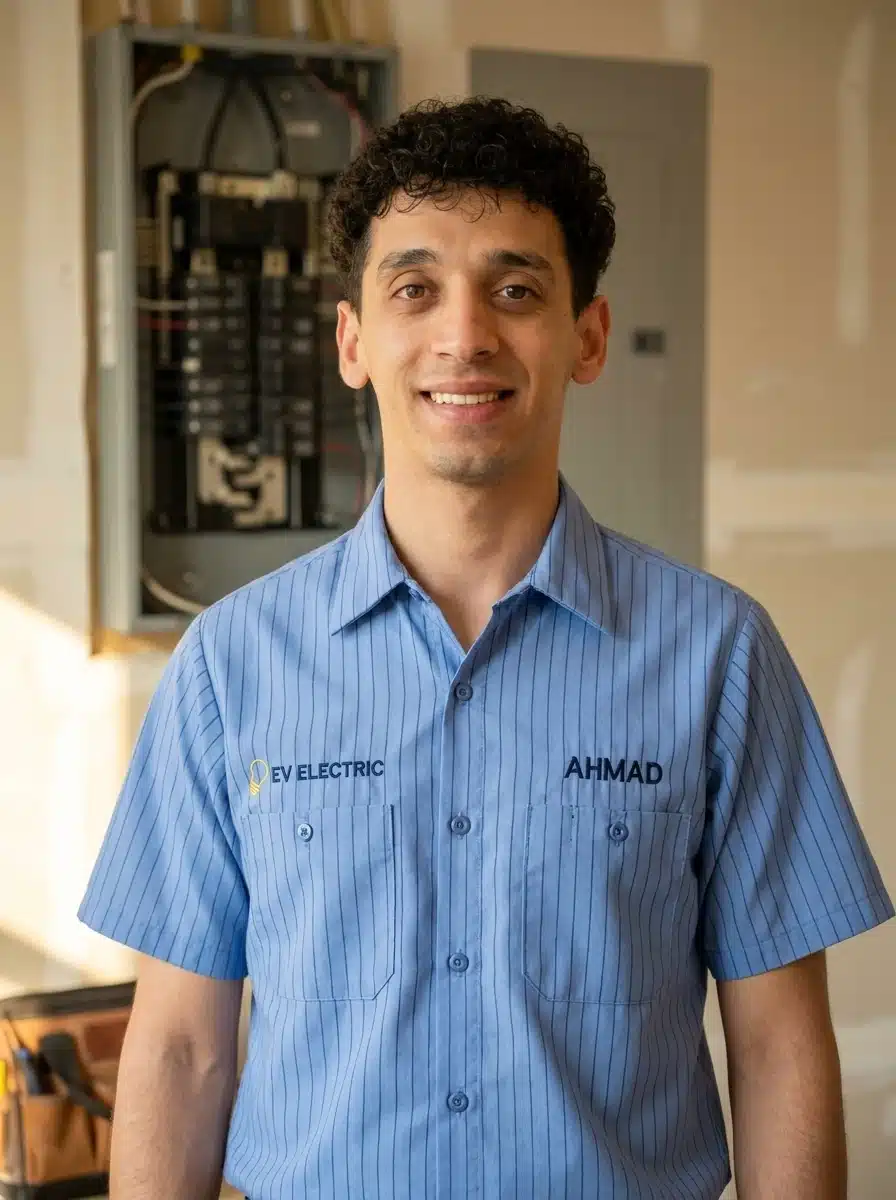
EV Electric Services is headquartered at 9488 Fairfax Blvd — inside the City of Fairfax, not just serving it. Ahmad Shaban is licensed as a Master Electrician, Commonwealth of Virginia #2710086216 — the highest residential credential the Commonwealth issues, and EV Electric is fully insured for work across Northern Virginia.
Most of Ahmad’s fixture work in the City of Fairfax falls into two buckets: upgrading the builder-grade lighting in 1960s split-levels (Mosby Woods, Country Club Hills) where the original junction boxes and panel capacity need checking before anything new goes up, and installing statement chandeliers and recessed layouts in renovated or newer homes (Fairfax Corner, Fair Lakes) where the wiring is modern but the dimmer compatibility and AFCI sensitivity still need attention. He does both personally — quotes, installs, permit filings, inspections. No office staff routes calls; no subcontractor shows up instead.
EV Electric Services holds a 5.0-star average across 122 Google reviews. The review base is real, recent, and from Northern Virginia homeowners — we don’t ghost-write reviews or recycle them across business directories.
Fairfax neighborhoods we serve
We cover all of the City of Fairfax, including:
- Old Town Fairfax — the original City of Fairfax core around Main Street and Chain Bridge Road
- Mantua — the established mid-century neighborhood north of Pickett Road
- Kings Park / Kings Park West — 1960s-1970s colonials south of Braddock Road
- Mosby Woods — split-levels and ranches near the City of Fairfax border
- Country Club Hills — mid-century homes near the Country Club of Fairfax
- Fair Oaks / Fair Lakes — newer townhomes and detached homes along the Route 50 / 66 corridor
- Fairfax Corner — 2000s townhomes and condos at the I-66 / West Ox interchange
- Penderbrook — 1980s-1990s townhomes around the Penderbrook golf course
- Greenbriar — 1970s-1980s neighborhood east of Route 50, near Fair Oaks Mall
Outside the City of Fairfax, we serve Vienna, McLean, Oakton, Tysons, Burke, Annandale, Falls Church, and the rest of Fairfax County. We also cover DC and Montgomery County, MD (Rockville, Bethesda, Chevy Chase, Potomac).
Related electrical services in Fairfax
Light fixture work often connects to other electrical needs — a panel that needs room for a new circuit, or troubleshooting a dimmer that flickers. Here’s what else we do in Fairfax.
Frequently asked questions
Do I need a permit for light fixture installation in Fairfax?
For a straightforward fixture swap on existing wiring, no permit is typically required. For new fixture locations, a new circuit, or cutting into a wall or ceiling, the City of Fairfax requires an electrical permit filed through the City’s own Permit Portal — a single filing, since Fairfax City isn’t subject to Fairfax County’s separate PLUS process. We handle the filing and the inspection.
How much does it cost to install a light fixture in Fairfax, VA?
Standard fixture installation and recessed lighting are $100-$250 per fixture (2026) — a six-can room prices as six fixtures. Heavy chandeliers that need structural reinforcement, and new fixture locations that need a circuit run, cost more and get a written estimate after a free on-site look.
Can I install a chandelier myself?
A lightweight fixture under about 25 pounds on an existing junction box is a reasonable DIY swap for a handy homeowner. Heavier chandeliers — 50 pounds and up — need a fan-rated or weight-rated junction box, structural reinforcement bolted to a ceiling joist, and safe rigging at height. That’s not a risk worth taking on a two-story foyer.
Is my home’s panel old enough to be a concern for new fixture wiring?
Fairfax’s median home was built in 1967. Homes in Mosby Woods, Mantua, and the Old Town border commonly still run 100-amp original panels, and some carry Federal Pacific or Zinsco equipment recognized as a fire-hazard brand. If a new fixture circuit means opening that panel, we check it before proceeding.
Can you install a fixture I bought myself?
Yes — customer-supplied fixtures every week. Any brand, any style, any weight, as long as it arrives with mounting hardware and instructions. If parts are missing, we flag it before we start.
What’s the difference between a regular junction box and a fan-rated box?
A standard box is rated for roughly 50 pounds — fine for a flush mount or light pendant. A fan-rated box is reinforced and bolted to the ceiling structure to handle heavier static weight plus the vibration a ceiling fan or a large chandelier produces. Code requires it above that weight threshold.
Do you install recessed lighting?
Yes — IC-rated housings where insulation is present, wired in series to a compatible dimmer, laid out to light the room evenly instead of clustering in the center. Recessed cans price the same as any other fixture: $100-$250 per fixture.
Ready to Get That Fixture Installed?
Light fixture and chandelier installation in the City of Fairfax — from the initial call to the final switch flip, Ahmad handles it personally.
Based on Fairfax Blvd. Most City of Fairfax jobs can be scheduled within a day or two of the first call.