
Level 2 Home Charging · Northern Virginia & Maryland
Level 2 EV Charger Installation — Charge at Home by Tomorrow Night
Level 2 EV charger installation — Tesla Wall Connector, ChargePoint, JuiceBox, Wallbox, and every UL-listed unit. Ahmad handles the permit, the circuit, and the install. Written estimate before work starts.

Key Takeaways
- Licensed: Master Electrician, Commonwealth of Virginia #2710086216
- Insured: $1 million per-occurrence, $2 million aggregate general liability
- EV charger installation: $300–$2,400 (charger unit not included)
- All major brands: Tesla, ChargePoint, JuiceBox, Wallbox, Grizzl-E, Emporia, and OEM units
- No trip fee, free estimates — on-site panel assessment before any work is scheduled
- Fairfax County permit pulled and inspection scheduled
What EV charger installation covers
A Level 2 home charger runs on a 240-volt dedicated circuit — the same voltage as your dryer or oven, but on its own breaker. It charges a typical EV battery from near-empty to full overnight (8–10 hours), compared to 24+ hours on a standard 120V outlet. That’s the difference between waking up to a full charge and hoping you have enough range to get through tomorrow.
The installation starts with an on-site panel assessment. Ahmad checks your panel’s remaining capacity, measures the run distance from the panel to your charging location (garage wall, carport, driveway-adjacent exterior), and determines whether your panel can support the new circuit or needs an upgrade first. You get a written estimate before any work is scheduled.
Ahmad installs across every major brand: Tesla Wall Connector, ChargePoint Home Flex, JuiceBox, Wallbox Pulsar Plus, Grizzl-E, Emporia, and OEM units from Ford, Rivian, Hyundai, Kia, and BMW. Hardwired or plug-in — both options are available depending on your charger model and preference. Ahmad pulls the permit under his own Virginia Master Electrician license and schedules the inspection.
Cities we serve
Each town below has its own page with local details and service-area specifics.
Vienna, VA
Same-day assessment availability — our shop is 10 minutes from most Vienna addresses.
Fairfax, VA
Our home base in the City of Fairfax. No trip fee, free estimates.
McLean, VA
McLean and Great Falls — longer driveway runs are common, we plan for them.
Oakton, VA
Oakton garages and carports — typical 20–30 foot runs from the panel.
Bethesda, MD
Montgomery County coverage for EV charger installations.
Tysons, VA
Townhomes and condos, where the run from panel to parking space is the whole job.
Will your panel take a charger? The honest answer
Before anyone talks about brands or where the box goes on the wall, one question decides whether a level 2 EV charger installation is a half-day job or a much larger project: does your electrical service have room for another big load that runs for hours at a stretch?
That is what separates a charger from a dryer. The National Electrical Code treats anything drawing for three hours or more as a continuous load, and a continuous load must be carried at 125 percent of its rating. A 40 amp charger needs a 50 amp circuit and conductors to match. A 48 amp charger needs 60. The breaker is sized not to what the charger pulls in a moment, but to what it pulls all night, for years.
Whether your house can absorb that is settled by a load calculation, which reads three things.
- The service rating. The amperage entering the house, usually 100, 150 or 200 amps. It is the ceiling on everything, read off the main breaker rather than guessed from the age of the house.
- Breaker spaces. A 240 volt circuit needs two adjacent slots, and panels that look half empty are often full of tandem breakers that not every position accepts. A gap at the bottom is not the same as room.
- Existing loads. Heat pump or electric furnace, electric range, electric water heater, air conditioning, a hot tub. Two houses with identical 200 amp panels land on opposite sides of the answer purely because of what sits behind the breakers.
On a 200 amp service with gas heat there is usually room to spare. On a 100 amp service feeding an all-electric house the numbers often do not work, and wanting them to does not change them. The honest answer then is that the charger is the second job and the service is the first.
So what does a panel upgrade cost? A panel upgrade is the usual fix, and we do not publish a price band for one. Going from 150 to 200 amps and going from 200 to 400 are different jobs, and the cost turns on the meter position, the service entrance, the grounding and what the utility requires at the connection. It is quoted per job, after Ahmad has stood in front of your panel. It is also the largest cost that can attach to a charger project, which is why the calculation comes before the quote rather than after the equipment is in your garage. If that is you, read the detail on panel upgrades in Fairfax first.
There is a middle path. Many current chargers support load management, watching the whole-house draw through a sensor on the service conductors and throttling back when the rest of the house is working hard. That can seat a charger in a tight panel without touching the service. Where it cannot, you will hear so, with the numbers behind it.
What the install actually involves
Assess the service and the run
Ahmad reads the panel — service rating, breaker spaces, existing loads — and works the load calculation. Then he walks the route from the panel to where you want to park: through a finished wall, along a garage ceiling, or outside to a detached garage or driveway post. The length and difficulty of that run drives the wire size and the method as much as the charger does.
Permit
An EV charger circuit is permitted work through your local building official and the surrounding jurisdictions. Ahmad pulls the permit under his own Virginia Master Electrician license before any wire is run. That is what puts the job on record with the county and gets an inspector out to look at it — which matters later, for your insurer and for whoever buys the house.
The physical install
A dedicated circuit is landed on its own breaker in the panel — nothing shared, nothing tapped. Conductors are sized for the charger’s continuous rating and run in conduit where they are exposed or outdoors. The charger or receptacle is mounted at a height and position that lets the cable reach the car’s port without stretching across a walkway, and everything is bonded and grounded properly.
Inspection and hand-over
The county inspector signs off on the permitted work. Ahmad then commissions the charger with you — setting the amperage to match the circuit, pairing it to the app if it has one, and running a real charge session on your car so you see it work before he leaves. You get shown where the breaker is and how to reset it.
Charger choices, and where they differ
Hardwired or plug-in on a NEMA 14-50
A plug-in unit lands on a 14-50 receptacle, which makes it easy to unplug and take with you if you move. A hardwired unit is wired straight into the circuit. Hardwiring removes the receptacle as a point of heat and wear, and it is required above 40 amps continuous — a NEMA 14-50 is a 50-amp receptacle, and a continuous load may use only 80 percent of it, so a 48-amp unit has to be hardwired. Outdoors a plug-in unit is permitted with a listed in-use cover, though hardwiring is the better call in weather. Both need the same dedicated circuit behind them.
Tesla Wall Connector or a universal J1772
A Tesla Wall Connector plugs a Tesla in directly and needs an adapter for anything else. A universal J1772 unit — ChargePoint Home Flex, JuiceBox and similar — fits every non-Tesla EV sold here, and a Tesla with the adapter that came in the car. If the household may hold a different make later, the universal unit keeps that option open. The wiring behind the wall is identical either way.
Charger amps versus the car’s onboard limit
The charger on the wall only supplies AC power. The unit that converts it and sets the real ceiling is the onboard charger inside the car. If your car accepts 32 amps, a 48-amp wall unit on a bigger circuit will still charge it at 32. Paying for headroom is only worth it if the next car will use it — and the bigger circuit is the expensive half of that decision, not the box.
Can you install it yourself?
In Virginia the legal answer is narrower than the internet suggests. Under Va. Code §54.1-1101, contractor licensing does not reach an owner doing work on a single primary residence they both own and occupy. It reaches no more than one primary residence you own and occupy in any 24-month period, and it is not a standing permission slip, and it does not extend to a rental, a second property, or a pattern of repeat jobs.
The part that gets missed most often: the exemption is from licensing. It is not an exemption from the code, the permit or the inspection. An EV charger circuit is permitted work through your local building official whoever installs it, and a homeowner is expected to pull that permit in their own name and have the inspector sign it off.
What the exemption covers
- Work on one primary residence you own and personally occupy
- One such residence in any 24-month period
- Pulling the electrical permit yourself, in your own name
- Choosing the unit and deciding where it lives
- Being present for the inspection and holding the signed record
What it does not excuse
- The permit. Unpermitted work stays unpermitted whoever performed it.
- The inspection, and the record it leaves for your insurer and the next buyer
- Conductor and breaker sizing at 125 percent of the charger rating
- A genuinely dedicated circuit, on its own breaker, nothing shared or tapped
- Any work on a rental or a property you do not occupy
- Panel work with the service live
Three failures show up again and again in self-installed work. Undersized conductors: someone reads the charger’s 40 amp label, buys wire rated for 40 amps, and misses the continuous-load derate. Nothing dramatic happens on day one. The cable simply runs warmer than it should, every night, for a decade. No dedicated circuit: the charger gets tapped onto a dryer or garage circuit because the outlet was already there, which is the wiring people later describe as a mystery breaker trip and the sort of thing we untangle on electrical troubleshooting calls. No inspection record: costs nothing, until a claim or a sale turns an unsigned 60 amp circuit into a negotiating item.
None of that means a competent homeowner cannot do it. It means the money you save is real, and so is what you take on. If you would rather not, choosing an electrician for EV charger installation is mostly about whether load calculations and county permits are routine practice for them. And to answer the question people actually type: yes, a normal licensed electrician can install EV chargers. There is no separate EV license and no manufacturer certification needed to run the circuit. Virginia does tier the trade, though, and Ahmad holds a Virginia Master Electrician license, the level that carries responsibility for the design side, load calculation and permit included. On a home EV charger installation, that is most of the job.
What it costs
Most cost guides quote a national average, which is not much use when the same charger on the same wall can be a two-hour job or a two-day one depending on what is behind the drywall. Here is the range we work in, and the four things that decide where in it your job lands.
EV charger installation runs $300 to $2,400 in 2026, installation only — charger unit not included, because the unit is a piece of equipment you choose and buy, and its price is set by whichever brand you pick.
Installation only — charger unit not included.- Run length and route. A panel on the garage wall, three feet from where the charger goes, is the bottom of the range. A panel in a finished basement on the far side of the house, with a run that has to be fished through walls or trenched, is the top of it.
- Garage versus driveway. Inside a garage the wiring is short, dry and mostly surface-mounted. A driveway or detached garage means outdoor-rated methods, a weatherproof enclosure and often trenching, which is the biggest single jump in labor on this job.
- Hardwired or a receptacle. A NEMA 14-50 receptacle install is usually the cheaper end, and it lets you unplug the unit and take it with you. See 240 volt outlet installation for how that circuit is built. Hardwiring is required above 40 amps continuous — a NEMA 14-50 is a 50-amp receptacle and a continuous load may use only 80 percent of it, so a 48-amp unit has to be hardwired, and we recommend it for a unit that lives in weather, though a plug-in unit outdoors is permitted with a listed in-use cover.
- Whether the panel needs work. If there is no room, this stops being a charger price. A service upgrade is quoted separately, per job, and it is the reason the load calculation comes first.
Estimates are free. If the problem needs diagnosing first, we tell you what that costs before we begin.
Is there still a federal tax credit?
No. Almost every cost guide, comparison page and AI-generated answer in this space still describes an active federal credit for home charger installation, and they are out of date. The change is recent enough that the stale version is still the majority answer online, so it is worth being exact.
Incentive status, as it stands now
Federal §30C Alternative Fuel Vehicle Refueling Property Credit
The credit terminated for property placed in service after 30 June 2026, under P.L. 119-21. A residential charger installed after that date does not qualify, because the credit no longer exists to qualify for. There is no reduced version and no phase-down that applies to a home installation done now.
State and utility programs
Virginia programs and utility offers such as off-peak charging rates are set separately from federal tax law and change on their own schedule. We do not claim to track them and will not tell you one applies to your address. Ask your utility directly.
Practically: budget for the installed price as it stands, not for a number with a credit subtracted from it. Any figure you have read that assumed one is now wrong by whatever the credit used to be worth. If this changes again we will change the page. It has already changed once this year.
What charger customers say
Mike Ayoub had this exact job done: the assessment, the circuit, and a charger on the wall at the end of it.
Ahmad was super professional, kind and very experienced. He explained completely the scope of work in terms I understood. Now I have a car charger at my home that charges my car in hours versus days.
Hours versus days is the gap between a cord in a standard 120 volt receptacle and a proper 240 volt circuit, and it is why most people stop tolerating the cord. The line before it matters more to us: the scope was explained in terms he understood, before the work started.
How the charger visit works
The first visit looks at three things: the panel, the spot where the car parks, and the route between them. Ahmad reads the service rating and the breaker spaces, works the load calculation, then walks that route with you, so the wire length and the method are known before a number is quoted. No trip fee, free estimates.
If the job goes ahead, the permit comes first, pulled under Ahmad’s own Virginia Master Electrician license before any wire is run. That ordering is deliberate. A permit applied for afterwards is a different and worse conversation with an inspector.
Install day is one dedicated circuit, start to finish. Its own breaker in the panel, conductors sized for the charger’s continuous rating, conduit where the run is exposed or outdoors, and the unit mounted so the cable reaches the charge port without crossing a walkway. Nothing shared, nothing tapped.
Then the inspector signs off, and only after that is the charger commissioned with you standing there. The amperage setting on the unit is matched to the circuit it sits on, a step plenty of installs skip. It is paired to its app if it has one. A real charge session is run on your own car so you watch it work rather than take our word for it. And before he leaves, Ahmad shows you which breaker feeds the charger and how to reset it, because at some point on a bad-weather night you will want to know that without calling anyone.
Common questions about EV charger installation
How much does it cost to have an EV charger installed?
Our published 2026 range is in the What it costs section above, and it covers the installation only, with the charger unit itself not included. Where a job lands inside it comes down to four things: how far the charger sits from the panel, whether the route is open garage wall or fished through finished space, indoors or outdoors, and whether the panel has capacity for the circuit at all. Only the last one changes the size of the project rather than its price.
How much does it cost to install a Level 2 EV charger?
A Level 2 charger is the 240 volt install, and it is the one this page is about. That range covers installation, not the charger unit, which you buy separately from whichever brand you prefer. The cost driver specific to Level 2 is the continuous-load rule: a 48 amp charger needs a 60 amp circuit and conductors sized for it, so a higher-amperage unit costs more to feed even though the box looks identical. A panel upgrade, if you need one, is quoted separately.
How much does it cost to install a 240V outlet for an EV charger?
A 240V outlet install, normally a NEMA 14-50 receptacle, usually sits at the lower end of our published installation range, because it is the same dedicated circuit with a receptacle on the end instead of a hardwired unit. The variables are identical: run length, route difficulty, indoors or outdoors, panel capacity. A receptacle also lets you unplug the charger and take it with you when you move. Above 40 amps continuous it is not an option — a 48-amp charger needs a 60-amp circuit, and a 60-amp circuit cannot end in a 50-amp receptacle, and the circuit has to be hardwired.
Can my house handle level 2 EV charger?
That is decided by a load calculation, not by the age of the house. It reads your service rating, the free breaker spaces in the panel, and everything already connected: heat pump, electric range, electric water heater, air conditioning. A 200 amp service with gas heat almost always has room. A 100 amp all-electric house frequently does not, and load-managing chargers can bridge a tight case. If a charger is already in and trips the breaker, that is a circuit and breaker problem worth diagnosing rather than living with.
Can I install my EV charger myself?
In Virginia, Va. Code §54.1-1101 exempts an owner from contractor licensing for work on a single primary residence they own and occupy, used occasionally rather than as a pattern. It covers licensing only. It does not remove the permit, the inspection, or any part of the electrical code. A homeowner may legally do the work on their own home, and still has to pull the permit in their own name and have the inspector sign it off. On a rental it does not apply at all.
Can I install a level 2 charger at home myself?
Legally, on the home you own and occupy, yes, within the limits above. Practically, three things catch people out. Conductors get sized to the charger’s label rather than to 125 percent of it, which is what a continuous load requires. The circuit gets tapped off an existing dryer or garage circuit rather than being genuinely dedicated. And the permit gets skipped, which leaves no inspection record for your insurer or for the next buyer of the house. The savings are real; so is what you are taking on.
Can a normal electrician install EV chargers?
Yes. There is no separate EV license and no brand certification needed to run the circuit, so any licensed electrician can do this work. What matters is whether load calculations and county permits are routine practice for them rather than something added at the end. Ahmad holds a Virginia Master Electrician license, the tier that carries responsibility for the design side of the job. He installs any UL-listed unit: Tesla Wall Connector, ChargePoint, JuiceBox, Wallbox or whatever you have chosen.
Is the IRS tax credit for EV charger installation?
Not any more. The federal §30C Alternative Fuel Vehicle Refueling Property Credit terminated for property placed in service after 30 June 2026, under P.L. 119-21. A home charger installed now does not qualify, because the credit no longer exists. Most cost guides and AI answers still describe it as active, so treat any figure that assumes a credit as out of date. State and utility programs are set separately and change on their own schedule; ask your utility directly.
Why choose EV Electric for charger installation
- Ahmad does the panel assessment, the load calculation and the circuit design on every EV job, and is on site for most residential calls.
- Every major EV charger brand supported. We don’t push one brand — we install the unit you choose.
- Ahmad pulls the permit under his own license and schedules the inspection. The written estimate itemizes what is in the number before any work starts.
- Load calculation before anything is ordered, so the charger you buy is one your service can actually carry.
- 5.0-star average across 113 Google reviews.
The electrician doing the work
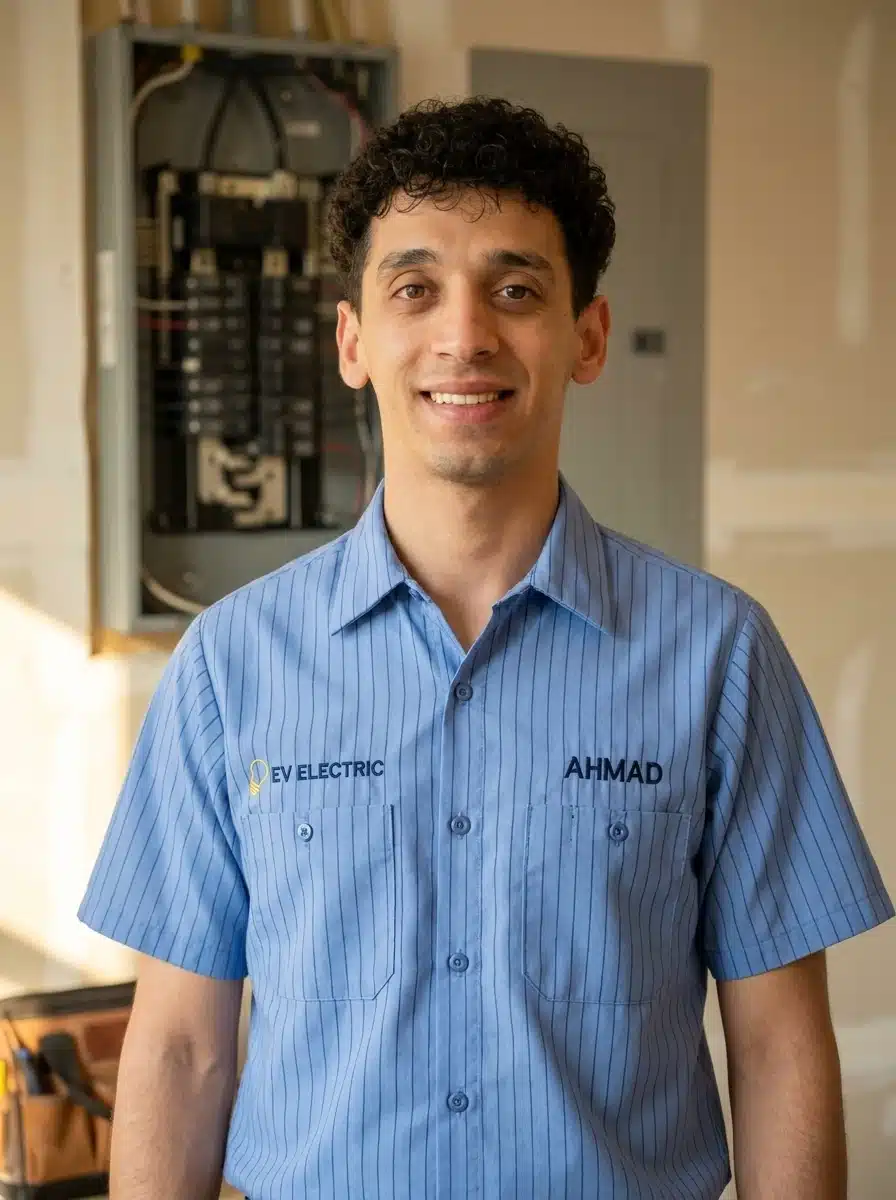
Ahmad holds a Master Electrician license issued by the Commonwealth of Virginia — the highest electrician credential the state issues. He earned it after several years of journeyman work and a passed state exam. EV Electric Services is fully insured, and Ahmad runs a maintenance team so scheduling doesn’t bottleneck on one person.
Ahmad is on the job site for most residential calls. He does the assessment, explains what he finds, and handles the work himself. You’re not getting a subcontractor you’ve never met — you’re getting the Master Electrician whose name is on the license. Our shop is at 9488 Fairfax Blvd, physically inside the City of Fairfax.
EV Electric Services holds a 5.0-star average across 113 Google reviews. Our review base is real, recent, and from Northern Virginia homeowners.
Towns we cover for charger installs
EV Electric Services is based at 9488 Fairfax Blvd in the City of Fairfax. We serve Vienna, VA, Fairfax, VA, McLean, VA, Oakton, VA, and Bethesda, MD, and the rest of Fairfax County. We also cover DC and Montgomery County, MD (Rockville, Bethesda, Chevy Chase, Potomac).
No trip fee and free estimates across our service area. For DC and Maryland, call to check availability first.
More from EV Electric
Ready to charge at home?
EV charger installation across Northern Virginia, DC, and Maryland — Level 2, every brand, permit included, Master Electrician on every job.
We respond within one business day.